

We dive again into the industrial multiplexes of Belo Horizonte and adulate the sadistic roar of the appropriately named Wagner Antichrist and Gerald Incubus, whose musical inventions did not stop with the blasphemous “INRI”, which defined the next decades of black metal. While the sophomore offering “Rotting” approached pure alcohol delirium in chaos and unsound production, yet containing both satire and atmospheric black metal in the form of “Sex, Drinks & Metal” and “Nightmare” respectively, “The Laws of Scourge” remains the most musically intact, fully developed and self-confident Sarcófago full-length album. As if the Finnish hardcore LP’s had been traded for German speed and death metal, themes of paranoia and divided, schizoid personality afflict this art while the compositions are architected upon cold, rhythmic, needle-sharp riffs occasionally enhanced by hyperdramatic, even cheesy, keyboards and concluded by Wagner’s desperate screams. Much in the vein of “Terrible Certainty” era Kreator, the old school metal patterns ride on a stream of militaristic, aggressive drumming that spaces the tension between the passages of hysteric stagediving metal too concretely energized to fully fit into the confines of shadowy underground death worship at this point, but too aware of causes and effects to simply become another Headbanger’s Ball “thrash” marketing item. A version of the classic “The Black Vomit” is included almost as if on purpose to demonstrate the technical differences between various approaches and strains into metal art, a dimensional revolving swastika whose arms are hardcore, speed metal, death metal and black metal – it’s unnecessary to determine in what ways exactly this album was worse than “INRI”, because the beautiful and terrifying moods on offer make “The Laws of Scourge” unique and indispensable as well.
Filed under: Death Metal Album of the Week — Tags: Black Metal, Brazilian Death Metal, Death Metal, Hardcore, Speed Metal, Thrash, War Metal — Devamitra @ April 25, 2010 12:31 — Comments (1)

Like the great Vuoksi river pouring its secrets into Lake Saimaa, the ancient Finnish Doomdeath cult of Unholy‘s second album is an hypnotic and psychoactively charged procession of swirling currents towards an expanded state of consciousness. ‘The Second Ring of Power’ is maybe a controversial selection for this week’s album, with its emphasis on a funereal pace that is practically unable to propagate riffs in a manner recognisable to Death Metal connoseuirs, the heavy use of keyboards and even clean female vocals, but this is no less an auspicious choice and as far from the effeminate Doom Metal of the past 15 years imaginable. If Pestilence were under the influence of Mescalin during the recording of ‘Spheres‘, it might have sounded something like this, although the spacey and downright evil keyboards by and large subordinates the guitarwork, still informed by the likes of Celtic Frost via. Unholy’s former incarnation of Holy Hell, which simplified this style yet injected it with some mysterious flavours. Beneath this recipe is a blissfully undulating bass line that connects the various mood premises of the songs to wider, meditatively layered soundscapes and adjusts the mind’s eye to synchronise it’s vision with the eternal and omniscient cosmic consciousness as guitars release streams of radically transformed melody, riding the endless waves of bass. Further influences, from the sonic incense of Dead Can Dance to the ethereal and evil rock of the Cocteau Twins are pulled in at points to enhance the ritualistic and trippy elements, but the brutal death vocals and the spirit of nihilistic awakening ensure this album remains a proud classic of the unholy left hand’s own path to Divinity.
Filed under: Death Metal Album of the Week — Tags: Death Metal, Doom Metal, Doomdeath, Finnish Death Metal, Finnish Doom Metal, Mysticism — ObscuraHessian @ April 17, 2010 23:51 — Comments (0)

Some early speed and death metal risked numbing its sense of continuity at times, and this could be put down to a number of factors. Much underground metal in the 80′s found a lack of conceptual focus in it’s topical and structural narrative, with thematic loopholes sometimes occurring in particular works. This was also a particular mishap apparent in some early heavy metal, where the musical restraints of blues and rock music had yet to be eschewed in favour of more direct, aggressive, and in many instances alienating forms of execution and structure. Along with classic and and seminal works from acts such as Possessed, Slayer, Bathory, Sepultura and Necrovore among others, the sole album by this Canadian act shows a simplification of previous themes and in the process crafts embryonic, yet furious death metal. Recorded early in 1986 and representing a quantum leap for the nihilism of death metal, Slaughter’s first album is a pioneering work that drones with hardcore simplicity, taking the rhythmical backdrop of Discharge and enhancing it’s pace and aggression in accordance to the standards of underground metal.
The guitars on the album are of very strong and distinct quality, with a buzz-saw cacophony that mostly churns out one-note strums with a emphasis on small melodic shifts at the end of each riff cycle,
just as minimal as Hellhammer but with a more compact and streamlined execution. On first listen anyone familiar with Swedish acts such as Carnage, Entombed, Dismember, Unleashed should without doubt acknowledge this similarity. In addition it could be argued that this record has all the hallmarks of a classic Sunlight Studios production, as stylistically both Slaughter and the aforementioned Swedes took their musical foundations from hardcore. The differentiations occur in the use of musical language, with ‘Strappado’ being percussively stern and less subject to variation, and lacking the technical motifs that are a mainstay of foundational death metal. Thematically and musically this bears a strong influence on later Canadian acts such as Blasphemy and Conqueror, especially when hearing the latter’s cover of ‘The Curse’.
For some the vocals would be a minor letdown, having none of the distinctive rasp or bellow commonly expected. Dave Hewson’s vocals are almost similar to that of Mike Browning on Morbid Angel’s ‘Abominations Of Desolation’ given a context that share a common timbre with speed metal and thrash. Lyrically cohesive and minimal, themes of execution, torture, occultism and devastation permeate ‘Strappado’, and when combined with the musical onslaught, evoke mystical images of a post-apocalyptic future in which primitive tribalism reigns upon the decrepit ruins of industrial society. Brilliant.
Filed under: Death Metal Album of the Week — Tags: Canadian Death Metal, Death Metal, Hardcore, Speed Metal, Thrash, War Metal — Pearson @ April 10, 2010 23:14 — Comments (1)

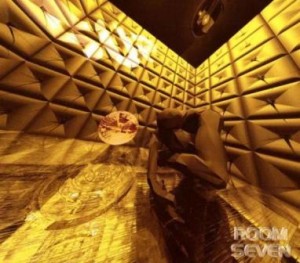
By the time 1997 rolled around Death Metal had all but returned to the primordial abyss from which it had emerged, and Black Metal had basically committed suicide. As if sensing the demise of extreme metal or unable to overcome the perceived expressive limitations of extreme metal, S.U.P. with an eye to their Heavy Metal and progressive rock influences, release a surprisingly expressive, intelligent and interesting album that could be referred to as industrial progressive death rock. Mid-paced, melancholy, unsettling, dreamlike and enigmatic, the listener of “Room Seven” is submerged into a world of varying and compelling experiences that often times work simultaneously to challenge and lift the listener beyond the simple, linear and emotive reactions that arise from rock and other forms of popular music. Despite some of the heavy metal fist pumping riffs and the common and accessible themes, “Room Seven” does a great job of placing the listener in a relative position of omniscience and thus introducing a position from which to contemplate and apply the wisdom of this release to one’s own life.
Masters at presenting simultaneously varying and subtly different shades of a theme, SUP reminds those who have the ears to listen that life is more than the mere temporal, logical and linear succession of events and experiences. Rather the listener is urged to contemplate life as the compound and expression of various and seemingly disparate elements, working simultaneously to create the complexity of life and its experiences, while remaining fundamentally connected. Vocals themselves, while melodic are emotionally restrained, dreary and often times express a profound fatalism, stoicism or a dissinterested acceptance of the superior forces alluded to above. Although “Room Seven” remains a compelling listen, the heavy metal and rock based themes preclude the possibility of this album reaching the cosmic heights of certain Black Metal and Death Metal classics, nonetheless as a testament to the intricacies of the human experience this album offers satisfying insight.
Filed under: Death Metal Music Reviews — Tags: Death Metal, Heavy Metal, Industrial, Progressive Death Metal — TheWaters @ 22:01 — Comments (2)
Golem – Eternity: The Weeping Horizons

This album has developed a small following over the years but from the ridiculous cover artwork to the irrelevant intro and outro from ‘Le Sacre Du Printemps‘, it’s difficult to understand why. The actual music is no greater indicator, although there are flashes of potential in the songwriting, which echoes more of the Hungarian composer Bela Bartok than it does Stravinsky. From pulsing but uniform rhythmic basis emerges melodies of varying complexities like Ceremony’s ‘Tyranny From Above‘, although it’s being punched out by the same AI that must have been responsible for the computerised approximation of Death Metal called ‘Dreams of the Carrion Kind‘ by Disincarnate. As with James Murphy‘s band, Golem have a generic sense of logic behind each riff progression, where the contextual dynamics of mood and tempo totally nullify the sense that there’s any idea behind the compositions, at least any worth listening out for. Add to this sterile formulation some really uninspiring rhythmic filler and you have a largely disappointing album.
Profanity – Slaughtering Thoughts

If you’re one of those deranged masochists who listens to Death Metal for the audial desecration of the senses that it can inflict, no matter how much you end up panicking to turn down the volume before your brain finally explodes, then Profanity might be one of the more tastefully executed methods of phrenocide. ‘Slaughtering Thoughts’ follows from the structuralism and down-tuned aesthetic of Morpheus Descends ‘Ritual of Infinity‘, but add to this the intensity of percussion and spiralling riff-work of Sinister and you have an album that steps out of the adipocere of decomposition and into the chaos of a sonic vortex. Like trapping a tornado inside a test-tube, this album captures the tumult of the mind in a world of illusions, based on the fragmentary nature of perception, creating a whirlpool of thoughts that veil the impersonal reality beyond. Sporadic outbursts of unexplainable lead guitars heighten the mental frustration, but with a kind of resolute beauty in trying to break free, creating patterns that would resemble the cracked and bleeding glass of its experimental, symbolic container, before being swept up in the almost ambient madness. All this brutality and not much groove nor a single breakdown in sight, this is the right music to attack your brain with and tear down all its worthless, mortal thoughts.
Filed under: Death Metal Music Reviews — Tags: Brutal Death Metal, Death Metal, German Death Metal, Modernism — ObscuraHessian @ April 8, 2010 13:52 — Comments (0)

You all had to see it coming… with the morbid pall on the skyline and the eerie chanting of despondent disciples. As the wheel of the year has turned again to unite Christendom in a moment of silence for the pains of the crucifixion, blasphemers pay respect in their own ways. A serious, appalling and invigorating death metal installation, “Onward to Golgotha” turned traditional streams of melody inside out in order to unleash a churning madness quite impeccably produced to sound like a neptunean battle on the bottom of an ocean, or a dragon trashing in its sleep, such is the bottom end riff barrage and the asymmetric droning commands of Craig Pillard‘s throat. The aspect most evocative of uneasiness and suffering is the control of tempo, from chaotic blastbeats raining as a multi-tailed scourge upon the back of the savior to the prolonged slow sluggish chords heavy and strained as the steps of one who bears his own cross on his back – symbolic of the aimless and hopeless moments each one of us has to face in the dark night of the soul, in order to resurrect once more, into flames and fire. The development of John McEntee to a potent composer was hardly a surprise since he was tutored by Henry Veggian in Revenant and early on accompanied by Paul Ledney and Aragon Amori of the ground-breaking Profanatica; yet, Incantation‘s debut is a hammer of darkness more suited to comparison with Krzysztof Penderecki‘s “Requiem” than anything descended from rock music.
Filed under: Death Metal Album of the Week — Tags: Black Metal, Brutal Death Metal, Death Metal, New York Death Metal — Devamitra @ April 2, 2010 17:24 — Comments (3)