 Experience dictates that the modern black metal listener is in essence a “hipster”; a self referential, individualist, egocentric and more or less self-pitying individual. Moreover, experience also dictates that the modern and profane black metal musician has more in common with the lowly pop artist than with the principles and individuals that helped to create the original Norwegian black metal movement.
There was once a moment in time when black metal, like all great artistic movements strove to express something eternal, whether that was the paradoxical juxtaposition of beauty and death, the joy in battle and the growth that ensues due to struggle, or the essentially inexpressible infinite cosmos.
One of the more salient features of the nascent black metal scenes was the romantic obsession those involved had with the past. Black metal’s obsession with bygone ages pointed to a nascent, articulated, although perhaps not fully defined, desire to rediscover traditional knowledge, including the mythology, and the social and traditional norms that defined their venerable, Indo-European culture, namely Norse. As these individuals invaded the undergrowth of wisdom distilled in the remaining works of bygone ages, listeners, onlookers and now later historians were and are provided with a glimpse into the workings of a movement that pre-eminently strove to rediscover lost wisdom and to participate and explore the multifaceted plains of reality, and its highest level therein, namely the Supreme Principle.

This desire to participate in the highest level of reality can be used to shed light on the enigmatic drive to self-imposed anonymity, such that these original European Mystics indeed strove towards. As we traverse the iconography and interviews, or lack thereof, of the original black metal scene we are forced to recognize the tools by which these individuals imposed anonymity among themselves; one recalls the corpse paint, used primarily although not exclusively to obscure their physical attributes. Indeed, we recall, the use of pseudonym to obscure, nay to eschew their name and ego. Recall lastly, the ambiguous relationship these individuals had with media, in itself the pre-emptive tool for modern ego worship, as either non-existent or outright hostile. Regardless of later sensational developments in the scene, the originators reveled in a mystique of anonymity that pointed not to a new marketing gimmick but rather to the participation in a higher principle or reality, from which peek their ego and its gratification seemed comic.
Awaiting the sign of the horns
A thousand black clouds storms
Blasphemous Northern rites
Mysticism touched
Pentagrams burning
– Immortal, Unholy Forces of Evil
The Main purveyors of the early black metal scene, and especially the Scandinavian Mystic Varg Vikernes seemed to be in fact consciously aware of this higher reality, from whence all proceeds. Commenting on the “illusory” nature of material reality, and its reliance upon a higher principle for its substantial and formal manifestation, the lyrics of “Lost Wisdom” proclaim:
While we may believe, our World, our reality
to be that is, is but one manifestation of the Essence
– Burzum, Lost Wisdom
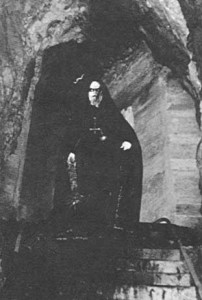 Although such an outright recognition of the Supreme Principle is rarely encountered as explicitly in other black metal bands of the time, the anonymity and symbolism utilized by many of the protagonists within the scene, for example Enslaved and their conscious decision to explore the themes surrounding the Norse gods and the profound metaphysical symbolism implied therein, seems to point to an implicit recognition of higher principles, and perhaps the higher principle itself, from whence an expression of anonymity logically follows.
Rene Guenon teaches us that it is a mere modern deviation from the Supreme Principle and traditional doctrine that has led to current notions of crass individualism, ego worship and “originality”. Current artists are very nearly obsessed with having works attributed to their ego, and such modern profanities have even led scholars on an endless search to provide the public, and novelty seekers, with the names of those artists who completed Medieval masterpieces. Of course these Medieval artists, due to their participation in the higher Principle from which all things emanate, had not the hubris to associate their works solely with their own ego. Likewise, a search for traditional knowledge and the participation of and recognition of a supreme Principle led to a general anonymity amongst the original black metal adherents from Norway. This participation precludes the notion of anonymity described as “infra-human”, implying the dissolution of a particular in a crowd, but entails rather a participation in a higher supra-individual order. Consider the words of Rene Guenon:
The being that has attained a supra-individual state is by that fact alone, released from all the limiting conditions of individuality, that is to say it is beyond determinations of name and form that constitute the essence and the substance of its individuality as such; thus it is truly anonymous because in it the ‘ego’ has effaced itself and disappeared completely before the ’Self’
– Rene Guenon, The Reign of Quantity and The Signs of the Time
The key to understanding what has been said above is to recognize that in this case the Ego has effaced itself in the face of the higher Principle from which it has emanated, nay from which all things, states and possibilities emanate, while in itself remaining unaffected and unchanged by this manifestation. It is the ego that produces the “subject vs. object” sensation and produces the dichotomy of “I and Thou”. However, participation in the Supreme Principle implies a transformation, in which one becomes consciously aware that all of existence is indeed one, and that all must fundamentally be attributed to It, the Supreme Principle. Indeed, all dichotomies will have been overcome, the barriers of subject versus object will have been overcome, and one will attain immortality. Hence, in aspiring to this reality and perhaps participating in it, Black Metal musicians were quick to live among the shadows, obscure, nameless, formless, recognizing themselves and their works as naught but one of the infinite possibilities inherent in the supreme principle. It should therefore come as no surprise in connection with these thoughts that certain musicians chose such pseudonym’s as if to reflect cosmic principles, representative of the venerable Indo-European tradition of the Norsemen.
Brahman cannot be realized by those who are subject to greed, fear and anger.
Brahman cannot be realized by those who are subject to the pride of name and fame.
– Tejobindu Upanishad

Delving deep into primordial traditions long forgotten, those Scandinavian mystics seem to have uncovered long forgotten mystic truths, hidden within the depths of the most primordial of the Indo-European traditions – Hinduism. It should come as no surprise to those familiar with Indo-European traditions that a study of, and adherence to strict Traditional principles, a fascination with the Norse Legends combined with some occult influences, however badly understood, would lead the black metal warrior down the road of ‘Self’ discovery. It is well known that Odin himself is etymologically derived from Gwoden, another name for Indra, a God venerated as the leader of God’s in the Hindu Pantheon. With the inherent and complimentary relationship between these two Indo European worldviews, namely Hinduism and Norse Mythology established, not only etymologically but through the recognition that all true traditions aspire to the same essential goal, realization of the Supreme Priciple, it is fair to conclude that both contain within themselves the seed for mystical realization, or a knowledge of the “essence”. Of necessity, we turn to Hinduism, a more complete metaphysical system to fill in some of the blanks as to what Vikernes and company were aspiring to during the apex of the black metal phenomenon.
Return to the ring of our forefathers gods
The flames of Midgard’s fires and ancient mysticism still are
– Enslaved, Fires of Midgard
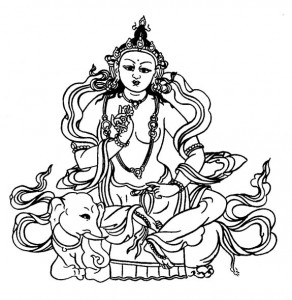 According to Hindu tradition the purpose of life is to become united with the ‘Self’, Brahman, the Supreme Principle, that which is enshrined in the hearts of all, according to ones station in life and capacity to do so. Again, this is the same Supreme Principle alluded to above, from which participation in, a true supra-individual anonymity necessarily springs. Although the original black metal purveyors may not have been consciously aware of the heights to which they were ascending, nor of the full traditional implications of what they were doing, it comes as no surprise that when re-discovering their traditional legends that they would inadvertently ascribe to the goal of, and rediscover some of the outstanding tenants of a more primordial, and complete Indo-European tradition, Hinduism, whose purpose again, much like that of the ancient Norse religion, was and still is to help facilitate the discovery of ‘Self’ knowledge, participation therein and the realization that all proceeds from the Supreme Principle.
Once again, truth is one, and it is the same for all those who, by whatever way, have attained to its understanding.
– Rene Guenon, Oriental Metaphysics
http://www.youtube.com/watch?v=bvlSTL4FOzg&list=PL040A10D617116119&feature=plpp_play_all
1 CommentTags: zine-articles


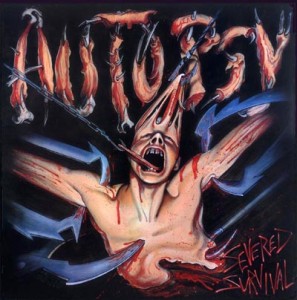
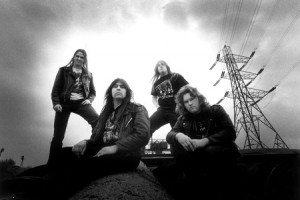 Autopsy’s barbaric and seminal album Severed Survival offered the listener what would by 1989 arguably represent the nihilistic and amoral apex of the burgeoning death metal genre and thereby cement their place in death metal history. Primitive and raw, the power with which Autopsy frantically bash out these energetic incisions into the human psyche, indicates a desire to transcend and break down the perceived but illusory moral world order and come to terms with the cold harsh realities of existence. On Severed Survival, Autopsy unabashedly presents the listener with a sometimes shocking but nonetheless candid and unmitigated reality, smashing to pieces any presupposition of a cosmic moral world order. As listeners we are forced to come face to face with death, desperation and the unspeakably twisted and cursed elements inherent in the mechanisms of reality and in the collective human consciousness, which Autopsy, like a skilled pathologist expertly dissect and examine. Exhumed are the intense, destructive and “degenerate” elements that are not spoken of in civilized society but which nonetheless drive reality and remain active as motive within the omnipresent but subterranean catacombs of the human mind. Unquestioningly suppressed out fear or an inability to place these depraved realities within the context of our currently constructed, illusory but ubiquitously advocated a priori moral world-view, it is Autopsy who courageously revel in exploring the obscene and who seem bent on destroying illusion in favor of discovering, conforming to and coming to grips with the power of reality.
 On first listen some would easily assume that this release were a mere product of nostalgia of underground metal of the 1980′s, at least indicated so by the production and indication that are present here. However this is death/speed/black metal firmly rooted in the underground
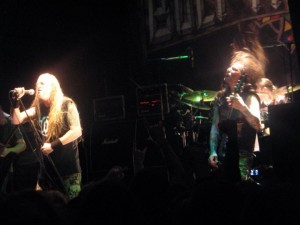
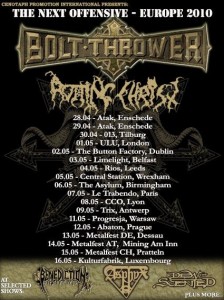 Returning from the brutality of a Bolt Thrower show to recollect the events that defined it brings to mind the task of Ernst Junger, depicting the graphic scenes of martial violence and destruction in his soldier’s memoirs, ‘Storm of Steel’. Not merely the sounds of war and chaos, but the philosophy of death is what one has to confront on such a stage, and this sums up the depth of the Bolt Thrower experience. The great elemental gods of Britannia fired the opening salvo of the evening, unleashing a torrential downpour on the troops to be in attendance once conscripted into the dismal but still functional ULU venue, around the University College London site and home of the un-elite Utilitarian philosophy. A single flash of lightning, probably striking the Cenotaph for the war dead a few minutes away in Whitehall, would indicate that this night belonged to only one elite group, and the slowly multiplying hordes as if signalled to the venue by this storm omen, proved that the headliners were in everybody’s iron sights.
 In the meantime, some fairly well-known bands would run through comparitively uninteresting sets in order to plug new albums or just an association with Bolt Thrower on this Next Offensive European tour. For the one unknown band, clearly grateful to the Coventry squadron for being able to provide opening infantry support, Ancient Ascendant took to the stage with some confidence and raged through their set infront of the minimal crowd at this time. The sound was not good and the technical setup of the venue’s sonic equipment would be a recurring issue throughout the night, usually leaving bands with an unbalanced sound. Even less impressive was Ancient Ascendant’s music, which was practically educated by the newer schools of Death Metal exclusively, sounding like a more frivolously melodic version of Bloodbath. A lot of generic rhythmic business with some predictably inserted flourishes of lead guitar lines and none of the compositional sense that at the very least ripping-off the old school Death Metal formula would have imbued the songs with by default. Even the next band, The Rotted’s only listenable song was from the older generic Gorerotted project, which is not much less moronic than The Rotted who are really damn retarded in this incarnation, with their stripped down songs consisting of one riff from a later Cryptopsy song played out as blasting Punk music. It’s also quite strange and not recommended to watch old, drugged up men performing breakdowns.
 Considered by many as nothing more than a brief distraction, this was soon forgotten as the once powerful entity of Promethean Greek Black Metal took to the stage and the floor swelled with eager hordes. For someone that reveres the older fraction of their catalogue as highly as the Nordic classics, the Rotting Christ set provided both frustrating disappointment but also possibly the biggest surprise of the evening (not the appearance of Diamanda Galas). The transition from ancient Heavy Metal-inflected compositions of blackened mysticism to a boring and cheap form of fast and extreme Rock music with pseudo-cultural embellishments that would make Vangelis either laugh hysterically or summon the wrath of Mars upon Sakis and company, was made quite some time ago when the band sold out to Century Media and although the recent jump to Season of Mist has only marginally improved the quality of their music, the bulk of their songs is blockheaded rhythmic work that wouldn’t sound out of place on a System of a Down joke and disembodied keyboards typical of mainstream Black Metal bands to accompany the minute flickerings of nostalgia that is the signature Rotting Christ melodic style, the same tactic used by fellow Greeks, Septicflesh. Within this disastrous but obviously crowd-pleasing selection of tracks was something quite unexpected given the current direction of the band and their most recent live performances. Almost as though the old spirit of Necromayhem broke free from his sealed confines, the band launched mercilessly into ‘Sign of Evil Existence’, flooding the crowd with a sea of beautiful, extended phrasal work, causing an absolute frenzy and evoking the first old school invocations of the night. Not content with such a brief introduction to arguably the pinnacle of their early discography, ‘Fgmenth, Thy Gift’ continued the magic of ‘Thy Mighty Contract’ with the folky but regal opening riff surging into those magestic, ascendant patterns of guitar. The higher register key of these older songs manipulated the flatness of the sound setup brilliantly, with every note perfectly audible and a memorable contender for song of the entire show.
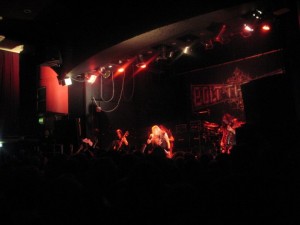 Benediction were next on stage, an aging group of Death Metal punks fronted by Dave Hunt of Anaal Nathrakh, Mistress and Never Mind the Buzzcocks fame, who nearly talks as much shit on stage as Barney Greenway, including an embarrassing appeasement of some girl’s sob story about a now deceased Benediction fan, thankfully met with a shout of ‘Only death is real’ from the front of the crowd. The set itself was a typically reliable collection of songs spanning most of their discography, better suiting the live environment than on CD, inducing as much violence from the crowd as their primitive, bouncy Death Metal can, like ‘Harmony Corruption’-era Napalm Death meeting ‘Tower of Spite’ by Cerebral Fix. It wasn’t much of a loss to have a guitar cut out during their stint, as the rest of the band seemed to push onwards, building up as much aggression as possible and justifying their placement on the bill, though it was huge relief to hear the end of Benediction at long last, for the lights to dim and the next offensive to commence proper.
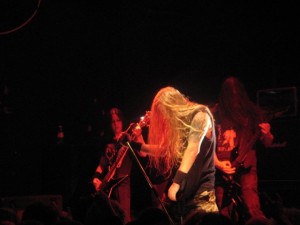 Bolt Thrower commanded the crowd, Karl Willets looked like a war-torn veteran but still yet to be tamed as the ferocity of his vocals didn’t let up for an instant. Jo-Anne Bench is undoubtedly the most menacing female presence in the entire Metal scene, and the poorly balanced sound worked well to render the songs with more bassy fury than can be heard on record. The subtle rhythmic variations of Baz’s guitars on the other hand were not as discernable, but for a seemingly undiscerning crowd, this did nothing to quell the primal violence that tore bones asunder in a ritual of combat replication. The signature riffs were also fairly muted but managed to somehow shine through like the sun between Afghan mountain peaks, and as the band returned for an encore, the perfect choice of songs scorched the stage like a vast napalm attack, with the ominous theme of ‘War’ transforming into ‘Remembrance’ as though the sorrows of Arjuna had been cast aside as he takes to the empty plains of Kurukshetra, seeing the world as it is.