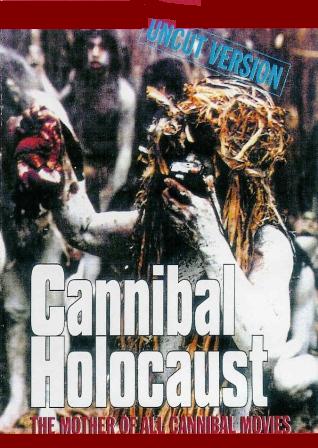
 This is by no means the easiest of films to watch. It has numerous flaws and executions within the film that would provoke one to make immediate criticism, for example the sub-par, almost at times robotic acting and unimaginative script, and what could indeed be labelled a lack of cohesion (could this be due to editing and censoring? I am not sure), Cannibal Holocaust never ceases to shock and provoke, as well as provoke immediate questions of ‘who are the real savages?’ and how people might want to generally assess their modern, non-organic way of living.
For those unaware, the film centers around an anthropologist who is searching the wherabouts of a film crew, lost and presumed dead after having gone on a expedition discovering primitivist tribal cultures, and the alleged cannibalism associated with it. Upon retrieving a camcorder containing reels of film that entail the ill-fated decline and fall of the expedition, the anthropologist then returns to the United States, to show the footage to the executives of a major television station. As each reel is played off, we see the young crew begin as arrogant, gung-ho, civilised and white skinned carefree adventurers, with little or no respect for a habitat that is not, and will never be their own. As the film footage progresses, we see the crew make contact with the native tribespeople, and imposing their presence on them in a harsh manner, committing beatings, tortures, arson and rape, whilst filming their deeds, which they attempt to justify on the grounds they are more civilised than they. As the title of the film partially implies, the predators surely but quickly become prey, each of them killed barbarically and ritualistically. In between the pausing of the reels, the executives of the television network are convinced that the celluloid they witness would indeed make for good viewing ratings, to the anthropologist’s objection that such a thing is exploitative and in bad taste.
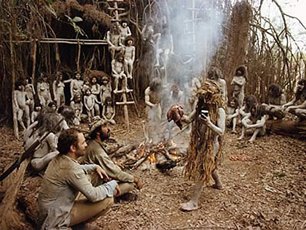
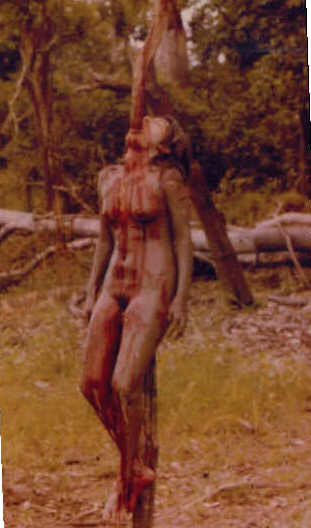
The film is at times unsettling, and we see many obvious critiques of how life, substance and nature are valued by the modern ‘civilised’ human being. One easily gets the impression at times that the intrusion of camera, gun and machete wielding Westerners into isolated, indigenous land is a metaphorical allusion to the ills of colonialism. The film also questions the bloodthirsty sales appetite we see in the modern media, ‘blood equals ratings’, which is too often seen when a mainstream newspaper is more than happy enough to make their own material gains from anothers tragedy. As I have illustrated in the opening paragraph, this film is badly executed in certain avenues, and when viewed it is easy to realise this. The real-life killings of animals are stomach-churning, and will alienate many. The depictions of sacrifice, abortion, rape, castration, mutilation and torture are profoundly realistic and shocking, they give a raw attribute to the film that very little in the cinematic world will ever match.
 The most redeeming features of the film are the soundtrack by Riz Ortolani, which utilises rather dated synthesisers alongside a string orchestra, often interspersed with music that sounds not too dissimilar to Italian religous music, with arpeggiated acoustic guitars playing upbeat music that adds a brilliantly sarcastic touch to an otherwise grim and unrelenting series of violent acts. The usage of hand-held camera is very effective. As opposed to films where every scene is portrayed from a multi-angle perceptive, we see absolute realism for the most part, and is done in a non-perfective, improvised fashion that otherwise contributes heavily to making the film for the most part, very convincing. Cannibal Holocaust is flawed, yes. But it is a triumph of the cold, efficient will. Unlike the humoured (but still excellent) Dawn Of The Dead, Cannibal Holocaust is the work of the cynical sociopath, and seems to metaphorically imply that when one reaches or exceeds a certain threshold of excess, be it due to ignorance, lust, greed, self-indulgence etc, there is not even the vaguest chance of redemption. In a sense, the message of this film is an all-out war against the modern way, and the belief that furthering it to those who are otherwise unwilling to accept it is nothing short of a disastrous consequence. The film also suceeds in that it doesnt moralise about the issues it raises, and also leaves the film open to many possible interperatations. Overlooked by critics for its very bad acting, reviled by the politically correct, adored by much of the exploitation crowd, here is a film which holds truths and meanings beyond a framework that would isolate and sicken many.
Tags: zine-video