


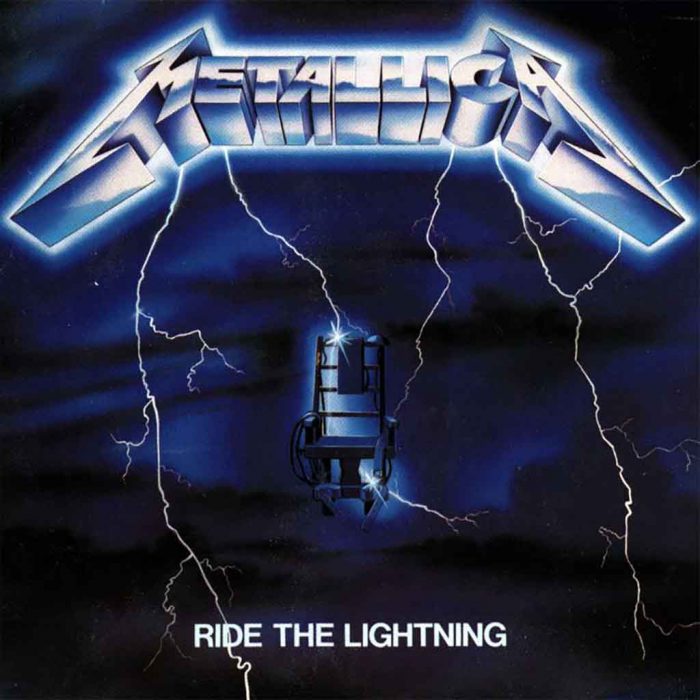
Metal scientists at the Institute of Hessian Studies (IHS) today revealed research that shows definitely how the guitar as the lead compositional instrument leads heavy metal songs but not rock ones.
For the first time, this provides an empirical framework to distinguishing metal from rock and hybrids of rock that, like Opeth or Pantera, often disguise themselves as metal despite having much more pop culture intentions.
This research illustrates the principle that metal is something driven by guitar (meaningful riffs, conversing, through-composed) and not driven by vocals. This principle of metal was mentioned in the metal FAQ.
By measuring the share of playing time occupied by vocals for several Metallica songs from different albums, researchers correlated vocal-domination to rock hybridization as well as selling out or commercialization.
| Song | Vocal Length | Song Length | Vocal % | 1984: |
|---|---|---|---|
| “Fight Fire with Fire” | 84s | 285s | 29.5% |
| “Ride the Lightning” | 118s | 396s | 29.8% |
| “Fade to Black” | 99s | 417s | 23.7% |
| “Creeping Death” | 133s | 395s | 33.7% | 1991: |
| “Enter Sandman” | 158s | 330s | 47.9% |
| “Sad but True” | 155s | 327s | 47.4% |
| “Unforgiven” | 226s | 387s | 58.4% | 1996: |
| “Ain’t My Bitch” | 181s | 304s | 59.5% |
| “Until It Sleeps” | 204s | 269s | 75.8% |
| “King Nothing” | 178s | 328s | 54.3% |
The earlier, relatively “benchmark” metal songs have meaningful non-vocal musical content, namely riffs, riff combinations and variations, solos, intros, outros — which can be listened to on their own and are memorable on their own.
These earlier songs could even do relatively well without any vocals. This is actually supported by the fact that Metallica had an instrumental piece in every of their first four albums but stopped doing this on later albums.
On the later albums, namely the Black album and the twang metal albums, more time was surrendered to vocals, while guitar parts have dramatically decreased in their significance and value. The songs have become “one-riff” songs, where you (are lucky if you) have only one main riff that is musically meaningful, memorable and independent of vocals (see “Enter Sandman”) while the rest of the guitar parts are just unobtrusive background accompaniment to vocals, often providing harmony to them as in pop rock.
Such transition from multiple-riff pieces to one-riff ditties is the metal equivalent of the transition from polytheism / paganism to monotheism. Easier to spread, easier to multiply, easier to monetize, easier to control.
In more terrifying cases, like above-mentioned “Until It Sleeps,” the songs became “no riff” songs because all of the guitar parts are just accompaniment / chord progressions so it makes no sense to give them any independent space.
Vocal parts on those albums merged into large time chunks where verses, pre-choruses and choruses go one after another immediately, without any kind of interlude riffs between them. This became vocals-driven music that would not be a meaningful listen without vocals.
A clueless listener who hears only the surface of the music might think that heavier sound makes you more metal — while ignoring the song structure and the instrumental vs. vocals / “song” ratio. For an example, one could say that “later Ozzy Osbourne albums are more metal than early Black Sabbath albums because the guitar sound is so intense!” In fact later Ozzy Osboune is pure vocals-driven rock, musically, while early Black Sabbath has quite a few songs where vocals are not the main thing.
Benchmark metal, where riffs have a significant role, is less human-dependent, less “human-all-too-human,” as it relies less on the particular human personality behind the mic. Just because generally it allows less time for this human to express itself. Such music is meant to, and built to, speak on more large scale and timeless topics than emotions and struggles of a person.
Tags: analysis, metal, music theory, vocals


Sabbath hasn’t aged well in my opinion, I definitely much prefer the solo Ozzy stuff on “Bark at the Moon” and “The Ultimate Sin” – it may sound like heavy pop music, but it’s really good at it.
With that being said, the best synthesis of good riffing with great vocals that I can think of at the top of my head is the early King Diamond/Mercyful Fate stuff. It still holds up, and shows that the rock/metal hybrid formula can be done right.
With that being said I’m too morbid to bother with classic metal most of the time, unless I get enough drinks in me. I will take Incantation any day, all day, again and again.
As for Pantera and Opeth… well they’re one of the main reasons why I stay the fuck away from metalheads when I can.
Having a lot of vocals doesn’t necessarily make a song non-metal. This is correlation rather than strict connection. You could look at a Slayer song and see that vocals often occupy much more than 30% of playing time; but the picture is different from Metallica’s “one-riff songs” because: with Slayer, it’s not vocals but rather riffs played in parallel with them carry the bulk of the music. The riffs are more musically meaningful than the vocal parts; or at least, they are equally meaningful. E.g. you can’t remember the “riffs” in “King Nothing” except the main one; but you can remember the riffs in “World Painted Blood”. Now we can try applying this model to Mercyful / Diamond.
You’re basically describing Sammath, war metal and a lot of other crap promoted here. It’s just incessant screaming on top of a one-riff-blast-salad, but somehow we experts have decided it’s more “meaningful” than sellout Metallica. It’s just darker rock music.
The only difference between rock and metal is the ratio of heaviness/aggression and the disparity of how radio friendly/unfriendly it is, because there’s enough (like 99%) bad one-note metal out there that it makes the infamous “Black” album seem like a goddamn masterpiece.
Autism is one hell of a drug isn’t it.
We appreaciate your reading of our position papers and following of our music recommendations.
Counting, as well as recognizing melodies, is key. Sammath’s “Godless” has 4 different riffs + variations of them. “Through Filth and the Remains of Man” has a minimum of 9 different riffs.
‘Shot in Mass’ by Sammath has plenty of riffs more than one.
Sometimes it even has multiple simultaneous riffs
Coincidentally, I’ve said since it was released that the biggest flaw of World Painted Blood is the incessant vocalizing over every song. There’s a lot of good music on that record (it’s their best post Seasons release) and the vocals aren’t *bad* (though some of the lyrics are), but they just never stop and it’s distracting. I think that’s also why many people hold Christ Illusion to be the superior album; it’s easier to tell what the guitars are doing on CI even though WPB is way better musically (great production, lots of good hardcore influenced riff ideas)
Luckily, vocals on WPB quite often sound as if it’s _them_ that is the _accompaniment_ – or even a metaphor of a drone string/note in a medieval instrument – while the guitars are the central thing to listen to.
Dear Dr. Phalussi, thanks for your insight! From my own very regard, I think the article above needs more variables to be introduced or in any case more albums to be compared, because comparing Ride the Lightning with that 1996 thing and saying the latter one is less metal is like, as we say here, discovering the Mediterranean!
Have a nice day all!
Never bothered with any Sabbath past sabotage
Cradle of Filth and Marilyn Manson are two of the worst offenders in this regard!
Possibly also Dead Kennedys too lol!
I don’t think Manson ever tried to fit into the “trve metal underground” scene. It was just commercial television music up there with Eminem and Britney Spears. Don’t care about any of them.
Cradle on the other hand is just mediocre funderground music with stupid sounding vocals, I’ve heard much worse.
Black Hawaiian rap metal
Done by lesbian aapi latina blacks
With dicks
Hahaha
That fuck blondes and xxx stars
And hate white trash and most people
Hahaha
Hey brett could this work or would liberalism destroy it?
Idk I hate shemales
Idk I hate women
Idk I hate dykes
How do I design chicks that don’t fall into the leftists trap if equality kills like everybody everything shit like it’s easy finding chicks that hate fucking wiggers and al b sure bratt pitt maggot homosexual bitches manly guys shit
Idk I hate men can I make fifty bitches do what I say and make my rap metal orchestra from hell?
I draw cool shit but necros faggy ass fucked it up I don’t want them pure black either
So it does not work huh?
So says
The grim reaper iguanodons
Gnathomortis prime raprockzilla
Ghost rider metalceratops
Gods of barbarity
Look I hate whites spics damn Jews ick…
How do I stop those groups from fucking up my ideas ok?
And what do you think of filthy xxx stars like eva lovia Jenna jameson jayden James
Are porn stars fucking kinda gross sluts hahaha can I fuck em before I kill them?
And isn’t rap just smut drugs violence with two turntables duh huh?
Can you please write a book? I’d buy it.
I’d buy 10 copies of it and give them to homeless people.
its even worse…watching metallica through the never you realize that metallica’s “metal” music is so fng boring that you actually need to be distracted with a third rate movie to even endure that shite…the horror…only thing soothing is Hetfielt’s beautiful, insightful lyrics.
Big man ting.
Except: Metal can be about many things, including the strife of one individual, for that can also be heavy in the way particular to metal
“Metalness” is a continuous function rather than a discrete one. We can agree that the aforementioned “Fade to Black” is closer to “benchmark metal” than “Unforgiven”, and this includes the difference in the lyrics. Both songs being largely about the strife of an individual.
Life is a continuum from yeast to gods. Pantera are on the left side of that Bell Curve. Some say it might even be binary.
The Proto-Indo-European religion would see material life as a wider continuum: from vacuum (or simply space) to stones to yeast to gods. So there are parts of the spectrum even more suitable for Pantera.
Read “Against the Neo-Pagans”; you are projecting an Arabo-Christian morality here. “Suitable”? They exist, and like mosquitoes, Pantera fans play a role, but it might be as that which we are born to hate, conquer, subjugate, and serve with a fine Chianti and fava beans.
Among other things, pagans worship objects not considered “living” by modern humans. This includes stones, springs/wells, rivers, lakes, mountains & hills, valleys. This is one of the precursors of ecocentrism / deep ecology and can hardly be a projection of christianity.
Pantera is great in a sewer, but if you get it on your peenor, you get a UTI and your urethra sprouts fungal wings.
“Fade to Black” and “Escape” are only a few tweaks away from being Greek black metal ala Rotting Christ/Varathron if you actually pay attention to the music
(side note: Anyone that says “Escape” is not a good song is a total fucking poser)
We have lots of “melodic” bands who are either vocally melodic or wheedle-dee on the guitars without much correlation to the song, but bands who can write melodic riffs are rare, and both Metallica and Varathron fall into this camp. Few people realize how truly great His Majesty at the Swamp really is.
At the very least, “Escape” is valuable as a piece that shows that the default quality of the band’s songwriting was fairly high – “default” meaning without inspiration or preparation. They were forced to write “something” and came up with this song. Metallica’s “autopilot” songwriting at the time was still better than most bands’ “best effort” – in terms of both music and lyrics.
There once was a fellow whose rash
He attributed solely to thrash,
So he put all his denim
And albums by Venom
Just where they belong – in the trash.
The average person doesn’t even know how to listen to metal since they’re so used to listening to easily-digestible vocal driven music. “You listen to metal? Raaaah! Screamo!” It’s like they can’t hear the guitar parts or interaction between the instruments at all. And of course the sellouts cater to this audience that doesn’t appreciate what once made them great
Let’s face it, there wouldn’t be any good metal without Jews. No, I don’t mean Chuck Schuldiner, RIP, HIV. I mean Arnold Schoenberg.
It has more to do with Bruckner and Wagner…
There’d be no Schoenberg without Bruckner and Wagner. But the former is responsible for taking the late Romantic dissolution of tonality to its final conclusion while simultaneously recovering and reapplying classical forms. Metal riffs, with their frequent use of tritones, are more akin to Schoenberg’s melodic lines than Wagner’s or Bruckner’s. Compositionally and politically, Schoenberg was a “conservative reactionary.”
Britannia rules the waves!
Englishmen were not meant to be slaves.
What you’re really talking about is poor songwriting. A prime example is modern Exodus, stretching four minute songs into seven minute bore fests.