


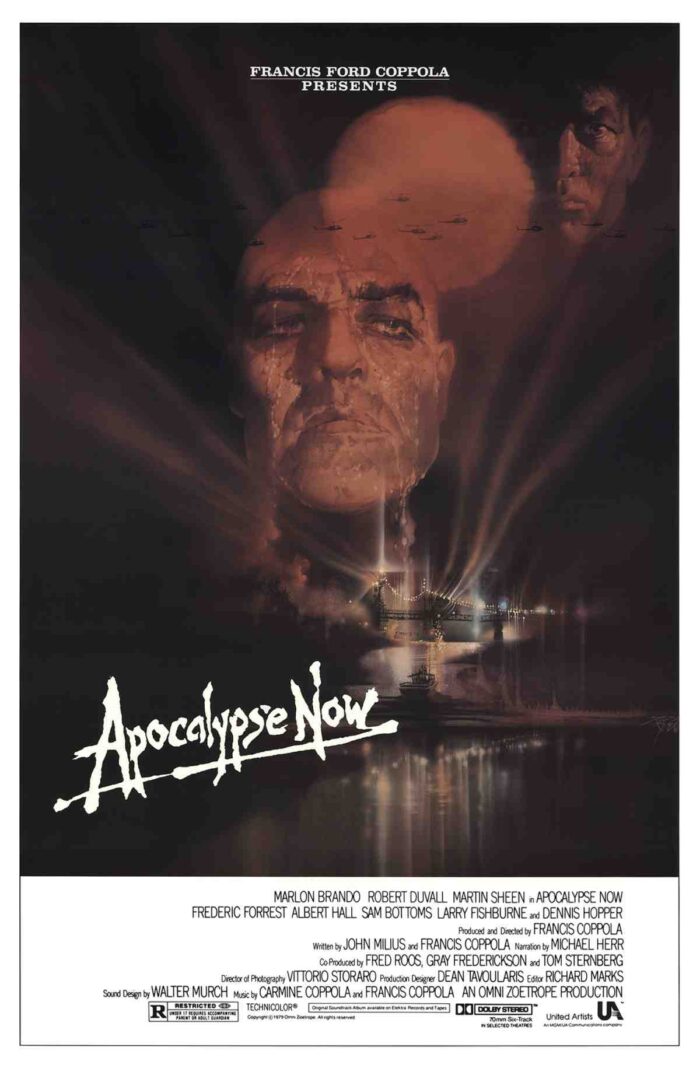
Very few movies manage to be relevant, or to show us something about life that makes us want to re-engage from our comfortable armchair debt servitude, and very few do it so insightfully and elegantly that they might be “classics,” but this film surely qualifies.
Ostensibly a war film, it re-tells Joseph Conrad’s Heart of Darkness in a Nietzschean take informed by the civilization collapse riffs of T.S. Eliot, set in the Vietnam war to symbolize the ongoing interaction of the West with the third world.
Instead of the usual hoorah nonsense we receive instead a meditation of the deepening of descent into both crisis and an escape from the mental poison of civilization, hitting on many of the themes of black metal which Conrad carries on from Plato.
Its peak may be the infamous sampan scene where means-over-ends reasoning collides with ends-over-means, a moral critique echoed in the final scenes, where an escape from social morality provides the characters a means of going forward, even if scarred by the past.
While it is criticized for its intense nihilism and seemingly depressing theme of the ongoing failure of civilization in the West, its message to a metal fan offers the usual hope: if we can escape the mental pathology of civilization, we can rediscover the wisdom of nature and become participants in our own lives again.
Tags: cinema, francis ford coppola, john milius, joseph conrad, t.s. eliot


“What will it be sir? Give me the usual Brett on the rocks”
Sammath mentioned recently – check
Plato/Nietsche mentioned now – check
“Anti-modernism” – check check check
Now you’re just trolling us like a broken record. I bet you’re going to mention Deer Hunter 1978 and Taxi Driver 1976 next since they’re similar… but careful though, like the movie reviewed here all three of them are Italian-directed movies… might cause you to have your 666th nervous breakdown (sperg-down) and write yet another “almost-white problem” article on Amerika that’s totally accurate, and which I’m sure the entire world will read and care about…
Good luck fighting “modernity” (whatever the fuck that is). Are you a time traveller perchance? Have you been to the “glorious” past, and how do you know life was better? Define better? As for me I’m happy where I’m now, so do not speak for all metal heads any more, thank you.
Fuck off back to Metalsucks, Redditard.
There’s just not enough intoxication involved on either hand here to ever be relevant.
Next up: Transsexual Penetrator 1 (2002)
Hahaha
This platonic anal raping sucks
Listen to slayer punk….
Fuck hip hop and you
Die bitch
Fuck diversity and del paso too
Fuck necro
Fuck Jewish rap metal
You want genocide you got it…
Try aiming right faggggot you bitch…
Bitch….
So says
The
Super villain rap metal
Tylosaurus prime thalassomedon police
Pliosaurs hate modern race mixed fucks like you ..by the way…
Hey Brett who would win black metal or rap in a war?
They are really from different worlds. Rap won in Pantera, at least. I was drinking the other day and had a sudden nostalgic urge to listen to Charles Mingus.
Just watch Streets on Fire 1984, where the pretty boy knight in shiny armor actually does NOT get the pretty girl, instead the rich “revenge of the nerd” gets to keep her, and this wonderful lyric kicks in “Say a prayer in the darkness for the magic to come” at the ending, which makes it a highly unusual inverse “nightmare on elmstreet” ending for the 80’s like Heathers 1989.
Speaking of Rick Moranis, I highly recommend Little Shop of Horrors 1986, idyllic movie with a lovecraftian ending, aside from the glorious Space Balls. Just do what I say, and you’ll thank me later.
Seconded, and the 1960s one with Jack Nicholson is brilliant too.
I think the best Twilight Zone episode for me is either the one where the aliens deceived humanity into being our benefactors, then ended up using them as food… or the one guy that had it so good that he got absolutely sick of it and wondered if he was in heaven, then Satan laughingly said something like “no you’re in the other place!” I forgot the names of these eps, but there were many good ones at least in the first seasons. I think the show became tedious in its last seasons, which is normal.
Overal slightly better then the 60’s Addams Family and 60’s Star Trek (the only Star Trek I liked, rest feels meh).
You said: “…but this film surely qualifies” REALLY?
Surely not!!!!!!!!! This movie is an absolutely cartoonish parody. It wasn’t good when it came out -well maybe the first 5 min ‘credits’ with that waste of CO2-producing Napalm with the Doors playing …but now it’s a badly-aged joke.
Do a beer review, it’s been a while