


All things in life strive to survive and perpetuate. This applies to genes, peoples, languages, ideas, and as a subset of that, musical genres. Black metal is a palatte for discussing a naturalistic, Nietzschean and Darwinistic view of the world that also retains a Romanticist focus on transcendental meaning and the possibility of hidden worlds beyond it. Like the rest of metal, black metal has been struggling to survive since 1994 when the genre bloated and floated, but some rise to the challenge with a sense of delight and the curiosity of discovery. This came to mind when Asgrauw floated across the review queue with their impressive Solips. Luckily the band were game for answering a few of our questions.
When did Asgrauw form, and what were the initial influences that made you want to write in this style?
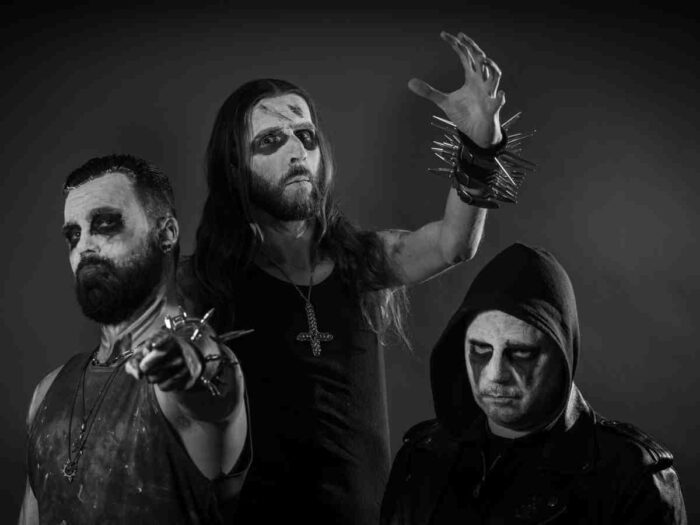
Asgrauw was formed in 2010 as a four-piece. In those early days, we played a rather raw form of black metal, mainly influenced by the Scandinavian sound that had inspired guitarist/vocalist Vaal: bands like Sargeist, Emperor, early Dimmu Borgir and Horna. We were mostly playing very local shows and gradually finding our feet as a band. Bassist/vocalist Kaos came from a punk background, but could relate strongly to the anger and aggression of black metal. So even back then, we had two vocalists, although the contrast between traditional black metal vocals and more punk-oriented screams became much more pronounced later on.
While we were recording our first demo, our second guitarist left the band, leaving Vaal to record all the guitar parts himself. In 2012, Batr joined on drums, and his arrival marked the beginning of the line-up we still have today. Since then, the three of us have remained a stable line-up, and there has been a steady progression in both the quality and character of our music. The Scandinavian atmosphere is still very much present, but over the years more of a punk attitude has found its way into the music, creating a contrast with Vaal’s more melodic guitar work. What started out as fairly straightforward black metal has gradually developed into a sound that feels much more like our own.
Your latest album seems to continue what you were doing on earlier albums but in a more compact, high-energy package. Is this a change in design philosophy?
We’ve maintained more or less the same style over the years and have never gone through any abrupt changes. There has been a natural evolution, though, and each album sounds slightly different. One is more atmospheric and expansive, while another features more compact and heavier tracks. It has been a natural progression and development rather than a deliberate change in philosophy.
In the early days, our compositions were simpler and more straightforward. Later on, we started looking for our own sound, experimented with keyboards, and taught ourselves how to record and mix. That meant we were no longer constrained by studio time, which gave us much more freedom to experiment. We have learned something from every album and have become better musicians, songwriters and producers along the way.
On Façade, released in 2022, the frustration and isolation of the COVID pandemic unintentionally found its way into the music. The music was angry, and Kaos sounded particularly pissed off. We carried that angry energy over to Oorsprong, where it felt like all the pieces finally fell into place. The new album, Solips, continues along that path, while taking another step forward in terms of songwriting and production.
On Solips, we consciously brought more speed and brutality back into the songs, partly because we wanted to add some new material to our live set. Live, we’re an absolute wrecking machine.
These days, we are very conscious of how we compose: we focus on building songs around strong, memorable riffs and a sense of narrative. We want the individual parts to serve the song as a whole.
How do you like to write songs, starting from a riff, an idea, a melody, a rhythm? Or are you influenced by visual concepts or experiences and build songs to fit those?
The process has changed quite a bit over the years. In the early days, we spent endless hours in the rehearsal room writing songs together and changing things until they felt right. It was a fun way of working, but it simply wasn’t very efficient. We also wanted to use our rehearsal time to work on the live set, so over time we started looking for a more efficient way of writing and developing songs.
These days, there is more of a division of roles. Guitarist Vaal usually starts by writing the basic structure of a song and recording scratch tracks. This gives Batr something to work with at home, where he can experiment with different rhythms and drum patterns. The guitar usually comes first, although the drums can have a major influence on the final shape and character of a composition. We then bring everything together, arrange and develop the material as a band, and record it in Batr’s home studio. From there, we keep fine-tuning the songs until they sound right, while Kaos works on the lyrics.
Vaal often gets inspiration from listening to music that influences him, but also from walking through the woods and geocaching in abandoned or forgotten places. We are fortunate to live in an area with plenty of nature and history, so there is no shortage of atmosphere and inspiration. He can also spend hours watching YouTube channels featuring footage of abandoned urbex locations or nature documentaries.
When it comes to lyrics, Kaos is always looking for subjects that speak to him personally. He dives deep into the most bizarre theories and ideas. The lyrics on the last two albums in particular have become quite abstract and layered.
Artistic movements communicate a philosophy or worldview through their aesthetics, some say. If this fits your understanding, what does black metal communicate?
For us, black metal is an expressive art form that gives a voice to the darker sides of human existence. It creates a sonic space for thoughts, emotions and subjects that often have no place in everyday life. Things that are difficult to talk about, or that you simply cannot discuss with most people. Fear, hatred, despair, isolation, death, obsession and the darker sides of human nature can all be explored through the music.
Black metal can also be an ode to nature or the supernatural, or simply a form of escapism – a way of stepping away from the world around us. History, philosophy, psychology, nostalgia, disgust with society and hatred of the modern world have all found their way into our music at some point. In that sense, black metal doesn’t necessarily have to be about one particular subject. It can be a way of exploring whatever is on your mind, especially the things that don’t easily fit into everyday life.
We don’t think black metal needs to communicate one specific message or worldview. That freedom is part of what makes the genre so interesting to us. It can be atmospheric or aggressive, personal or abstract, thoughtful or simply angry. There are no real boundaries, and that’s exactly how we like it.
Some of your riffing seems like a kindred spirit to what was done by
Sacramentum and Necrophobic, but there is also something like a Graveland influence. How do you knit together these fairly different styles?
All three are interesting comparisons, and actually not ones we’ve been confronted with before, but we can see where they come from. We play a form of melodic black metal in the Scandinavian tradition. Lots of fast melodic riffs, alternating between three-quarter and four-quarter time signatures, and an airy, atmospheric production with loads of reverb are certainly things we have in common with Sacramentum. Vaal is particularly inspired by the Norwegian school, but definitely by the Finnish one as well. Asgrauw’s approach is more chord-based, partly because we only have one guitarist. In the studio, we sometimes double a harmony to make the sound fuller, but live everything has to work with a single guitar.
Graveland… well, there is also a somewhat folkloric and epic element to our music, particularly in the way we evoke the feeling of dark coniferous forests. Bands like Drudkh, Windir and, especially, early Ulver are relevant references. Kaos listens to a lot of punk and black ’n’ roll, and those influences have found their way into Asgrauw as well. Batr likes a bit of variety in his listening, too. One moment he’s listening to Niden Div. 187 or Marduk, the next it’s jazz or fusion. So why not bring some of that into the drums as well? Blast beats and more unusual patterns can work perfectly fine alongside everything else.
We don’t consciously try to combine all these different influences. They are simply part of what each of us brings to the band, and somehow they come together naturally in Asgrauw. That’s probably why the music can contain quite different elements without ever feeling forced.
The Asphyx guys used to speak of “riff-glueing,” or making riffs contrast each other and then complement each other as a way of advancing the song. Do you have any opinions on this technique in metal, and do you use it yourselves?
Yes, this is actually the foundation of our arrangements. We believe songs should tell a story, so we deliberately look for contrasts between riffs, atmospheres, drum patterns and vocal styles. At the same time, we want to avoid giving the songs a cut-and-paste feeling. Everything has to flow organically and fit together as one coherent whole. We also avoid unnecessary repetition like the plague. We’d rather write compact songs without unnecessary ballast. Every riff should have a reason to be there.
To you, what makes a metal record great and not just a participation trophy? What are your favorites of all time?
That’s a good question, and certainly a relevant one in the current climate. Back in the day, you had to make an effort to discover new releases. We traded tapes, searched through record shops and saved our hard-earned money to buy a record. Once we finally had it, we played it to death, and our friends would make a copy of it. You really had to invest something — time, effort and money — to get your hands on music.
These days, in the age of streaming, there is an endless flood of new releases every month. Kids don’t have to look for anything anymore; practically everything is available with a single tap on a phone. There is so much music that it has become almost disposable. Most releases disappear from people’s playlists within a few weeks because there is already another hype waiting around the corner, conveniently served up by an algorithm. Sometimes it’s a band with a ridiculous cover that suddenly seems to be everywhere because the algorithm has decided you need to hear it.
But every now and then, an album sticks with you. Years later, you still find yourself returning to it – ideally not just as another entry in a playlist, but on your turntable. For us, that is what makes a great record: longevity. It has to be a keeper. Something you still want to listen to years from now, rather than something that gets replaced by the next shiny thing after two weeks.
Of course, that means something different to everyone in Asgrauw. Kaos is younger and keeps a closer eye on the current scene. Batr is a bitter old bastard who thinks very little of significance has been made in black metal since the turn of the millennium.
Vaal:
- Emperor – In the Nightside Eclipse
- Dimmu Borgir – Stormblast (the original, not the remake)
- Mayhem – De Mysteriis Dom Sathanas
- Urgehal – Ikonoklast
- Windir – 1184
Batr:
- Ulver – Bergtatt
- Bal Sagoth – Starfire Burning Upon the Ice-Veiled Throne of Ultima Thule
- Fleurety – Last-Minute Lies
- Obtained Enslavement – Witchcraft
- Lunar Aurora – Of Stargates and Bloodstained Celestial Spheres
Kaos:
- Spectral wound – Songs of blood and mire
- Marduk – Victoria
- Whiskey Ritual – Black Metal Ultras
- Urgehal – Aeons in Sodom
- Luctus – Stotis
How does our audience follow what you are doing and acquire physical
copies of your releases?
The internet, basically. We know bands that absolutely refuse to use social media, and we respect that. But if you have no online presence at all these days, you basically don’t exist. We have enormous respect for the labels that put a lot of money into releasing our music physically, and we want to do everything we can to make their investment worthwhile. We want them to feel that working with us was worth it, so they’ll hopefully want to work with us again in the future. That means putting a lot of time and effort into promoting our music and getting it in front of people. Unfortunately, that’s simply part of being a musician these days.
So we have little choice but to remain fairly active on platforms such as Facebook and Instagram, even though social media is definitely not our favourite hobby. We also occasionally appear on local radio shows and contribute to webzines ourselves. It’s not just about promotion, either. Keeping in touch with people, discovering new bands and supporting music we genuinely like are all part of keeping the scene alive. If we come across a band we think is great, we are happy to give them a push as well. The scene only really works if people support each other.
For physical releases, the best place to look is through the labels that released them. The new album, Solips, is being released through Zwaertgevegt in the Netherlands, Jems in the US and Zero Dimensional Records in Japan. We also usually bring records to our live shows, and many of our releases are available through Kaos’ label and distro, Void Wanderer Productions.
Tags: asgrauw, Black Metal, Melodic Death Metal

Dear Brett:
If you could ONLY listen to one band’s discography in rotation for six months, and nothing else, but this band for half a year, which band of the following options would you choose and why?
1. Kreator
2. Iced Earth
3. Overkill
4. Sentenced
5. Arckanum
6. Nocturnal Rites
7. Agent Steel
8. Dark Angel
9. Runemagick
I already basically do this with the first two Sentenced albums, so that would be an easy answer. Kreator has some quality work, I have enjoyed Iced Earth in the past, Overkill is a favorite for The Years of Decay, and of course Runemagick has a lot of great stuff, but I might go with Nocturnal Rites because they are a crossover between Iron Maiden, Queensryche, and Exodus that is easy to appreciate.
What albums from Runemagick and Nocturnal Rites are worth looking into?
The first and most recent Runemagick are the best, and Nocturnal Rites I am browing lazily through YouTube (which sounds like a term for the intestines).
Huge bonus points for not even acknowledging that Arckanum was listed!
Some things you just skim over. If I could sentence myself to any six-month listening block, I might go with Desecresy or Asgrauw at this point.
Something that pleasantly surprised you in the list of albums Asgrauw mentioned? I can imagine that we all are deeply in love with Mayhem and Emperor, some might include Stormblast. Personally, I do like Windir. I’m not so sure about the rest, although I do have a soft spot for Marduk and Bergtits
People get into black metal from any of a number of directions, and those are important to them because those releases were their initial contact (“you never forget your first really intense black metal album”). Same way people will say black metal is a vehicle for any kind of idea, then figure out years later that they mean any kind of idea they can relate to the black metal philosophy. It takes awhile to see this. I will endorse the original “Stormblast” because it is epic, imaginative music, even if the keyboard parts were borrowed. The Emperor is also highly important. For some reason, I almost never listen to Mayhem anymore (see first sentence) but then again, my first black metal contact was Darkthrone and Immortal.
Bill Cosby is finally a properly proven date rapist, 60 cases before the internet era cannot lie.
Maybe. Women like to gain power and prestige by doing favors for famous men. They knew what they were getting into after the first one.
I think Von and sarcofago were that for me, followed quickly by dmds and hlto. I’ve really savored my descent into black metal and have taken my time learning the canon; there’s just more to gnaw on pound for pound.
There’s way more death outside what DMU strictly prescribes than there is black metal.
DMU’s pretty spot-on with BM, but way too anal about DM. Admittedly everything in the archives is mandatory but for the hungry deathhead there’s much more to scour out there.
Feel free to list some names.
No one ever does. C’mon, I listen to glitched out tranny harcore and old raver music and think Power Metal is a great album, I’m always hungry for more, bring it on.
Well, if we are doing shameful normie music confessions, half of the early days inspiration came from REM (the rest from Slayer and DRI). I have listened widely, used to have a huge jazz collection, pound the classical quite a bit, and even checked out stuff like Bernie Worrell and floaty keyboard music like Tangerine Dream. All roads lead back to metal for me, but that is how I am wired.
I used to listen to a lot of jazz too, even studied it a little bit in school which included an improv class and my professor always gave me shit for riffing on the low notes instead of noodling around higher up the fretboard when it was my turn to improvise.
It’s weird, I want to like jazz sometimes, but ever since I truly embraced metal it just doesn’t do much for me. There are some records I’d still throw on in the right company I suppose, if they can’t handle some Impaled Nazarene or Demigod or even Cryptic Slaughter.
Cryptic Slaughter was big for me in the pre-reek days, alongside DRI, Sabbath and early Metallica and Slayer. Fortunately love of music runs in the family so I was exposed to a lot of stuff growing up. Didn’t stop me from a brief foray into nu-metal, but I was a kid and it was popular. We don’t need to get into that.
The thing for me with jazz was, once I listened to enough of it, recognizing how much improvisation went badly because it was fairly random and based on emotion-as-technique instead of emotion arising from the music like in classical, and from that, realizing why structured improvisation like Eric Clapton beat the heck out of your average random jazz piece. I still have certain favorites from Coltraine, Monk, Mingus, and Coleman especially. Hearing classical musicians do structured improvisation also made it hard to want to fall back into the emotional drama of jazz.
Those four are pretty much it. When I want to hear improvised music these days I just listen to noise.
The thing is that improvisation levels change everything. If there is structure, bands can riff on that as well as the harmony, and this makes a better experience. The best improvisers work within structure, sort of like street poets or beatboxers.
True. There is a certain restraint required. Indian classical music is a great example of this. Ragas are almost completely improvised, but within a very strict set of rules.
Believe it or not, same is true of most church organ music. Even the nice lady who played piano in my lower school did this. She was pretty good!
I’m seeing a parallel here with regards to the aesthetic consequences of “free will” vs choice. And forgot to mention Suicidal Tendencies as the third corner of my unholy trinity that also includes DRI and Cryptic Slaughter being the music that primed my brain for death metal when I was a kid and I. was. so. wasted.
The album “All Thoughts Fly” by Anna Von Hausswolff is an excellent example of this perfect amount of improvisation. It is like a symphony, meant to be heard in its entirety. Played on some really old organ in some really old church somewhere. Unlike her other output, which is cool but not really my thing, this I guess you could call it ambient neoclassical.
I still include Corrosion of Conformity in the unholy quadrants along with the three you list. It had a great influence back then, although the obvious standouts were DRI and Cryptic Slaughter. Much of death metal owes a great deal to Convicted.
The Black Saint and the Sinner Lady is just what I’m looking for in jazz, but I find most of Mingus too chipper.
He was immensely positive, which put him at odds with the jazz community, and very playful in his use of implicit harmony (and its negative space). All jazz is sentimental, but most of it is closer to Darkthrone than Abba, so I can see your point.
This makes me think of Sun Ra, who I used to listen to a lot, and probably still would if I didn’t listen to jazz like once every 6 months, like Ornette Coleman, Pharoah Sanders, Don Cherry, Cecil Taylor. A lot of the old bop stuff was pretty upbeat; stuff like Bix Beiderbeck and Charlie Parker – I’m too rusty now to recall much of it now. What I usually want out of jazz is basically that dance scene in Permanent Vacation.
An album I still go back to now and then is John Zorns’ tribute to Ornette Coleman called Spy vs Spy. It’s what I wanted Brotzmann’s “Machine Gun” to actually be, instead of a joke song like that one Flipper track (it’s on the jukebox at the Coney Island Freak Show…don’t let them turn it off…pussies…)
As an R.E.M. fan, I’m curious to know what albums inspired you and which you consider essential.
Hot damn! At this point, I listen to “Dead Letter Office” and “Eponymous” exclusively. Interspersed with early Sepultura of course. Good question.
Great choices! Throw in Out of Time and Automatic for the People, and you pretty much have an all killer, no filler R.E.M. essentials set. Enjoy the rest of your weekend. \m/
I have my own taste as well but nothing to add to the DLA as mandatory listening; with regards to death metal as often as not it’s going to be Deicide or Morbid Angel, maybe Atheist. The old shit of course. Shit I’d be fine if all I had was DRI and Cro-Mags to listen to for a month. Maybe Bathory to round that out a little. I listen to all kinds of music but with regards to metal it’s like 95% rotating through the DLA.
I can still remember the night I was sitting around my buddys apartment getting wrecked and heard Reek of Putrefaction for the first time. Blew my fucking mind. You know, it was like Melvins and Misfits and Verbal Abuse and shit before that – still love that music too. But that album was the tipping point and years later I discovered the DLA and there’s all this stuff I was already listening to on there. Moral of the story – we need more Metal Cosmos.
I keep meaning to check listening stats. I figure it’s mostly AIs at this point cloning my voice to use on spam robocalls.
I download them all, like I did with the KCUF stuff, and then go on to listen to pretty much every album that makes an appearance. Keep fighting the good fight.
I listened to I.N.R.I by Sarcofago because of it
I’d like to go and check out Houston, but I’m afraid I’ll get run down by Joel Osteen in a dually! ha ha ha
The biggest risk here is alcohol. Drunks fall into the bayous, then drown (good idea at that point: never trust anything that has gotten soaked in that water). Cars run over kids on bikes, or crash into your house. One Modelo over the line, or pink seltzer water gin cocktails? Hard to tell. Then there’s all the shootings. They keep finding random bodies in the woods and empty lots.
oof. Yeah, I’m gonna hold off for now.
Daily Houston news:
From the third “ward” to the related topics at the bottom, probably the most unintentionally hilarious article in history. You sure proved your point ha ha
I am thinking of starting a blog around the idea that Houston is a Shakespearian tragedy, basically the collision of human hubris with hard cold reality (diversity sucks, massive growth sucks, democracy sucks, voters are retards).
And I assume the auto accident industry is thriving. This is an interesting and strangely taboo topic, probably because of the eye-popping demographic trends one would find in the data (true of all cities).
If Houston has a theme song, it is “One Modelo Over the Line,” and that is why it is good to avoid most roads after dark. Even DRI wrote a song about drunk driving in Houston (well, Richmond-Rosenberg area).
I think that their list explains overall lightness and melodicism of Asgrauw music very well. Windir, Urgehal, Obtained Enslavement, they could pick as well Setherial, In Battle, etc. – that kind of generally more Swedish style of bm, most of which are ignored in these parts, but I do find some merits in all of them.
Asgrauw strikes me as more organized than most of those, with an exception for Setherial, and In Battle of course is straightforward but enjoyable.
Asgrauw is also more lively and climactic, in a definitely modern, but still good style. As for In Battle, at least their first, I would rather say that it’s actually too convoluted for its own good. Enjoyable nonetheless.
In Battle weirdly reminds me of Kreator in that way. Great riffs, but some stuff that never connected up. I hop they are not plumbers in their daily lives.