



Although it currently gets a lot of flak from the Right-wing critics that no one reads but still get paid well, postmodernism offered a simple upgrade to modernism: what if relativity influenced perspective, as well?
While this has a smiley hippie side, it does not say that all perspectives are equally accurate, only that all are part of the picture, like the five blind men who each touch a different part of an elephant and describe it.
After all, like all literature, it believes in holistic external consistent reality in which we are winding our own personal paths through relative perception. Sometimes what we do works, sometimes it fails; we can learn.
There is also a Vlad the Impaler side of this. “Of course they are lying,” he would say. “They are Turks and they want to bully and con you into laying down your weapons so that they can kill you!”
Or maybe your grandmother, who would tell you that of course poor people always have a sob story because it is how they get free stuff from the middle class when they cannot outright steal it. Postmodernism is eugenics, too.
However, following the work of early-1900s artists like Pablo Picasso, modern consciousness embracing the rising theories of relativity from Schopenhauer and Nietzsche, who wrote just thirty years before.
Postmodernism properly reigned from the 1920s through the 1970s and then fizzled out as it was replaced by ideological literature and bourgeois self-help style navel-gazing novels. Literature was pretty much as dead as metal at that point.
|
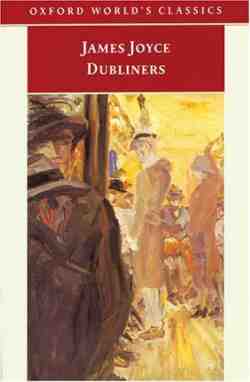
James Joyce – Dubliners
He experimented with style after this, but never content; the basic idea here is that people exist outside of the nice format of equal, and instead are these little trails of experience through a world with not only uneven but infinitely varied topography where animal ideals of self-interest and intellectual abstractions like self-image prevail over practical concerns, mainly because those are out of the control of the everyday person anyway. Filled with characterizations both compassionate and cruel at the same time, this book shows us humanity trying to leave behind mass conformity and find its soul in individual experience. |
|
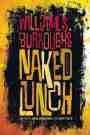
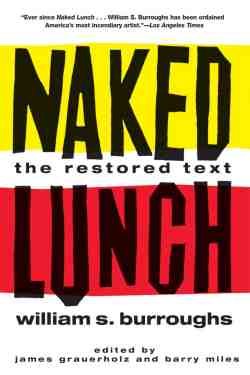
William S. Burroughs – Naked Lunch
Postmodernism peaked with this, a book that demonstrated the predominance of reality through many fractal views that converged on a thermodynamic reality, namely that all things seek a perpetuation of energy but the sad tired controlling human mind wishes to monopolize that possibility. A cry for the liberation of the human species, this book shows us horrors in order to paint in negative space the opposite potential, and in doing so, reveals to us the chains and the cave so that we might leave. Other than Jane Austen, the most influential author in my experience. |
|
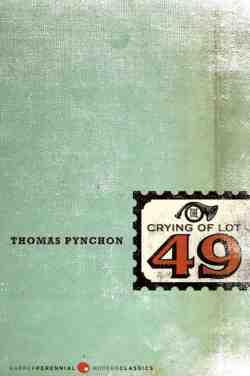
Thomas Pynchon – The Crying of Lot 49
Internet hipsters will tell you to read V or Gravity’s Rainbow, knowing that the chances you will wade through seven hundred pages of dense text in order to punch them out are slim, but this book contains all of Pynchonian theory and technique in a short and hilarious volume that contains a melancholic Romantic longing unmatched in the rest of his work. Expect to look into the modern soul and find the abyss of meaning created by human projection, plus intimations of a metaphysics of order that encloses and manipulates physical reality. It helps us escape modernity in order to see what it might have meant all along. |
|
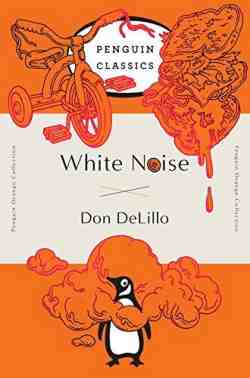
Don DeLillo – White Noise
Alex Jones thinks he knows paranoia, but this book shows us the tragicomedic nature of living in modern society where paranoia is the norm because every person acts in self-interest without much knowledge beyond their material desires within the next pay period. This book shows us what the Misfits and postmodern literature wanted us to see, which is that beneath the chrome and good wishes, modern society is comprised of subtexts formed of stultified desires and suppressed naturalism. We are prisoners in a gilded cage because reality must be denied for the human individual to become our new god. |
|
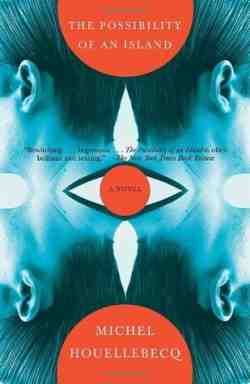
Michel Houellebecq – The Possibility of an Island
Building on a tradition that even predates Mary Shelley and Aldous Huxley, The Possibility of an Island shows us human existence taken as a reduction to extremes: what if we truly were free, independent, and accountable to nothing? The bleak existential crisis that confronts us when we get everything that we want reveals the emptiness of our wants, and shows us where there may be more hope of finding something interesting to do. Even more, it captures the hollow solipsism we impose on ourselves by mutual individualism, which makes the human more important than nature, logic, history, culture, or eternity. |
|
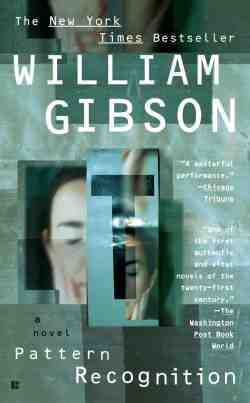
William Gibson – Pattern Recognition
Gibson broke into the scene with Neuromancer, but that was really a visual gloss on the themes he wanted to expand upon from Pynchon and Burroughs, namely the hidden order invisible beneath all events that might be both divine and scientific. In this book, a mystery encoded in everyday events, characters must confront the lack of meaning in their lives in order to discover inner heroism and through it, grow up to be able to see reality as something like what it is. |
|
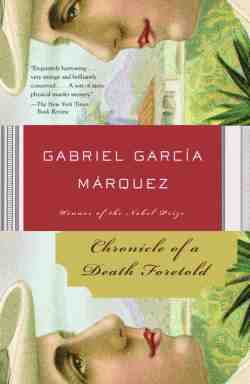
Gabriel Garcia Marquez – Chronicles of a Death Foretold
“Magical realism” may not technically (“eckshyually”) be postmodernism, but it uses the same device, namely the elevation of individual perspective above universal perspective in order to affirm a reality alien to both. In this case, we move steadily into the metaphorical framework of individual minds as they try to adapt to events beyond their comprehension, in the process revealing a poetry, rhythm, and order to reality. |
|
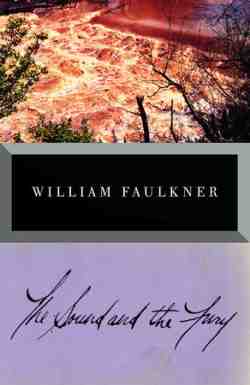
William Faulkner – The Sound and the Fury
Faulkner, a Romantic with the heavy heart that study of history brings, read Joyce and realized he could expand this by reducing the sympathetic fallacy to simple synchronization, and so you get this magical world where the trees bend to the wind which weaves with the twists of the tale, a story based on the restoration of order in a time of inversion where insanity is so popular that people routinely drive themselves insane just to fit in. |
|
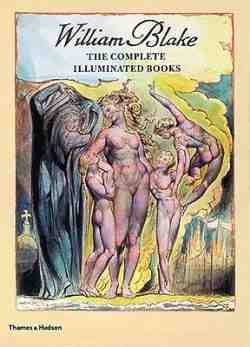
William Blake – The Complete Illustrated Works
Absolutely no one will like this, but meso-Romantic author William Blake invented postmodernism: the telling of a centralized story from decentralized fragments. Each character, like a subroutine, has its own memory, limits, and imperatives, and when they come together, we see a richer world underneath the smoothing-over (like concrete) that civilization does by treating us as a fungible horde of equal individuals. Instead, through Blake, nature blooms in all of its ambiguity and infinite potential. |
Tags: books, don delillo, gabriel garcia marquez, italo calvino, james joyce, jose luis borges, kurt vonnegut, lifestyle, literature, michel houellebecq, postmodernism, thomas pynchon, umberto eco, william blake, william faulkner, william s. burroughs






Outstanding. Thanks
A hundred years of solitude is fucking flawless. Marquez is the man
I enjoy his works. He is like the Hispanic Faulkner (himself the American Joyce, and Joyce was the Irish Goethe).
On that note, I picked up the Luke translation of Faust (both books), and it is excellent. I’ve only ever looked at my tattered old Kauffmann version.
And on THAT note, I also recently acquired the Oxford publication of Beyond Good and Evil, which is the Faber translation, and so far I don’t hate it but somehow it lacks the urgency Kauffmann was able to channel.
Kauffmann “got” Nietzsche in a way that few have, sort of like how Roy Cohn “got” Caesar.
I read Naked Lunch in my early twenties and could not make heads or tails lf it lol.
Well… now you know an expert. My advice: read it once through to enjoy, just picking up on the scenes and humor, and then flip the fucker over and read it again. The structure will manifest in your consciousness.
Dhalgren by Sam Delany if you can handle all the gay sex.
Does Gene Wolfe count?
House Of Leaves by Mark Danielewski which did some pretty cool things with tangential and meta narratives and text layout.
[ IPJI authors ]
Say what?
Pynchon’s shorter works really are his best — in addition to this one, critics hated “Bleeding Edge”, but it’s probably his second best work overall, really drilling into the psychology of his characters through a simpler-than-usual metaphor and wrapping that same sense of longing within the kind of story that will also make you pump your first and cheer, with a “life-affirming” ending that manages to stay just on the right side of saccharine.
Just read the Gibson instead!
I did not bother to read it, but that’s a good review. I think I stopped caring at Vineland but enjoyed Mason & Dixon.
Much like The Capital and The Communist Manifesto with communism
I enjoy Vineland a lot too. It’s hugely funny and psychedelic.
I was massively unimpressed with later Pynchon.
Yeah… good point. :)
It is funny to me how quickly a classical economist can explain Marxian theory, and how the Marxists have made a lifestyle, obsession, and pathology out of it.
The worst part of modernity for me is disproportional population (or overpopulation), which comes with a prevalence of the extroverted sheep type that force introverts along into their “socializer ant-worker” lifestyle like in Office Space – all into a dystopian melting pot feeding the probably non-human corporate overlords and their useless inventions.
In a sane society I would imagine there to be some kind of healthy segregation between personality types or classes if you will.
The Sacred Galactic Imperium is upon us. People can keep being cucks paying off the poor and fatties with their income and property taxes while purchasing cheap crap made in China, but as for the rest of us, we’re seeding worlds suffused in alien starlight with our ultra virile man seed giving birth to further demigods.
In the future, the average wagie will live in a thousand-square-foot condo and pay for everything through services and rentals. He will own nothing and like it, but always go to his job, because if he does not, he owns nothing under a bridge while getting raped by grinning orcs and goblins.
The best ants are those surreptitiously planted, grown, cultivated and then their vocal chords cut like in Motel Hell 1980, in order to be good citizens of our beloved Midgard. They can… function, but they will never have a tasty of my fine brandy or anything.
That movie is pure exaliotriote pulchritude.
In the future?
That is social hierarchy. Most people are ants and force others to be ants through the free market. To your average ant, it makes more sense to hire more ants that are willing to be there for twelve hours a day than to hire one guy who can do it in two hours. The optics are better.
Sodomize the worker ants!
Wish I knew how to pay the monthly interest with my SSDI check.
Convert it to Tide boxes first
We have loaded an AI with 500,000 articles from the AARP, NYT, Consumer Reports, and other Boomer publications. You can query it online using tokens which represent the mineral value of the average person of blended into a fine paste.
Nah, not my wants. I would be fine
Read The Possibility of an Island. See the mailing list for more.
Sometimes I dream of being on an island with my teleporter, replicator, hyperspace drive, and robot army that can defeat any enemies. I would read all the books, listen to all the music, finally brew my own beer and press my own tobacco, and make feces sculptures that would rival the works of any civilization. However, in retreating from the world, one removes the utility of these things too, and dies of solipsism.
I would be fine if I got my wish, because I don’t want to be “accountable to nothing”
Cool thought experiment bro. Get yourself an utterly thorough cynicsm towards all of thought and life and a freewheeling multimillionare sugar momma and let me know what happens. This won’t work if you’re not very beautiful and charistmatic, because must be able to ignore your flaws if they even notice them.
Where does Herman Hesse stand amongst these authors? I’ve recently acquired some 1960s translation of “Demian” and it’s a very quick read for something of a 120ish page book. It’s the only book I’ve acquired of Hesse, only having read about him and not his books in brief instances over the decades. I suppose “Demian” is something of a self-confession from the author about his regret for being unable to propagate sodomy of the weak and find publishers.
I enjoy Hesse and he probably fits in on the edge, sort of like Goethe. He not only contributed the name Steppenwolf to some Boomer band but also gave DRI “Beneath the Wheel.”
Why is it “anal sex” not “rectal sex”? I hope to hit the descending colon.
And why is the check engine light on?
Do we want the reflecting pool to be flag blue or blood red?
Why do we call them “Muslims” when we really mean mixed-race Denisovanisch hominins?
The anus is the vulva, the rectum the vagina, and the descending colon the uterus. This is how you make poogolem people.
*people must
Fiction bores me. Heavy drama, low content.