Ras Algethi – Oblita Divinitas
Helheim – Walpurgisnatt
Alioth – Channeling Unclean Spirits
Graveland – Drunemeton
Tsjuder – Ved Ferdens Ende
Ras Algethi – Oblita Divinitas
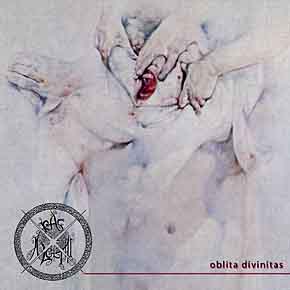
If the architecture of the great Gothic cathedral, with its upward arches, towering spires and cosmic domes laden with images of the suffering divinity on this earthly realm, had been constructed as a kind of sacral road sign to the eternal paradise beyond, then the music of Ras Algethi’s demo is a fitting soundtrack of cathartic expression, a release from the pain and misery of the mortal existence. Like the immortal Oneiricon – The White Hypnotic album to follow, ‘Oblita Divinitas’ relies heavily on the sounds of the mighty organ for it’s intensity as an imposing beacon of death, magnifying the mournful, melodic patterns that guide the listener through the distinct passages of these songs. Where the organ picks up on the general idea of a riff that’s introduced first, the guitars go on to elaborate this phrase in an almost improvisational, though highly restrained, story-telling manner. The bigger picture develops more gradually – far more slowly and funereal than the full-length – and the organs and percussion eventually give way to the austere logic of the main riff, with clever variations that manipulate this momentary freedom from time and space, or blissful acoustic passages that prolong and reflect in it (anticipating ‘When Fire is Father’, one of the most memorable songs on ‘Oneiricon’), before the other instruments return in an emphatic transition, taking the music to an even deeper level of suffering. Ras Algethi show a very mature compositional style from the onset, not just giving a vague sensation of sadness, but carefully detailing the journey with a reference point of possibly going beyond the world that causes it, re-addressing this emotion as a painful longing for release. –ObscuraHessian
Helheim – Walpurgisnatt
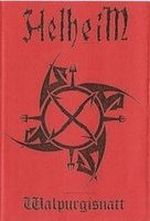 Ghoulish, ethereal and enwrapped in a magnetic tape production reeking of ancient tombs and broken 4-trackers, Helheim’s vision of industrial black metal is far more elemental than the connotations of that description during the last decade. As with the primitivist throbbing drum machines of Mysticum and the ambient blankets of Sort Vokter, the aim is ritual-hypnotic music which does not try to spice up black metal in order to make it more comforting or exciting; instead, it challenges one’s concentration by looping, returning and rewiring little fragments and pieces of riff in powerful early Norwegian black metal language, conducted by the raging screams of the now-deceased vocalist Jon A. Bjerk. The svastika simulacrum depicted on the cover highlights the natural difference with the smoother approach of the other Helheim of the same era, famed mostly for the vagrant mythological epics of “Jormundgand” – this Helheim rather spits in the face of the observed tradition in order to bring forth the subconscious terror of life and death that has been embedded in the mythos of all ancient cultures and bring across a pertinent message to the civilization (macrocosmically) and the black metal of our time (microcosmically). –Devamitra
Alioth – Channeling Unclean Spirits
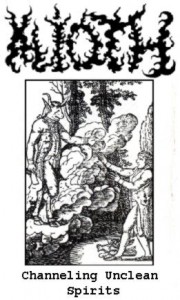 Remember how disappointed you were the last time you heard a new Varathron or Rotting Christ album? If the same lack of consistency and effort permeates other areas of Greek society, them having descended from the mythic glory of Athene into debts and poverty needs hardly the prophetic eye of Cassandra to fully explain. As in Neil Gaiman’s fantasy novel “American Gods” the lost European deities are found prowling the Wisconsin backwoods, Chicago based Alioth’s mystical and sensual tribute to Hellenic black metal ca. 1993 is admirably not only a continuation of the electric technoid dynamo drumbeat and an application of the palm muted speed and doom riffs in esoteric underground context; it’s also a highly logically strung sequence of moods as if the physical organization of pain and pleasure in a Dionysian ritual theatre, succumbing with the heavy held back moments of “The Channeling” and “Apocryphal Dimensions” and rising through the interludial “Invocation” and “Invocation II” to softly expire orgasmic relaxation. So much could be created out of this basic concept that it’s a pity the full-length album has remained cloaked in the depths of the primal sea, while Wargoat Obscurum iterates far less subtle (and far less interesting) metal with Cult of Daath. –Devamitra
Goreaphobia – Morbidious Pathology
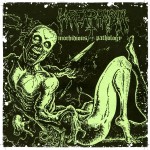 Goreaphobia’s debut album wouldn’t have been quite so eagerly anticipated without a strong back catalogue of minor releases such as the ‘Morbidious Pathology’ demo, which provides an unexpected listening experience if Mortal Repulsion is the only recording you’ve heard from the band. Where the full-length communicates visions from the abyss through the blank eyes of an old mystic locked in a lucid dreaming state, this demo is full of enough youthful energy to express the paranoia of a thousand souls trapped within the claustrophobic confines of their own mortality. Variations in riffs reflect these tightly packed structures, seeming to progress with not so much a linear logic than the re-arranging of parts of the whole, like limbs being removed from a body and sewn on to somewhere else entirely until the true grotesqueness of humanity is revealed. As with Mortal Repulsion, despite the physical connections to Incantation, there is a stronger similarity to the craftsmanship of Immolation and albums that would come in later years, such as the complex and disjointed but melodically evocative Here in After. The lead guitar work, though highly restrained, possesses a sense of neoclassical refinement that bridges some short-burst riffage with eloquent but totally disturbing solos. This demo shows the beginnings of an all too rare experiment in Death Metal where you can observe the maturation of a consistant idea as it goes through the turmoil of a tortured, temporal existence. –ObscuraHessian
Graveland – Drunemeton
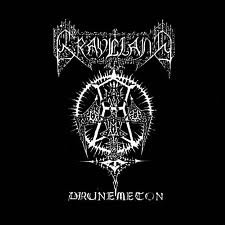 It’s not difficult to understand the distaste that Darken has for the recordings commited to tape during Graveland’s infancy in the light of his recent catalogue of pristine, epic and Atlantaean creations. Some distance away from the expansive scenes of battlefields and expressions of Romantic nationalism, this ancient offering from the living master of Pagan Black Metal is totally shrouded in a necrotic production, like ghostly shadows moving through oaken forests, casting a spell within more cloistered and Druidic surroundings than the output of Graveland from the past 15 years. Alongside the visions that created the force of Scandinavian Black Metal in the early 90′s, this demo represents the reclusive and misanthropic esotericism of that era, especially the primality of the lowest fidelity cults, Beherit and Ildjarn. Sounding like the work of a punk ostracised by that increasingly over-socialised group for being too idealistic and inhuman, Darken conjures a lurid interpretation of hypnotic Bathorean riffing that develops through the echoing of majestic, synthesised voices that open this recording as though a prologue to ‘The Celtic Winter’. The experimentation with primitivism in ‘Drunemeton’ is so deconstructionist that the guitar technique becomes fragmented completely and subordinated to reveal gloomy ambient moods that amplify the silence of a forest at night before the dawn of battle. There’s a similarity to the Beherit song ‘Nuclear Girl’ in how the guitar is used more like a sample, reverberating it’s texture through the keyboards to emphasise a cloistered sensation, accompanied by monastic chants at other times. Culminating in the ambient classic, ‘The Forest of Nemeton’, this demo is the successful beginnings of Graveland’s exploration into unconventional and nihilistic territory beneath the folky phrasing of guitar-led melodic work, which would shape the dynamic of his entire discography to follow. –ObscuraHessian
Tsjuder – Ved Ferdens Ende
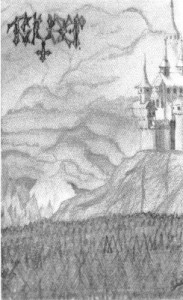 Fifteen years ago, we were too proud and lofty to listen to it, our sensory devices soothed and inflamed by Panzerfaust, Battles in the North and Høstmørke, while the new generation of neo-progressive and mainstream black metal bands sought to enrapture even wider audiences with movie soundtrack influenced keyboards and angelic female voice conjured by fat-bottomed gothic tarts. For the atmospheric maniacs only, as it’s hard to argue for its musicality against the likes of Vikingligr Veldi; but the epic wanderlust and distorted pagan death ritual of this demo’s centerpiece, “Fimbulwinter”, unfolding like a flower at dawn or the psychedelic mandala of LSD invading brain receptors, is one of the pure innocent and mesmerizing gems of underground black metal in this sacred and forsaken era. The primal Isvind-esque melody dance like ripples of waves on a forest pond, the hissing tracker production complete with the macabre clack of a drum machine and the dampness of a Nordic bedroom cellar permeate the recording to such a thickness of adolescent black metal fury that it’s hardly palatable to generic audiences then and now. Barely a trace of the fast norsecore of the more familiar debut album Kill For Satan is noticeable here, the only similarity being the guitarist Draugluin’s technique of bricklike tremolo chord architecture where rhythm plays little importance. While primitive, this compositional method bears an intrinsic beauty which is worthy of recapitulation when the pure augustness of early Norwegian black metal has mostly become forgotten in favour of seemingly more rich and elaborate indie stylings. –Devamitra
Tags: alioth, Ambient, Black Metal, death metal, demos, Doom Metal, Funeral Doom Metal, goreaphobia, graveland, helheim, Industrial Black Metal, Norwegian Black Metal, Polish Black Metal, ras algethi, tsjuder, zine-reviews

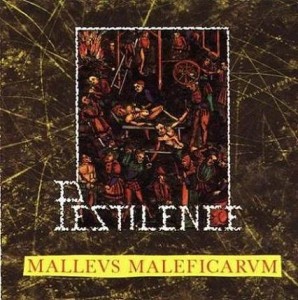
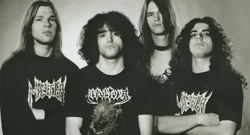 Summoned forth to rage fury upon the unsuspecting but no less innocent, Pestilence, on each of their first three albums ushered in a predestined Apocalypse of the mind and struck at the heart of the dark forces of the Kali Yuga thus completing their microcosmic responsibility as “Kalki”, and providing the foundation upon which a new golden age and conciousness would hopefully arise. On their uncompromising and frenetic debut album, Malleus Maleficarum, Pestilence as corporeal manifestation of death and conqueror, harnessed the power of becoming to destroy the destroyer that is illusion and ignorance, and defiantly placed themselves within the torrential stream of becoming in a quest for truth. We as listeners are thus treated with no less than a passionate and structurally free form album that through its fluid, intelligent and precise use of riff craft probes and attacks on multiple fronts the lyrical themes tactfully explored by Van Drunen and Co.
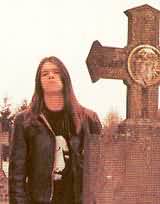 Although one may be quick to argue that that the addition of socially conscious lyrical subject matter such as genetic manipulation and religious strife defines Malleus Maleficarum as a strict Speed Metal album, it is nonetheless better characterized as a highly refined and progressive speed metal album that straddles the death metal fence. Indeed, indicative of their speed metal roots is the common use of hysterical and staccato driven guitar technique reminiscent of bands such as Exodus, Destruction and Slayer that, coupled with an emerging yet competent sense of dynamics, melody, development and recapitulation of themes, successfully places “Malleus Maleficarum” outside the realm of pure Speed Metal and onto a pedestal of its own thereby providing the impetus for not a few debates regarding the essential nature of this album. Not to be missed of course is the embryonic vocal performance of Van Drunen, who while courageously exploring the memes that have driven modern society into calling forth the forces of plague and death to precipitate the end of this current cycle of humanity, opts for a hoarse rasp like yell in contrast to the later visceral death metal growl he is better known for.