

With the advent of another grim Autumn, half of the world retreats into glowing boxes of warmth and comfort to preserve the sickly and feverish Summertime langour. In a time where the seasonal rituals of harvest survives only as a novelty for urbanites and other moderns, for the sinister few, this is the season to step out into the growing shade of night and harvest the souls of the damned for they will be reborn into a new, unholy dawn. Such apocalyptic ends have necessitated a gathering of gargantuan proportions and could not be more appropriately named as the third ‘Black Mass Festival‘ in Helsinki later this week. Nefarious and astralic cults known to Hessians the world over, like Necros Christos, Sadistic Intent, Cruciamentum, Neutron Hammer, Lie in Ruins, and Death Metal legends, Demigod will be devastating the city and delivering winter even earlier than the Arctic already experiences it. Among such legions and Deathmetal.Org personnel in devout attendance will be London-based Death Metal occultists, Grave Miasma, making a similar journey to myself, but before our paths would re-intersect on the shamanic land of ancient Suomi, I posed a few questions to their guitarist and vocalist, the acronymious Heruka C.C.O.T.N., who seeks to re-ignite the dying embers of Death fucking Metal’s true fucking spirit on the very soil of the wider genre‘s birth.
ObscuraHessian: The change from Goat Molestör to Grave Miasma seems to have been a real metamorphosis, as the former atmospheres of graveyard desecration are, on ‘Exalted Emanation’ imbued with a deeper sense of occultism and morbid mysticism. What was going through the mind of the band during this transitional time?
C.C.O.T.N.: Quite simply, the band evolved without the necessity for conscious thoughts mapping a direction for this metamorphosis. There was a lengthy period of exchanging ideas and writing material following the ‘Realm of Evoked Doom’ recording sessions. I would say that this enabled us to define the Grave Miasma sound, with the name change not being an important contributing factor.
ObscuraHessian: Interest in more archaic forms of Death Metal is growing all around the world, as if returning to first principles and rediscovering our primordial selves. Consequently, as evidenced in your EP, the music is becoming esoteric like it used to be, wrapping dark and cosmic imagery in death-worshipping ‘theological’ statements. How important is esotericism in such a style and scene as Death Metal? Is it just a ‘thematic choice’ or something more?
C.C.O.T.N.: Esotericism is the driving force behind Death Metal. Many bands attempted, and unfortunately succeeded, to reduce the genre to a brainless parody. For Grave Miasma, riffs and rhythms are not just music for the sake of existence, but the key to unlock inner mysteries of the subconscious and beyond. Only the contents of bands’ recordings can separate those who utilise such imagery for thematic choice from the genuine.
ObscuraHessian: You invoke everything from Vedic, Greek and Egyptian deities to Qabbalistic designations in this suffocating EP. Why do you connect these symbols, like building a temple filled with antique curiosities to stand before the Abyss?
C.C.O.T.N.: Whilst not professing to have any cultural link with the Vedic, Greek and Egyptian deities alluded to, studying the esoteric traditions through the ages, it is clear that there is a principle of unwritten transference of intrinsic principles between epochs. For instance, one can find similarities between some of Crowley’s thoughts and doctrines of certain Mesoamerican shamanic cults. Through making and meditating upon such connections, one can discover only a fraction of the eternal laws of this universe.
ObscuraHessian: There’s a lot of sounds from ‘Joined in Darkness‘-era Demoncy that surface in the music of ‘Exalted Emanation’, which adds a Black Metal flavour to it. Is this a favourite album of the band or are you more into Death Metal? Who would you say are your biggest musical influences?
C.C.O.T.N.: A highly astute elicitation, as ‘Joined in Darkness’ was perhaps the most instrumental album in spearheading the Black/Death ‘revival’ of last decade. It was and is a major staple in the listening habits of all four members. Concerning musical influences, our earlier era was characterised by inspiration confined to Death and Black Metal. As the band and our selves developed, we draw from the source of many wells. I would go as far as saying that elements found in Ambient/Cosmic and Near-Eastern music are of greater importance than Metal when it comes to obtaining conscious insight and ideas.
ObscuraHessian: How strong is the Death Metal scene in the south of England, right now? Are there many other bands have you listened to or played alongside with the potential to crush the skulls of mortals?
C.C.O.T.N.: There are very few bands in the UK generally who play Death Metal with the old coffin spirit. Whilst completely detached from Death Metal, one newer band I worship are The Wounded Kings.
ObscuraHessian: London is an interesting city, with a lengthy and diverse history represented by ancient Mithraic temples, Medieval Christian architecture and modernist hubs of rabid consumerism. How does living in this capital play a part in your music, if at all? How does life here compliment or conflict with an existence aligned with occult knowledge?
C.C.O.T.N.: To draw inspiration from my surroundings, I go out of London – often far indeed. Man is attuned with his surroundings, and living in this city is not congruent with the contemplation needed to collate this stimulation. I do find desolate urban areas during the dead of night to exude such sinister ambience, however. Whilst there are locations of Occult interest in the capital, other provinces of England are more relevant whether in regards to tangible brooding atmospheres or unseen power currents.
ObscuraHessian: Are there plans for an album as yet? Having released ‘Exalted Emanation’ last year, what is the vision for the future of Grave Miasma?
C.C.O.T.N.: The next step will be a full length album. We are not a band who place deadlines upon ourselves, as creativity often has no limits and needs time to bear fruit. Should the forthcoming material not meet the ‘standard’ of ‘Exalted Emanation’, then it is most likely we will cease to exist as a band.
Hail to C.C.O.T.N. and Grave Miasma for answering these questions and contaminating this urban wasteland with their noxious, cemetary fumes. The ‘Exalted Emanation’ EP and re-release of ‘Realm of Evoked Doom’ MCD can be obtained directly through the band or Nuclear Winter Records.
Filed under: Death Metal Interviews — Tags: Black Metal, Black/Death, British Death Metal, Death Metal, Occultism, Sumerian Music, US Black Metal — ObscuraHessian @ September 29, 2010 23:48 — Comments (4)
As death approaches, documentation increases. As a circle closes, individuals are given an oppurtunity to reflect on, track and document the meandering course that a society, individual or movement took and assess and re-evaluate this course to determine both its moments of strength and those of weakness. One consequence of this tracking and documentation is that the diligent and astute student of life is provided with an opportunity to discover those behavioural patterns that have been forged in the fires of history and are therefore conducive to success. The intelligent will reflect upon these lessons and apply them to their own worldview, life, ideology or movement and increase the quality, although not necessarily quantity of those lives. Therefore, we serious Hessians take the outpouring of heavy metal documentation rather serious, as it contains for the discerning, the lessons upon which the ideological, and perhaps spiritual foundation of a new spring, a new dawn and a new beginning for our culture may rest.
Heavy metal documentation has progressively reached new heights in this age of mass media as rabid fans, bands, and sociologists alike are taking it upon themselves to exploit available media outlets in order to document the rise and fall of extreme metal, an alienated cultural phenomenon, that unsurprisingly late is being treated with respect outside of the insular metal community. Along with the ideological documentation of Black Metal in the excellent documentary, Until the Light Takes Us, and the chronological presentation and thus preservation of the history of Swedish Death Metal in Daniel Ekeroth’s book of the same name, Hessians world wide are now being treated to an outpouring of band and album documentation in the form of DVD’s and texts exclusively dealing with important bands such as Asphyx and At the Gates, and seminal albums such as Reign in Blood.
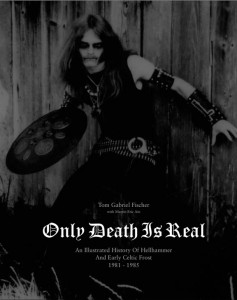
To date, “Only Death is Real” by Tom Gabriel Fischer represents the apex of extreme metal texts. Appropriately prefaced, most notably by Darkthrone’s Nocturno Culto, this near-perfectly laid out, hardcover text book, is full of historical relevance for the aspiring and established Hessian and includes a bounty of interesting photos that shed light on the enigmatic and sometimes adolescently awkward manifestations of both Hellhammer and early Celtic Frost. The strategically arranged photos, intriguing and aptly chosen, are unsurprisingly monochromatic, and this combined with the enclosed paper quality, reveals a sense of aesthetic class and attention to detail becoming of the fastidious and perhaps benevolently pedantic, eccentric and inspiring personality of the authour. Additionally, the book contains a plethora of interviews with previous members of Hellhammer and Celtic Frost, which at various junctures provide strange as well as enlightening anecdotes that augment the history of the band(s), and provide an otherwise unattainable depth to Fischer’s account. Given this, it seems somewhat surprising that this history reads as well as it does, as Fischer’s narrative, although periodically interrupted to include these interviews, remains clear.
As for the historical documentation itself, “Only Death is Real” retains a genuinely human tone that while undeniably revelatory does not diminish the mystical aura that surrounds both Hellhammer and Celtic Frost. In fact, throughout the text one senses an undeniable theme of mythic struggle as Fischer recounts the vast amount of turmoil, characteristically determined by some unforeseen variable, which plagued the establishment and development of both Hellhammer and Celtic Frost. We read with growing interest as the seeming omnipotent forces of dissolution strive to subdue and shackle the steely will of Fischer and his desire to create. Perhaps slightly melodramatic, the testaments of Fischer and others remain inspiring in the face of what Hellhammer and Celtic Frost would undoubtedly accomplish.
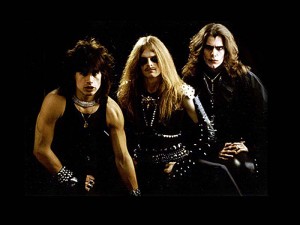
“Only Death is Real” is consequently rich in history and provides a level of historical depth perhaps unmatched in extreme metal literature. Developing chronologically from an account of Fischer’s childhood and his musical inspirations, to the establishment of his first band Grave Hill and beyond, readers are also provided with enlightening expositions on a variety of pertinent subjects. Such subjects include but are not limited to, the realities of Hessian life in Switzerland during the early 80’s, the meaning and inspiration for the name Celtic Frost and the conceptual considerations that went into the development of the band, Fischer and Eric Ain’s relationship with the works of H.R. Giger, and the critical and undeniable influence of Martin Eric Ain in the development and maturation of Hellhammer and Celtic Frost.
Fans are also provided with a chronologically precise account of the sometimes dizzying array of Hellhammer and early Celtic Frost releases, including exact track listings, facsimile demo and EP sleeves, the intriguing history surrounding the development of each release, and verbatim and oft-times hilariously slanderous copies of reviews of these releases. Obsessive fans can also rejoice as Fischer has included a complete visual account of the evolution of both the Celtic Frost and Helllhammer moniker, including copies of hand drawn rejections completed by band members themselves.
Overall, this history proves itself essential reading for anyone who takes extreme metal seriously. Fans can rejoice as we are provided with a comprehensive history of two bands that became cornerstones in the development of extreme metal. Any Hessian neophyte would do well to take this text seriously as it provides a great introduction to the personalities and music of a band whose clarity of vision, will and capacity to inspire, has left an indelible mark on countless bands and individuals. Perhaps now, in the midst of what appears to be a bourgeoning extreme metal renaissance, fans and musicians would do well to look back, find inspiration in, and relentlessly devour the lessons of our forefathers. In so doing we may overcome the progressive deterioration of extreme metal, usher in a new epoch and raise the flag of Hessiandom to new and unparalleled heights.
Filed under: Death Metal Book Reviews — Tags: Black Metal, Death, History, Literature, Speed Metal, Swiss Metal — TheWaters @ September 28, 2010 21:17 — Comments (1)

How likely is it for a town of less than 20,000 inhabitants to deliver powerhouses of Death Metal simultaneously in Demigod and Adramelech, only Beelzebuth knows, probability about equal to an asteroid hit upon New York. While Demigod’s fractured melody and driving aggression recalled Swedish Sunlight productions but with the distinct morbid woodland funeral edge of Finnish forgotten death cults anno 1991, Adramelech was sub-technical, incisive, almost dryly surgical in a foreboding riff nightmare of chugging and delving passages akin to an excavator attacking the entrance of a pharaonic burial chamber. The debut “Psychostasia” was already nearly worthy of Demilich, setting the tone for the Rantanen brothers’ mythological and grotesque existential vision which eschewed the more concrete material of gore, suffering and serial killers in favor of archaic symbolism and ancient magical rites, at moments treating its sources uncannily similar to Nile‘s famous egyptological sagas. And like war history in Bolt Thrower‘s repertoire, devaluing and haphazard glorification is scorned as the nearly computerized and emotionally mummified roboto-riff mimics the pattern language of bestial nature, witnessing both the conflicts of gods and men as compulsory synthetic events of opposite principles necessary to fuel an abstract path through the aeons, throughout the universe, man aiming towards the vastness of space yet only descending into the depths of his subconscious mortality.
The frightening, deadset rigidity of “Pure Blood Doom” recalls the relentless, suffocating instruction of ancient Egyptian priests in passage through the demonic gates of the Afterlife, where only the perfect incantation and the straightest line will suffice to evade the Second Death. While simplifying Death Metal is hardly in the agenda of these musicians par excellence, it’s hard to find a more logically functional composition than their “Lord of the Red Land”, which grooves as effortlessly as anything from Carcass’ “Necroticism” dragging its wicked hooks in the skin of the leprous repentant, and alongside “Evercursed” and “The Book of the Black Earth” forms probably the most evil triple-punch of Finnish Death Metal history. Dreamy solos and rather relaxed drumming by Jarkko Rantanen alike to a much more chill Steve Asheim form a perfectly understated counterpart to the ambitious and cool melody lines and the hoarse, powerful but non-drama voice of Ali Leiniö. The fate of such brutal artistry is to be forgotten into the mists of time for the masses wish their metals to conform into aesthetics utilitarian for the current mode of “entertaining slavery” practice.
Filed under: Death Metal Album of the Week — Tags: Death Metal, Finnish Death Metal, Mythology, Occult, Progressive Death Metal — Devamitra @ September 22, 2010 23:46 — Comments (2)

“For our God is a consuming fire” – Hebrews 12:29
Although North America and Scandinavia are primarily regarded as the two great bastions of extreme metal, Germany herself has birthed not a few great extreme metal acts including Blood, Ungod, Nox Intempesta, and Atrocity. Continuing this tradition and formed in 1991, Fleshcrawl have been releasing quality albums for nearly 20 years, illustrating their profound understanding of the art of death metal by releasing evocative records that effectively string together various motifs, developed primarily through the fluid use of power chords, in order to create an expressive language that eschews novelty in favour of lucidity.
Enter one of 1996′s great releases, “Bloodsoul”, an album that stands out as a recklessly orthodox and violent album at a time when extreme metal was descending into either maudlin and effeminate Black Metal or streamlined and diluted Death Metal. The album opens with two light cymbal touches, effectively evoking the ominous impression that something is looming, a state or reality that with the first crash of the album can no longer be ignored. The momentum built by such an inspiring introduction never wanes and each battle cry on “Bloodsoul”, augmented by an apt approximation of the infamous “Sunlight Studio Production”, is characterized by a youthful vigor and an atmosphere of power and aggression that remains one of the fundamental hallmarks of a great Death Metal record. Employing familiar lyrical themes, Fleshcrawl also utilize an ambiguously familiar sense of melody that far from simply emotive becomes the function of a larger and more profound vision of life, adding a level of depth and texture to the musical experience. With that said, “Bloodsoul” is a superlative example of cyclical composition as each phrase ends, and “paradoxically” begins, on a cadence that acts as the primordial embers from whence a new impetus for struggle, power and self overcoming is born – the spectacle of life begins anew. The second half of each track generally recapitulates exactly the first half, leading one to contemplate whether Fleshcrawl had simply run out of the creative vision necessary to create a full song, however given the already microcosmic structure of each track it would seem likely that these seasoned death metal veterans applied the same logic to their macrocosmic structure in order to present a wholly unified attack. The application of such logic leads to an ever interesting study in the cyclical nature of time and reminds this listener of the Nietzschean concept of the eternal recurrence. Refreshingly, there is no fatalism on this record, but rather a heroic, inspiring and clear sighted vision of reality, a willingness to struggle anew and give meaning to life.
Furthermore, each instrument while played with surgically tactful precision remains refreshingly restrained – working in complimentary synchronicity, executing and augmenting the vision of each song at appropriate junctures to create an all encompassing experience where listeners can contemplate, among other things, the final inevitability of our existence and any concomitant realization. There is little in the way of “flash” on this album but there does exists a depth and “heaviness” in so far as Fleshcrawl are able take concepts that have hitherto remained esoteric, perhaps slightly metaphysical and taboo and explore them – using a language that for the undiscerning may seem rather cryptic.
See – Open your Eyes – Take a look back
Find truth in the past.
Your mind, gliding through time
reminds you of signs, once seen, but defied.
Trapped, by paranoid dreams
World inside the skull, whatever that means
Lies, Built Upon rules, reject and refuse
Deny and Abuse
The paradox of life, preserve and destroy
Heal the scars of the past
Disappear into the Void

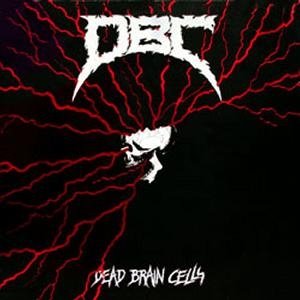
The Canadian province of Québec seems to be situated upon some geographically freakish turf that exudes such a phenomenal electromagnetism as to twist and convolute whatever waveforms happen to waft into its borders. Psuedoscientific petrology aside, Dead Brain Cells are one such Canadian faction that reinterpreted the equatorial American sounds of skatethrash and reassembled its raw energy into a hyperborean bizzarerie, with an ambition in expressing the absurd crises symptomatic of a classically Huxleyan, oblivious society lured into the grip of an Orwellian tyranny by the mesmeric attractions of self-pleasure.
Taking aesthetic inspiration from the cruelly intelligent, modern firearms cacophony of Slayer’s ‘Chemical Warfare’ but fashioning riffs over the roguish, bursting structures typified by crossover acts Suicidal Tendencies and Corrosion of Conformity, Dead Brain Cells had paradoxically succeeded in applying scientific methods to truculent vandalism. Vocals, in compliment to the factorial churn and tumble of the instruments, are delivered in a robotic rant like the outcries of a citizen-turned-automaton denigrated by a lifetime of vacuous routine; lyrics are remarkably coherent and incisive considering the
band’s Québécois nationality, of course with the mother tongue of French being a perennial obstacle for all aspiring Hessians allied under the fleur-de-lis. However, it is clear from DBC’s rather involved compositional style that their telos was not merely in writing protest music, but in establishing engaging, punkishly dynamic narratives such that every song is represented as its own vignette of dystopia — a sensibility that would be incorporated into the region’s burgeoning death metal movement, with vestiges apparent in such seminal works as ‘Considered Dead‘ and ‘From This Day Forward‘.
This eponymous debut remains one of the exceptional examples of quality crossover thrash from outside of the U.S.A. and England; it’s also required listening for any avid scholars of Canadian death metal, in order to better understand the music’s gestation from heavy, quirky progressive rock to complex and sublimely dissonant killing noise.
A planet defaced with death and decay
An atmosphere of hate
Cities destroyed
Their meanings forgotten
And fertile lands lay waste
A planet once prosperous
Its future looked bright
But an immature race had evolved
Given time and the knowledge
They soon could destroy
The planet on which they revolved
Not one life would be spared
It wouldn’t happen again
Because there is no second chance
It certainly feels as if quite a few cosmic epochs have passed since we’ve last discussed the Floridian aerospace-institution Nocturnus on this cybernetic outpost, but our keenest veterans will recall that their release ‘Thresholds‘ was treated with some degree of distaste. Rummaging back further within the dustier recesses of this band’s time-capsule, though, brings to light their much more praise-worthy debut ‘The Key’– the first successful gene-spliced hybrid of both the primitive occultist and advanced technocratic schools, built upon the ridiculous yet resoundingly Death Metal concept of a cyborg assassin sent back in time to terminate the infant Christ.
Much of ‘The Key”s infamy is derived from its employment of a keyboardist: though the presence of synthesizers hardly tweaks the brow of any Hessian today, the prominent molestation of ivory on a death metal record was a controversial innovation at the time of this release. Louis Panzer’s synthwork, however, adds a vital strain of harmonic depth to t
hese compositions, invoking phosphorescent starscapes and futurisms similar to the ambient pieces contributed by Vangelis for the film Blade Runner. The riffs themselves charge forward in their characteristically Floridian, caustic angularity, imparting a sense of frantic acceleration as of a spacecraft disintegrating into flames as it reenters a gravitational atmosphere. Still other riffs, though, express an exhilarating air of interstellar surveyance, briefly veering away from ripping brutality into the more progressive territory of science-minded speed metal in the line of Watchtower or, more explicitly, Agent Steel. It is unfortunate that this is the only Nocturnus full-length to feature Morbid Angel alumnus Mike Browning as drummer/vocalist, as his distortedly monotone snarl lends a compelling voice to the pernicious droid that presumably narrates this album; ironic, then, that he would soon give up the role of vocals to a full-time frontman who showed little talent for subtleties of characterization.
Most probably due to the polarizing effects of its synth-sodomy, ‘The Key’ tends to not be mentioned in the same breath as the usual fixtures in the classic canon of FLDM. Nonetheless, the album perdures not only for its historical incorporation of techno-astronomical imagery in death metal, but for the NASA-grade engineering ambitiously applied to its multiplexed intricacies of craft.
Filed under: Death Metal Album of the Week — Tags: Cosmos, Florida Death Metal, Science — Thanatotron @ September 6, 2010 06:06 — Comments (2)

For the true disciples of our thanatical religion, Gothenburg exists in the shadow of Stockholm as a spirtual centre for Death Metal; the latter being associated with the nobley barbaric masterpieces of Dismember, Therion, Necrophobic and their Sunlight Studio-powered comrades, while on the opposite coast, the city of Göteborg managed to establish itself as a breeding ground for faggots, feminists and pop musicians to collaborate on what has become one of the most abhorrent and effete styles of the genre. By eliminating the primal sensory and cerebral patterns by which Death Metal defines itself in order to communicate horror-tinged revelations through dead eyes, the Melodic Death Metal sound of Gothenburg relies on a few aesthetic reminders to bestow the illusion of being musically relevant, while remaining based entirely on the harmonic and rhythmic interplay of Iron Maiden, serving as the melodic ‘antitode’ to the chaos of Death Metal, or rather, a cheap excuse not to engage with it and instead delude the mind with pleasant riffs of insignificance that form the basis of roadkill which the most recent incarnations of this style along with metalcore and other forms of rock music that can trace their influences back to early 90′s Sweden all resemble.
Prior to this great epidemic of weakness that has not since ceased, the power of harmony in Death Metal music was becoming integral to the compositional framework of important bands, adding to a melodic lexicon established by the disharmonic experiments of Slayer, Morbid Angel and even Darkthrone albums, moving from traditional riffing to an almost contrapuntal sense of melodic tremelo style in ‘Soulside Journey‘. Atheist’s apex of fusion music, ‘Unquestionable Presence‘, handled Jazz harmony competently within Death Metal epics and back in Gothenburg, At The Gates were synthesising Atheist’s complexity with what began in Stockholm as Dismember and Unanimated‘s more Classically-aware debuts. This incessant emphasis on melodic development would see Finnish neighbours Sentenced refining the use of harmony with their ‘North From Here‘ album that rendered Iron Maiden technically obsolete, and following in Taneli Jarva and co.’s footsteps came Dark Tranquility, representing perhaps the last great height of this scene before Melodic Death Metal subsequently descended towards the cheap and childish music it became. That’s not to say ‘Skydancer’ didn’t verge on the edge of wimpish territory, as this album alongside At The Gates’ ‘With Fear I Kiss the Burning Darkness‘ could probably be described as the Phyrrhic victories of Melodeath (mellow Death), opening the therapist’s door to concepts like ‘hurt’, ‘loneliness’ and a general sense of agnostic and angst-ridden confusion. Nevertheless, what we’re dealing with in an album like ‘Skydancer’ extends far beyond the broken human spirit, reaching into both the depths of the cosmos and the self to find the same, ultimate source of power.
Where At The Gates’ seminal masterpiece, ‘The Red in the Sky is Ours’ was an autonomous quest for spiritual awareness from out of the ruins of Christianity, painted in all it’s pain, struggle and disharmony, Dark Tranquility’s ambitious sophomore effort exalts the harmony of nature as the goal of union for the human soul, the spiritual imperative of a ‘Skydancer’. The album is built around this ideal in relation to the darkness of modern reality that makes the beauty of the natural world seem like it only exists in a fantasy, and the experiments with harmony and counterpoint represent the voices of the real and ideal in a kick-drum punctuated dialogue. The highly courageous ‘Shadow Duet‘ takes this even further, using two vocal personifications of this theme to battle out in an aggressive, almost Grecian discourse. The riffing style, drawing equally from Scandinavian folk motifs and Baroque melodic interplay is reminiscent of the Romantic composers’ desire to create a holistic music that united the earthy folk tradition with the transcendental heights of Classical music. In the same way that Varg took Paganism away from the neo-Pagans and revealed the underlying Essence of what is usually otherwise depicted as a quaint and obsolete mythology of demigods, the mystical Paganism of Niklas Sundin is totally panentheistic in nature, where transcendence equals the ‘communion with the Oversoul of the universe’. The weak link lyrically, is Mikael Stanne who lacks this dimension, although his nationalistic references add another Romantic flavour to the album. Another In Flames member, Anders Friden, provides the vocal work, which sounds quite drunken and doesn’t meet the demanding lyrical placements within the songs. The yearning in the voice of a Tomas Lindberg is totally absent where the lighter, but still highly emotional melodic guitar work not distorted by discordant riffs would have complimented it very well. On a similar vocal note, the addition of clean vocals (the male singer is very bad) were totally unnecessary but it seems like even at this stage in their career, the band needs to make certain thematic elements and contrasts unbearably obvious, which is why a discriminating listener will stick to this album and not bother with the subsequent exhibitions. Bassist Henriksson draws no such complaints, accompanying the guitarwork to provide a deeper foundation for the melodic development, as expressive as the two other guitarists, adapting the sound to slower, heavier or tremelo riffing.
‘Skydancer’ is often the subject of complaints for it’s relentless flux of melody like an amphetamine-influenced violin concerto but this is not an unfocused, Liers in Wait experiment in seeking the limits of riffcraft. The compressed but pregnant structures bring the listener to focus on the narrative of the melodies and truly experience the restlessness of this spiritual life, rather than just passively drool at the ear-pleasing harmonies and other musical sensations as the success of Melodic Death Metal would later rely on. Hail to this once great band, so full of youthful ambition to widen the musical palette of Death Metal without resorting to cheap gimmicks but exploring the polar opposite of colour and texture in order to see the beauty of the cosmos through the symbiotic language of the Divine.
My yearning to be part
of nature’s truthful solitude
Of wisdom’s inner light
that shines in mystic multitude
The guiding source within,
so few of us will ever know
And few will ever climb
the great world-tree from which we’ve grown
But those who seek will find
the rhythm that vibrates high and far
And rearrange the cosmic threads,
the pattern of the Weave of Stars