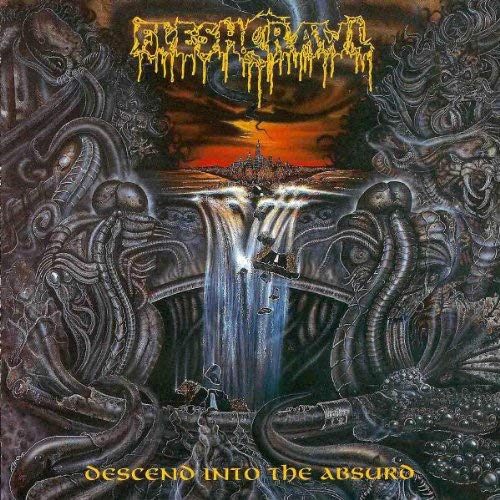
When one hears the name Fleshcrawl, the first thing that comes to mind is the legendary Autopsy song from Mental Funeral, yet a very peculiar German band carries that name. Descend Into the Absurd marks their highest peak musically and rightfully so. Taking more from the fully formed European style of the time that was influenced by Autopsy than Autopsy themselves. Combining Doom dirges that exude morbidity and flowing pensive phrasal riffs, Fleshcrawl create a forgotten classic and an important addition to Death metal. (more…)
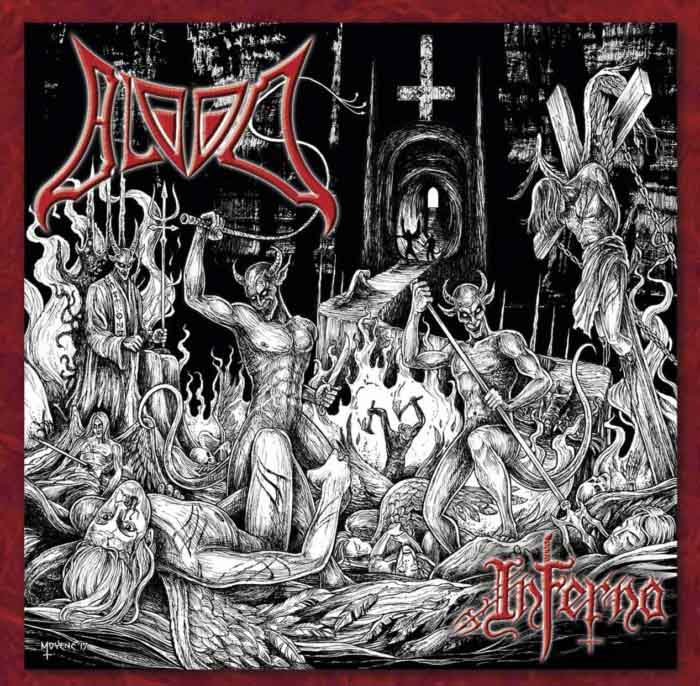
Continuing the path of a storied band, Inferno mixes re-recorded versions of older tracks with new material in what seems to be a band redefining itself. Blood started as a grindcore band with more of a death metal attitude, then adopted an outlook closer to black metal for its opus O Agios Pethane, but since then has struggled by being caught in the middle of three genres.
Following up on Vic Records’ reissue of Christbait a couple months ago, Dunkelheit Produktionen from Germany is preparing a reissue of that album’s followup. O Agios Pethane also got a good review from the Dark Legions Archives at some point in the past and is presumably a worthy continuation of the band’s career in a similar style. The album is currently available for preorder from Dunkelheit’s online store and will be officially available on March 20th, 2016. Like its predecesssor, it should serve as a historic example of well written grindcore/death metal, although any band seeking to draw inspiration from it may need to also pull from other sources in order to produce something valuable.
Once again the streams of ancient songcraft from the kantele of Finnish past extended their freezing grasp across the ages to bring death-skalds from around the world to gather in a morbid mass of heavy sound at Dante’s Highlight, Helsinki, on the wake of the massively successful event one year ago headlined by the supreme warmongersBlasphemy and Revenge. As if gripped by demiurgish megalomania the organizers deemed that two days of black/death hybrids and Blasphemy clones are not enough, this time the event spanned three nights of violence, bloodshed and alcohol while the weak were trampled upon the mossy floor of the woodlands.
Unbending intent
The gates of Dante’s church opened wide for the worshipers to enter in the middle of the busy workweek of the middle class, but true to the ethos of Death Metal, it didn’t stop the venue from being filled to the brim with headbangers ’til the late AM hours. The attendance of underground gigs in Finland, especially near the capital area, has steadily grown from the meager cult of the 90′s and this contributes to the possibility of gig organizers to summon up massive events the likes of which are unknown probably everywhere else but Germany and USA. By all criteria, three nights of underground death metal mostly in a similar sub-style is an overdose but we couldn’t help but step up to the challenge. Even though the day already had included work, exercise and painting, I dragged my sorry ass up to the venue to get brutalized by the sounds of the foreign bands who deemed to come across the seas to herald the apocalyptic messages of old school Death Metal once again.
Vorum and Neutron Hammer from Finland are decent bands, but I didn’t care enough to try fitting their ritual into the schedule since plenty of chances to observe them await the locals. While traveling through the nocturnal cityspace, which always seems to bring forward a more grey, industrial, overcast threat when Metal is imminent, I inadvertently also lost the chance to see UK’s Craven Idol, reputedly a doomy, crisp and unpretentious massacre. I did get to see Diocletian‘s more old school incarnation Witchrist though, who spent about an hour conjuring a tempo-flipping contrast between Doom and Grind much like the forte of Finnish cult classic Rippikoulu, except lacking for one thing: intricate melody. Without it, the maiming down tuned web of chords seemed like a mockery of the modern war metal ethos with its Black Witchery spawned “street credible” ghetto hoodie “evilness”; lacking a dimension where essential things are said. Tough without purpose, the heartless spawn of urban netherworlds.
The wait for the main band of the evening, for this reviewer the main band of the entire festival, was torturously long since the Californians Sadistic Intent had but just arrived on their star-crossed flight and carefully proceeded with their soundcheck, as if carefully honing their weapons for the one and only decisive battle. At this point the atmosphere at the venue was expectant but relaxed, much less strung than the hysterical chaos that gripped even the most balanced partygoer in the insanity of 2009. When the sadists got their shit together, there was no evading the invincible force of Death Metal roaring from the stage. Sadistic Intent, who never released a full-length album in their career, had nevertheless realized the essence of Death Metal better than all those blackened bands of the 2000′s who were too caught up in “necro” manifestations of ghastly pallor; this band breathed energy, blasted away as if it was the world’s final hour. One of the central pillars of Sadistic Intent’s dark symphony was the sharply dynamic percussion work of Emilio Marquez, though we must not forget the clarity and precision of Rick Cortez’ and Ernesto Bueno’s dueling guitars. Through this band, the young audience glimpsed a mighty vision of the history of 80′s underground metal, with all its sensible and senseless implications – to me, it meant much more than the routine Morbid Angel gig in this land two years ago. –Devamitra-
This sound is no Nirvana
When arriving at Dante’s, I couldn’t help but feeling this visitation was to only a regular festival in the Finnish capital, for so strongly the walls of the old church emitted still the atmosphere of madness from the Blasphemy live ritual a year ago. That being said, it was time to commence the forthcoming aural hammerings. I didn’t see the beginning act, Stench of Decay, due to overlap in my tactical schedule. Them being a domestic act, I presume many more chances of seeing them in the future. Maveth didn’t ring any bells before the festival, and being the quick replacement for perhaps my most anticipated act personally, Cauldron Black Ram, I felt somewhat disappointed and in the end, Maveth doesn’t ring any even now after the whole event! Next up was Grave Miasma, who delivered their material as well as they could, I believe. Their precise playing and overall presence pretty much reflected the visions I have had from their “Exalted Emanation” EP. Even the sounds of the venue, in some odd way, seemed to back up their aural pathworking in the catacombs of darkness.
The muddy sound seemed to haunt all the bands during the three nights and not everyone profited from its nature. Mainly the rhythm and tempo of the bands seemed to dictate the clarity and catchiness of the acts, if one was without better acquaintance of the material being performed. This facet of reality added a huge positive impact into Hooded Menace‘s first live appearance, for their slower, blind-dead-worshiping, doomy metal profited from the overall muddiness of the sound, and structure-wise, concerning the night’s band line-up, their gig acted as a very functional breathing space between the other, more faster majority of bands, while Karnarium played their Swedish death metal of which I had only a few short experiences beforehand. The wickedness of live situations is that even though some bands do sound quite all right from their recordings, the reality of the gig can be just the opposite. All elements are right, but for some reason, the whole thing just doesn’t deliver. Unfortunately this was the case with Karnarium.
Although I expected things from Excoriate, their act suffered from the shitty sound at Dante’s and the whole gig just entirely passed me by, while my comrades praised their straight-forward deathrash brutality and merciless un-pretentious playing. Maybe I get to witness them again at some point in time and space. Also meeting an incognito man of mystery, who bribed me with a 7″ EP of best Finnish death metal and oversees the Finnish underground scene and the happenings from the shadows of the European Union committee, might have added an element of disturbance into following the deeds of the Germaniac necromancers. Nirvana 2002‘s classical Swedish death metal sound echoed throughout the church as the last act of Friday. I was a little suspicious about them being just another band riding the reunion wave. After the gig I really couldn’t tell if it was so. Maybe to some it served as a good soundtrack to beer-drinking, to some it might have refreshed the memories of the early scene of Sweden, and the band seemed to enjoy playing – might have been a reaction to the audience’s reaction. I guess that those not into the Swedish sound didn’t really get much out of Nirvana 2002, although they were supposed to be the very headlining act of the evening. –SS Law-
Towards the mist-enshrouded Infinity
For those who have not inhaled anything like the cold, northern atmospheres of Finland, it’s possible that they have never really taken a breath at all and filled their lungs with so much ancient mystery and natural purity. That these primordial dimensions of the Finnish experience could give rise to such canonical works of the Metal underground as are unquestionably from this realm, in all their brutal and grotesque yet contemplative and spiritual totality, is a unique and unsurprising fact. To be in the company of two proud Finns, journeying through eerie woods of twisted fractal forms, landscapes that crumble before the sea to be swallowed by sinister mists, and sites of the unknown dead, buried by millenia and rocks is nothing short of an education in the origins of Finnish Death Metal. An education that would close with the ultimate but unofficial final statement of this 3-day long Black Mass Ritual, taught by true professors of unholy metaphysics.
The doors of Dante were already wide open and broadcasting the buzz of hordes and other indeterminable bestial sounds from deep within, as one more apocalyptic night of darkness and chaos was underway. The bloodstained figures of Cruciamentum were the first band to be witnessed onstage as their set was nearing it’s end. The familiar polish and precision to their otherwise rumbling riffs, like a more rhythmical Grave Miasma, would be a sign that the sound of the venue would be favourable to this kind of band who played according to a careful dynamic framework, only to leave the blasting War Metal legions that comprised the middle-era of the evening struggling to convey their manifestos with enough clarity to lead any would-be army into battle. Blasphemophager from Italy followed with a set that would epitomise all the technical difficulties of the festival, with a lengthy period of being at odds with the sound before finally commencing their angry and drunken attack; a musical mess but nevertheless potent in the way the band creates a time-travelling vortex of sound, caught between the war worship of Blasphemy and the tropical heat of 80′s Death/Thrash from Brazil. Though not as peturbed by the failings of technology, Diocletian‘s sound would receive no favours from the set-up, with the indistinct noise of raging guitars falling short a much needed quality in this type of band, to justify their existence apart from the countless others who cast global nuclear omens. If there was any positive element of these New Zealanders’ performance, it lies exclusively with the hands and feet of their drummer, an expert in militaristic precision and the cascade of bombed city ruins and rubble.
With civilisation’s demise at least envisioned in some form, the time of more abyssic and introspective prognostications had arrived in the form of the legendary Death Metal band from Loimaa, Demigod, to once again reveal the eternal fate of all mankind. With all but a session guitarist returning as the force that channelled the transcendental ‘Slumber of Sullen Eyes’ album – one of the undisputed masterpieces of the genre – this was something of a special moment for anybody who recognises the importance of Finnish Death Metal and as the introductory keyboard motif of ‘Apocryphal’ finally sounded, this was the signal that the atmosphere of the venue was metamorphosising into a Dead Can Dance state of mystical curiosity. The band’s near perfect, though slightly re-ordered rendition of the album was a masterclass in riffcraft and energy as only the most elite Finns know how to deliver, demonstrating control over the requirements of their complex sound. Most notoriously is their penchant for disharmony which gives the songs their expansive and cosmic sense of beauty, as the blasphemy and discord of tearing down layers of ignorance and the control of human terror only serves to reveal the awakened visions of reality. Closing the set with the ‘Slumber of Sullen Eyes’ song itself, echoing those final words behind the mists of eternity, Demigod had completed a mesmerising and what should have been a headlining performance and dispelled all memories of the last couple of albums associated with this band.
Having shown all the young guys how to do it, even with an aging roster of musicians, Demigod entrusted the stage to one of the few worthy inheritors of true Death Metal spirit that remains in this current age. Greece’s Dead Congregation provided a highly competent and tightly delivered set that surprised the fuck out of the entranced onlookers. The sound was well-balanced enough to facilitate both the most crushing riffs and otherworldly ambiences, showing the strength of melodic composition as spectral leads passed through songs like an occultic storm of neutrinos. Dead Congregation demonstrated how they excel where other bands in this style fall straight into insignificance, putting many acts on this bill in their places. However, holding the supreme position on this night, as the night grew old and entered the early hours of a new day, Necros Christos had the daunting task of not just following two excellent bands, one being exceptional, but also risked lulling the entire audience into a deep sleep. Perhaps it could be said that they did just that, but with confidence and morbid intent, grasping the reins of the creeping, collective subconscious and transporting the entire venue to distant lands and times where the revelations of Hebrew gods are oppresed by the rule of tyrannical death-worshippers. Even Dante’s mists turned into a deep sandstorm as the cyberchrist-like figure of Mors Dalor Ra addressed the bloody, brainwashed crowds and launched into the sardonic dirges of the ‘Triune Impurity Rites‘, while introducing the promising and lengthy compositions from the upcoming Doom of the Occult. This veteran act concluded the night’s ritual with a sense of overwhelming evil power, regality and clarity, leaving the hordes to disassemble in a daze of hypnosis. A fitting end to the festival, and definitely justifying Necros Christos’ headlining status. Only the blackness of the morning unlight remained, to disappear into the mists where, in the words of Amorphis, “men can realise the meaning of life”.