DEATHMETAL.ORG: THE ULTIMATE DEATH METAL RESOURCE

HOME REVIEWS ARTICLES EVENTS EXHIBITS CHANNEL NETWORK

Death Metal Album of the Week: Tenebrarum - Alta Magia

Album Reviews: Gontyna Kry - Welowie

Live Reviews: July 16th, 2011 - A Day of Death in Buffalo, New York

Book Reviews: Jeff Wagner - Mean Deviation: Four Decades of Progressive Heavy Metal

Film Reviews: Romero's 'Dead' trilogy: An autopsy

Essays and Research: Forgotten Death Cults from Finland: An Overview

Morbid Scriptorium: A Museum of Metal Zines

DeathMetal.Org is a joint project of the net's oldest underground metal resource Dark Legions Archive and collaborating writers who share the commitment to serious Death Metal. Bands, labels, zines, gig organizers and other parties working in the true spirit of Death Metal who wish to get the word out there through our site are invited to get in touch.


In order to establish a solid, even scientifical basis for the study and appreciation of Death Metal, we are collecting and digitizing diverse materials related to Death Metal history, such as zines, flyers and demo covers. The death metal zine reference center and the death metal art repository are at your disposal. If you appreciate the contents of these archives, please get in touch and contribute something from your own collections in order to preserve memory, information and knowledge and to save these rare gems from being buried by the sands of time: The Past is Alive. We also would like all our noble readers to stay active in their own productive manner and through their contacts spreading the word about all these projects, archives and analyses which ultimately achieve their meaning by the responsive awareness of the intelligent observers somewhere out there, who prowl as wolves among the sheep. Here are some Death Metal related flyers, links and banners you can spread like the plague in order for our hordes and communication networks to grow towards world domination and eternal victory.

100% Death Metal and Black Metal Forum: death metal, black metal, heavy metal and ambient philosophy, discussions and MP3100% Death Metal and Black Metal Forum: death metal, black metal, heavy metal and ambient philosophy, discussions and MP3

Glorious Times, A Pictorial of the Death Metal Scene 1984-1991

100% Death Metal and Black Metal Forum: death metal, black metal, heavy metal and ambient philosophy, discussions and MP3

Dark Legions Archive

Hessian Studies Society: Political Rights for Death Metal Fans Now

Abraxas Neoclassical Music Reviews

Death Metal, Punk, Heavy Metal, Classic Rock Features

Death Metal, Heavy Metal, Black Metal Encyclopedia

National Day of Slayer

Forest Poetry

Metaleros

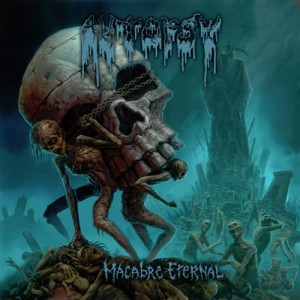
Death Metal Album of the Week: Autopsy – Macabre Eternal

The last couple of years have seen a artistic renaissance of a genre that throughout the best part of the mid- to late 90′s, and the early reaches of the millennium, was perceived to be a ghost that had long outlived it’s most glorious moments of artistic clarity. Great quantities of ‘gore’ and ‘brutal’ Death Metal acts have over the last two decades, dumbed down the mystical perversity that gave a genre the likes of ‘Blessed Are The Sick‘, ‘Legion‘, ‘Cause Of Death’, ‘Onward To Golgotha‘, ‘Imperial Doom‘, has in years past given way to acts that aim principally for shock value, sidetracking any of the compositional and dynamic attributes that were the essence of what made Death Metal so vital in it’s 1989-1993 heyday.

It’s great that Autopsy should record such a gem as this, as it serves to vanquish the plasticity and dross that once great acts such as Morbid Angel and Deicide have spluttered forth. Not only does it filter out these negatives, but it also does great justice to many artists who embrace an archaic yet craftsmanlike and refreshing interpretation of Death Metal.

In addition to having put out the excellent ‘The Tomb Within‘ EP last year, Autopsy have eschewed the notion of ‘re-recordings’ or filtering previously released material onto this new record. Instead what we have is a colossal, quite lengthy record, lasting greater than an hour but never straying from momentum and vibrancy.

It wouldn’t be unfair to say that in terms of intricate song structuring, Autopsy have perhaps even upped on what they originally achieved on ‘Severed Survival‘ and ‘Mental Funeral’, with a more obvious sense of grandeur. This exhibits itself on tracks such as ‘Bridge Of Bones’ and ‘Sadistic Gratification’, which sound somewhat like a logical conclusion of what was being hinted at on their second album. Eric Cutler’s riffs and modes are the usual tritonal, Black Sabbath meets Hellhammer-esque death dirges, which occasionally recycle patterns and forms familiar in early material, yet also giving the album a renewed sense of consistency. It is this grasp of orthodoxy within the metal genre which always makes for contributing to the collective framework of the artists work, which Autopsy fulfill here.

This is however not to say that there are flourishes of ‘experimentation’. Luckily the band have played a good hand of cards, and have not fallen into the ludicrous corner of ‘evolving for the sake of it’. Particular songs on ‘Macabre Eternal’ show the band using greater song lengths than before (‘Sadistic Gratification’, ‘Sewn Into One’), and also display a greater sense of direct melodicism (‘Dirty Gore Whore’). Whilst Autopsy have never been associated with playing at fast speeds, large stretches of this album are more uptempo.
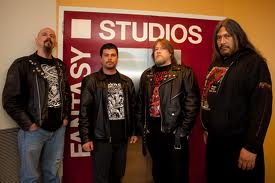
Chris Reifert is on top form as a vocalist. His ability to evoke majestic visions of dismemberment and perversion seem to contain a greater dynamic than usual, as to suggest that nearly fifteen years of prolonged absence has only allowed his strengths to re-accumulate.

Though certainly not a complaint on behalf of the reviewer, what may potentially put off some fans of earlier material is the production, which is undeniably modern in tone. Whilst Chris Reifert’s drumming is still top notch the only minor complaint being that the compression on his drumkit seems to somewhat nullify the sense of ability, flair and aggression that a more analogous production would bring out. Whilst ‘Macabre Eternal’ possesses all of the right atmosphere and conviction worthy of great death metal, the more aesthetically orientated listener will notice that the overall tonality is not as analogous as what was committed to tape in the 80′s and 90′s.

In spite of this minor specific, this album is superb, and rightly deserves to be considered a beacon of the revivification of a dark and morbid art form that until the turn of the new millennium, was considered a dead horse. Hail the new dawn. Not only in terms of structural and grandiose perversion does this album triumph, but fragments of it’s lyrical scope only serve further as to compliment the metaphysical and transcendental nihilism that death metal eternally symbolizes.

“Under the sign of a skull faced moon
We rise from abysmal embryotic doom
Existence as torment, yet locked in a grave
A sick fragile cycle from which no one is saved”

Within the recent decade, this is the best ‘comeback’ release that has emerged from any of the elder practitioners of the genre. Undoubtedly, this shall also be a worthy contender for being the best album of the year.

Filed under: Death Metal Album of the Week — Tags: , , , , , — Pearson @ July 18, 2011 06:06 — Comments (2)

Romero’s ‘Dead’ trilogy: An autopsy

Each of the three films that made up George A Romero’s conceptually linked ‘Dead’ series were quite enigmatic, and now stand as some of the most influential memes in modern cinematic history. This feature for Deathmetal.Org need not explicitly make side references between the musical subculture of which we write to this realm of celluloid, as its popularity with many of death metal’s listening base is well known to those who have insight.

Mankind eschews the macabre and the horrifying and in so doing never fully realizes, learns of or utilizes his whole nature. With the exception of a few brave souls, many people prefer to lead idle unchallenged and unexamined lives, if only because the contrary adventure is difficult and exposes one to multifarious existential realizations, including the reality of the ephemeral nature of ones existence. This I conclude is one reason why the horror genre is generally held in such contempt by modern man, when utilized effectively, not only does it confront the eschewed amoral primordial concerns of mans essential being, it does so in a way that is urgent and demanding of ones attention. Having set up his ever safe concrete abode, modern man now hibernates, avoiding existence and its deeper philosophical puzzle’s in favour of sugar coated half-truths such that soothe and reassure him of his “equality” his “individual uniqueness” and his “inherently universal importance”.

The legendary, provocative and incendiary “Night of the Living Dead” does the exact opposite as it confronts, plays on, and plays with the innate primal fears, dynamics and concerns of mankind. Although loosely conceived as an apocalyptic encounter with the forces of the “living” dead, a profound level of psychological insight and evocative symbolism permeates George A Romero’s “Night of the Living Dead” and thus qualifies this work as a true modern masterpiece and a generally overlooked piece of art

With no little genius Romero effectively lulls viewers into a world viewers can easily relate to by evoking and mirroring significant aspects of our everyday life. Each detail, from the realistically portrayed incompetence of societal authority figures, the naive adherence of people to the demands of the television, the undeniable emotional bond between brother and sister, to the familiar sounds of everyday life, including the incessant chirping of crickets, allows the viewer to fundamentally relate to and plunge into Romero’s world. In fact, the capacity to create a world or setting that so closely mirrors not only a Cold War world obsessed with science and technology but also a timeless, comfortable and familiar, although eerily de-contextualized reality represents perhaps the most important aspect of Romero’s film. These considerations in conjunction with Romero’s capitalization on further cinematic realism, forces the viewer to take seriously the events unfolding within it. Rather than questioning the veracity or possibility of the events unfolding viewers are drawn into reacting, along with whichever psychological archetype they most closely identity with, to the horrifying and challenging events that are taking place. 

Although shot in black and white, Romero’s masterpiece lends itself to such profound levels of interpretation that a mere moral and linear evaluation of the film, the characters, or the actions and events therein becomes impossible. To suppose that the contrast between the black and white film and the various gradations of interpretation the film lends itself to was an intentional decision does not appear as dubious as one may suppose. In fact, it seems to coherently present an ingenious tongue in cheek and subtle level of social commentary on a society that was, and still is, increasingly seeing the world in simple morally absolutist ways amidst an inherently complex reality that disdains simple moralistic evaluations.

Through an ingenious development of the story, viewers, while perhaps horrified at the attacking zombies, are not given the pre-requisite moral education or signifying variables that would make it intellectual honest to morally condemn these purely instinctual flesh eating parasites, whose origin can be laid at the feet of man alone. This of course increases the profundity of the film as Romero brilliantly turns the story away from the simple and exhausted “us versus them” or “good versus evil” theme. Viewers are thus forced, beyond the categories of good and evil, to search for, construct and perhaps impose upon the film a more profound meaning.

Romero’s ability to vividly explore, amidst an environment whose intensity is heightened due to the proximity of death, the nature of human relationships, tribal power dynamics, and the capacity for the characters to deal with the prospect of their immanent demise reveals an attempt on part of the film to explore and highlight some of the fundamental aspects of mans primal nature. The intriguing and dynamic character relationships, for example, reveal and augment the inherent antagonism between virtue and vice and we witness concretely the poignant disparity between courage and cowardice, shortsightedness and wisdom, emotion and reason, optimism and pessimism. Viewers also witness the psychological development of each character as they are confronted with possibility of death, themselves symbolizing at a more significant level various timeless psychological archetypes with which it is difficult for the viewer to not identify with.

Additionally, the revelatory and intrinsically personal antagonisms that define each character bear witness to a decisively human element within the film, such that it becomes difficult for the viewer to not empathise with the manifold and sometimes dubious decisions and reactions of each character. This thankfully increases the level of interpretative depth and challenges the viewer; cowardice contextualized instead becomes the instinctual protection of the father, co-operation and perhaps courage resemble stupidity, pessimism becomes realism, optimism becomes fantasy, and so on. In contrast to many latter day films which celebrate an easy and crowd friendly reality that is typically one dimensional, “Night of the Living Dead” successfully transcends this pitfall and successfully mirrors the complexity of the human condition and the multiple variables that determine its structure.

Moreover, “Night of the Living Dead” includes the uncanny capacity to raise an array of questions that unsettle and challenge the mind: Who exactly is Romero referring to as the “Living Dead”? In what ways does technology bring about mans apocalyptic future, has our technological hubris undone us? How does the theme of technology relate to the zombies aversion to fire? How do we relate to and mirror the zombies at an instinctual level? Indeed, a plethora of questions, paradoxes and insights awaits the discerning viewer.

However, in the end what is horrifying about “Night of the Living Dead” is not the flesh eating zombies, it is the capacity for this film accurately reflects mans condition on so many levels, and to expose the viewer to his or her own primal nature. Above all, what meaning one extracts will depend on each individual’s capacity to plume the philosophical depths implied by one of the main conceptual tenants that drives this movie forward: Only Death is Real
-TheWaters

Combustive, feverishly paced and exploitative almost in an infantile way are some of the qualities of the first follow-up to Romero’s original terror classic. By 1978 merciless killing, cannibalism, pile-up of corpses and explosions of gore had journeyed through the forbidden territories of ‘grindhouse’ B-movie theaters all the way to the brink of mainstream as it seemed already the norm to distrust the ‘establishment’. This is satirically extrapolated by the first few minutes where a cop operation gone awry climaxes with a spectacular scene of shooting a person’s head completely off as if it was no big deal.

The colorful but dimensional 35 mm cinematography, financed with the help of Dario Argento’s Italian team, lets Romero to indulge in more ‘hi-tech’ action than before with plenty of fast tracked views from helicopters but also conduct long and gritty depictions of places and people (and of course the zombies) as if we were watching a documentary. He did not originate this technique, but especially in ‘Dawn of the Dead’ mastered it so far that if there is one movie that seems to truly reveal the morbid but ordinary facets of disillusioned 70′s life in the United States, it must be this. The fantasy elements do not seem to be such when immersed in the logical and natural unfolding of the events.

‘Dawn’ is the first of the movies where a point is made of the zombies being less than authentic enemy but rather pathetic victims of a disastrous failure of civilization. The hard boiled soldiers’ execution of zombie families with children is chilling, echoing the amoral vigilante mentality that pervaded a myriad of cult classics of the era. When the supermarket setting allows the script to use both the human characters and the masses of the dead as two ‘classes’ of consumerism, the dimensions of the movie become delightful and tormenting – especially as it is conducted with the flair of a movie magician without an ounce of excess political rant.

Ultimately the angle is cynical since the characters seem very happy with their boring and cyclical existence in the safety of the supermarket, shielded from the dangers of the outside world and appropriately only at the moments of danger does an enlivening sparkle permeate their mind and hands. The intrapersonal dynamics are still reminiscent of ‘The Thing from Another World’ (1951), a veritable science fiction classic where the alien ‘thing’ was deemed almost irrelevant because of the all-around devastation wreaked by social and personal problems of respected figures such as scientists and soldiers.

Despite the passed decades of pushing all-around borders, the gore in the movie still repulses in its humorous viciousness. Besides the more didactic ‘Salò’ and the more amateurish ‘Texas Chainsaw Massacre’, it’s one of the earliest full-fledged exercises in movie brutality, of the bombardment of visual ugliness. It is entirely in parallel with syncopated, jagged, atonal and growled music as medium; it forces the mind to make certain choices while most mainstream entertainment attempts to unify people with hypnotized neutrality and smooth edges.

It’s hard to pick a favorite from the trilogy but there are nuances and an all-out spirit of warfare in this one quite unmatched by the others, which do raise different points of abstraction by themselves. The battle of solitary but teamed individuals against the masses of horrible biological abomination strikes a note which can seem scarily familiar. The message is cryptic but it is spoken loud – there is no more room in Hell…
-Devamitra

Undoubtedly the most cynical and dark of Romero’s ‘Dead’ trilogy, ‘Day Of The Dead’ continues the concepts explored in ‘Night Of The Living Dead’ and ‘Dawn Of The Dead’ which to the social anthropologist fall perfectly within the societal contexts of their decade, both in terms of appearance and issues dealt with. 1985′s ‘Day Of The Dead’, the intended third of George A Romero’s trilogy for the most part tackles Cold War paranoia dead on, and conveys a sense of isolation, disorder, and internal conflict that 1978′s ‘Dawn Of The Dead’ hinted at.

Whereas ‘Night Of the Living Dead’ contaminated the countryside, and ‘Dawn Of The Dead’ contaminated greater consumerist society, the third of these films now brings the viewer to a conclusion in where all previous facets of Western human society have been fully violated, with the few to emerge unscathed hibernating in underground shelters where in spite of a common need to survive, greater in-fighting occurs. This film is a much more dramatic affair than any of the previous two, and as a result its subject matter becomes more obtuse. Science and anatomy play a greater role in this film, in which the chief lab technician attempts to find means as of how to reanimate the once living, or do bring about a reversibility to the impulse-only movement of the undead. The soundtrack is mostly synthesized, having an emotive depth not unlike a cross between the scores to Scott’s ‘Blade Runner’ and Argento’s ‘Tenebrae’.

The graphical element of the third of these films is more prominent, the gore more repulsive, the atmosphere more repulsive and suspensive. Some would suggest that the quite lengthy build up of this installment is detrimental to the overall quality of the film, but in the opinion of the reviewer gives an excellence not seen in the previous two installments, the most intelligent and and serious of Romero’s zombie films.
-Pearson

Filed under: Death Metal Film Reviews — Tags: , , , — Pearson @ April 9, 2011 14:22 — Comments (1)

Death Metal Album of the Week: Purtenance – Member Of Immortal Damnation

This overlooked Finnish gem, from 1992 sees an act from the Southern Finnish town of Nokia (the same town that gave the world Convulse, and a phone company of it’s namesake) playing death metal in the style that characterizes their native country. It is quite raw, sludgy and semi-melodic, yet in terms of rhythmic dynamics, has quite a lot in common with American acts such as Autopsy and Incantation. The seminal music of Demigod also garners a valid comparison though  the production is much more murky, with the guitar tone having something more in common with the likes of Rippikoulu, and the drums having a quite jilted, and occasionally offbeat syncopation, aesthetically complimenting the strangulation strings. Keyboards, and additionally acoustics, used quite sparingly, accentuate a gothic sense of clarity amidst an aural dimension that conjure mental images of wriggling life beneath cemetary dirt. Like the best Finnish releases the real cohesion of this album is attained through a collective listen to the album in it’s start to finish entirety, rather than picks of individual compositions, which if played alone would render giving the album less significance than it deserves. For those that like death metal worth it’s salt, this is certainly worth listening to, and some 18 years after it’s original release, more than easily attains a lasting value in the annals of the history of this genre.

Filed under: Death Metal Album of the Week — Tags: , , , , — Pearson @ November 16, 2010 10:31 — Comments (4)

Death Metal Album of the Week: !T.O.O.H.! – From Higher Will

We’ve already sung our infinite praises for the Czech Republic’s nauseating-yet-festive tradition of goregrind, notably with our review for Pathologist’s ingeniously gurglesome ‘Grinding Opus of Forensic Medical Problems‘, vintage 1993. But as the 20th Century drew ever closer to its final, blood-red sunset, it was apparent that a fair amount of sophistication had permeated this previously unpresumptuous brand of Carcass-veneration — a stylistic leap best exemplified by the Bohemian progressive death technicians !T.O.O.H.!: the name being a nonsensically embellished acronym standing for no less a misanthropic slogan as, “The Obliteration Of Humanity”.

The putrid fruit of an intensive collaboration between the two Veselý brothers — guitarist Humanoid and drummer Schizoid — after their self-confinement into a godforsaken cottage isolated in the morbid Teuto-Slavic wilderness, this debut full-length communicates its ambitions even through the cover art alone: that of conjuring an interdimensional sonic wormhole, transcending the realms of carnality onto astral planes of unknown and unfathomable horrors. In this manner, ‘From Higher Will’ is not only an aesthetic contemporary to Gorguts’ otherworldly ‘Obscura‘ (bolstered in no small part by Humanoid’s fretboard tomfoolery and psychotically violent howls), but is comparable even to Demilich in its blackly humorous and paranormally intuitive grasp of the absurd.

Compositionally, there remain ties to the grindcore stylings of wanton riffage, seemingly senseless blasting, and an apparent disregard for consistency in either form or genre that brings to mind the most brow-raising releases by Carbonized, though with a more coherent death metal approach as practiced by Atrocity circa ‘Hallucinations‘. The Veselý brothers also transpose and transmogrify motifs cleverly borrowed from the familiar gamut of the great Czech masters: the alternately jubilant and harried folkisms of Dvořák, the jazz-inflected oddities of Martinů, and of course the carnivalesque and rather ridiculous marches of Fučík. But a closer study actually reveals much more of a musical lineage to the dissonant repertoire of the Hungarian Bartók — in particular, his extraordinarily grotesque pantomime ‘The Miraculous Mandarin‘, which relates the tale of three criminals and a prostitute in their strains to rob and murder a Chinese bureaucrat whom inexplicably resists death no matter how many times he is stabbed or asphyxiated. Indeed, such a plotline seems to resonate well with !T.O.O.H.!, what with their bizarre lyrical handle concerning the foulest indulgences of cannibalism, torture, genocide, random terrorism, vehicular childslaughter — et cetera, et cetera.

Within the bleak decade that has passed following this release, the practice of technical death metal has rightly become an object of derision amongst Hessians: instrumental prowess, rather than serving as a means towards more sophisticatedly adumbrating a musical Truth, degenerated into an end in itself, and subsequently polluted our world with insipidly mechanistic, gaudy, and tautological compositions that spoke nothing of mortal transcendence. Even !T.O.O.H.! themselves, unfortunately, would later fall prey to the same sort of contrived bombast — as if they had put away their holocaustic fantasies and instead taken up egalitarianism. But ‘From Higher Will’ in no way suffers under any such pretenses. Like the work of a mad scientist (or perhaps the Angel of Death himself), this album communicates an emphatic joy in the partaking of its own sadistic experimentations: injecting, vivisecting, and surgically conjoining all the wrong things — just for the hell of it. Equal parts gruesome and eclectic, ‘From Higher Will’ is a lamentably underappreciated work of droll genius, and fully deserves to be heralded amongst the Czech Republic’s greatest musical outputs.

Filed under: Death Metal Album of the Week — Tags: , , , , , , — Thanatotron @ November 6, 2010 11:22 — Comments (1)

Death Metal Album of the Week: Deceased – Luck Of The Corpse

One of the older and more unsung extreme metal bands to come out of North America, Virginia-based Deceased issued ‘Luck Of The Corpse’ in 1991, playing death metal in the most primitive of fashions, in ways not too dissimilar to the likes of Autopsy and Impetigo. The common perception of a musical aesthetic often dictates to the more automative listener that anything that bares an adherence to or authenticity that speaks ‘simplicity’ this conveys the perception that nothing unique is to be expected, and in the case of death metal that it conveys no sense of originality or otherwise is quickly assumed to be something that breaks no ground.

Deceased’s full-length debut serves to shatter a couple of myths, and whilst firmly rooted to the aesthetical mould of death metal’s oldest school, drummer/vocalist King Fowley’s taste for eclecticism makes itself clear in abrasive compositions. The influence of progressive metallers such as Voivod and Prong come through in varied sequences of riff patterns that use a variety of strumming techniques, from low end death/thrash melodic motifs to discordances that have nuances of discordance that also was prevalent on the likes of ‘Killing Technology’ and ‘Dimension Hatross’. The drums are very impressive, sounding very upfront in the mix, and King Fowley’s vocals are that of an animated, puking corpse. His execution and hitting of the skins is quite direct and barbaric like his fellow instrumentalist Chris Reifert of Autopsy, though has a much more varied sense of rhythmic dynamism and interchange that works in solid cohesion with the dense yet flexible musical dimension that this band craft for themselves.

Filed under: Death Metal Album of the Week — Tags: , , , , — Pearson @ August 5, 2010 09:48 — Comments (6)

Death Metal Album of the Week: Evisceration – Hymn to the Monstrous

The time-honoured, warm and fertile nation of Portugal, once the ruler of the Southern seas, never gave death and black metal movements any immense impact but has nothing to be ashamed of in comparison to its vastly larger neighbour, Spain, which probably boasts an even more scant number of memorable little releases from the golden age of grindcore and death metal. While the country’s major global success story, gothic satanists Moonspell, shared thrash and grindcore roots with countless marginal demo level bands, mostly only to be found archaeologically from the pages of dust covered zines, the fruition of the style in the shade of Sintra forests’ timeless sylvan spell was conceived by Setubal’s Evisceration – who successfully, if unpretentiously, combined lurching doom with Carcass-inspired corpse-shredding chaos much like Blood did a thousand miles away in Germany, creating a devastating, desolate atmosphere by manipulating space and tempo across an album formed of short, intercutting scenes of violence.

Effectively a counterpart to the promiscuously eclectic and baroque sound of the earlier covered fusion band Disaffected from the same lands, Evisceration brings simplicity but tenderness to the face of the listener in morbid delight which united early grindcore in a heavy substance of evil, far from the trash entertainment jokes and putrid politics that later on caused a major collapse of interest in the phenomenon, alongside a tendency to musically overemphasize elements such as fast blastbeats and radically rhythmic growls, that used to serve as sensible pieces of an overall emotional, psychological and philosophical architecture. Simply put, this means that while there are no obtrusely “progressive” parts, Evisceration are alike agile in utilizing moody synthesizer akin to early black metal bands in “Consumed Act”, as a quasi-classical acoustic guitar in the intro piece “Farewell to Earth, Heaven and Sun”, not to forget short but gripping Slayer-esque leadwork in “Dead Foetus”. This 35-minute collection of short but easily differentiable songs doesn’t overuse any of its ideas, and this disciplined compactness is, as previously mentioned in regards to Blood‘s “O Agios Pethane”, a testament to the theoretically endless possibilities of grindcore which are rarely heard in action.

Filed under: Death Metal Album of the Week — Tags: , , , , , — Devamitra @ July 22, 2010 14:46 — Comments (5)

Cannibal Holocaust

This is by no means the easiest of films to watch. It has numerous flaws and executions within the film that would provoke one to make immediate criticism, for example the sub-par, almost at times robotic acting and unimaginative script, and what could indeed be labelled a lack of cohesion (could this be due to editing and censoring? I am not sure), Cannibal Holocaust never ceases to shock and provoke, as well as provoke immediate questions of ‘who are the real savages?’ and how people might want to generally assess their modern, non-organic way of living.

For those unaware, the film centers around an anthropologist who is searching the wherabouts of a film crew, lost and presumed dead after having gone on a expedition discovering primitivist tribal cultures, and the alleged cannibalism associated with it. Upon retrieving a camcorder containing reels of film that entail the ill-fated decline and fall of the expedition, the anthropologist then returns to the United States, to show the footage to the executives of a major television station. As each reel is played off, we see the young crew begin as arrogant, gung-ho, civilised and white skinned carefree adventurers, with little or no respect for a habitat that is not, and will never be their own. As the film footage progresses, we see the crew make contact with the native tribespeople, and imposing their presence on them in a harsh manner, committing beatings, tortures, arson and rape, whilst filming their deeds, which they attempt to justify on the grounds they are more civilised than they. As the title of the film partially implies, the predators surely but quickly become prey, each of them killed barbarically and ritualistically. In between the pausing of the reels, the executives of the television network are convinced that the celluloid they witness would indeed make for good viewing ratings, to the anthropologist’s objection that such a thing is exploitative and in bad taste.

The film is at times unsettling, and we see many obvious critiques of how life, substance and nature are valued by the modern ‘civilised’ human being. One easily gets the impression at times that the intrusion of camera, gun and machete wielding Westerners into isolated, indigenous land is a metaphorical allusion to the ills of colonialism. The film also questions the bloodthirsty sales appetite we see in the modern media, ‘blood equals ratings’, which is too often seen when a mainstream newspaper is more than happy enough to make their own material gains from anothers tragedy. As I have illustrated in the opening paragraph, this film is badly executed in certain avenues, and when viewed it is easy to realise this. The real-life killings of animals are stomach-churning, and will alienate many. The depictions of sacrifice, abortion, rape, castration, mutilation and torture are profoundly realistic and shocking, they give a raw attribute to the film that very little in the cinematic world will ever match.

The most redeeming features of the film are the soundtrack by Riz Ortolani, which utilises rather dated synthesisers alongside a string orchestra, often interspersed with music that sounds not too dissimilar to Italian religous music, with arpeggiated acoustic guitars playing upbeat music that adds a brilliantly sarcastic touch to an otherwise grim and unrelenting series of violent acts. The usage of hand-held camera is very effective. As opposed to films where every scene is portrayed from a multi-angle perceptive, we see absolute realism for the most part, and is done in a non-perfective, improvised fashion that otherwise contributes heavily to making the film for the most part, very convincing. Cannibal Holocaust is flawed, yes. But it is a triumph of the cold, efficient will. Unlike the humoured (but still excellent) Dawn Of The Dead, Cannibal Holocaust is the work of the cynical sociopath, and seems to metaphorically imply that when one reaches or exceeds a certain threshold of excess, be it due to ignorance, lust, greed, self-indulgence etc, there is not even the vaguest chance of redemption. In a sense, the message of this film is an all-out war against the modern way, and the belief that furthering it to those who are otherwise unwilling to accept it is nothing short of a disastrous consequence. The film also suceeds in that it doesnt moralise about the issues it raises, and also leaves the film open to many possible interperatations. Overlooked by critics for its very bad acting, reviled by the politically correct, adored by much of the exploitation crowd, here is a film which holds truths and meanings beyond a framework that would isolate and sicken many.

Filed under: Death Metal Film Reviews — Tags: , , — Pearson @ July 12, 2010 02:53 — Comments (8)

Death Metal Album Of The Week: Rigor Mortis – Rigor Mortis

Whereas the structural and musical approach would not constitute for an FM-radio listener’s definition of ‘progressive’ this album is highly important and innovative in many ways. Given a nice thickening fuzz that anticipates the textural approach of the pioneers of Greek and Norse black metal, Mike Scaccia’s rhythm guitar is middle range yet lacks the crunch and the preferential techniques used in speed metal (constant palm muting, an emphasis on staccato), having  a much smoother sense of transition in execution than many speed metal and death metal peers. This also allows the other instruments to stand ground within this framework, helping a sense of musical advancement and accomplishment that is beyond mere head-banging fodder. Good word must also be given to his solo playing, which is intricate and whilst not dissonant evokes the more dignified of neo-classical shredder playing crossed with the King/Hanneman sonic attack.

Casey Orr’s bass as a result of this is made just as audible and distinct as the percussive backdrop, and almost as if to capitalise on the dark and foreboding atmospheres that Slayer and Possessed first realised on early works, we get a textural sense of craft that anticipates the outcomes of many important metal acts to follow, two major examples being Massacra and Mayhem. Bruce Corbitt’s vocal delivery is the typical rhythmic-cohesive delivery that is a mainstay of this musical field. It has lingering sense of camp in it’s mildly gore-fantasist lyrical depictions, resembling a cross between Dave Hewson of Slaughter and John Connelly from Nuclear Assault, with more of a rasp than a sung tone to it, perfectly fitting and well executed. Along with the work of Californian thrash unit Cryptic Slaughter, these Texans should be considered one of the more important missing links in the structural advancement of the extreme metal that was to flourish from the late 1980′s, and onwards…

Filed under: Death Metal Album of the Week — Tags: , , , , , , — Pearson @ June 1, 2010 21:29 — Comments (0)

Death Metal Album of the Week: Blood – O Agios Pethane

In the forgotten backwoods, abandoned cellars and dimly lit city alleys of this devastated remnant of social collapse prowl psychotic minds that rule their victims with fear and torture and traumatic pain shall be their legacy on earth. Serial killers have left their bloody trail on our culture because of their mechanical insistency of treating people as objects, as useless organic spawn of a world that offers little appeasement for neurotic, frustrated impulse or desire. As if to prospect a visceral counterpart to the psychoanalytical surgery of many previous albums of the week, such as “Changes” and “Hallucinations” (both appropriately originating from Central Europe), this ritual of Blood alongside the recent Autopsy review lunge into gore and swarming maggots, while entrails burst and bodyparts are severed by brutal bludgeoning weapons.

Readers of our zine archives have noticed the tremendous impact of Napalm Death and Carcass pioneered social but spirited grindcore upon the entire scene, as well as how quickly the failure to invent surprising music within the boundaries of the style evaporated the desire of bands and audiences alike to keep to the principles of grind as something sacred. While countless German demo bands were cranking out noisy, self-indulgent and hectic odes to fun and horror movies, Blood’s economical but poetic hallucinations spanned the philosophical (“Linear Logical Intelligence”), the mythological (“Kadath”) and twisted black humor (“Sodomize the Weak”), building into an entire self-consistent worldview on par with the anguished, outwardly more serious output of contemporaries Morgoth and Atrocity.

The tuneless, stumbling, roaring moments recall Canada barbarians Blasphemy and early Voivod, while the drawn out, precise clarity glimpsed like sun behind the clouds when the band regroups and reformulates its attack through moments of slow, traditional metal riffs are akin to Finnish death metal moments (hardly surprising as this band was widely heard in early 90′s Finland despite being almost forgotten nowadays). The truncated track lengths (3 minutes maximum) reveal an ascetic, rigorously disciplined plan to build albums from sheer musical force of expressionism, cut into bits as in a Burroughsian tapestry of absurd and horrifying moments trapped inside the madness of civilization and natural lifecycles. Nothing could be farther from the haphazard, elongated drone rock-outs that characterize trendy metal of the new millennium, so it is perfect time to taste the Blood.

Filed under: Death Metal Album of the Week — Tags: , , , , — Devamitra @ May 26, 2010 23:03 — Comments (3)

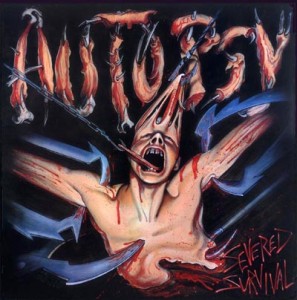
Autopsy – Severed Survival

Although Chris Reifert’s work on the now legendary, but perhaps over hyped “Scream Bloody Gore” was compelling, it is hardly worth mourning the fact that this death metal genius would leave Death and form the mighty Autopsy. On the contrary it remains a blessing, and while Death would continue to churn out a few more solid death metal records, Autopsy would themselves create a few classics whose extreme visions of death would underlie much of the philosophical vision of countless metal bands. Undoubtedly, Autopsy would also influence the worldview of many fans who would learn to eschew the illusion and flight and fantasy of modernity, in favour of a sober glimpse into the workings of reality in all its horrifying and powerful glory.

Autopsy’s barbaric and seminal album “Severed Survival” offered the listener what would by 1989 arguably represent the nihilistic and amoral apex of the burgeoning death metal genre and thereby cement their place in death metal history. Primitive and raw, the power with which Autopsy frantically bash out these energetic incisions into the human psyche, indicates a desire to transcend and break down the perceived but illusory moral world order and come to terms with the cold harsh realities of existence. On “Severed Survival”, Autopsy unabashedly presents the listener with a sometimes shocking but nonetheless candid and unmitigated reality, smashing to pieces any presupposition of a cosmic moral world order. As listeners we are forced to come face to face with death, desperation and the unspeakably twisted and cursed elements inherent in the mechanisms of reality and in the collective human consciousness, which Autopsy, like a skilled pathologist expertly dissect and examine. Exhumed are the intense, destructive and “degenerate” elements that are not spoken of in civilized society but which nonetheless drive reality and remain active as motive within the omnipresent but subterranean catacombs of the human mind. Unquestioningly suppressed out fear or an inability to place these depraved realities within the context of our currently constructed, illusory but ubiquitously advocated a priori moral world-view, it is Autopsy who courageously revel in exploring the obscene and who seem bent on destroying illusion in favor of discovering, conforming to and coming to grips with the power of reality.


A bloody pile of discharge flesh
Is what you see as you face death
On the ground is the lifeless meat
Stillborn child lays at your feet

Musically, “Severed Survival” is a conceptually flawless album that offers insight, contrast, and dynamic through its expert use of eclectic influences and moreover, succeeds in synthesizing musical and lyrical expression to form a complete experience also made possible through the phrasal composition inherent in the songwriting of all good death metal. Drawing on Celtic Frost and the simple power chord progression that made the latter’s work so completely unified and clear, synthesizing it with heavy metal’s tendency to express impending doom through the use of slower meditative riffs, and drawing on the frantic and schizophrenic lead guitar work of proto-death metal or speed metal giants, such as Slayer, Autopsy on "Severed Survival"  executed an effectively simple, dynamic and epic work whose elements united  to create a gripping journey that remains to this day, compelling, interesting and perspective altering. Highly recommended!

Filed under: Death Metal Music Reviews — Tags: , , , — TheWaters @ 07:50 — Comments (6)

Death Metal and Black Metal Search Engine