DEATHMETAL.ORG: THE ULTIMATE DEATH METAL RESOURCE

HOME REVIEWS ARTICLES EVENTS EXHIBITS CHANNEL NETWORK

Death Metal Album of the Week: Tenebrarum - Alta Magia

Album Reviews: Gontyna Kry - Welowie

Live Reviews: July 16th, 2011 - A Day of Death in Buffalo, New York

Book Reviews: Jeff Wagner - Mean Deviation: Four Decades of Progressive Heavy Metal

Film Reviews: Romero's 'Dead' trilogy: An autopsy

Essays and Research: Forgotten Death Cults from Finland: An Overview

Morbid Scriptorium: A Museum of Metal Zines

DeathMetal.Org is a joint project of the net's oldest underground metal resource Dark Legions Archive and collaborating writers who share the commitment to serious Death Metal. Bands, labels, zines, gig organizers and other parties working in the true spirit of Death Metal who wish to get the word out there through our site are invited to get in touch.


In order to establish a solid, even scientifical basis for the study and appreciation of Death Metal, we are collecting and digitizing diverse materials related to Death Metal history, such as zines, flyers and demo covers. The death metal zine reference center and the death metal art repository are at your disposal. If you appreciate the contents of these archives, please get in touch and contribute something from your own collections in order to preserve memory, information and knowledge and to save these rare gems from being buried by the sands of time: The Past is Alive. We also would like all our noble readers to stay active in their own productive manner and through their contacts spreading the word about all these projects, archives and analyses which ultimately achieve their meaning by the responsive awareness of the intelligent observers somewhere out there, who prowl as wolves among the sheep. Here are some Death Metal related flyers, links and banners you can spread like the plague in order for our hordes and communication networks to grow towards world domination and eternal victory.

100% Death Metal and Black Metal Forum: death metal, black metal, heavy metal and ambient philosophy, discussions and MP3100% Death Metal and Black Metal Forum: death metal, black metal, heavy metal and ambient philosophy, discussions and MP3

Glorious Times, A Pictorial of the Death Metal Scene 1984-1991

100% Death Metal and Black Metal Forum: death metal, black metal, heavy metal and ambient philosophy, discussions and MP3

Dark Legions Archive

Hessian Studies Society: Political Rights for Death Metal Fans Now

Abraxas Neoclassical Music Reviews

Death Metal, Punk, Heavy Metal, Classic Rock Features

Death Metal, Heavy Metal, Black Metal Encyclopedia

National Day of Slayer

Forest Poetry

Metaleros

Jeff Wagner – Mean Deviation: Four Decades of Progressive Heavy Metal

Mean Deviation; cover art of course rendered by Michel "Away" LangevinHuman progress will forever be linked to those most primal memories of our species, wherein there emerged that intrepid curiosity that formed the crux on which history could be built. Moreso than the will to merely survive and subsist, it was the will to forsake the paradise of safety and pursue instead the harsh, untamed dusklands of the unknown, where intense tribulation could reveal the fiercest potentials of the few that could overcome. Within the realm of music — that most iconically Romantic of arts — this sentiment persists as a striving to expand the capacities of willful expression into an all-encompassing whole, swelling into symphonic full bloom during the 19th Century. But now, in the dreary modernity that constitutes post-World War II planet Earth, Metal music has proven to be an improbable successor to this upward-climbing composing ethos, and its 40-year history itself resembles less some linear development than it does the genealogy of a warrior race: evolving as one from troglodytic Rock origins, but then splintering into variegate subdivisions as established kingdoms become ever stiflingly overpopulated. If it is those most radical of subdivisions commanded by wildcat eccentrics, hermitic technicians, and sadistic savants that best define the nebulous label that is “progressive metal”, then ‘Mean Deviation‘ — the new and exotic pet project of Metal Maniacs veteran Jeff Wagner — is the one book ambitious enough to fasten a historical yoke around such a chaotically polymorphous Metal strain.

It’s a ridiculously exacting task to try and chronicle the entirety of a musical subgenre that isn’t really a subgenre, and whose content cannot be readily identified by formal analysis alone. And yet Wagner, being the dauntless historian that he is, enters the Nocturnus Time Machine® with naught but the earnest objective of highlighting whichever works were exceptionally bizarre, brainy, or both. Placing his starting coordinates in the late 1960′s when progressive rock and early ambient music had already begun to explore more neoclassical avenues, Wagner narrates the concomitant emergence of heavy metal, and oversees its unprecedentedly rapid appropriation of prog complexities. The most non-canonical, wildly erratic career choices of Black Sabbath, King Crimson, and especially Rush receive extensive coverage, and upon this foundation of classic radio giants, Wagner uncovers many of the grandiose intellectual motivations that would plant the seeds of ambition in the burgeoning ’80s underground — an explosive era that Wagner veritably lived and breathed throughout.

From this point is of course where the bulk of the book begins and where divergent paths are most numerous and dramatic, starting with an initial divide between what is now commonly known as Progressive Metal proper — Fates Warning, Queensrÿche, Crimson Glory, and [must we mention them?] Dream Theater as examples — and the more abrasively progressive styles that were set in motion by speed metal aberrants Watchtower, Voivod, Celtic Frost, Coroner, and a small conglomerate of other leaders whose names consistently haunt the chapters further on. The subsequent outgrowth of extreme metal within the following decade then takes the spotlight for what seems like a third of the book, and the magnitude of its proliferation logically finds Wagner having to document deviance on a steady, region-by-region basis. But in this manner, he is as remarkably thorough in his examinations of familiar prog-extremists as he is with some of the more impossibly obscure names, reliably identifying which recordings showed noteworthy marks of ingenuity. A study of Finland, for instance, seizes Demilich by the tentacles and takes special interest in Beherit‘s darkwave transmogrification. Norway’s chapter highlights Mayhem‘s early adoration of Swedish prog band Änglagård and of course German synthpop and kosmische musik, and goes on to investigate the growth of Manes, Burzum, Enslaved, and Neptune Towers. Continental Europe reveals a constellation of luminaries ranging from Supuration to Atrocity, whilst the melting pot frontiers of the Americas yield regional anomalies as diverse as Gorguts and Obliveon up in Québec to Atheist and Hellwitch down in Florida. And, wherever possible, Wagner takes great efforts to cite any intellectual influences or achievements on the bands’ parts; tellingly, Classical and ambient music is a frequent subject here, as are academic degrees in a surprising array of fields.

It is surely impossible to write a “progressive metal” book that will be accepted in all circles of the culture, as controversy and even widespread disapprobation seem to be taken for granted in the music itself. But for the particular minority who identify themselves as hessians, it is certain that many will lose interest as the final hundred pages close in, simply because almost all of the so-called cutting edge Metal bands of the late ’90s and onwards fail to contribute anything significant to the genre; but in Wagner’s defense, there are many instances where he does bring attention to the growing problem of entropy. The more philosophical among us may further object to the very grounds for Wagner’s criteria for “progressive-ness” — that is, how much the work in question defies convention and expectations. To build from an early example, Wagner argues that Voivod’s ‘Angel Rat‘ — an album widely lambasted as a sell-out for its regression to verse-chorus, consonant indie stylings — is in fact a progressive step for the band because it was so utterly unlike any of the albums that preceded, or anything else in the scene at the time. But this is nothing if not the most prostrate kind of optimism, which accepts an undesirable antithesis — in this case, total artistic decline into meaninglessness — as a necessary part of a dubious process towards some ideal of absolute artistic freedom or whatever. It’s true that to speak of “progress” we need to postulate an objective or end of some sort to move towards, but externalities like novelty and individuality alone are insufficient; something more intrinsic to Metal’s being must be identified, otherwise you allow for a flood of the same self-obsessed, irrelevant music-as-product to garner the association simply because it’s clever enough to imitate the distorted aesthetic. Therefore it is best to assert as an axiom that for the subject to be Metal, it must have as its essence that visceral if rather elusive-to-define spirit of vir, whose amorally creative will to power is partially outlined in the introduction to this review. From here, determining progression in Metal is only a contextual (and decidedly more limited) matter of whether the subject meaningfully transmits its central motivation using methods previously unexplored, for any number of nuanced reasons ranging from technical breakthroughs to conceptual maturation to ingenious angles of arrangement; of course, the ironic consequence to progressive forms is that they are often seized upon by the majority and ossified into standard forms over time. So, based on these tenets, you would have to re-evaluate progressive-labelled, impostor Metal bands like Opeth as actually not effectively progressive as a band like Morbid Angel, who were significant not only for innovative technique, but for using their talents towards representing death metal philosophy with hitherto unheard-of imagination and perspicuity. Take this same critical hammer to the “progressive eras” of Enslaved, Amorphis, Death, and all related corrupted prodigies who allowed themselves to be domesticated into entertainers, and suddenly ‘Mean Deviation’ is chiseled down from a bloated tome to a slim pamphlet.

Now it’s apparent that ‘Mean Deviation’ surely has its points of contention, but then again the book’s stated aim isn’t to illustrate a concrete and ontologically-sound definition of what progressive metal is, nor is it out to namedrop every single band that may have garnered the label through whatever happenstances of popular delusion. Essentially, the book’s aim really is as simple as what its title conveys: to reevaluate the Metal timeline with a specific interest in whatever was outstandingly highbrow and/or shunned by the hypothetical average headbanger. It is a scholarly, well-referenced, yet personable inquiry of metallurgical innovation, which harbors aspirations towards objectivity and acceptance amongst society’s intellectual elite, but never mistakenly reduces the art to a mere science. Rest assured that trivia in abundance is here to tantalize the reader’s inner nerd; just remember to take it all in with a sizable grain of sodium chloride.

Filed under: Death Metal Book Reviews — Tags: , , , , — Thanatotron @ October 16, 2011 06:13 — Comments (0)

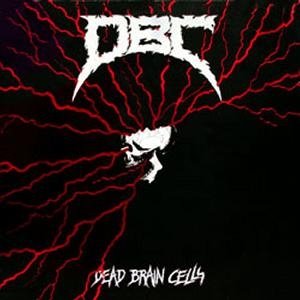
DBC – Dead Brain Cells

The Canadian province of Québec seems to be situated upon some geographically freakish turf that exudes such a phenomenal electromagnetism as to twist and convolute whatever waveforms happen to waft into its borders. Psuedoscientific petrology aside, Dead Brain Cells are one such Canadian faction that reinterpreted the equatorial American sounds of skatethrash and reassembled its raw energy into a hyperborean bizzarerie, with an ambition in expressing the absurd crises symptomatic of a classically Huxleyan, oblivious society lured into the grip of an Orwellian tyranny by the mesmeric attractions of self-pleasure.

Taking aesthetic inspiration from the cruelly intelligent, modern firearms cacophony of Slayer’s ‘Chemical Warfare’ but fashioning riffs over the roguish, bursting structures typified by crossover acts Suicidal Tendencies and Corrosion of Conformity, Dead Brain Cells had paradoxically succeeded in applying scientific methods to truculent vandalism. Vocals, in compliment to the factorial churn and tumble of the instruments, are delivered in a robotic rant like the outcries of a citizen-turned-automaton denigrated by a lifetime of vacuous routine; lyrics are remarkably coherent and incisive considering the band’s Québécois nationality, of course with the mother tongue of French being a perennial obstacle for all aspiring Hessians allied under the fleur-de-lis. However, it is clear from DBC’s rather involved compositional style that their telos was not merely in writing protest music, but in establishing engaging, punkishly dynamic narratives such that every song is represented as its own vignette of dystopia — a sensibility that would be incorporated into the region’s burgeoning death metal movement, with vestiges apparent in such seminal works as ‘Considered Dead‘ and ‘From This Day Forward‘.

This eponymous debut remains one of the exceptional examples of quality crossover thrash from outside of the U.S.A. and England; it’s also required listening for any avid scholars of Canadian death metal, in order to better understand the music’s gestation from heavy, quirky progressive rock to complex and sublimely dissonant killing noise.

A planet defaced with death and decay
An atmosphere of hate
Cities destroyed
Their meanings forgotten
And fertile lands lay waste
A planet once prosperous
Its future looked bright
But an immature race had evolved
Given time and the knowledge
They soon could destroy
The planet on which they revolved
Not one life would be spared
It wouldn’t happen again
Because there is no second chance

Filed under: Death Metal Music Reviews — Tags: , , , — Thanatotron @ September 11, 2010 22:27 — Comments (0)

Death Metal Album of the Week: Nocturnus – The Key

It certainly feels as if quite a few cosmic epochs have passed since we’ve last discussed the Floridian aerospace-institution Nocturnus on this cybernetic outpost, but our keenest veterans will recall that their release ‘Thresholds‘ was treated with some degree of distaste. Rummaging back further within the dustier recesses of this band’s time-capsule, though, brings to light their much more praise-worthy debut ‘The Key’– the first successful gene-spliced hybrid of both the primitive occultist and advanced technocratic schools, built upon the ridiculous yet resoundingly Death Metal concept of a cyborg assassin sent back in time to terminate the infant Christ.

Much of ‘The Key”s infamy is derived from its employment of a keyboardist: though the presence of synthesizers hardly tweaks the brow of any Hessian today, the prominent molestation of ivory on a death metal record was a controversial innovation at the time of this release. Louis Panzer’s synthwork, however, adds a vital strain of harmonic depth to these compositions, invoking phosphorescent starscapes and futurisms similar to the ambient pieces contributed by Vangelis for the film Blade Runner. The riffs themselves charge forward in their characteristically Floridian, caustic angularity, imparting a sense of frantic acceleration as of a spacecraft disintegrating into flames as it reenters a gravitational atmosphere. Still other riffs, though, express an exhilarating air of interstellar surveyance, briefly veering away from ripping brutality into the more progressive territory of science-minded speed metal in the line of Watchtower or, more explicitly, Agent Steel. It is unfortunate that this is the only Nocturnus full-length to feature Morbid Angel alumnus Mike Browning as drummer/vocalist, as his distortedly monotone snarl lends a compelling voice to the pernicious droid that presumably narrates this album; ironic, then, that he would soon give up the role of vocals to a full-time frontman who showed little talent for subtleties of characterization.

Most probably due to the polarizing effects of its synth-sodomy, ‘The Key’ tends to not be mentioned in the same breath as the usual fixtures in the classic canon of FLDM. Nonetheless, the album perdures not only for its historical incorporation of techno-astronomical imagery in death metal, but for the NASA-grade engineering ambitiously applied to its multiplexed intricacies of craft.

Filed under: Death Metal Album of the Week — Tags: , , — Thanatotron @ September 6, 2010 06:06 — Comments (2)

Death Metal Album of the Week: Order from Chaos – Stillbirth Machine

What do you obtain when you combine the violence of “War and Pain”, the temperament of “Blood Fire Death” and the malicious groove of “Symphonies of Sickness”? Well, amongst unexpected atomic reactions with statistical possibilities including the destruction of all cosmos, you will meet this deservedly cult Kansas City band whose heatwaves are still crashing against metalheads’ record players in the form of not only Helmkamp’s Revenge and Keller/Miller’s Ares Kingdom, but practically everyone who plays war metal or simply impudent, militant black thrash. The debut album “Stillbirth Machine” is an eternal favorite from this solid discography. It’s one of those albums that relentlessly crush for their entire playing time, grinding riffs convolving into spectral dimensions underneath the precise drum/vocals interplay. While sounding extremely old school despite the aggressive means borrowed from the blackgrind generation of Blasphemy and Beherit, Order from Chaos merges the Faustian essence of vectorized attack into pathless realms (best exemplified by the vocal chorus manipulation akin to a belligerent neo-fascist Kraftwerk and the absolutely crazy leads that sound like a neutrino storm at CERN shooting off) with a modern streetwise speed metal sensibility of using common phrases that elsewhere would be utilized for beer-thrash, but here the elité ambience is extricated much in the manner of Bathory classics to lead the brain onwards to serious contemplation of triumph, death and destiny.

We stand on a constant threshold of
A quantum hierarchy, universal and pure

Filed under: Death Metal Album of the Week — Tags: , , , , — Devamitra @ March 28, 2010 22:51 — Comments (5)

Vektor – Black Future

Were the year 1988/89, when Speed Metal was making it’s final, most definitive statements of dystopian frenzy and technical invention, the reverberations of this music would undoubtedly be traced back to places like Canada and Texas, detecting the names of Voivod, Obliveon, Watchtower and dead horse among others. Certainly not Arizona, where, in Vektor‘s case, these sounds have travelled to and eventually merged in an energetic experiment of nuclear fusion. To some, the last few years have been good times for Speed Metal and saw a resurgence of bands trying to capture the spirit of the 80′s. In reality, this was one of many niched exercises in nostalgia and the long out-of-date fruits of useless bands like Evile, Merciless Death, Lich King and Municipal Waste reflected the trivial trend with sounds of supreme tackiness. Vektor are among the very few in revitalising Speed Metal, creating more than just a retrospective and methodological account of that genre’s heyday. ‘Black Future’ is a work that honours the past enthusiasm for innovation and musical proficiency, thus having a mind of its own to render this music for present and future audiences.

Voivod is the most visibly emblazoned influence on this band’s aesthetic, touching everything from the logo to the trademarked discordance and the futuristic scenes of technocratic dissolution it portrays. The Obliveon influence is quite explicit also, as there’s a lot of complex and unconventional movement of individual notes that resembles some kind of robotic Pagannini-droid, disembodied from the more rhythmic sections to emphasise the Classical aspirations of this band where melody is concerned. The rhythmic sections also stress this connection via. Metallica and their revolutionary instrumentals such as ‘Call of Ktulu‘ and ‘Orion‘ (there’s even the odd riff-a-like worked into the otherwise unique and beautifully crafted compositions). These songs flow very well through the course of the album, arranged much like one would theoretically expect it to sound had the band announced that they’ve written a ‘concept album’. It progresses from scenes of human conflict, chaos and error to glimpses of dark matter and the expanses of space hitherto undiscovered, mutating the neoclassicism into crescendos of high-end, sci-fi movie score material. Vocals are piercing shrieks that sound like the most ultrasonic intonations of Destruction with a touch of Absu. The drumming is really skillful but, as with the guitar-work, is almost over-indulgent at times, bringing undue attention to staple techniques like galloping kick-drums and shredding, though these occasions are few and far between and in any case, it’s infinitely more enjoyable to hear such exponentiated energy where it really belongs.

This album took us by surprise as 2009 was drawing to a close, capping off a year filled with more quality albums than the discerning Metal listener of recent years is used to. Vektor’s grasp of their ancestry is profound and combined with an epic concept and insane and elegant musicianship, ‘Black Future’ plays out like some cosmic race towards entropy with mankind in the driver’s seat.

Filed under: Death Metal Music Reviews — Tags: , , , , — ObscuraHessian @ February 12, 2010 00:41 — Comments (5)

Death metal is good for you

So they think they can keep us blind
We must be aware to survive

Glen Benton

Our friend from Houston wrote recently a piece on why heavy metal is good for you while the Hessian Studies Center relentlessly works to get the Hessian cause and viewpoints matter in society and politics. Everyone with personal experience of death metal bands knows that the musicians are intelligent and often highly educated, so there is no reason the average fan would want anything else than live, join in action and search for knowledge. The intricate and mysterious subject matter of death metal is a conglomeration of the scientific and the occult, inspiring personal and social development and even creating multiple career choices far more useful than a menial job at Wal-Mart, if one is capable of dealing with the intellectual challenge of an academic institution.

Parents since the dawn of time have been skeptical about death metal and convinced that it magically makes youth into losers, because they are not prepared to accept the idea that one can “win” by critical thinking and penetration of the illusion that makes up the world of adults – the unholy trinity of propaganda (in advertising and politics), numbing of mind / evasion of challenge (entertainment and most of work life) and consumerism (egoistic individualism).

Science

It’s probably not big news to anyone that if you fight for the truth, you are going to offend people and you are going to get into problems. Parents, teachers and men of religion spent decades fighting against rock music that was basically about the problems concerning dating and loneliness, until heavy metal came along and changed matters for far worse. The songs dealt with social reality in a dark way and actually incorporated mythology and influence from philosophy. Progressive rock or psychedelic rock (The Doors, Pink Floyd…) might have opened the gates for heavy subject matter, but still there was something about Black Sabbath‘s demonic prophecies and Judas Priest‘s irreligious romanticism that was simply too much, particularly for reborn Christians involved in movements. Ironically, when death metal and black metal submerged into more and more extreme symbols, the PMRC and the preachers didn’t care so much anymore – because their agenda was mind control based on paranoia about hidden messages and symbols. Documentaries such as Decline of Western Civilization part 2 paints a picture of heavy metal as unintellectual hedonists, but the chosen interviewees, you might notice, are mostly shock rock and hard rock performers.

Organized satanism and blatantly satanic art didn’t give zealots any chance to exercise their status as messengers of God, who reveals hidden evil. The extreme death and black metal of Hellhammer and Bathory stimulated fantasy, circulated in the underground and was in all ways a separate phenomenon from mainstream youth culture, where always resided the “souls that needed saving”. That’s why WASP and Twisted Sister albums were burnt – they were supposed to corrupt the innocent, while the assumption was that no-one in their right mind would listen to death metal in the first place. The reputation was backed by misconceptions I’d like to examine.

War The morbid visuals of death metal, reminiscent at once of Gustave Doré, surrealism and satanic kitsch, were of course portraying the contortions of a soul writhing in the agony of Hell. Psychologists seem almost equivocal about the fact that this kind of feasts of gore fulfill a need in our personalities which can be repressed by formal, robotic upbringing and circumstance in a modern consumeristic society. Some of the lyrical content is focused on depictions of murder, satanic rituals and otherworldly visions. Like religious literature, mystical poetry and horror novels, dealing with powerful subjects seem evil and dangerous not because they would correlate with inspiring psychopaths, inciting youth violence or anything of the kind; the most frightening of scenarios is the journey – being taken outside of oneself to see reality from a cold, inhuman perspective, to grasp the freedom of a mind that exists beyond the boundaries of jurisdiction and morality. In other words, the slave is afraid to escape the master because out there is the world of predators and vastness, with no hand to feed him or slap him; survival requires action, not reaction, so the lazy and the ineffective choose never to test themselves, never to really engage.

The imaginative music of death metal, which incorporates chromaticism, atonalities and wild, untamed structures, incites unease, confusion and even revulsion. As when faced with a reasonably difficult piece of text or mathematical equation, the untrained human mind can develop surprising and irrational excuses in order to not deal with the challenge presented by the information at hand, such as claim that it is ugly or random or that “anyone can play that noise”.

Atheist‘s metaphysical, spatial vision of human existence is only thoroughly understood by the application of theoretical philosophy and psychology. Bolt Thrower‘s tactical war metal inspires one to study military history and even national defence. Carcass‘ satirical surgery of organisms is perfect listening when reading for your medical degree exams. Deicide and Immolation challenge the theologist‘s empty dreams and drives to contemplate the images of God and Satan throughout cultural forms. Nocturnus seeks for the limits in astronomy and physics while Napalm Death is pure sociology and economics. Amorphis and Nile practically force you into World History 101.

The PsychicYou catch my drift. Be useful. Study. Develop. Win. Sodomize the weak! The war rages on…

And so the Psychic Saw meaningful ends
Become the meaning of it all
To set the stage
For the fears that will be
To pull the curtain
For the whole world to see

Filed under: Death Metal Essays and Death Metal Research — Tags: , , , , , , — Devamitra @ October 15, 2009 21:41 — Comments (4)

Risen from the past, Finland’s memory

img_0426

On this windy, half-lit day, I resurrected memories by bicycling off to the countryside to visit Tusby’s archaeological sites, including the stone covered grave of an unknown archaic warrior. The histories of the cultures and tribes of this area have been lost to the sands of time. Pieces of archaic weaponry and tools are all that is left. Mythology tells of shamans commanding the forces of air and underworld by their feats of poetry and chant, while the Germanic tribes feared the power of Lappish witchcraft. No real civilization seems to have existed before the Viking age, Sweden and the crusades. Yet recent work by astronomers and archaeologists shows that Bothnia’s mysterious “giant’s churches” bear imposing similarity to Stonehenge’s pre-Celtic cromlech and Peru’s ancient citadels – observatory of the cult of Sun worship, orientations marking the times for the solstices and other nights of power when the wheel of Time turns and the cold hands of the ancestors reach out from the netherworlds, witnessed by the eye of the sorcerer who performs the animalistic rites again.

Filed under: Death Metal News — Tags: , , , , — Devamitra @ June 7, 2009 16:33 — Comments (1)

Mysterious planets and the maze of metal

planet

Who hasn’t dreamt of life on another planet? While humanity still has not reached the possibilities of interstellar travel, artists, magicians and scientists find ways to connect with the vast reaches of space and strands of existence separate from our earthly reality. The latest discoveries of astronomers include exotic planets in distant star systems of our galaxy, such as freezing spheres of rock that orbit white dwarfs, remnants of a stellar apocalypse. Aleister Crowley, Kenneth Grant and other modern warlocks described archaic methods of tantric ritual that can be used to access divinities and commune with strange forces beyond the limits of human perception. The most vital strands of modern black metal have merged with ambient and cosmic music to create hyper-spheres of ancient, droning sound that have only fleeting similarity with rock structures and methods. As if weaving all these strands together, the famous heavy metal warrior John Cyriis (ex-Agent Steel) has reformed his psychedelic heavy metal band Stellar Seed in the form of SETI, in collaboration with Dr. Shuichi Oni who has promised to release essays on cosmology and astronomy in addition to “velocity guitar”. It’s interesting to live in a time when Cosmos and Chaos meet.

Filed under: Death Metal News — Tags: , , , — Devamitra @ June 6, 2009 17:04 — Comments (1)

Voivod returns with one final tachyon bomb + tour

voivod

Voivod’s bloody history from early Canadian barbaric speed/thrash to progressive metal structures and later to progressive rock is probably familiar to any true metalhead. Few musicians’ deaths have caused such an unanimous burst of grievances as when Voivod’s Piggy in 2005 succumbed to cancer which is weirdly appropriate for a person who seemed to be able to conjure genetic mutations simply by his tormented guitar composition. His final home recordings have been preserved by his bandmates and post-produced into a complete album, which shall be the final Voivod document.

Infini was built from the final songs created by the band with Piggy. There were many discussions and ideas as to how to complete these recordings of songs that had never been actually performed with the whole band in one room. All of his original demo guitar tracks appear as they were recorded, no re-amping, no overdubs, just Piggy as he played the tracks he envisioned in his small bachelor apartment, the amp in the bathroom, capturing his performance with the laptop given to him by Jason Newsted.

Additionally, the world has one of the last chances now to see these robotic devastators on tour, performing material from the first 10 years of their discography with original bassist Blacky and guitarist Dan Mongrain (Martyr, Gorguts, Cryptopsy) completing the lineup. The following dates are currently confirmed (no US dates, sorry!):

Fri 05.06.09 Sweden Rock, Sweden
Fri 12.06.09 Download, Donington, UK
Sat 13.06.09 Waldrock, Wâlden, Netherlands
Fri 19.06.09 Hellfest, Clisson, France.
Tue 23.06.09 Petofi Csarnok, Budapest, Hungary with Down
Fri 26.06.09 Bang Your Head, Balingen, Messegelände, Southern Germany
Sat 27.06.09 Gods of Metal, Arena Park Nord, Bologna, Italy.
Mon 29.06.09 Rockwave, Athens, Greece
Fri 03.07.09 Woodstock en Beauce, QC
Sat 04.07.09 Jonquiere, QC
Fri 11.07.09 Knock Out, Krakow, Poland
Sun 12.07.09 Masters of Rock, Vizovice, Czech Republic
Sat 25.07.09 Lorca Rock, Lorca, Spain
Fri 14.08.09 Jalometalli Metal Music Festival, Club Teatria, Oulu, Finland.
Sat 15.08.09 Summer Breeze, Germany.
Fri 28.08.09 Hole In The Sky, USF, Norway.

Voivod
Samples from Infini

Filed under: Death Metal News,Death Metal Show Announcements — Tags: , , , , — Devamitra @ May 21, 2009 11:44 — Comments (1)

Pandemic death

Virus

You might have heard the news and encountered the spreading panic relating to this year’s outbreak of swine flu, most notable in Mexico but by now also spread into USA and possibly Europe. Anyone who agrees that the Earth can not support a population of 6 billion people shouldn’t be anything less than happy about this bit of news. Prepare for your personal encounter with the disease by listening to some death metal.

Clips
Slayer – Epidemic
Morbid Angel – Lord of All Fevers and Plagues
Pestilence – Chronic Infection

Filed under: Death Metal News — Tags: , — Devamitra @ April 27, 2009 10:14 — Comments (1)

Older Posts »

Death Metal and Black Metal Search Engine