Interview: Omid (Fearless Iranians From Hell)

Some artists like to tell you what to think, and others make you meet them halfway. These provocateurs are both more artistic and more realistic than the others, who are usually using those bold political opinions to mask a lack of direction otherwise. Of the metal-influenced genres to exist, thrash (crossover between hardcore punk and metal) was the most playfull provocative, and of all the thrash bands, the Fearless Iranians From Hell were the arch-jesters of making people think. During their reign in the 1980s, America freshly smarting from the OPEC debacle of the 1970s was convinced its next big enemy was Islamic fundamentalism while at the same time becoming more politically fundamentalist itself; it took some balls to tweak that self-righteous outlook by the nose, and even more to do so by mocking the American vision of democracy, justice and history — by appearing to endorse Islamic fundamentalism from within America’s borders. We were fortunate enough to catch Omid (drums, guitar, art direction, producer, and co-writer of both music and lyrics) while he was cleaning his gold-plated AK-47 in San Antonio, Texas.

Rumor has it that members of the Fearless Iranians From Hell were in an early thrash band called The Marching Plague. Was your interest always in thrash and extreme hardcore, or did you get introduced to music through other genres?
Check out the Texas hardcore compilation that Gibby Haynes (Butthole Surfers) released in the 80’s called Cottage Cheese from the Lips of Death, and the harder-to-find punk compilation on Matako Mazuri Records that Jeff Smith (The Hickoids) released called Metal Moo Cow. You’ll find all of Fearless Iranians From Hell’s members previous bands there: The first Fearless Iranians From Hell line-up consisted of members of The Marching Plague and the future lead guitarist for the band Toejam (on bass). The Fearless Iranians From Hell line-up that recorded for Boner Records was comprised of ex-members of The Marching Plague, The Butthole Surfers, Prenatal Lust, and Toejam.

The members of Fearless Iranians From Hell grew up listening to all kinds of music: pop, punk, synth, industrial, avant-garde, reggae, rap, classical, and especially disco. Many a disco party was held at Fearless Iranians From Hell headquarters. In fact, Fearless Iranians From Hell recorded, but never officially released a disco record called Dance for Allah. It’s pretty hard to find, though there are a few warbly cassette copies of it floating around out there. Although Fearless Iranians From Hell’s guitars are loud and often out of tune, and the vocals are shouted, you can still hear that pop sensibility in the songs.

In politics, we usually hear about The Other of some form or another being a threat to our way of life. Rock music has traditionally grasped for “authenticity” by identifying itself with an other, whether African-Americans, drug users, gender-ambiguous individuals or criminality/gangsters. The Fearless Iranians From Hell seem to have inverted this formula, by embracing a larger-than-life vision of The Other in order to show us more about ourselves. How did you hit on this doubly ironic technique?

We were influenced by The Martial Arts. Seriously. It was a Judo strategy: Turning your enemies’ power against themselves.

How do you feel when you turn on CNN or your favorite news service, and see headlines that could well have come straight from Fearless Iranians From Hell lyrics?

Not suprised, unfortunately. While the band was still together, we had the ultimate punk PR man: The Ayatollah Khomeini. Every time you opened the paper, or turned on the news, there he was, stirring up the shit. World News doubled as advertisments for our band.

You were appearing to endorse the Ayatollah Khomeini, radical Islam and jihad against Americans during the Reagan 1980s in the heart of Texas. How did people react? Were there differences based on their alignment in the political spectrum? Do people still react the same way?
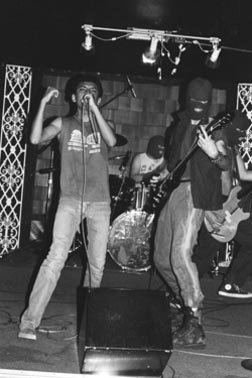
How do you think they reacted? Hahahaha! They HATED us. Especially in the South. The more intelligent people figured out it was political satire, and that what we were doing was ridiculously over-the-top. But we were banking on the more thick-headed ones getting it wrong, being offended, thus drawing more attention to the band. We were attacked by police, protesters, skinheads, right-wing radio hosts, left-wing college boy bands who were too caught up in their seriousness to get what we were doing, gangs, religious organizations, promoters…hell, Fearless Iranians From Hell album covers were even featured in PTA slide-shows portraying the evils of rock ‘n’ roll. Mission accomplished.

Political views varied between our band members, but Fearless Iranians From Hell didn’t have a specific political agenda. We did however have a common creative agenda. We purposefully garbled political rhetoric, so it was confusing to all ends of the spectrum. The band refused to do interviews at the time, which helped further the misinformation and confusion + there was no internet, so it was a lot harder for people to get the facts straight about who we were and where we were coming from.

We eventually went on tour, and did a few radio interviews in ’88 and ’89, and thought we had let the cat out of the bag. However, it appears many have remained uninformed. For instance, just a couple of years ago, some idiot posted a bounty on the heads of the band members on his web page. One of our lawyers had the site removed.

How did the fearless Iranians in your mythos (the world of characters created by your lyrics and cover art) end up being hash-smoking maniacs? Is this part of a satire of American artists who endorse drugs in their music?

The song “Iranian Hash” is a reference to Hassan-i Sabbah, who founded a group known as the Hashshashin. Hassan-i Sabbah was a Persian Nizari Isma’ili missionary who converted a northern Iran community in the late 11th century. Part of his indoctrination technique was to keep his young assassins stoned out of their minds on hashish. Of course, it’s also a jab at Reagan’s “War on Drugs”…a turn-of-the phrase, as the Hashshashin literally went to war on drugs.

You had four releases: a self-titled EP, the Die For Allah LP, Holy War LP and Foolish Americans LP. What were the differences between them, how did they “progress” if at all, and which is your favorite?

The 7″ EP was more mid-tempo punk. Lyrically, it was an almost rap-like introduction to the band, and featured the horrifyingly prophetic “Blow up the Embassy.” The first album, Die For Allah, was like a soundtrack to a movie. Much harder hitting, and faster-paced. The second album, Holy War, was the most raw and explosive. Having played live together for a couple of years at that point, the band were at the top of our game and were pushing everything to its extreme both musically and lyrically.

The third album was more studio-fied, verged on heavy metal at times, and along with the usual outrageous lyrics, contains some “serious” non-tongue-and cheek songs like “A Martyr in Every Home.” The band went into the recording studio knowing it was going to be our last album, planning to break up before we started repeating ourselves. Amir’s Farsi-spoken vocals on the last song, “Decade” were decidedly our final words to the world. No favorites. I look at all the albums as one single body of work, to be listened to in order.

Evolution of life, and the emergence of man, is a natural process in which chance, failure, waste, disorder and death will ultimately prevail. The entire destiny of the upsurge of life and all of its efforts have been enshrouded, from the beginning, by a cloak of “heat-death,” which, one day, will cut off the source of life — the sun. The very air we breathe is drawn from a thin film of atmosphere which hovers precariously over the seas and mountains and praises that have been pushed up for us to stand on.

– Raymond Nogar, The Lord of the Absurd (1966)

In an interview, you talked about an important concept — not “taking music at face value.” Face value, we assume, is what the music projects; are you saying that little in this world matches up to what it projects, or that its actual causes are different than what it tells you are its causes?

Americans, as a whole, have an underdeveloped sense of irony.

How did you get involved in playing and writing music?

We all came from different levels of musical appreciation and education. Our lead guitarist always had to tune our rhythm guitarist’s axe, because he never learned how. But that didn’t matter, because the music we were into at the time favored creative ideas over virtuousity. The Sex Pistols playing in our hometown, San Antonio, and the DIY punk aesthetic are what brought it all together.

How did the members of the Fearless Iranians From Hell meet?

Fearless Iranians From Hell’s first singer, Amir, moved to Texas with his family after the fall of the Shah of Iran, to flee the reign of the Ayatollah Khomeini. Amir made friends with the other outcasts in his American high-school, punk rockers who were in a band called The Plague. The Plague rotated lead vocalists a few times ( Amir may have even been the singer for a show or two ) before settling on a line-up and changing their name to The Marching Plague. The lead singer for The Marching Plague appeared as the voice of Anus Presley on the first Butthole Surfers EP ( the tracks “The Shah Sleeps in Lee Harvey’s Grave” and “The Revenge of Anus Presley” ) and, after joking with Amir that he should have his own punk band, wrote the first Fearless Iranians From Hell songs.

The first Fearless Iranians From Hell line-up, comprised mainly of Marching Plague members, would wear ski masks to both enhance the terror-rock concept, and so they could open for The Marching Plague without the audience knowing they were watching the same band twice. This line-up recorded “Burn the Books” for the “Metal Moo Cow” compilation, with Amir on lead vocals. Around this time, The Marching Plague, having released an EP chock full of notorius, made-to-offend lyrics, took an about-face, and influenced by the more positive DC scene, headed in an emo direction. Shortly thereafter, the Marching Plague’s lead singer left the band, devoting his full attention to Fearless Iranians From Hell, calling on ex-members of Prenatal Lust and Toejam to fill out the roles of his ex-bandmates.

Maximum Rock ‘n’ Roll magazine’s Tim Yohannan, who hated The Marching Plague’s un-PC lyrics, actually loved the live Fearless Iranians From Hell demo sent to him for review and recommended, “Get thee to a studio, or off with thy hands”. Fearless Iranians From Hell obliged, securing a record deal with the California label, Boner Records, home of Fang, The Melvins, Tales of Terror, etc. Before Fearless Iranians From Hell entered the studio, Amir suggested he be replaced by a more capable lead vocalist. Amir stayed on board as a songwriter, manager, information source, and spokesman. Amir also contributed vocals (the ones that were sung in Farsi) to the 1st and 3rd album. Before recording our debut album, the bassist who played on the Fearless Iranians From Hell 7″ was replaced by the Butthole Surfer’s first bass player.

How do you think our society uses icons like the Ayatollah Khomeini to make us live in fear, how does it benefit from that, and how does using those icons in over-the-top satire (like Jonathan Swift’s A Modest Proposal) change how things are done?

It’s the age-old cult tactic of making people feel that they are in imminent danger. It’s an instrument of control, and an insult to our intelligence. The Ayatollah Khomeini was bad news. No doubt about it. But the danger is in mimicking his behavior in our own free country, villianizing an entire race, and simplifying complex issues into a battle between “good” and “evil.” I’m not quite sure if “A Modest Proposal” or Die For Allah actually changed anything, or if we were just preaching to, and entertaining, the choir. You’ll have to find some Fearless converts out there to answer that one.

Do you feel genre is important, and that specific genres have specific conventions that make them distinct from others? What genre would you identify as that which encloses the Fearless Iranians From Hell? Did you call yourselves skatethrash, thrash, crossover punk or punk hardcore, or something else?

Conforming to a particular genre can be a good starting point…taking advantage of a popular movement to get people’s initial attention, but from that point you have to carve out your own identity, and leave the genre behind. When Fearless Iranians From Hell emerged, the flavor-of-the-day was hardcore punk. It’s arguable that we were an art-rock band, but we definitely wouldn’t have classified ourselves as that at the time.

Though I didn’t consider us skatethrash, half of the band were actually skateboarders, and our record label worked out a deal with Thrasher Magazine where you’d get a free Fearless Iranians From Hell album when you bought a subscription. We thought that was pretty funny: Fearless Iranians coming to America, getting infected by capitalism and selling out. It added to the confusion.

Did thrash music, which is what I’m calling the metal/punk hybrids like DRI and CRYPTIC SLAUGHTER, have its own style and val, ues that were separate from its “ingredients,” both metal and punk?

Living in San Antonio, which is known as “The Heavy Metal Capital of the World”, there was no escaping the influence of Heavy Metal. Being fairly isolated, the Texas punks took whatever info we could get on punk rock and often played it using the Metal musical vocabulary we were raised on, quite often parodying metal at the same time ( as on the Marching Plague EP, “Rock and Roll Asshole”). So it was kind of a love-hate thing.

Early Fearless Iranians From Hell, much like early DRI (circa The Dirty Rotten EP) didn’t have as much an obvious metal influence, but the Judas Priest-style riffing is still there. At the outset of Texas punk, the Punks, the Jocks and the Metalheads were all opposed to each other. I’m not sure if the fusion of the two genres/audiences was a good or bad thing. Maybe a bit of both, as Crossover brought people together, but resulted in a generic, cookie-cutter playing style for many bands.

What distinguishes art from entertainment, and if they overlap, is there a difference in goals between the two?

Funny you should mention that. At the time of the band, I was getting my degree in fine art, and approached Fearless Iranians From Hell as a work of art, so here’s the party line: Art can be entertainment, and entertainment can be art, but ultimately, art serves a greater purpose…well, at least that’s what the artist will tell you!

Do you believe music should be mimetic, or reflect what’s found in life, or ludic, and show a playfulness with life that encourages us to experience it in depth? Do the two ever cross over?

All of the above. Music should have no boundries in purpose, style, or subject matter. No rules.

In one interview, you say your goal is to insult every last person and every nation on earth; what do you hope to achieve with this act?

We did it for our own amusement.

The modern propaganda of commodities and the good life has sanctioned impulse gratification and made it unncessary for the id to apologize for its wishes or disguise their grandiose proportions. But this same propaganda has made failure and loss unsupportable. When it finally occurs to the new Narcissus that he can “live not only without fame but without self, live and die without ever having had one’s fellows conscious of the microscopic space one occupies upon this planet,” he experiences this discovery not merely as a disappointment but as a shattering blow to his sense of selfhood. “The thought almost overcame me,” Exley writes, “and I could not dwell upon it without becoming unutterably depressed.

– Christopher Lasch, The Culture of Narcissism (1979)

Should people be less ready to get offended? Are you trying to innoculate them against being offended?

Good point. Maybe so. Perhaps people should become more aware of their “buttons,” and how easily they can be pushed, so they won’t be manipulated by the button pushers.

Do you think Muslims and Westerners share any values, and are they misunderstanding each other? Is fundamentalism more of a religion than the specific religion it inhabits, or is it just another way of saying “conservative interpretation”?

Though there are obvious differences, I think we share more values than we’re often led to believe, however, it is convenient for many, particularly those seeking some kind of power, to perpetuate our misunderstanding of each other.

Did you ever study music theory or take lessons? Did this help you or slow you down in achieving your musical goals?

Our lead guitarist was taking Music Theory in college at the time. I had some formal training on guitar, but was a self-taught drummer. Our singer had piano training. The rest of the band were 100% self-taught. Since Fearless Iranians From Hell had both trained and self-taught musicians, there was always a tug-of-war between being a bit brainy, and keeping it simple. I think that yielded interesting results. Our basic concept was that any kid who picked up a guitar for the first time should be able to bang out one of our songs. The idea being that if you could play one of our songs on your guitar, you instantly related to our band, and felt like an insider.

Some have said that rock music is about individualism, or escaping the rules of society and nature to do whatever the individual wants to do. However, some have also said that heavy metal breaks with that tradition with its “epic” and impersonal view of life. Where do you fit on the scale?

Our goal was to tip the scale over on both sides.

Will Fearless Iranians From Hell ever re-unite to play shows, tour or write more material?

Do we really need to re-unite? I’ve received emails from several modern punk groups with 100% Iranian-American membership who claim that we inspired them to start their own hardcore bands. Some of them even cover our songs. But, hey…you never know! We’ve been offered some pretty good money to re-unite, but at the moment, we really don’t need the money. We’ve become business owners (you’d NEVER guess which businesses), teachers (That’s right, PTA, the Fearless Iranians From Hell have now infiltrated your educational system and are directly influencing YOUR children), and doctors (hey, our lyrics still hold true: Your life IS in our hands!).

Personally, I’m not a big fan of reunions. Especially punk band reunions. Who wants to see a punk “oldies-but-goodies show”? To me, it’s a contradiction of the punk aesthetic. Reunions are for bands like The Eagles. Fearless Iranians From Hell are a band from a certain time of history, about a certain time of history, but as you hinted at earlier, history keeps repeating itself, so our albums are still relevant today. Maybe even moreso than when they came out. Also, even though they deal with serious subject matter, the records have a sense of humor, and that has kept fans coming back to them over the years, as well as creating new fans.

Are you going to release the Fearless Iranians From Hell EP as well? Will the compilation of the 3 LPs stay in print?

Although Boner Records has not been putting out any new albums by new artists, it has continued to re-issue several of its top-sellers, so our first three albums can still be purchased on CD. For how long? — I guess as long as they keep selling. All three albums and the Fearless Iranians From Hell EP can be purchased in MP3 format from iTunes, etc. Also an album of Fearless Iranians From Hell demos and outtakes called Peace Through Power has just been released, and is now available from CD Baby and iTunes. Although there’s no talk of writing or recording any new material at the moment, there have been discussions about starting up an official Fearless Iranians From Hell website and selling t-shirts and other merch online.

Any plans to write books or articles about your experiences as the Fearless Iranians From Hell?

We’re being approached more and more often these days about doing interviews and telling our story, so who knows, if there’s enough interest maybe someday there’ll be an “I Was a Fearless Iranian” tell-all book…available at Wal-Mart! Stranger things have happened.

Open your chest welcoming death in the path of God and utter your prayer seconds before you go to your target. Let your last words be, “There is no God but God and Mohammad is His messenger.” Then, inshallah, you will be in heavens.

– Osama bin Laden

We are grateful to the Fearless Iranians From Hell for this interview. From the internet archives, we’ve pulled fragments of other interviews to keep alive the spirit of this iconic band. The text of those interviews follows.

SOUNDS magazine April 23, 1988

“Sam King talks terrorism with hardcore fanatics, FEARLESS IRANIANS FROM HELL”

The pop prophets of Fleet Street, ever anxious for a true story, appear to have found a new bete noire.

Fearless Iranians From Hell, an aggressive American hardcore band from San Antonio, are the latest victims of the Street’s pop pundits, having tastefully titled their debut LP “Die For Allah” and released it just in time for the recent hijack.

The band aren’t doing themselves any favours. Song titles include the title track, ‘Ultraviolence’, and ‘Blow Up The Embassy’. Lyrically, too, it’s hot, with lines like, “You will see that terrorism is the key” and “I’m going to hijack a plane / Won’t do it for glory or fame / when they catch me they’ll say I’m insane.”

Are FIFH provocateurs or just plain insensitive? Amir Mamori, an Iranian exile and the band’s singer, explains

“We want to show the Americans just how foolish they are. They want to see Iranians in a specific way and we’re taking their bigotry and stupidity and spitting it back in their faces.

“We may inadvertently be doing a lot of harm to the image of ordinary Iranians, by sticking so closely to the American stereotypical vision of them, but I’m not that worried. I have higher goals to consider.”

Do you feel driven to this?

“Definitely, I’m driven in the sense that there are points which I have to make. The funny thing is that people seem to think that we’re not really serious. In fact, we could hardly be more serious. At the moment there’s no bigotry in America that comes close to their feelings about Iran. Americans can’t understand or cope with the Iranian fanaticism and so they’re afraid of it.”

What about lines like “Terrorism is the key”?

“I don’t think terrorism is the answer, but I would say that I think it goes on on both sides. Innocent people are killed all the time.

“But if all people believe that all Iranians are beasts, then we will give them their ridiculous stereotypes and sit back and watch them make fools of themselves.”

NEW MUSICAL EXPRESS magazine April 30, 1988

“Gulf Balls”

NME kinda wondered if there’s anything you can do to help us with regard to Mr Terry Waite’s continued captivity in the Lebanon?

“I suppose”, muses the slightly foreign accent across the transatlantic phone-static, “We could do a benefit gig for him…in Beirut.”

Whaaaat??

Something’s gone sadly awry here. I rang Amir (main mullah of San Antonio’s FEARLESS IRANIANS FROM HELL) fully expecting to be scorched by a Koran – crazed, hostage eating psycho-child of the Ayatollah – and now the bugger’s gurgling about bloody charity shows!…

The source of this confusion is the Fearless Iranians’ LP which Big Takeover Records have just released on an unsuspecting Europe. Its cover is dominated by the glowering features of the Khomeini-monster and the unambiguous command / title ‘Die For Allah’.

The record itself — a procession of hardcore grunges with names like ‘Deathwish’, ‘Iranians On Bikes’, ‘Ultraviolence’ and ‘Blow Up The Embassy’ — crystallizes the worst nightmares of Ronnie’s America; wave upon relentless wave of death-defying Iranians traversing the USA (on bikes and in “Turbo Trans-Ams”), exploding in a ceaseless orgy of fanatical hatred and terrorism. It’s both mad and hilarious.

Could these guys, I trembled after a single hearing, be serious? Amir, Iran-born but US-educated, hoses down my wilder imaginings:

“Our stuff is not to be taken at face value. It’s designed to let an audience react in the predictable ways, to make fools of themselves.”

So you’re not the mad-eyed blood-caked Yank-slayers suggested by the record? Not even a teeny bit?

“No, not at all. We love what we do, but we don’t take it too seriously.”

Other people, however, most certainly do. A brief over-the-phone recitation of some of some of the choicer Fearless Iranian lyrics ( “Nuke the people / Kill’em dead / Come on, Ronnie / Give me head !” ) elicited a frothing reaction from Tory MP Harry Greenway : “They’re sick!…It’s an obscenity!…We don’t want them spreading their filth in Britain…”

Same story with something called the National Movement Of The Iranian Resistance: “To find a so-called pop group promoting terrorism is just appalling and revolting. If they were ever allowed into this country, we’d seriously consider picketing concert venues.”

Amir sniggers sheepishly down the phone: “So it sticks up people’s ass – that’s good. We have trouble over here, too – Americans are just so stupid. The Marine-types think we’re insulting their country and their president: the liberals think we’re insulting Iranians!”

So what’s the point of it all?

“Our ultimate aim is to insult every last person, and nation, in the world.”

No Comments

Son of Metal FAIL

When we let rip with our “Metal FAILs — Volume I,” people were pissed — mainly because we didn’t include their favorite fails. So in the grand tradition of whoring ourselves for populist acclaim, and thus perhaps thousands of grubby fingers clicking on the same links, we’ve brought you the sequel: “More Metal FAILs” or “Son of Metal FAIL,” depending on what you want to call it. We just call it not letting this abundant bushel of failure slip the noose. So without much further ado, here’s another heaping helping of metal FAIL:

10. Celtic Frost – Cold Lake

Years of being a metalhead will condition a bowel release when you see this album. Celtic Frost is one of the handful of bands who created a completely unique take on metal, and this album represents their moment of exhaustion with life and its deeper questions. “Screw it all, we’ll be a hair metal band!” While this record is clearly a fail, it’s a minor fail because while the music is dressed up as glam, the compositions would have fit seamlessly onto “Into the Pandemonium” without the vocals.

9. Death – Individual Thought Patterns

As in life, in music the time when you are most likely to screw up is right before your final victory. Death clawed their way up the ranks and after the superlative “Human,” appeared poised to take over metal entirely. Then out came this throwback to the pretentious, glammy, art-metal of the late 1980s. It’s basically reboiled Queensryche and Shok Paris, given a death metal edge, but under the skin pure heavy metal. Now the only people who like this album are drunk masturbators on guitar has-been forums.

8. Massacre – Promise

Alcoholism is probably to blame for this weepy, whiny, and downright creepy rendition of Massacre. Their first album was great brainless hard-driving death metal, and then they tried to get all emo on us, ending up simultaneously smug and as brain-bleachingly confessional as Facebook at its worst. This album was so bad it would bring an easy chair and a newspaper whenever it arrived in a used CD rack, knowing it would be there for a while… a long while.

7. Atrocity – Blut

Their first album was good cryptic death metal, and their second a feast of technical death metal that could compete with the American bands. Next logical move? Why, go Goth metal, of course, probably because after the 11th beer what record label execs say almost seems sensible. So Atrocity excreted this poppy, dance-friendly piece of crap, and now the only people who buy it are Germans, out of misplaced national loyalty. (True story: I found one at a garage sale in the distant suburbs two months ago, proving just how far metalheads will drive to drop off this furry turd.)

6. Cryptopsy – Whisper Supremacy

Riding high on “None So vile,” Cryptopsy was a sure winner… until this. Wanting to be both death metal and “different,” as their label probably kept whining for them to be, Cryptopsy invented proto-deathcore with this disconnected, jaunty, chaotic album. The same people who love Marilyn Manson and Slipknot think it’s pretty cool. I repeat… well, you get the point.

5. Terrorizer – Darker Days Ahead

Legendary band makes comeback album almost twenty years later. Quick, what’s the first thought that pops into your head? Legendary fail? That’s correct! Unlike the first Terrorizer album, which had balls and distinct songs, this collection of riffs sounds like these guys working around their drug habits, appointments for car repair, ex-wives and beer guts. Uninspired and wandering, this album will stun you into a stupor.

4. Sepultura – Chaos AD

How do you follow up to an album as classic as “Beneath the Remains”? You make a watered-down but more musical version, Arise. One of the ten billion things you did to that record was include a few seconds of tribal beats… so that’s your new direction, obviously. It wasn’t the quality songwriting, the epic riffs, or the powerful atmosphere: it was that tribal beat. So start making standard nu-metal with a tribal beat and hey, you’ve got your niche! Even though this album pre-dated nu-metal, the (Mordred) writing was already on the wall that this was how mainstream rock would take over underground metal.

3. Carcass – Heartwork

Famous for making gutter-level grindcore, you decide to make a frilly speed metal album like your older brother (you know, the one on methadone) might have liked. Most fans don’t know this, but this album is a collection of recycled riffs and cliches from the power metal bands of the late 1980s who didn’t make it. Just a few years later, Carcass decided to re-envision all that old stuff with their trademark vocals intact. The result is as painfully blockheaded as speed metal, and as inept as grindcore bands without a good topic to write on. Fail and forget.

2. At the Gates – Slaughter of the Soul

Wait, he must be crazy; that’s their most popular album! Yep, but if you made a graph of its popularity since release, you’d see it’s a steady downward curve. That’s because unlike everything else this band did, “Slaughter of the Soul” is an attempt to sound like other bands who made it big, just — you know — Swedishy instead. So it’s recycled 1980s speed metal with death metal flavor, like soda pop’s flavor is inspired by something that once tasted sort of organic. Now that we have dozens of melodic death metal bands, this FAIL just seems ordinarily bad.

1. Atheist – Elements

The number one dropping on our second list of bulging, greenish, corn-studded, mucus-sheathed turds is this raging FAIL from Atheist. This band is clearly one of the best in metal, and their first two albums are top notch. Then there’s this thing. Sounding like a Phish ripoff with occasional metal riffs, it fails like all progressive music does, mainly by being so busy jamming on cool stuff, man, that it fails to concentrate and write songs. So instead you get the kitchen sink: a little funk, a lotta jazz, some rock riffs, some metal, and then back again. Add the extra pretense of a prog metal album and you have a turd with an English accent, an emo livejournal, and a disorganized snobbery even us prog-metal fanatics cannot stand.

BandFAILs

Now, as an added bonus track to this blog posting, you’ll get more — BANDFAILS: bands who should never have existed or if they had to exist, should have stayed underground in mom’s cellar until suicide was the better option.

10. Weapon

We get it — all those years of black metal getting beyond its roots were too hard to re-do, so you’re going back to the roots as you see ’em, which is Venom. Nevermind that Venom sounds like clumsy NWOBHM, not black metal. Let’s re-live that past one more time!

9. In Flames

If you’re a Dissection clone, and the Dissection guy shoots himself, do you do it too? Might not be a bad idea. From their first derivative album, which sucked in comparison to everything else out at the time, to their recent awkward contortions in order to stay “hip,” this band have been like AIDS at a swinger party.

8. Origin

This comical deathcore band make really goofy songs, to the point that you think someone would say, “Hey, didn’t I hear that melody on a commercial for a 24-hour law firm?” But people seem to not want to notice, because someone in a magazine somewhere told them this band is the future of metal. If so, I hope the sun swallows us first.

7. Meshuggah

During your first year of guitar lessons, this band just seems killer. Man, listen to those rhythms. Then as time goes on you realize that (a) not much goes on in Meshuggah songs and (b) past the rhythmic technique, nothing they’re doing is particularly hard. So you’re listening to faux prog that really has more in common with a bad Exhorder or Vio-lence clone. Errr… I’ll pass.

6. Cannibal Corpse

This band makes experienced musicians weep through their laughter. A large musical joke, Cannibal Corpse depends on fans being stoned enough to think irony means pretending you like something really dumb because, you know, dumb is funny. That lets the band keep touring and buying the quality weed. When they “compose,” they buy the cheap weed. Repeat the same blunt-shaped metal riff and chanting vocal, then split for fast guitar and a breakdown, then repeat. This music demands nothing of its fans except they think it’s pretty funny, when you’re high. In fact, you have to be wasted on something to even tolerate it.

5. Opeth

Over a breakfast of fish eyes in milk one morning, Mikael said to his friends, “You know, metalheads have low self-esteem and like simple music. If we make simple music that sounds like it is complicated, it will make the metalheads feel smart, and we will be able to afford all the spandex we want!” So Opeth was formed, causing progressive rock fans everywhere to weep. The riffs don’t add up. The fans don’t care. They’re too busy thinking about how smart they are.

4. Cradle of Filth

If someone paid me, I could not design a bigger metal failure than Cradle of Filth. If a new metal genre comes about, try to make it as boring as possible by repeating the same old formula with the new vocals and faster drumming. Then again, if they hadn’t, we’d think they were just another piss-poor Iron Maiden clone.

3. Mortician

While just about no one remembers this band now, for some time they were the future of metal: basic riffs, no key changes, simple rhythms and a drum machine doing kickbeat drums at dirge pace. It’s as if Spock rushed back into the engine room, screamed “Set phasers for dumb!” and then let the ship’s computer write an album.

2. Necrophagist

Like Opeth and Cynic, this band survives by convincing people with little experience of music that they’re experts. Overnight, they become sophisticated aficionados of the difficult, obscure and brainier-than-thou art of technical death metal. But when you peel back the hype, you find very simple songs wrapped in layers of sweep, chug, squeal, repeat. Confusing this with quality metal is like admiring a painter who can paint cars really well, but sucks at painting anything else, so he makes who pastoral scenes out of Hyundais talking to Lamborghinis.

1. Pantera

This is it, friends… the metal doofus epicenter of the universe: Pantera. They started as a hair band, then were a Metallica/Alice in Chains crossover that hit MTB big time with “Cemetery Gates,” and then suddenly they became the metal equivalent of hip-hop. Songs about the hard life on the streets: Check. Marijuana songs: check. Violent, swaggering attitude: check. Songs based mostly on rhythm with occasional random melodic fragments: check. If these guys were more honest, they would have just been a Public Enemy tribute band called We Rule the Burbs.

For whiners

Yes, we know: you hate us, you hate them, you hate something, you’re bubbling over with rage at how someone on the intertard can be so wrong. Either that or you were reading ANUS once, came upon a word you didn’t recognize and instead of growing a pair, tip-toeing your fingers to dictionary.com and rising to the occasion, you wimped out with the chorus all failed people like to repeat: “It’s not my fault, you’re an elitist, it’s not fair!”

To all such people we say: Go whine up a rope, because the only people who like that kind of mealymouthed rambling are other failures. You can all go fail together somewhere. And maybe touch each other, but in the grand tradition of being in denial so you can fail more efficiently, you’ll insist you’re not gay… it has nothing to do with what Uncle Ted did to your peenor after he’d been drinking. If you’ve failed at life, it’s because you’re disorganized and cannot man up and face reality. Don’t blame us for your weakness; fix it. (Listening to the albums on this list will not help.)

People get bent out of shape about our opinions, but somehow it’s only the people who have nothing better going on. Humans of that type enter any situation with the goal of making it “safe” for themselves, meaning that they don’t want to hear about how some fail and some are great, only that we’re all accepted. We’re all the same and we’re all OK. That kind of bullshit, of course, converts thriving metal scenes into big circle-jerks where everyone accepts everyone else but ten years later, you look back and realize finally that all the music was thinly-disguised FAIL with smugness for bling.

No Comments

The poetry of metal

Writing good lyrics is part of having a complete song. In my view, a bad song with good lyrics is still bad, but a good song with bad lyrics is going to get listened to less because people want to avoid hearing the verbal stupidity. Metal has some amazing lyricists among its ranks.

Here’s one of my favorites:

Far away from civilization
A secret farm full of obscure persons
And full of weak cattle exists
Every morning the farmfather
Satisfied himself with the cattle
SODOMIZE THE WEAK creatures
Fatigo – it’s an everflowing plague
No escape from the penis of dead
No hope for all the dead chicks
Crucio – the same procedure everyday
The same thing the whole night
Sometimes, when travellers enter the farm
They won’t return from those pervert people
Get strangulated by the evil farmers
Get buried somewhere in the desert around

http://www.metal-archives.com/viewlyrics.php?id=84385

I wish someone would translate it to English, but it says it all. The metaphor is so rich, thick with nuance, and the language in protean contortions mimics the world it describes. If you’re a fan of 13th century Sicilian poetry, you’ll notice the sequential repetition of concept, which was considered desirable in that art form. Blending old and new, in a nod to our great living poets, its use of language in flux defines this as a top-notch work of poetry.

No Comments

The Ugly Side of Life is Pure Beauty for the Hessian

There’s a very nice short story from the booklet of Burzum’s album Filosofem that reminds me a lot of the misunderstood path that the hessian chooses as life:

Creeping And Crawling, Rustling And Fluttering

There are two natural lights in this world, the sun and the moon. The first distorts the appearance of the other, often until it is unrecognizable. The sun gives us colour, warmth and clarity, while the moon gives us no colour, coldness and unclarity. We live in the sunlight, and we make artificial sunlight, after Arvakr and Alsvinnr, send by Sol, have drawn down the sun in sea in the West, because we like colour, warmth and clarity. The starting-point of our reality lies in this light; when Naglfaris’ wife, Night, comes, our world disappears in a certain way. She is illuminated by a light, that we don’t like, the colourless, cold and indistinct moonlight. Strange beings show themselves in the woods and the people draw back into their reliable, small houses. Out there, only the forces of darkness reign, yes, in the most true meaning of the word. The world becomes a total different one, for some the world becomes a place worth living. For those, who want to challenge these giants, who are brought to us by the moon in the shape of uncontrollable powers of nature, the world finally becomes a place really worth living in.

Booklet of Filosofem (English translation), Burzum.org

We live in a world where light and darkness interact with each other to conform the whole of the universe with both its living and inanimated elements.

Most people in our modern era would like to see only the light and forget about the other side of the coin. In this way, humans become self-centered and irresponsible as we mentally split from any notion that would seem scary or unconfortable. Hell, we don’t even watch the killing that takes place to put steaks on our table. Hence, most of us fail to see any connection(s) between our actions and the ensuing negative consequences towards our world. Ever wondered why human society is so fucked up, like the lyrics of Napalm Death, Morbid Angel, Slayer and countless other acts have been telling us throughout the years? Because society is essentially an undifferentiated mass of people that agree on very few things, many of them childish and self-destructive, like this mentality.

That’s what metal sought to fight by offering a morbid, depressing and yet very real view of the negative side that our enlightened, yet pussified society tries so pathetically to hide from: war, plague, death, blood, guts, natural selection, Satan, witchcraft, environmental death, stupid religions, stupid secular beliefs and so on and on, the purpose of it impeled by this one thought: that the only way to live sanely is to recognize both sides of the coin and embrace them as equal parts of existence.

That’s a perspective that has been from the very beginning of the metal genre. Even its forefathers had this very death metal view of life:

We’ve all got this opinion about the world today, you see. We’re aware that, at some time, a big change is going to come. With SAD WINGS OF DESTINY, we’re telling people to enjoy life, but at the same time be prepared for something that could happen. Tracks like ‘Genocide’, ‘Tyrant’, ‘Epitaph’ and ‘Prelude’ seem to us to follow this idea through – they act as possible preludes to this change…

(…)

We don’t want to be set up as prophets or disciples; we’re just five aware guys stuck in the middle of a lot of complacent people. Now everybody enjoys life, but we think it should be brought to people’s attention that, at any moment, we could all be wiped out… We’re far from being pessimists.

Judas Priest’s interview with Sounds Magazine (May 8, 1976), Judas Priest Info Pages

Like the music they love, hessians firmly believe on the crude realities of individual mortality and the potential collective doom that could be triggered by our stupidity, irresponsibility and delusional beliefs: these are the strange beings that show themselves in the woods at night. Only instead of retreating to our comfy houses and pretend they don’t exist, we choose to face them.

It’s for this reason that hessians like to live their lives on the edge of things, sometimes by doing a lot of reckless behaviour, but mostly by having beliefs that are considered taboo by the majority of people. We embrace those taboos joyfully because they give life their meaning. Denying them is to deny life itself, and in this process we kill our souls and become faceless drones fighting for political power, money and other delusions given by the shadows cast by the fire in the chimneys of our warm, small and reliable houses.

No Comments

Tags:

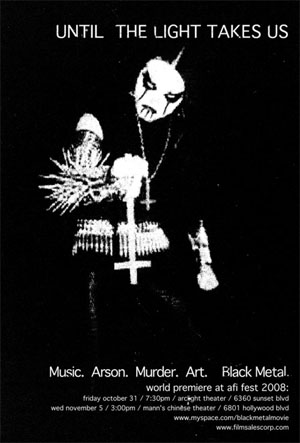
Interview: Audrey Ewell and Aaron Aites (Until the Light Takes Us documentary)

Over the last half-decade, metal documentaries have proliferated — there are now a handful, which is several fingers more than before. One of the more unique ones is Until the Light Takes Us, a look at the Norwegian black metal scene of the early 1990s, in that it attempts to understand not a phenomenon but the reasons it came about. We were fortunate to get a chance to chat with filmmakers Audrey Ewell and Aaron Aites, who answered these questions in a single voice through collaborative writing, as they took a break from a busy schedule of promoting the film so that it can achieve the crucial next stage of distribution.

What first attracted you to black metal as a subject? Are/were you a listener?

A lot of people seem interested in the fact that we don’t come from a metal background, and that’s certainly true. Neither of us were ever particularly into a lot of metal before (except for doom/stoner rock – things like Sleep, Sunn O))), Earth etc). But we do come from a background of obscure experimental lo-fidelity noise rock. I mean, the leap from something like Harry Pussy or The Dead C to Norwegian black metal isn’t exactly a gaping chasm. (In case you don’t already know this, a lot of the musicians in our film are also into stuff like this — Enslaved have even collaborated with Merzbow). It’s not like we were reaching for a Sting record and accidentally grabbed a Stigma Diabolicum demo. The driving similarity in all the music we love is that it’s intelligent in some way, and psychically or culturally relevant and usually extreme in nature. Whether by way of insanity, artistry, ideology, invention or what have you.

We were introduced to black metal by a friend (Andee Conners who owns Aquarius Records in San Francisco) who knew that it was something we were going to be into. We both really care about music, we had gotten into black metal, and we both just wanted to see a good film on the subject. That’s really how it started. We were looking for a good documentary on the subject and couldn’t find one. So it really just started as a way to find the answers to our questions, and to explore a genre that had deeply moved and surprised us, and which described an experience of being alive on this planet that had not before existed in this way.

What kind of research did you do for the film?

We researched extensively for a year. First, we bought every Norwegian black metal record we could find (as well as all of the precursor bands like Bathory Hellhammer/Celtic Frost, Venom etc.). We listened to everything, read all the lyrics, went over liner notes. Luckily, we’re pretty obsessive so that part was fun. Next, we sought out every magazine, fanzine, blog, book, newspaper and anything else we could find and compiled giant bound books of interviews of every musician that we wanted to talk to. These books were massive, they were like telephone books consisting solely of interviews by Norwegian black metal musicians. We also spent a lot of time on review sites like Markus Karlsson’s site, do you remember that? We loved his reviews, if you know how to reach him please put us in touch, we’d love to have him to do something for the DVD.

Did you prepare a project abstract first and shop around for funds in order to make the film?

Yes. Before we filmed, we went to Norway and wrote a fifty page proposal, a thesis essentially, of what the film would be. This took a lot of time. It was actually helpful in that it forced us to refine our ideas, to take into account what we saw around us and to plot the trajectory of the film, of which we had a very clear vision by the time we started shooting. It also forced us to do a second round of research, because in order to explore the ideas of globalization, postmodernism and dissent (ideas that we have thought from day one were relevant to black metal), we had to read up and be sure that our ideas were intellectually sound. One of the big resources for us was a book called Jihad Versus McWorld by Benjamin Barber. Another was The Lexus and the Olive Tree by Thomas L. Friedman. These guys are both cultural theorists and economists, who come at things from a markedly different perspective, but both deal with the struggles of retaining cultural identity within a globalized society, and the tension this creates.

The other big reference point was post-modernism and theories of simulation and simulacra, essentially the idea that a thing can be transformed out of existence if it is copied inaccurately enough times. That the sheer volume of incorrect copies can overwhelm the original truth, until the original truth becomes a sidenote in history, and the degraded or even just altered copy becomes the reality. People ask us all the time if we like current black metal bands. As far as I’m concerned, it’s a trick question. Yes. And no.

What kind of reactions did you get from people when you explained what you intended?

From people that we were trying to raise funds from, or from the musicians? Funders did not get behind this movie until we had done a substantial amount of filming. There were some amazing people who helped and supported us, but we spent a year trying to raise funding and it just didn’t work. Norway was willing to fund us but there was a catch: the movie would have to be about “American filmmakers who go to Norway to investigate black metal.” It would have to be as much about us as about black metal. Um, no thanks. So we scratched and scrambled, begged and borrowed, and ran up our credit cards to get to the point where we could raise finishing funds. We turned down hundreds of thousands of dollars because we weren’t interested in making the movie that they wanted us to make.

With the musicians, it differed. We clicked with Gylve instantly, and he agreed to be in it right away. He was the first person we approached, and I think that helped to establish that we hadn’t just read Lords of Chaos and hopped on a plane.

It would seem to go without saying that a film about Norwegian black metal has to have Gylve, Varg, and hopefully Hellhammer. Just, period. Or it’s just fatally flawed. Gylve and Varg, with Euronmyous, CREATED Norwegian black metal. It would not exist were it not for the three of them each playing a distinct and crucial part in the formation, codification, and dissemination of the genre. There are certainly other great musicians who have contributed a ton to the genre, but it was the originators that we knew we needed to talk to.

We clicked with Gylve immediately, we spent less time with Hellhammer but have great affection and respect for him, and we were prepared to stop at any time, fold up, go home if we weren’t able to get Varg’s participation. We knew it would be very hard. We were relieved when, after eight months of correspondence with him, he finally agreed to meet Aaron. We were pretty confident that if we were given that opportunity we would be able to get his participation, and we did. I admit though, it was a relief, because by the time that happened, we’d been in Norway for eight months and had spent an awful lot of time and money on the film. He used to write us letters that stated that even if we made exactly the movie that he himself would make, he STILL wouldn’t be in our movie. Those were hard letters to get. But we kept on with it, and finally he agreed. Once he actually met Aaron and talked with him and was able to see where we were coming from, it was not at all difficult. He was very open and forthcoming, except in cases where for legal reasons he couldn’t say certain things on camera. Obviously, we can’t and won’t repeat any of that either. But even when he couldn’t state things, he would allude to them. He was very open with us. Of course you can’t blame him for being initially wary. He felt that he had been burned (no pun intended) by the international media circus that erupted in the early 90’s. But we were able to convey to him what our intentions were, and once he realized that we were not there to make a quickie hype piece, and that we’d actually researched the hell out of everything, and I think just based on who we are, he agreed to participate. And we think that he would agree that the film is fair, and most importantly, honest.

Is it expensive to make a film of this nature?

Of this nature — yes. Hundreds of thousands of dollars. A big part of the expense was just the day-to-day cost of living in Norway for two years. But that was necessary. We had to spend time with the people, establish trust, etc. It wasn’t interesting to us to make a film that skimmed the surface. We wanted the film to be from the perspective of the musicians looking out from the inside. For that to be possible, we had to be inside.

Were metal fans and bands cooperative, for the most part?

We didn’t talk to many fans for the purposes of making the film. This isn’t like other movies about metal. But, literally everyone we met was extremely helpful.

The eye may be said to owe its existence to light, which calls forth, as it were, a sense that is akin to itself; the eye, in short, is formed with reference to light, to be fit for the action of light; the light it contains corresponding with the light without.

We are here reminded of a significant adage in constant use with the ancient Ionian school — “Like is only known by Like”; and again, of the words of an old mystic writer, which may be thus rendered, “If the eye were not sunny, how could we perceive light? If God’s own strength lived not in us, how could we delight in Divine things?” This immediate affinity between light and the eye will be denied by none; to consider them as identical in substance is less easy to comprehend. It will be more intelligible to assert that a dormant light resides in the eye, and that it may be excited by the slightest cause from within or from without. In darkness we can, by an effort of imagination, call up the brightest images; in dreams objects appear to us as in broad daylight; awake, the slightest external action of light is perceptible, and if the organ suffers an actual shock, light and colours spring forth.

– Johannes Wolfgang von Goethe, Theory of Colors (1810)

What equipment did you use — were you shooting direct to digital, using film, etc? How did you edit?

We shot on 35mm and PAL minidv and edited on AVID (telecine to tape for the film parts), eventually outputting an HD D5 master, from which we make copies in other formats as necessary. Our original intention was to end up with a 35mm print, but expenses were too great, we couldn’t do it. The film industry imploded a few weeks after our festival premiere in LA 8 months ago. The pressures of the economy, combined with some industry specific factors, drove it into the ground. Six of the top independent film distributors went out of business nearly overnight. Ripples went far and wide, those that were left became extremely conservative in what they would fund or distribute. So the money to transfer to film just wasn’t there anymore.

How long did the whole project take?

Many years. I don’t like to talk about how many. It disturbs me. A lot of my life has gone into this. Aaron got very sick as well and we had to take a year off while he had surgery and recovered. We also had to spend over a year raising finishing funds when we got back from Norway. Luckily, we found that in two great companies who have been very supportive of us and of the film, even in this horrible climate for independent documentaries. We would not have finished without their (continued) support. And we found an editor, Michael Dimmitt, who loved the project and agreed to work for deferred pay. He also made it possible for us to finish the film. He actually hasn’t been paid yet, and that sucks and we feel crappy about that, but he knows we’re good for it. It takes a lot of dedicated people to make a film like this. And we’re so grateful to everyone who has helped us.

What were some barriers you ran into?

Money, health, equipment problems, time. I’ve had a job consistently since a few months after we got back from Norway. Aaron was ill and I was trying to support us, as well as raise money to finish the film. That was a horrible time. It lasted for over a year, and it is a very dark period in my life. I was extremely depressed, as was Aaron, and it felt like we were never going to be able to finish the film. We finally found the funding and support we needed in two companies, Artists Public Domain and The Group Entertainment, and were able to start editing. It took six months just to digitize and log our 350+ hours of footage. Finally, moving forward! Then our system crashed. We lost it all. That was so disheartening. We took a break, regrouped, got a new editing system and editor, and started over, half a year’s work down the drain. It took about two years to edit the film, we had so much material and even though we knew what we wanted, it was difficult to achieve. We were both working at this point, so our free time was very limited, and it all went into the film. I’m not complaining, but there are years of my life dedicated solely to surviving and making this film.

Is it expensive to distribute a film so that the DVD is available on Amazon and in stores? Do you have other options to pursue for distribution?

Well, if you make a quickie movie with a small budget and don’t invest that much into it, you can do things like release it straight away on Amazon and platforms like that. If however, you do what we did, which requires a huge investment of time, money and work, then you can’t and don’t want to do that unless you have no other option. We are currently hundreds of thousands of dollars in debt on the film. We have investors and co-production partners who did not give us nor loan us the money, they invested it in our film. So that’s one aspect of why we are committed to doing a proper release of the film. In order to legally be able to release a DVD, we have to first pay about $50,000 in outstanding expenses. So, that’s just a reality we’re dealing with.

The other reason is that this is a creation that we have made, and there is a certain way that we want it to be presented. The film is about black metal, but we also deal with wider issues and it is relevant to the larger culture, not just fans of the genre. I am a filmmaker before I’m a fan, and a person before I’m a filmmaker, so there are a few masters that I serve when I make something. This is a communication between us and the world, and if there’s one thing I’ve learned from making this film, it’s that if you don’t control your creation to the utmost degree that you possibly can, you lose your ability to do so very quickly. We refuse to see this released in an exploitation context. This is an art film, and if people want to cheapen it, we will make that as hard as possible for them to do. Some people do, by the way, want to cheapen it, just like they want to cheapen metal in general.

Have reactions differed between metalheads and mainstream audiences?

It’s mostly metal fans who have seen it thus far. With our sneak peek screenings, what we have attempted to do is bring the film to places with interested metal scenes and give them a chance to check it out first and give us a chance to get feedback from them. And so far, the reaction from fans has been really great. 95% of them really like the film. Even the ones who thought they weren’t going to like it. You don’t know how many times we’ve heard “I was really worried that I was going to hate the movie, but I’m happy to say that I thought it was incredible.” Mainstream audiences are more mixed in their reactions. Some of them get angry that we don’t make the musicians look like complete assholes or lunatics. But the reactions from non-metal fans has been mostly positive as well. Especially from those who like dark underground films.

What are your hopes for this movie: what should it accomplish, who will see it, where will it fit in our pantheon of culture?

I think it is the best documentary about a music scene ever made. You can quote me on that. It isn’t like anything else. It is not a balls to the walls expose of youth gone wild. It is not sensationalized, nor exploitative. It is elliptical. It is a contemplative look at the evolution of the creators of a scene that has all but morphed out of existence, at the forces in the culture that brought it into being, and the forces of culture that take it into a different place in the culture’s conscious (or unconscious). It’s about mechanisms in society that eradicate authorship, identity, intent. It’s about black metal, a scene and genre of music that deserves to be accurately recorded, once and for all, for whatever place in history it will take.

Beyond that, as filmmakers, we want it to be a work that resonates with the audience. The filmmaker who has had perhaps the biggest influence on me is Chris Marker. While our film deals pretty solidly with a story and characters and a time and a place, it also borrows from Marker the notion that a film can be more than the sum of its parts and that you can weave together seemingly disparate elements and timelines in a traditionally clear-cut documentary mold and create something that will hopefully resonate on levels beyond a linear re-telling. That was our goal anyway, or at least part of it. Hitting the tone that we wanted and striking the balance between telling the story of real people but also getting at the truth at the center of the story, while also exploring the other themes that we see as part and parcel of the story, was always going to be a challenge.

We also know that the contemplative tone and elliptical structure is going to piss off people who think that a documentary about metal should be a certain way, or done in a certain style. Our film isn’t like other works that people would superficially be tempted to lump us in with. I hope that eventually the film will be perceived as a unique work of cinema, valuable as a document of a music movement and a moment in time, but also valuable as a creative work in its own right.

Well, you can’t be objective when you’re dealing with passionate situations, politics and so forth. I guess you can, I never have. For instance if you were objective about Richard Nixon, you would never get him or understand him. You had to be subjective to understand Nixon. You have to be subjective to understand the Hells Angels.

– Hunter S. Thompson, interview with Freezerbox magazine (2003)

Do you think black metal is a subculture in itself, or solely a genre of music? An ideology?

All of the above. It is a subculture, sort of, but one made up of individuals if that makes any sense.

What kind of audience response is required for a distributor to be interested?

We have to reach a wider audience to make the expense of making it make sense to a distributor. And we want to reach a wider audience, because it is a smart and moving and relevant film that deserves to be seen. Due to the collapse of the indie film industry, we’ve had to really think about a way to make this all work. Our current plan is to show the film theatrically at these sneak peek screenings and festivals that we’re currently doing. This does a couple things: 1) Lets the theater bookers know that the film does have an audience, and that they won’t lose money if they book it. 2) Lets DVD distributors know that we will work like that crazy to make it worth their while, and again to prove that there is an audience. And 3) to get a break from all these people writing us all the time telling us to release the film or bring it to their town already!

We get A LOT of requests to bring it to places all over, we plan on bringing the film around the US for special engagements through September, then we’re going to Europe in October, premiering in London at the Raindance Film Festival in October, then bringing it to a few more countries before we head back to the states to finish our theatrical run in the fall. A lot of people have been asking us to bring the film to various countries, and we’re trying, but some are very hard. Like France, they basically won’t screen the film without French subtitles, and we don’t have the money to have it subtitled. But we’re working on these things! We actually listen to the people who write to us and we try to set up screenings wherever we can. I’m actually slightly terrified by some of the ones we’ve set up, I mean is anyone going to go see the film in Atlanta? I really don’t know. But a couple people wrote and asked us to do it, so we set it up. So, I hope so. It’s a gamble. Failure at any screening is very damaging, this is a truly stressful process.

By the way, one thing I should point out. Probably a lot of your readers, who are immersed in the metal culture, look at our film and think “this thing will sell a lot” but believe me, distributors etc. look at it and say “what the fuck is this?” The metal market is a small one by film standards, and not large enough to justify the expense alone (for distributors). Even people who like the film tell us that the film is great, but they have no idea how to market it. So we have to show them that we do. So, that’s the plan. Time will tell if it worked.

Would you want them to show this film on prime time cable?

I want people to have the option of seeing the film in a theater first. Magic and ritual and mysticism is all but gone from the world already, but there is something of that surviving in the ritual of seeing a film in a darkened room with a bunch of people there with the same purpose. Maybe you think that’s dumb, but you don’t become a filmmaker if you don’t respect the power of the medium. And no, that doesn’t apply to all films. A lot of films can be appreciated just fine on DVD only! But my hope is that people take something from the experience of seeing the film in a theater, and leave thinking about it, or talking to their friends, because the film is not as straightforward as some might think before seeing it. We tried to make it multi-layered, and I think we did. It’s meant to be watchable more than once, because there are things that might not be apparent on the first viewing. And that’s true of all my favorite films. But, then, I truly love film! I’ve seen some of my favorite movies countless times, and will see them countless more! And as I change, I see different things in them. A film can function as a statement, as a record, as a cipher, as a puzzle, as an experience, or as a mirror. Or all of them.

Did your attitudes toward metal bands and fans change?

Not really. We are fans ourselves. All fans are different. The film is very specific to Norwegian black metal. It isn’t about the fans. We’ve found the fans, by and large, to be really engaged, smart, and generous. There are always a few people who say that they will never see this film no matter what because they can’t conceive of the possibility that it just doesn’t suck. And that’s fine. There are about half a million movies that come out every year that you couldn’t force me to watch. Then there are a few who say that we should be punished for not releasing it on DVD sooner. That’s retarded. Let them go put their entire life, all of their money, all of their time, and make their own movie and then we can talk.

Anyway, this is like people who get upset because we didn’t include certain bands or certain people, or that there aren’t American bands in the movie, and I just can’t relate to that mindset. Usually I just tell them that sounds like a really great idea for a movie, go make it. What are we supposed to say to this? Did people get angry at Spielberg when he didn’t put giant squids, barracudas, piranhas and sea-snakes in Jaws? This isn’t an encyclopedia. It isn’t journalism. It’s a movie. It’s OUR movie. It’s what we combined to make. There are an infinite number of possibilities, people create what they are moved to create. We were moved to make this, and we’re happy with the film that we made. Most people who see it are happy with it too. And if they’re not, that’s fine too, I like that some people hate the movie, I think that’s healthy. Love it or hate it, a strong response is a victory. Of course, I can say that because so far, most people have loved it. I might feel differently if more people hated it!

Do you see comparisons to other genres and black metal?
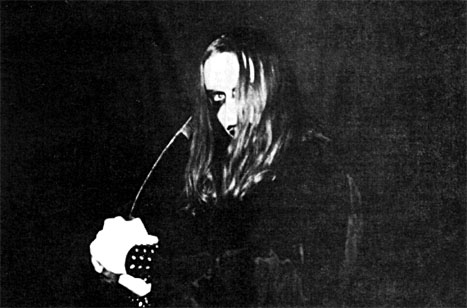
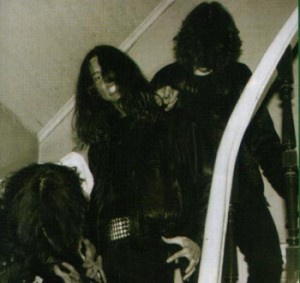
You can compare anything to anything else. You can compare a grape to a Ford Taurus. You can compare Einstein to the A-Team. Of course you can compare other genres to black metal. And of course, being a huge fan of black metal and other kinds of music, I see comparisons. But that’s entirely subjective and totally irrelevant. We aren’t doing that. We don’t talk in the film. The idea of the film is that the musicians themselves are the ones who are talking about it. Not cops, not priests, not fans, not musicians of other genres, and not us. Some metal fans call us hipsters (only on blogs mind you) because we like more than metal. That’s absurd.

Do you think black metal was a moment in time, or will it continue to exist like other heavy metal?

Both. Things change. There was certainly a lot of music that inspired the Norwegians and they in turn inspire others.

What other films have you done, and do you plan to do?

Our next film is a thriller that takes place on a commune. I was born on a commune. They can be a bit cultie. Some are stranger than others. Our film will have some supernatural elements as well. We want to call it Possesion, but there is already a great film from the 70’s with that name. So its working title is The Living Day.

You seem remarkably gentle when handling metalheads. What do you think is the psychology of the average metalhead?

I don’t really put people into different categories like that. A lot of my friends are “metalheads.” To a lot of mainstream people, I’m a “metalhead.” To others, I’m a hippie. I don’t believe that there is a generalized psychology to any subculture. There are so many factors in making a person like one thing over another, and so many differences within subcultures. If there is a similarity amongst people we’ve met in the scene it’s a certain interest in looking past the surface of things. Always a good idea.

What would you advise a first-time watcher to do as they see your movie?

Let the movie’s logic do its thing, don’t come with expectations or an agenda.

Art is a creative act. Paul Klee said that art does not simply render nature, it renders it visible. The artist sees something that others do not see, and by seeing it and putting it on canvas, he makes it visible to others. Recognition art. A particle physicist at the University of Texas named John Wheeler has developed something that he calls “recognition physics.” Wheeler says that nothing exists until it is observed. Well, the artist as observer is like that. The observer creates by observing, and the observer observes by creating. In other words, observation is a creative act. By observing something and putting it onto canvas, the artist makes something visible to others that did not exist until he observed it.

– William S. Burroughs, interview in Contemporanea (1990)

1 Comment

Ur-Tod – on the birth of death metal

Something like the problem of transubstantiation for the church fathers, the birth of death metal, who did it and where, is one of the prime causes of contention of metal messageboards across the world. Some give credit to Venom‘s blasphemies and chaos that were basically Motorhead with less technique and more sluts, ca. 1981. Thomas Gabriel Fischer‘s Hellhammer, formed in 1982, was an extreme entity from Switzerland that explored the furthest reaches of negativity and doom, guitars tuned low and vocals devolving into grunts and screams. Around this time the same guys also started a fanzine called “Death Metal”, later to lend their logo to a 1984 compilation of Noise Records bands, including Hellhammer. Around 1983, still not more than two years after Venom’s “Welcome to Hell” and the same year Mercyful Fate and Metallica would debut, Kam Lee of Mantas (pre-Death) and Jeff Becerra of Possessed were utilizing growled low vocals from the bottomless depths of Hell and elements of death metal guitar (tremolo and chromatics) and drum technique (blastbeat) that are staple elements of what consist a normal death metal album today.
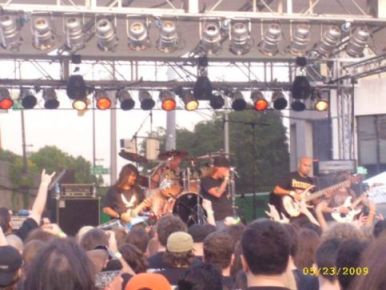
I went to high school with Jeff Becerra and Larry Lalonde. They actually recorded and released ‘Seven Churches’ when we were in school. I even had a copy of the demo. I read all the time people citing that album as one of the first Death Metal albums and that they helped start all that. I seem to remember those guys being really into bands like Destruction, Venom and Celtic Frost… but I guess Possessed took it a little further. At the time I didn’t think it to be the start of anything.

– Mark Peters

The above quote from the Peacedogman forum highlights the essence: bands were taking the influence of the previous generation of bands into areas that seemed so natural to them that they were not thinking of going out of their way to create another “experimental” genre. Thinking about thrash and thinking about death metal in their pre-trend incarnations is mostly an invention of the historians – it’s best to focus on the organic development of metal over time and remember how people unrelated to each other stumbled across the same kind of approach independent of each other. To celebrate the diversity and energy of this formational period when speed metal bands were discovering the praise of death and invocation of satanic forces, one could do worse than listen to this old school death metal compilation created by Fenriz for Vice Magazine – it’s in fact a good supplement to our article on the history of Norwegian death metal, because it represents both the contemporary sound of Sweden and the various evil conjuring voices from around the world that these kids heard by tapetrading, thus influencing their sound.

Written by Devamitra

1 Comment

Tags:

Maryland Deathfest VII in Baltimore, Maryland

Maryland Deathfest VII
May 23, 24 and 25, 2009
Sonar, Baltimore, Maryland

The summer metal festival — Europe has a number of them: Obscene Extreme Fest, Party San, Wacken. Seemingly long gone are the days when North Americans had their own Milwaukee Metalfest to make pilgrimage to at the end of every summer. Fortunately, after several years of festival lull, two metal fans decided to put on a show that featured “real” metal bands again.

The Maryland Deathfest is now an annual event that takes place for three days near the end of May. This past year featured an impeccable lineup, perhaps the very best seen at MDF thus far, a strong hint that quality and old-school death metal and grindcore remain vital forces in the greater metal world.

After making the trip down the coast to Baltimore a day early, my cohorts and I decided to attend the pre-show for a mere ten dollars. Not much was of note during this “pre-fest”. Czech grindcore band Jig-Ai showed themselves as instrumentally competent, and able to cook up a good riff, but a lack of dynamics and irritating pig squeals prevented their music from being enjoyed further. Following Jig-Ai came a few more bands that were not significant, so relaxing outside in the cool spring night was much preferred.

It was not until Lethal Aggression that the pre-fest picked up. This reviewer had never heard said band before, but they presented a charming fusion of crossover thrash, early grindcore, and the best of hardcore punk. It could be likened to Cryptic Slaughter mixed with Siege and a hint of speed metal. Their performance was quite spirited, and the band ripped through an assortment of songs with professionalism and an impermeable cohesiveness as a group.

The headliner of the night was Ghoul, a “supergroup” of sorts made up of members from Exhumed, Impaled, and Dystopia, among others. Musically, this outfit melds together speed metal, hints of death metal riffing, and a surface aesthetic very much like Danzig-era Misfits. From their ridicule of the new, ridiculous “retro-thrash” trend to their spraying of liquid all over the audience in a bottle labeled “swine flu,” their performance did not disappoint for pure satirical entertainment.

Day One

Despite the “deathfest” name, grindcore has always figured prominently into Maryland Deathfest’s festival repertoire. The grindcore scene, as with death and black metal, has come upon hard times, with very little of excitement being generated. Still, this general trend was not enough to prevent several fantastic grindcore bands (as well as a few merely good ones) from appearing on the Friday bill.

Following a good night’s sleep, my cohorts and I met with up with other friends from around the city and trekked back to the venue. It became readily apparent that Sweden’s blast-and-forget black metal crew Marduk would not be playing, due to troubles concerning their visas, which was of little loss to festival quality as a whole.

Instead, the outdoor stage schedule was modified to include Cephalic Carnage, and the indoor show would end earlier than planned. The first band of my day was Sayyadina, who sounded much like a more aggressive Nasum. The Swedegrind sound has never been terribly interesting, as most bands who are involved with it are wont to make it much too technical and polished. This contrasts readily with the unrefined edge required of grindcore; instead the entire experience is spoiled with a big budget and nice, “clean,” rock-n-roll production. Fortunately, based on their live performance, Sayyadina seem to integrate much of the early 1990s American grindcore style into their take on the genre. The downside would be their insistence on blasting — way too much of it — and not enough variation in rhythm. Further investigation will be needed to determine this band’s ultimate listenability.

Perhaps unsurprisingly, the most anticipated band of the night was Mayhem. The band took the stage and opened with “Pagan Fears.” What was immediately apparent were two things: the first being how truly inhuman Attila Csihar’s voice is, and the second being that the sound engineers had absolutely no idea how to mix black metal in a live setting. The guitars were so unbelievably screechy that I had to move back from the stage in order to prevent my eardrums from imploding. Apart from this problem (which was only partly fixed roughly halfway into the set), Mayhem delivered a commendable performance, with plenty of highlights (“Deathcrush”; “Freezing Moon”), and even a very surprising presentation of the title track off De Mysteriis Dom Sathanas. Atilla’s presence was undeniable, almost messianic, as he warped his vocal chords into his own plaything: screeching, bellowing, chanting, and growling to great effect. The two new guitarists had a decent understanding of Mayhem’s material, apparent despite the detriment of the horrific sound.

One strange thing to see was how many people turned up for Mayhem, and how about half of them looked like they had never heard the band in their life. Given Mayhem’s controversial past, one might be inclined to believe that half of the people there were just turning up in the hopes of seeing some immature novelty act. Further proof that in the underground metal world, hipsters unfortunately abound.

Up next was the legendary Dutch death metal group Asphyx, playing their first-ever American show, which was accompanied by a unanimously great reception by the large crowd. For the occasion, they were given the honor of wrapping up the first day of the outdoor stage. Vocalist Martin Van Drunen, though becoming a death metal gray-hair, was easily one of the most engaging and sincere frontmen this reviewer has had the pleasure to see live. His banter with the audience and habit of high-fiving crowd surfers contributed to the sense of fun that permeated Asphyx’s performance. In blazing through several tracks from a variety of studio albums (save for the embarrassing God Cries), Asphyx even managed to play “Abomination Echoes” from the Crush the Cenotaph demo. Unfortunately, Mayhem’s longer-than-anticipated set forced Asphyx to cut theirs short in accordance with the ludicrously early outdoor sound curfew of 11 pm. Ending with the massive title track offThe Rack, the sound engineers axed the power to the amps with only about a minute left in the song. Coincidentally, the original recording ends by fading out, so in essence the audience was able to experience a full studio version of it. Asphyx bowed off the stage to massive applause.

Upon heading inside, I caught the set of crossover/hardcore “supergroup” Venomous Concept. Made up of half of Napalm Death and half of Brutal Truth, this quartet retains interest through their exploration of embryonic extreme metal and hardcore styles. A very energetic and very intoxicated Kevin Sharpe kept the crowd on their toes, even cutting his forehead open after smashing it with the microphone. After pummeling their way through a half-hour set, Venomous Concept left the stage, and this reviewer hiked back to his hotel room.

Day Two

The next day, feeling energized and with ears freshly ringing, my group headed down to Sonar for day two of the festival. After skipping over the many bands of no interest, the first band of day two we encountered was P.L.F. (formerly known as Pretty Little Flower, now apparently going by the name Pulverizing Lethal Force). This Texas grindcore trio was highly impressive with their regressive style, revealing influences from the best of the genre, chiefly Assuck andTerrorizer. The singer/guitarist joked that their merch was available in the back room, and that they brought plenty of long-sleeved shirts, as only true Hessians wear them in such obscenely hot weather. Despite a very short set time, P.L.F. managed to rumble through their setlist with a few minutes to spare, and received mostly positive reactions from the audience.
Since the next batch of bands was not of interest in any way, my friends and I skipped them in favor of finding some food, after which we returned to catch Sweden’s Rotten Sound. Although one may look upon them unfavorably because of their association with the Nasum/groovy-grindcore scene, Rotten Sound are not, sonically at least, deserving of such condemnation. Their music is like Dead Infection or Sweden’s Dawn: wholly unoriginal, but executed in such a manner that one cannot find much fault in what they do. Their brand of grindcore is much more “British” (for lack of a better description), in that it takes more influence from early crust and hardcore than it does groove metal.

Following Rotten Sound, this reviewer chose to relax in the shade with a cool water and rest while Hail Of Bullets played on stage. Their album was not impressive in the slightest, and neither was their performance, despite the ever-present charm of the previous night’s star vocalist Martin Van Drunen. It is quite probable that if the lineup did not include such prominent members of the death metal scene, the album would not have received a second thought or listen by anyone.

Thankfully, Brutal Truth took to the stage next, alleviating the crushing boredom wrought by Hail of Bullets, immediately stirring me from my needed respite. Bassist Dan Lilker commented that his throat was hoarse, and he would be unable to do backup vocals; luckily, their performance was not hindered by this revelation in any way. Frontman Kevin Sharpe, sporting a nice cut in the middle of his forehead from the previous night’s on-stage chaos, was as engaging as ever as the band merged classic and new in a seamless display of veteran competency.

After a short stint of watching Misery Index (who were capable, though nearly totally unfamiliar to this reviewer,), the ever-anticipated Immolation was up next on the outside stage. Baffling is the fact that Immolation is not a more recognized band in the death metal community; they have been together for over two decades, and have received a good deal of praise and notoriety, but when the heavy hitters of the genre are mentioned, Immolation is rarely on the list — modern audiences seem, unfortunately, to be fixated on flashy technicality, blast beats and other novelties rather than on songwriting, one of the talents at which Immolation has always excelled.

A highlight of Immolation’s set was a favorite off of Dawn of Possession, “Into Everlasting Fire.” Unfortunately for them, equipment problems at the beginning of their set forced the band to shorten their playing time. Nonetheless, their performance was top-notch, and those who have not witnessed them in a live setting are truly missing out on one of death metal’s legendary acts.

Atheist was poised to perform shortly thereafter on the outside stage. The long-awaited return of Atheist was most certainly a reason for many who attended MDF. Before their initial arrival, the feeling that one was about to hear such classics as “Mother Man” and “Piece of Time” in a live setting seemed almost unreal. Despite this overwhelming anticipation, it seemed almost immediately that their performance that night would be good, but not great, as might be expected on such a fortunate occasion from these exemplary musicians. Vocalist Kelly Shaffer (who, thanks to his well-known tendonitis affliction, was not playing any instruments) apparently smokes a lot of cigarettes, and it showed in his strained performance almost as if it hurt him intensely to do his characteristic snarl. Despite the slight disappointments, it was a welcome sight to see Atheist performing together again, and musically there were few real mishaps.

Up next outdoors was one of the bands that I specifically wished to see: Napalm Death. Their material from 1985 to 1992 is some of my favorite music from any genre. After that period, a lot of mediocrity and occasional awfulness plagued the band. More recently,The Code is Red had enough fire in it to be a moderately enjoyable album — a breath of fresh air for old time fans. Despite their last two albums feeling more like a band having totally given up, rather than one whose enthusiasm and creative drive are intact, I was still eager to see them perform. All-time classic tracks — “It’s A! M.A.N.S. World,” “Deciever,” “Life?,” “Scum,” “The Kill,” and of course, “You Suffer” — were battered through with the confidence and poise of professionals clearly beyond comfortable with their abilities, inducing the crowd (including myself) to a violent moshing melee. With luck, this confidence will shine through in future recordings to provide the element of desire that has been conspicuously absent in their latest works.

The final performer on the outside stage at MDF was none other than England’s Bolt Thrower. After years of prodding by the event organizers, Bolt Thrower was finally convinced to cross the pond to headline Saturday’s show. A quick glance around the concert area told me that Bolt Thrower had quite possibly drawn the largest crowd of the fest thus far — with good reason, as this would be Bolt Thrower’s first show in the USA in 14 years. A thunderous ovation erupted as the band took the stage. It was a welcome return for some of the older spectators; for most on their first time through, it was a near-magical experience to see one of death metal’s stalwarts performing their numerous classics in the flesh. As expected, Bolt Thrower unleashed an audio barrage upon the helpless audience, the sound rolling over the crowd like an armored division. Particular highlights were “The IVth Crusade,” “Cenotaph,” and “For Victory,” though every song, old to new, was performed flawlessly. The fervent feedback from the audience fed the band members, who thrived off the positive energy.

Day Three

Day three began like the other two days: with a bunch of bands no one gave a shit about. Apart from Magrudergrind’s violent intensity, there wasn’t much to see until Absu took the stage outside.

When Absu did finally take the stage, they began playing immediately. After a short ambient intro piece, Proscriptor greeted the rather large turnout. Strangely, Proscriptor mostly stuck to drumming, providing backup vocals through parts of the set, but only leading on a few songs. This choice proved to be a bit disheartening, as the new guitarist/singer is comparatively timid = vocally. Absu soldiered onward regardless, doing what they manage given their criminally short set time. With their latest album being a mishmash between excellent instrumental performance and less than stellar songwriting, it wise probably wise that only one song from the album was played.

After Abscess and Aura Noir, who were both competent (especially the latter), Destroyer 666 took the stage to end the final night of outdoor performances. The Australian quartet was greeted with an enthusiasm that was transferred directly to their fiery presentation. Like the other major acts present, D666 were tight instrumentally, and frontman KK Warslut was able to whip the crowd into a demonic frenzy. The booming choruses of “I Am The Wargod” and “Black City – Black Fire” were particularly memorable. All in all, an appropriate high point to conclude the outdoor stage.

Pestilence had apparently run into visa issues, and like Marduk, were not able to enter the USA. To compensate for this, the outdoor stage bands were given slightly longer set times, and it was announced that a surprise performer would take Pestilence’s time slot on the inside stage. Rumors abounded as to who this surprise would be, and it turned out to be Bolt Thrower, who had stayed behind to tear through a second set in top-notch fashion and enthusiasm, which will only further cement their weekend appearance as one of latter-day death metal legend.

Maryland Deathfest, while somewhat choked with vagabonds and hipsters — an inevitable side-effect of the longevity of the festivals themselves and urban environments in which they are nearly always held — was well-attended and exceptionally well-organized. Coupled with the amicable staff, this made for a superbly positive experience often lacking in metal gatherings at this scale. Besides the superb planning and execution in the background, the line-up was likely one of the best of any fest of recent vintage, including several notable reformed death metal acts and a number of rare appearances in the same three-day span.

Refreshing was the fact that the more hipster-oriented bands did not receive nearly the reception of the respectable and established bands; more refreshing still was the welcome that awaited the old guard death metal/grindcore bands — the likes of Asphyx, Bolt Thrower, Brutal Truth, Immolation and Atheist — who after years of struggling against the “deaths” of their respective genres and the attendant mediocre aftermath are finally again reaping the rewards of writing and performing music that embraces original ideals. Perhaps this is just a part of a potential rebirth of metal, hopefully one that MDF will continue to foster by providing sanctuary to the bands of quality that have made these genres exciting to listen to since the beginning.

– Written by deadite

Bands:
Bolt Thrower
Asphyx
Napalm Death
Mayhem
Atheist
Abscess
Immolation
Destroyer 666
Aura Noir
Brutal Truth
Absu
Hail of Bullets
Sigh
General Surgery
Cephalic Carnage
Venomous Concept
Cattle Decapitation
Birdflesh
Pig Destroyer
Misery Index
Wolves in the Throne Room
Rotten Sound
The Red Chord
Devourment
Victims
Sayyadina
Trap Them
Phobia
Despise You
Flesh Parade
Catheter
Antigama
Splitter
Crowpath
Krallice
Pigsty
Jig-Ai
Kill the Client
Unearthly Trance
Weekend Nachos
Gnostic
Magrudergrind
Withered
Lair of the Minotaur
Pretty Little Flower
Maruta
The Endless Blockade
Yakuza
Triac
Agenda of Swine
Complete Failure
Drugs of Faith
Hero Destroyed

Promoters:
Maryland Deathfest

No Comments

Interview: Wes Infernal and Matt Mayhem (Blaspherian)

Blaspherian comes from Houston, Texas, and makes old school death metal with its own voice. Their music does not sound like any known band but is clearly influenced by the old school of booming, primitive, dark, introspective and alienated metal. Formed in 2004, Blaspherian arose from the collaboration of Wes Infernal — formerly of Infernal Dominion and Imprecation — and Desekrator, but rapidly branched out to include Matt Mayhem on drums and Apollyon on vocals and bass.

Since that time, through several releases culminating in Allegiance to the Will of Damnation, after which Joe Nekro replaced Apollyon, the band has been crawling its way to the top of the Texas death metal stack, and will release a new album, Infernal Warriors of Death, shortly. We were fortunate to get some moments to talk with members Wes Infernal (guitars) and Matt Mayhem (drums) about this raging force of death metal.

Is it hard for you to create new riffs, ideas, songs and a “voice” for yourselves in old school death metal, since so much of the genre was established before?

WES: Not at all. We’ve been at this for long enough that it comes quite naturally, although there are occasional “dry spells.” One thing that sticks out is out guitar sound… once you hear it, you know it’s us. That and the way I write creates an original “voice” for us, as I see it.

MATT: Wes and I continuously get better at writing together. I think both of our hearts are in death metal. That and our strict guideline of writing songs is what keeps the ideas flowing. The right part for the wrong song, the song as a whole, and most importantly to remain evil and heavy at all times.

BLASPHERIAN finally has a stable line-up. How did you (Matt and Wes) decide to form the band; what was the catalyst?

W: BLASPHERIAN was created by myself and Desekrator, the original vocalist. Matt joined a short time afterwards, when Desekrator and I decided to get a lineup together. We originally had the idea of starting a thrash band back in 2004, but then I realized for me it had to be Satanic death metal, as that’s my true unholy calling. I had been without a band for about a year, and had enough time off…it was time to create this sick unholy force known as BLASPHERIAN.

I went to the Garden of Love,
And saw what I never had seen;
A Chapel was built in the midst,
Where I used to play on the green.

And the gates of this Chapel were shut,
And ‘Thou shalt not’ writ over the door;
So I turned to the Garden of Love
That so many sweet flowers bore.

And I saw it was filled with graves,
And tombstones where flowers should be;
And priests in black gowns were walking their rounds,
And binding with briars my joys and desires.

– William Blake, Songs of Experience (1794)

Have the values of metal music changed from the early 90s? How, and what does it make you think?

W: The values have not changed for the diehards, for the true. But in the poseur world, of course their values change with every trend, with most of them eventually getting out of the scene altogether. To me, metal is a way of life, forever — until death. Long live the true metal warriors of death!

M: Unfortunately, I wasn’t there to experience the glory of the old days. I’m only 25, but the majority of the death metal I listen to is from the late 80s to early 90s. From what I see happening now, there are a lot of new killer bands coming out that keep that tradition alive. People are getting fed up with the bullshit that’s labeled “metal music” nowadays and rightfully so.

Wes Infernal has hosted the “From the Depths” radio show for a long time now. How long has it been, how has the show contributed to knowing metal, and has it showing you what is important to the listening audience influenced your approach to writing music?

W: I’ve done “From the Depths” since 2000, anno satanas. The show really hasn’t contributed to me knowing metal. I do the same things I’ve always done: buy CDs, collect records and magazines. The fun is turning all the listeners on to the stuff I get.

M: Honestly, I think to the older generation “Sweet Nightmares” was more important. Especially from the late 80s through the 90s. I know from my own experience before meeting Wes, “From the Depths” was definitely a pivotal point as far as finding out about new music goes. Me and my friends would get together and drink every Sunday and listen to awesome music we had never heard before. It eventually became a game of sorts, guessing which band he was playing at the time as well as an opportunity to test your knowledge of the underground.

When the band HELLHAMMER said, “Only Death is Real,” what do you think that meant?

W: To me, HELLHAMMER were one of the first metal bands to introduce death into their lyrical and visual themes. Life is short, death is eternal, therefore only death is real.

What were the early influences on your playing and songwriting, both individually and as a band?
W: Without a doubt, POSSESSED… and SLAYER. Which later developed into DEATH, MORBID ANGEL, etc.

M: In the beginning I think we were very influenced by INCANTATION, DEMIGOD, IMMOLATION, GRAVE, MORBID ANGEL and POSSESSED. I still try to incorporate those influences as much as possible, but I think that BLASPHERIAN has developed into its own beast by now! As far as drumming influences: Chris Reifert (AUTOPSY), Jim Roe (INCANTATION), and Craig Smilowski (IMMOLATION) are considered before all!

Does being fully metal conflict with having a career, family or non-metal friends? How do you all balance being in an occult death metal band with the needs of normal life?

W: Yes. It’s not easy, dealing with people that do not, and will not ever, understand the things I believe in or the things I do. You just have to go through life standing up for what you believe in. Try to explain, and most never get it. The few that do still think you’re crazy, which to me is hilarious. Explaining to a Christian how they are the embodiment of the herd mentality, and a slave in every way possible — I look forward to it sometimes.

When you write songs, do you start with a concept, or a riff, or something else?

W: It works either way. Sometimes a song title can trigger music, sometimes music will conjure a song title. But for the most part, at least so far, music gets written first.

How did you learn to play? Do you use music theory or another method? Did musical illiteracy help or hinder you in learning to make music that sounded the way you wanted it to?

W: I used to just jam along to SLAYER, METALLICA, and DARK ANGEL records. That was the foundation for me to learn everything I needed to learn. I know very little theory, really it’s more about pure feeling and emotion, each riff must mean something on a purely emotional level. So to me musically illiteracy has definitely helped, as strange as that may sound, because I would hate to have any kind of limitations, which is what theory is in my opinion.

I am not disclosing any trade secrets. In fact, the manager said afterwards that Mr. Kurtz’s methods had ruined the district. I have no opinion on that point, but I want you clearly to understand that there was nothing exactly profitable in these heads being there. They only showed that Mr. Kurtz lacked restraint in the gratification of his various lusts, that there was something wanting in him — some small matter which, when the pressing need arose, could not be found under his magnificent eloquence. Whether he knew of this deficiency himself I can’t say. I think the knowledge came to him at last — only at the very last. But the wilderness had found him out early, and had taken on him a terrible vengeance for the fantastic invasion. I think it had whispered to him things about himself which he did not know, things of which he had no conception till he took counsel with this great solitude — and the whisper had proved irresistibly fascinating.

– Joseph Conrad, Heart of Darkness (1902)

Starting with INCANTATION, occult death metal bands have a unique way of titling their songs, like “Enthroned in Blasphemous Triumph” that emphasizes an older, more complex, more formal way of speaking. Why do you think that is?

W: I’m not really sure. I just know I like titles like that — they are from the heart, that is the heart of pure darkness and evil — and to me that’s what it’s all about.

What are the differences between BLASPHERIAN and IMPRECATION, and how do these reflect what you’ve learned or thought in the intervening years?

W: The most obvious difference is that Phil and Ruben wrote most of the music in IMPRECATION, at least early on. In BLASPHERIAN, I write 99% of the music thus far. I will say that without IMPRECATION, there would be no BLASPHERIAN…plain and simple. Those guys showed me everything, 666 goat hails to those wonderful lads!

What distinguishes great music from bad? Can it be distilled into technique, or is it something less easily defined?

W: Lack of honesty, really. You know you hear something, and you know if it’s real; to me that’s the most important thing, moreso than sound quality or production…those things mean nothing. It’s what’s in the intent, the meaning behind the music, that matters, not production.

Your riffs sound to me like there’s a heavy MORPHEUS DESCENDS and ASPHYX influence. What are the pivotal bands for all old school death metal acts to know?

W: I love old MORPHEUS DESCENDS but it’s not like I listen to them all the time. More often, I listen to IMMOLATION, INCANTATION, old MORBID ANGEL, GOREAPHOBIA, and of course IMPRECATION. You mentioned ASPHYX; I would definitely throw them in there as well as old DEICIDE, PARALYSIS, CRUCIFIER… so many.

If you could re-live the underground years of 1988-1994, what would you do differently? Do you think that kind of era is coming back again for metal?


W: I’d collect more old records, go to more shows, collect more demos and posters. I’d keep all of my old stuff in better condition. Some of it got fucked up along the way. I hope the old era will come back. It seems to be going in that direction, at least on an underground level. A lot of the newer death metal bands are keeping the old spirit alive, like DEAD CONGREGATION, NECROS CHRISTOS, just to name a few. Hail to the old school, and hails to those that keep it alive.

Is metal a culture, like many other “subcultures” which are part of this one big culture we call modern society? If so, what are its values?

W: In a way, it is a subculture. Definitely a counter culture to the norms of modern society. Metal values — hmm — standing up for real metal, as well as keeping vinyl, spiked gauntlets, denim vests, patches, crushing poseurs, collecting metal, not following the herd mentality…fighting against the blind Christian fools… you know, the fun stuff in life.

Some have claimed that art is a warning to society; others say art serves a necessary role in celebration of life. Still others believe it should celebrate the artist. Where, if anywhere, do these views intersect?

M: Our goal is to spread as much negativity as possible. The music is most important to us, not recognition as artists or opinions of others. We create this music for ourselves but we also welcome those that enjoy what we do as well.

Now that you’ve got several shorter releases out, the most prominent being 2007’s Allegiance to the Will of Damnation, how are you going to expand your empire? Has your songwriting or approach changed?

W: We’re working on our debut full length, for one. As for changes, there are none really but I think the new songs are stronger. Better riffs, better arrangements… and more fast stuff. But unquestionably along the same lines.

Although your music is old school death metal, your songs seem to concentrate on creating an atmosphere of pervasive doom, then rushing back into energetic metal as if to imitate a camera panning away from a battlefield of devastation. What is the importance of this atmosphere in your music?

W: Contrast, kind of like a roller coaster ride. Not all fast, not all slow, a mixture to keep things interesting. At least, that’s what I shoot for.

Is there a relationship between how an artist sees the world, and the type of music he or she will then make? Do people who see the world in similar ways make similar music?

W: Interesting question. I’ve never thought about it; I don’t see how others see. But if I had to guess I’d say no. I think for someone that feels exactly like me, their art could manifest itself completely differently. I mean, if you look at death metal, most bands sound different, but some may have the same hate and the same musical influences.

The CD version of Allegiance to the Will of Damnation has two additional tracks that the vinyl does not have. Were these recorded at the same time? What’s their story?

W: The first track we recorded as a band was “To Walk the Path of Unrighteousness” and it was for the split 7″ with Adumus. The other tracks were recorded at the same time. We used “Of Unholy Blood” for the split with Evil Incarnate. It’s been an honor to work with these bands, and with these labels…horns forever up!

I’m excited about how good this CD is and am looking forward to future output, live performances and presence in the genre from BLASPHERIAN. I think our readers are too.

M: Thank you Brett for the tons of support!

W: Thanks for the great interview, absolutely one of the best so far. Also thanks for the support, and thanks to all that support true death metal. We do this for ourselves, because we love to create heavy evil, Satanic music… it means a lot when others enjoy it as well. Look for our debut Infernal Warriors of Death soon. Hail!

We shall be able to gather, if not to create, this Life; to transmute it into other forms of force, as now we transmute heat to light. We shall be able to store it, to harness it, to guide it; to absorb its energy ourselves directly, without resorting to our present gross, inefficient, cumbrous and dangerous means of abstracting it from ores (if I may say so) mechanically, blindly, empirically, and with such toil and strife. Our journey–by such means of transit–is necessary and hateful; our travelling companions are our diseases, and the host to ease us at the end of the short, the weary day, is Death.

– Aleister Crowley, Liber CCCXLIII: AMRITA (1920)

Photos by AngelaTXDM

No Comments

Comeback albums you can forget

We all know the syndrome: old band with a recognized name pops up, and we think, their old stuff was good; it’s great they’re back!

What they’re thinking is that they don’t want to go back to working at Target, so here’s a chance to cash in on the old name. They no longer hope to get big, but now, they just want six months or a year of something more interesting, and they’re going to use you toward that end.

Of course, they’ve forgotten that even though most of the metal audience are dunces at this point, the rise of MP3s means that we can hear the stuff in advance, and pitch it in the bin for being junk. So their comebacks fail.

Pestilence – Resurrection Macabre

Did you ever wonder what would happen if you streamlined the dry production of PESTILENCE’s Testimony of the Ancients to meet modern standards, and kicked around substandard versions of some of the band’s backcatalog riffs into mind-numbing ABABCAB cut-and-paste architecture? What if the illiterate jazz was jammed in every song in the form of the guitar solo? Nary a song passes without hammering the one- or two-word song title home as chorus in some manner; the bafflingly sophomoric lyricism is merely occasionally deferred. Just another testament to the pervasive laziness of this entire affair, and revealing of the pathetic scheme they are implementing in trying to sucker in the most ancient of the longtime fans. Without that motive, it is nearly incomprehensible that a band would return from a giant sabbatical to cobble together this rubbish.

Absu – Absu

There’s no polite way to say this but: this CD sounds like everything else out now. A whole lot of power metal riffs, a few death metal structures, and some melodic parts borrowed from the new wave of Swedish black and death metal bands. What does it add up to? Randomness. No one cares except the kids who’ve invested themselves in being metalheads and so pretend to like this stuff. For serious listeners, this is a waste of good musicians on disorganized, repetitive, obvious material.

Suffocation – Suffocation

Yeah, this is an oldie. I mention it not because it’s incompetent. It barely changed styles, and all the rules are still followed. It just has no soul. It’s a hollow album that you can listen to for several weeks, then wake up and think, if it left my life, would I care? And then you realize that if Pierced from Within left your life, you’d shit bricks. It’s in the “A- and why bother” category, which is sad given the vast potential of this band. I think after the style they invented got appropriated by Cannibal Corpse, who took it to vast popularity, they got bitter and have been trying for revenge by success ever since. Doesn’t work that way.

Seance – Awakening of the Gods

This is every bit as painful as the Pestilence, but less cynical. I think they tried to figure out what The Kids Today like, and so made a product, but it ends up being unsubstantial, yet not catchy enough for the kids who are buying the real idiot fodder. So they’ve both alienated their own audience and failed to gain the big-time audience, which makes this album an uber-fail. Banging drums and super-loud distortion run around my head in circles, riffs are made like Soulfly without the bounce, and the whole thing is a grab-bag of influences and half-finished ideas. Next, please.

Lots more death metal bands are up on the block. If they didn’t have the presence of mind to keep going after the 1990s metal boom, they’re probably not going to fit today’s audience, which means that if they’re writing an album, they should simply target the old schoolers and do what they do best instead of trying to fit in. Also, they should know that any self-reference title, or reference to resurrection, rebirth, awakening, etc. means the album will blow ass because they are thinking of nothing but themselves. I expect none of them will figure that out.

The best metal albums continue to be those composed by intelligent, thoughtful, realistic people who make music that they think they would enjoy. Not surprisingly, other people of the same inclination also enjoy it; it gets lost in the flood of music for drones, like emo, nu-black/hardcore/shoegaze, carnival music, bad heavy metal, and other stupefactive nonsense.

No Comments
Classic reviews:
A B C D E F G H I J K L M N O P Q R S T U V W X Y Z