Interview: Jon Konrath (writer)

What does it mean for you, to be a writer? Do you consider yourself in this position?

It’s a tough call – I mean, I put the profession of writer on my tax return, and that’s what I do for a living. But I think a lot of people expect a writer to be something different, some kind of Stephen King character, or a celebrity that publishes millions of books and appears on Charlie Rose and stuff. I’m far from that, because I really avoid the classes and readings and events – I’m not interested in the business of publishing or books, and I find most writers to be far too aggressive and egotistical. Most of my coworkers don’t even know that I write books. My parents don’t even know I write books. Writing in this day and age is considered strange, but I see it as a necessary evil.

What has been different about writing your second book than the writing of the first?

Summer Rain, my first book, was very linear. It was based on reality, and it followed an outline that I carefully managed. There were things that completely didn’t happen, but much of it could have occured during your typical summer on campus in 1992.

Rumored to Exist, on the other hand, is completely random. It’s the literary equivalent of Kentucky Fried Movie, a bunch of pieces put together to form feeling, terror and energy rather than emotion. It involves a lot more research, reading stuff to get ideas for bits and pieces. And a lot more stuff comes to me spontaneously, and ends up on scraps of paper and backs of envelopes before it is developed further. It’s not about character development and fleshing out a huge outline like Summer Rain. It’s a lot more the way I like to write, and it’s closer to my voice. But it’s much harder to do. The two are very different.

Both of your books have been print-on-demand, and you’ve been doing web-based writing for over a decade. Do you use these technologies to avoid conventional publishers, or do they have other advantages?

iUniverse and print-on-demand happened at the perfect time, just as I finished a draft of Summer Rain and really wanted to print a few hundred copies for fans and maybe to sell online. I looked at printing companies that could do 500 or 1000 books for several thousand dollars, and didn’t have any way to put that much into a book. And I was certain publishers weren’t going to even answer my mail if I sent them a thousand-page coming-of-age tale set in Indiana. Then I found iUniverse, and within six months, had this first novel sitting on my shelf and sitting on Amazon and other stores ready for purchase.

PoD is really analogous to the web’s model of letting anyone publish. When I first did zines online, I was able to avoid dealing with jerkoffs at Hit Parader or Metal Edge and write my own reviews for anyone to see. Later, I wrote fiction, and did a literary zine called Air in the Paragraph Line without dealing with any of the pretentious people that usually run small literary journals. Print-on-demand let me take the same style of writing and move it to paper without dealing with the logistical problems of storing a bunch of paper copies, going to the post office every day, cashing rubber checks for $3, and so on.

With Rumored, the decision for iUniverse was a tough one, because I really wanted to find a publisher. But I know a lot of former publishers here in New York that are begging for spare change, and nobody’s doing anything adventurous now that the entire economy is collapsing. And I didn’t want to deal with a bunch of agents or publishers that would look down their nose at a book that advocated sex with sheep and spends page after page talking about the Satanic anti-Christian holocaust or whatever. Also, I just wanted it DONE, and in paper. So it’s out now, and I’m sure it will sell less copies, but it’s out and I didn’t have to deal with anybody to print it.

Do you do any graphical or layout design besides what’s on the book? if so, which do you think will be more important as a stressed aspect of any new design, during the next two decades: perspective, color contrast, impact fonts or religious icons?

I do a limited amount of web page work, and I do some layout stuff for my day job, but it’s not my specialty. I’ve also been experimenting with some fake porn stuff lately, putting people’s heads on naked people’s bodies – I think this is one of the most underrated art forms out there.

I think perspective has the most subliminal impact on any layout, at least the ratio of everything in the layout. The golden ratio has always been a strange constant in nature and in classic art, and it’s amazing that you can still see it in most modern movies. I had an old roommate doing a thesis on the films of Stanley Kubrick and the use of the golden number in how he framed his shots and arranged some stuff during editing. I thought it was total bullshit, and then he brought me to The Shining in a big-screen movie theatre, and every fucking shot was perfectly framed that way. I did a lot of reading about film a few years back and I realized that every aspect of film editing has to do with this – make a plane come into a shot one way and it’s beautiful, but the other way is threatening. I think the way people are drawn to a web page, to a subway ad – it’s the biggest aspect of anything.

Color contrast – that’s a fad. In a few years, it will be something else. My mom used to be an interior decorator, and used to go to these big conventions and they would basically say “this will be the next color”. One year, she came home and told us that small appliances and electronics would be coming out in pastel colors, and I thought she was smoking crack. Next Christmas, every store was selling pink jamboxes and baby blue telephones. Much later, we had the iMac and all of the clear plastic, clear color stuff. Who knows what will be next.

It’s weird that you say religious icons, because I don’t see them in ads much, but then think of what icons have replaced religious ones in our culture: Coca-Cola, Microsoft, AOL, Britney Spears, MTV. You see Pepsi billboards more than you’d see large crosses in towns a hundred years ago. The Nike swoosh is probably more recognizable than the crucifix. And there are billboards with just that swoosh. Not a picture of the shoe, not a description of how much it costs or what its value is over other shoes. Just the fucking swoosh, and maybe a slogan that sounds more like a self-help mantra. I’ve never created any layout that has to do with that, but seeing as I spend a lot of time on the subway, I see it constantly.

When you describe the writing of Summer Rain, is this close to the William S Burroughs cutup technique, or that of oral literature? How similar do you suppose this process is to the means by which death metal bands compose technical masterpieces by collecting riffs and shaping them recombinantly into narrative?

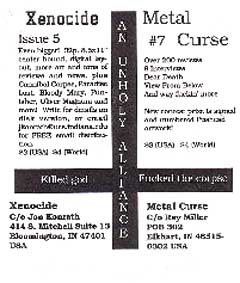
It’s funny you should mention that, because I’ve been talking to Ray Miller (creator of Metal Curse zine and the death metal band Adversary) about how he should start writing a book. He worked for years in an indie record store, and every shift there was some strange, weird story. It could be like that book High Fidelity, but much more underground or strange. And in talking to him about how to get started, I mentioned the analogy of a death metal band creating an album. Instead of starting at page one and telling the story, sometimes it’s helpful to write these “riffs” and collect them, and later put them in place, like how you’d write songs. Rumored to Exist happened very much like that. So did Summer Rain, but it’s much less apparent because it’s a linear story. Rumored prospered from this lack of concentration on my part. It also made things much more difficult to edit.

And from what I’ve heard, that’s how Burroughs got Naked Lunch together, as opposed to the Kerouac straight-narrative, typing on rolls of paper approach, which would drive me nuts.

Do you find that being a writer makes you more prone to socialize, or more paranoid?

I wouldn’t say I’m paranoid, but I’m not a social diva, either. I’ve generally kept to myself, partially because I spend a lot of my time chained to the computer, but also because there aren’t many social outlets for writers that aren’t swimming with writers that have severe ego problems. I don’t like classes or workshops because I usually end up getting in fistfights with diva writers who think they are the next Michael Crichton or something. That said, New York is a decent place to be as a writer, especially if you work the corporate office environment. I know a lot of people who are aspiring actors, or long-time musicians, or occasional standup comedians, or wannabe screenwriters, or part-time directors, or something. So there can sometimes be some support from these people, so that’s cool. But most of the time, I socialize and don’t talk about the book, because I don’t want to be like those Amway people, always trying to push their product on everyone.

When you sit down to write, do you have an outline in front of you or in your head? how much of your work is improvisational? how many times do you edit and, what intoxicants are required to begin the editing process?

It depends on the book, of course. My first one, Summer Rain, was very outlined and regimented – I had to plan out with a calendar what would happen and I vaguely followed what really happened to me that year. But Rumored was more like playing with legos, because of the nonlinear format. At first, I simply wrote bits and pieces that gelled into segments. Later, I had a lot of trouble balancing this out – some things were a line long, others were the size of a short story. So I had to do a certain amount of planning on paper to balance things, move things around, and give the whole thing a feeling of continuity.

Most of Rumored was born from ideas I’d get anywhere – while in the shower, while reading a book, a web page, watching a movie. I wrote ideas, phrases, bits of dialog on scraps of paper, notepads, spiral notebooks, and in a slush file in emacs. Bits and pieces got moved around, and improv had a large amount to do with how to place those ideas and actually turn them into readable pieces of text. My best writing was when an idea came to mind and had enough inertia to pull out a very energetic piece without much thought. When I had a good night, it was much more like channeling than actual writing.

Of course, this left a very fucked up and uneven manuscript that required a lot of editing. And edits actually rewrote the entire book several times over. There were seven major versions of the book, with each one comprising of sometimes more than a dozen paper edits. Even with this, I know there are still mistakes in there. But the other problem with a book like this is that it’s hard to say when it’s done. I can’t just say, “the good guy beat the bad guy and got the princess, so I guess it’s done.” It took a lot of work just to put the fucking thing down and concede that it wouldn’t get any better.

As far as substances, the drug for this trip was caffiene, with some ephedrine thrown in for good measure. Anything else would slow me down or change the tone. I still don’t see how Bukowski or Hemingway or whoever could load up on booze and write. And I’m not into any other drugs. I even quit caffeiene during the final editing of the book, and it made the work in the last stretch twice as hard.
Who are your favorite postmodern writers?

I’ve always thought the phrase “postmodern” was too vague and gimmicky in categorizing writers, kindof like how “open standard” in the computer world doesn’t really describe anything. But I guess Mark Leyner would be at the top of the heap, and Raymond Federman. I’ve read a lot of Burroughs, although I like the story of his life more than I like his actual work. Naked Lunch is a landmark book, but I’d rather read interviews with WSB where he’s rambling on about Mayans and Yage and Control and everything else. His theories are incredible, and I wish I could live a life a percent as interesting as his.

Do you believe that postmodernism – the concept of linear rationality being dead and supplanted with the world of subconscious imagery – in literature has place, or is merely a deviation soon to be forgotten by history?

I think it has more of a place than people realize, now that everyone’s using the web, and that’s the biggest mess of nonlinear shit out there. It’s only a matter of time before people write good nonlinear books of pieces of imagery cataloged by link instead of linear pages, and people will be able to parse it perfectly. I don’t think that the human mind thinks in a straghtforward way, and it’s just a limitation of technology that presents literature in a straightforward way. If they ever start injecting works of art into peoples’ brains like a drug, the linear story will be the one that is forgotten by history.

Some people claim to remember stories and ideas visually, like William Gibson’s concept of cyberspace, but others describe a non- linear structural memory. Is this because events, actions, objects have internal mechanisms that describe their function in a unified external reality, or because of our tendency to associate ideas with other ideas for the purposes of contexting?

The original concept of Rumored to Exist was that each section would be a part of a person’s brain or memory, and at that time, I did a lot of reading and research on human memory to see if this was true or if I was just making it up. And human memory isn’t linear, it is organized chronologically or in neat pieces like an MP3 library or something. It’s easy to see when you look at stroke victims, and how they selectively remember things, but because other organic parts of their brain were destroyed, other parts are gone. So after a stroke, you might not remember how to speak, or butter a piece of bread, or operate a microwave oven. And it’s sometimes possible for these people to re-learn these skills using free memory in other parts of the brain. That makes me think the mind is more like a hard drive with a bunch of loose inodes and a file allocation table, and the importance or relevance of different things determines how well that information is kept. That’s why you can’t remember the songs a band played at a show, but you remember the way the beer tasted.

To answer your question, I think this is a feature and limitation of our organic brain. I think the way we group disparate parts and pieces of our external reality into events and stories and nightmares and memories is how the software works for this hardware.

But it was a particularly unlucky star for the Italian painters of genius in the fifteenth and sixteenth centuries that, in the narrow sphere to which they were arbitrarily referred for the choice of subjects, they had to resort to miserable wretches of every kind. For the New Testament, as regards its historical part, is almost more unfavourable to painting than is the Old, and the subsequent history of martyrs and doctors of the Church is a very unfortunate subject. Yet we have to distinguish very carefully between those pictures whose subject is the historical or mythological one of Judaism and Christianity, and those in which the real, i.e., the ethical, spirit of Christianity is revealed for perception by the presentation of persons full of this spirit. These presentations are in fact the highest and most admirable achievements of the art of painting, and only the greatest masters of this art succeeded in producing them, in particular Raphael and Correggio, the latter especially in his earlier pictures. Paintings of this kind are really not to be numbered among the historical, for often they do not depict any event or action, but are mere groups of saints with the Saviour himself, often still as a child with his mother, angels, and so on. In their countenances, especially in their eyes, we see the expression, the reflection, of the most perfect knowledge, that knowledge namely which is not directed to particular things, but which has fully grasped the Ideas, and hence the whole inner nature of the world and of life. This knowledge in them, reacting on the will, does not, like that other knowledge, furnish motives for the will, but on the contrary has become a quieter of all willing. From this has resulted perfect resignation, which is the innermost spirit of Christianity as of Indian wisdom, the giving up of all willing, turning back, abolition of the will and with it of the whole inner being of this world, and hence salvation. Therefore, those eternally praiseworthy masters of art expressed the highest wisdom perceptibly in their works. Here is the summit of all art that has followed the will in its adequate objectivity, namely in the Ideas, through all the grades, from the lowest where it is affected, and its nature is unfolded, by causes, then where it is similarly affected by stimuli, and finally by motives. And now art ends by presenting the free self-abolition of the will through the one great quieter that dawns on it from the most perfect keowledge of its own nature.

– Arthur Schopenhauer, The World as Will and Representation

If there is an afterlife, what do you think it would be?

I don’t think there is an afterlife, so I try not to speculate about it. I think the afterlife is the carrot on a stick that leads the religious to do really stupid things and waste their lives. People should stop thinking they are one of the chosen few that will go on to a better place and actually do something with their lives that will make this world a better place.

Are you following the growing penetration of drugs into American society? From where do you think this originates? What is the significance of drugs – altered perception – in the time after perception was considered inherently faulty?
Let me hijack this question and answer it in a different order. First, drugs are omnipresent in American society because any highly industrialized nation doesn’t utilize its population efficiently. Back in the old days, people spent all of their cycles hunting game, planting gardens, making quilts, raising babies, building log cabins, and tending fires because they had to, to survive. There wasn’t much leisure time, and it was used by religion. There was little free will – you either hauled water from the well a mile away, or you died. Humanity doesn’t always have things easy now, but it’s not hard to get an easy job at McDonalds or a factory, pay your rent, never break a sweat, and have 128 of your 168 hours a week free to your own devices.

Now some people use that time in a cool way. They go to school, they create cool web pages, they climb mountains, they work on their car. But many people don’t know what to do with their time. They feel a need to belong, this tribal instinct. They watch sports, they drink beer, they become xenophobic, they develop ulcers, they try to keep up with the Jonses. Most of the ailments of the late 20th century have to do with people who have too much free time on their hands, from corporate corruption to gangs to religion. This isn’t a new theory; even though he is legally considered criminally insane, this is the logic the Unabomber was laying down.

Okay, so you have this straight man’s culture, where you’re expected to buy into the white picket fence thing, and have kids, and buy a sports utility vehicle and play golf. And more and more people think this is a crock of shit. And they get high. They find out that controlled substances make them forget about this void in life. And it might even make then enter a new subculture with other stoners, where these rules don’t exist.

I’m not a drug user, except for the occasional beer with friends, so I don’t know if I really buy either side of it. I’m not the kind of person to hang onto either extreme and consider it right, so I’d rather sit in the middle, or not even participate. I write about drugs a lot, though, because this culture interests me. It’s something that hasn’t been touched in a creative way, something to be explored.

I thought Naked Lunch was pretty creative, but the reams of drug fiction following were mostly social irresponsibility pornography. If you were going to write with drugs as your topic, what might you create?

I think the best way to write about drugs would be to have them an integral part of the story, but not be in the forefront. Drugs are just a chemical; any real story is about humanity, and any compelling story about drugs would have to describe the human condition in a compelling way. Drugs are usually used in a plotline as an evil, or an excuse. Like, a guy robs a bank because he’s on drugs. Occasionally, someone writes about drugs as a catalyst, a conduit to action, like in most crime films where mobsters have a shitload of cocaine and that temporarly reverses things so they are on the heavy side of the law, and there’s no way the cops could win. Think about movies like The French Connection, where these guys with a fuckload of heroin were above the law. That’s about as far as most books and movies really go with it.

I think Hunter S. Thompson did some great work beyond Burroughs in this area, but I also think if he wasn’t taking a drug store full of junk when he was in Las Vegas, he would have written a book just as entertaining as Fear and Loathing. But it’s a book about excesses, and the writing and the search for humanity is what makes it for me.

Do you see writing in this time period as democratic, or elitist?

It’s probably more elitist. Most writing in this country is actually the production of “media” by “media figures” who are pop stars known for their name instead of their craft. It’s nice that technologies like Print on Demand and the Internet are making it easier for anyone with skill to create art, but I don’t see much of a community surrounding this. I’m hoping we’re at a crossroads where the truly intelligent will realize that writing for fame and fortune is futile, and it’s better to write for yourself and put it out there, even if only a dozen people see it on the web or in a zine or whatever. And then those intelligent will congeal and find each others’ work and form an unstoppable movement of real work, rather than the imitation writing that marketers present to us in book stores.

This seems to be the same problem faced by aging death metal bands however. At some point, having a day job to write books or death metal music reviews all night becomes tedious, and one wishes to be supported by the primary labor of life, writing. How does this fit into ideological niche marketing as you describe?

It doesn’t fit, and that’s the catch. You can’t support yourself selling twelve copies of your work a year. And there are other forms of support, like grants or communes, or scholarships, or universities, but they all dilute you into something else just as much as a day job. Like, I went to an art museum once, and there was an exhibit that was a bunch of hay and horse shit on a floor, and a bunch of Macintosh computers showing bitmapped animated pictures of Planet of the Apes. Was that art? I’m not sure. But the grant application that paid for all of that hay and shit was probably incredible art. And if you want to do that all day, and you are good at it, that’s great. But it probably means you aren’t producing art like you originally wanted.

When did you first decide to be a writer? If a role model, what qualified that person as insurmountable by their world?

I’ve always been able to write to a certain extent, but I got more involved with computers as a kid, and during school, so I always thought that was my destiny. I thought I had a book in me, but I was more concerned with learning how to hack and program. I eventually hit a wall in my formal CS training, around the time I also got dumped by this girl I was dating. I was going through a serious “what should I do with my life” phase, and didn’t entirely know what I wanted to do. I’d been working on a few Death Metal zines and I enjoyed the journalism and writing, but didn’t know if I could become a “serious” writer.

So the writers that got me started were guys who were not pretentious, and made it look easy. I liked the spoken word of Henry Rollins, and it got me into writing in a journal every day, and observing things around me. Charles Bukowski made me look at autobiographical fiction and consider it easy. So did Henry Miller, but Bukowski’s work had a certain sense of truth to it, and showed me that it wasn’t what you were writing about as much as how you wrote it. That got me started on short stories, and eventually Summer Rain.

Should writers stay celibate?

Not really, or at least not by choice. Granted, it’s hard to write on a daily basis and maintain any kind of relationship. I can’t write as well when I take off Friday and Saturday to spend time with a girlfriend or cruise around looking for one. Those are the days I write most, so my stretches of not getting any also tend to be when my writing volume increases. But interacting with people is – well, it’s not essential to writing, but it helps.
This seems to me why ancient religions and cultures recommended a studied celibacy for men. It seems that one workaround to this would be a more anti-social culture, where fewer people attempt the emotional interdependency that works well to glue society together like plywood, in which a relationship offered briefer, more passionate encounters with a significant other living in a close but separate location.

Do you see there being any humor in that being hard makes it hard to write?

There are a lot of strange catch-22s in our society like this. For example, most people that teach acting are not good actors, because if they were, they’d be getting parts, not teaching. If you’re teaching any practical field, like business, you can’t be working in that field, unless you are doing a half-ass, part-time consulting job or whatever. Very few people can pull it off, but many don’t, so it makes you wonder how the hell people figure this stuff out.

Writing is the same because writing involves translation of the human element into word. And to be a specialist in the human experience, you’re going to date people and be married, and go to parties, and have a family, and travel all over, and do all of this stuff. But if you did all of this, you wouldn’t be able to write! And I always wonder if my writing would be better or worse if I was hidden away at my ranch in Colorado all year around, where the nearest living person is ten miles away. I also wonder what would happen if I simply went full-tilt wife-hunting and gave up everything to get married and settle down. I wonder if I did that if I would ever write again.

On the other hand, it’s no coincidence that when I’m not in a relationship and I want to be in one, I tend to write more vividly about the situation. Summer Rain was started after a horrible breakup back in college, one that probably wasn’t that horrible at all, but I just couldn’t kick it. That kind of pain gives you motivation to do more, so I can ultimately appreciate the cruel irony of the whole thing.

How do you feel about Christian presence in American politics?

It’s sickening. There’s supposed to be a freedom of religion, and a freedom FROM religion, but look at any piece of American money and tell me that this is nothing except a joke. Christians funnel serious money into American politics, and this won’t change. I wish someone would get in the primaries to have some visibility, and then just get up during a speech and say “If you believe in God, go FUCK yourself.” Until then, we have politicians pandering to these idiots. It’s scary stuff

Do you think psychology as a science is unduly influenced by Judeo-Christian values?

It depends on the brand of psychology. When a lot of people go to a shrink after they get dumped or someone dies or whatever, they usually get this fast-track band-aid treatment that involves spilling out your problems and reassuring you that it will be better, but not actually offering any “reprogramming” or heavy understanding of what possible psycho-somatic issues could be causing your problems. That dovetails nicely with the christian belief that if you have problems, you just pray to Jesus and it will all be better. Both are simply a distraction, and that works for a lot of people, but I’m the kind of guy who wants to know what the hell is really going on. I mean, as a kid, every toy I was given was taken apart as soon as I learned where to dig up a phillips screwdriver. So when I was in high school, college, and I wanted to go to a shrink and really pull apart my head and find what was defective and either comment it out or replace it with a new subroutine, I was always running into these shake-and-bake therapists that just wanted me to tell them what was wrong in sixteen one-hour sessions, maybe give me some pills, and it was better. And it wasn’t!

There’s a smaller, but more focused area of psychology that focuses on finding the basis of problems, realizing that your actions and reactions shape the way you see the world and eventually how well you work with it. This is called NLP, and it’s more analogous to debugging a computer program than praying to Jesus, which is why it’s interested me. It’s also more expensive, harder to find, and takes a much longer time to work through, which is why I’m currently not working on it.

What do you think in the same context as Christian political presence about Muslims? About Jews?

There’s less of a Jewish presence in politics, although you see it here in New York. If anything, it’s refreshing to go from Indiana, which is 107% fundamentalist Christian, to New York City, where there are enough Jews that a fundie probably couldn’t run for office without some flak. I don’t even know much about the Muslim influence, and I’m not up on the Middle East, so I’ll leave it at that.

According to the doctrines of Buddhism, the world came into being as the result of some inexplicable disturbance in the heavenly calm of Nirvana, that blessed state obtained by expiation, which had endured so long a time – the change taking place by a kind of fatality. This explanation must be understood as having at bottom some moral bearing; although it is illustrated by an exactly parallel theory in the domain of physical science, which places the origin of the sun in a primitive streak of mist, formed one knows not how. Subsequently, by a series of moral errors, the world became gradually worse and worse – true of the physical orders as well – until it assumed the dismal aspect it wears today. Excellent! The Greeks looked upon the world and the gods as the work of an inscrutable necessity. A passable explanation: we may be content with it until we can get a better. Again, Ormuzd and Ahriman are rival powers, continually at war. This is not bad. But that a God like Jehovah should have created this world of misery and woe, out of sheer caprice, and because he enjoyed doing it, and should then have clapped his hands in praise of his own work, and declared everything to be very good – this will not do at all! In its explanation of the origin of the world, Judaism is inferior to any other form of religious doctrine professed by a civilized nation; and it is quite in keeping with this that it is the only one which presents no trace whatever of any belief in the immortality of the soul.

– Arthur Schopenhauer, On the Sufferings of the World

It seems to me the only difference between fundamentalist Christians and Jews is that Judaism is a materialistic religion with a racial xenophobia, while Christianity is a pseudo-idealist religion with a xenophobia of abstract orthodoxy. In many ways, that last phrase could describe what happened to European intellectualism, with a few bright exceptions, after Christianity arrived. What are your thoughts on these provocations?

I don’t know. To me, I see the main difference is that Christianity has sought to grow by being a very inclusionary religon. That means if you aren’t Christian, you can always be saved and sign on the dotted line and give us money and all will be well. That’s why if you sat in a bus station in Indianapolis on the average Tuesday, someone is going to try to convert you to Christianity about every twenty minutes. And that’s why Christianity is such a basic, dumbed- down religion, with very little orthodoxy. There aren’t a lot of rules to learn or classes to take (unless you’re Catholic) and you can even get an illustrated kiddie bible to read if the King James is too tough for you. Everyone’s invited, and that’s why their numbers grow.

On the other hand, I see Judaism as a very exclusionary religion. Jewish singles are taught to date only partners who are also Jewish. It’s very hard to convert to Judaism. It’s all protected by a very complicated and orthodox system of language, rules, calendar, holiday, diet, and everything else. But that means it’s kept pure.

I think both methods are inherently wrong, though. Any religion stresses that its members are the chosen one, and that other people are pieces of shit. Otherwise, religion would be universal, and individual churches wouldn’t have a way to make money anymore.

Which would you kick out of bed more quickly, Janet Reno or Keanu Reeves?

I think if you had an amateur porn of yourself fucking Janet Reno, it would be pretty much the ultimate party conversation item. And you know I’d go for the ass, as a little Waco retribution.
Speaking of Waco, what is the function of government?

Good question. I’m far more socialist than liberitarian in that I think the government should provide the functions that a free market economy can’t or won’t provide. In the old model, that’s stuff like roads and healthcare, retirement and men on the moon. There’s also protection and enforcement, from jails to armies. You could argue that any of these things could be done better by private companies, but corporations might not want to do them if there’s no bottom line for them. If a company is paid a billion dollars to build a one billion dollar university, they don’t have any motivation to do it, unless the company is a Christian-run shell corporation that wants to ram religion down the students’ throats, or unless Microsoft wants to build the school and brainwash the kids into using their crap. That’s why in theory a government would get involved – to make sure the alterior motives are decided by the people instead of some marketers.

In my perfect world, peoples’ greed and stupidity wouldn’t come in the way of advancement of society, and government projects like space exploration, computing, scientific research, and healthcare would actually be progressing instead of just being a sick joke. The problem is that people are too greedy, and want to know what’s in it for them. We haven’t found the cure to cancer because the top research scientists are figuring out how to make Sports Utility Vehicles even bigger, because that’s where the money is.

Does this imply that all governmental systems share common functions of both socialist and capitalist behavior? Would it be possible play with words and call socialism “social behavior” governmental theory, and call capitalism simply “competitive behavior” theory? One is implicit centralization; the other abstract. In this view, it might be possible that capitalism is closer to the anti-democratic social ideals I have interpreted from some of your statements above. If competitive rather than capitalism were seen as an American value, how do you think our social outlook might change? Would there be a blurring between the “public fiction” and “private truth” of various economic, social, governmental enterprises?

Socialist socieites also work for a collective goal by the nature of social behavior, but libertarian societies expand social behavior to include as a basic value an indifference to collectivism. Is this true in your view?

It’s true, and I think it’s an inherent flaw of most libertarian systems. For one, I think collectivism is a basic human instinct – one that can be unlearned and avoided – but it’s normal, and something the sheep out there understand. Also, I don’t think everyone can be the center of their universe; I mean, I can’t cook well, I can’t run a nuclear reactor, I don’t want to be the one to clean my septic tank, and I have to rely on doctors, lawyers, grocers, farmers, and many others to survive. A system of collectivism is supposed to provide a method to have those people help each other, while benefitting the most from it. I’m not saying our current system works, but only so many people can vanish from society and hide out in Idaho with their guns and dogs before things fall apart.

Do you believe in conspiracies?

Hell yeah. But I find the myth of conspiracies far more interesting than the conspiracies themselves. I’m writing about them a lot in Rumored, in a very playful and mocking sort of way. I don’t necessarily believe in aliens or whatever, but the Area 51 shit is great. Every society has its own myths and mytholgies, and centuries from now, people are going to be studying the X-Files like we now study Thor and Zeus.

I do seriously believe in a lot of government conspiracy. I seriously think the CIA has its hands in many evil plans, and I know billions of tax dollars go toward creating craft like Aurora, the next-generation hypersonic spy plane. I think a lot of the UFO sightings out there are probably Lockheed test craft operating at night. I know if I would’ve seen a stealth fighter in 1977, I would’ve thought the Martians were coming, too.

Jon Konrath on Death Metal

I know you’ve been a big metal and death metal listener for years. What are you hearing these days?

I actually listen to more stuff in the “prog-metal” genre these days, like Dream Theater, Fates Warning, Queensryche, Joe Satriani, etc. When I put on an “old” CD, it’s more likely going to be an old-old band like Saxon, Judas Priest, Mercyful Fate, SOD, or Anthrax. When I do have some 90s-era Death going, it’s usually Dismember, Macabre, Carcass, or Entombed.

Pick five of the most important metal bands in history and give a brief rundown on each one and why it necessarily fits into the history of metal music.

Metallica – Kill Em All: Although the band later became butt-pirates, this album was practically an anthem to millions of metalheads, and acted like a gateway drug for virtually everyone that went out and started a band or got involved with heavier metal.


Motorhead – No Remorse: With their wide appeal and universal mythology, Motorhead became almost a meta-band that everyone respected as the loudest, rawest, and coolest. It’s hard to pick just one of their albums, so I chose their ubiquitous double-album compilation, filled with a little bit of everything from their early career.


Queensryche – Operation : Mindcrime: This obscure group of Seattle prog-rockers put their mark on the world with what’s possibly the best concept album ever.


Entombed – Left Hand Path: This immaculate work filled with unprecedented heaviness but yet an incredible depth and complexity was the high water mark for the early 1990s Swedish Death Metal genre, and in my opinion, was never topped.


Slayer – Reign in Blood: Although their earlier work was just as impressive, this album defined how fast metal would be played for years, and also got Slayer kicked off of Sony.


Do you consume any mainstream media?

I meet a lot of people in New York who either think they are bohemian or think they are upper-class and say “Oh, I don’t have a TV” or “I don’t watch movies” or whatever. In general, I find that these people are more fake and uninteresting than the people I know who spend their Saturday on the couch with a beer watching NASCAR. I’ve found that a lot of people that purposely don’t watch TV are still living a fantasyland existance, even without the sitcoms and John Hughes films. They’re still told what to do, and they still obey. It’s not a coincidence they all go to the Hamptons or all pierce their eyebrow or all dye their hair the same way. It doesn’t make them any better than me.

I admit, I do watch TV and I do go to movies and I buy DVDs and play video games. I don’t have cable TV, and I have pretty much given up on newspapers and magazines, although I might flip through whatever’s in the doctor’s waiting room. I enjoy it, but I don’t let it run my life. I think there’s a difference between watching TV and believing in it. If you believe in TV, the ads will lower your self esteem, and make you think you’re a loser because you can’t own a new Oldsmobile or land a chick like one in a Revlon ad or beer commercial. And when your esteem is low, you’re hit with the food ads – 50 grams of cheese fat stuffed in a pizza crust, a bunch of sugar and desserts, and high-fat snack chips that will make everyone happy. It’s no wonder America is obese these days. But I don’t think you need to buy into this to enjoy TV, and I think there are movies that are good entertainment, and just that. It’s just important to remember not to compromise your own life because what you see on TV is neat.

How controlled do you believe the US media to be?

Everyone should read Ben Bagdikian or the Fairness and Accuracy in Reporting (FAIR) stuff, or at least listen to Jello Biafra rant about it. Pretty much everything we read or hear is controlled by a couple of huge corporations. And many smaller outlets for news and information become available, like the internet, but as the big companies get bigger, it seems like less and less people get involved with underground sources. And most people don’t believe stuff on the internet, because it’s diluted by so much shit. I mean, there are some great web sites out there with conspiracy theories, investigative reporting, and stuff like Slashdot, tech news, but there’s so much spam and make.money.fast and urban legends, that it’s hard to believe anything you read anymore. But to answer the question, yes the US media is controlled. And being controlled by big money is worse than being controlled by the government, like it was in old Communist countries. Because you can overthrow a government or vote out a leader, but you have no recourse against GE or Newscorp. You could stop buying their stuff or watching their shows, but that won’t hurt them much – many more sheep will continue to keep them in business.

But here steps in Satan, the eternal rebel, the first free-thinker and emancipator of worlds. He makes man ashamed of his bestial ignorance and obedience; he emancipates him, stamps upon his brow the seal of liberty and humanity, in urging him to disobey and eat of the fruit of knowledge.

– Mikhail A. Bakunin

It seems to me that evolution is a nihilistic thing, meaning it has no morals or concerns for outcomes. Thus when a society is built that values competitiveness at the expense of social logic, and you get the most fascist possible outcomes disguised as the most empowering, convenient, financially beneficial to the individual. Is this a virus humanity will shake? Is there any way out of the big money media control mess?

I think the real question to ask is, “will this virus kill itself?” Enron and WorldCom both died; this week I heard QWEST said they “accidentally” underreported a bajillion dollars of profits, and Ziff- Davis might file Chapter 11 this week. It’s not good news to our economy that these companies are falling, but it’s a demonstration that even the biggest corporations will eventually fail.

Do you think civilization often hides ugly truths behind social behavior?

I’m not sure what you’re getting at – does civilization hide truths with behavior? I think so, but it also has the ability to modify society so that the lies become the truth. That’s part of religion – a while ago, half of the kids born wouldn’t live to see their first birthday. So the churches told people to fuck like bunnies, so they’d have more customers. Now, almost all kids survive, so the world is overcrowded. And we certainly look away from problems and are drawn to others, but that’s more of a problem with capitalism. Everybody talks about school vouchers and keeping porn off the Internet this election, but nobody really gives a fuck about their kids. They never talk to them and treat them like animals. It’s all very silly.

My question might be phrased thus: does civilization have a public justification for a hidden agenda, although not necessarily an articulated and conspiratorial one, which disguises some “private” and/or unpleasant truths?

Just a stab in the dark on this: the human is the only animal that has an inherent double-standard to its nature. I mean, dogs shit on the ground, they fuck each other whenever the need arises, they dig through garbage, and they don’t think twice. But humans are more sophisticated, so there’s this whole obvious-but-secret life to everyone. Everyone has sex (well, I haven’t lately, but that’s another topic) but there is a strong taboo about sex. The same with bodily functions and death and sin and a bunch of other things. Now, I’m not saying we should all run around naked and shit in the streets. But what I am saying is maybe the human mind has this unconscious desire to have these double standards, these things that keep everything running that nobody talks about. Because if you live in an ultra-rich environment, you don’t clean your toilets. You don’t even talk about them; you pay someone else to do it. That sets up this strange double-standard, and that breeds similar things in business and politics, in the guise that it makes us “more sophisticated.”

What do you think makes us greedy, evolutionary mechanism out of control or social conditioning? Or is it possible that the former would naturally check itself eventually, but the later “justifies” it somehow to our symbolic and rational mind?

There’s a lot of social conditioning in our world that we don’t even see. There may be a primal base of darwinism, but the virus of advertizing and marketing tells us we are not complete unless we own a car with leather seats and 7-speaker CD sound system, and it puts off a huge spiral of related stuff. I also think when you don’t get the big things, you overindulge in the small. So when you see that TV commercial of a happy family and you are alone, and then the next commercial comes on and it’s for the new Pizza Hut Pizza with ten pounds of heart-clogging cheese per slice, you pick up the phone and order the pizza and eat the whole fucking thing. There’s this combination of greed and a desire for more mixed with a despiration to fill your life with something, and it’s injected into you pretty much from birth.

It is one of my theories that Christianity isolates the individual by forcing the individual into moral self-comparison with the holy deity, “God.” This causes people to think strictly in terms of their own prospects, and to lose sense of social hierarchy and collective goals. Where do you see this as converging with your own beliefs?

I would agree, although I don’t know if I would call it self- comparison as much as fear of failure. God is like a parent figure, more than a parent because he’s all-knowing, and people don’t want to disappoint their parent, especially if they will get an ass-beating over it. The strange thing is, in a theoretical sense, that would mean people would do unto others, create communities, and help the needy. But I think when you have the Christianity mixed with the unchecked greed, you get this horrible mutation of Christianity that most people in the USA preach, the kind where they think everyone is going to hell but them, but they are also really shitty to others.

Sometimes it seems as if humanity has justified this expansion using warmed-over Renaissance feeling coupled with a Christian ethos of dominating nature (which is “evil”). Do you think there’s any truth to this?

Oh, sure. Corporate branding is a billion-dollar industry, and they grab onto any emotion then can find. The Christian thing is a popular one, but throw in the “it’s for the children” and “it will make people like you”, and you’ve got a good start.

Most American kids feel neglected in the areas that are most intangible, such as time spent, value in the family unit, and that ephemeral “love,” for the third or fourth generation now. Is this a product of industrial society? Did people once treat their kids with more care, and have a collective interest in childrearing as near the top of their hierarchy of demands from a civilization?

It’s tough to say, especially now that single-parent families have been a regular way of life for over 30 years now. I think our industrial society makes it harder for parents to spend time with their children, but I also think people want immediate results, so they aren’t willing to invest time in childrearing. I mean, everyone *thinks* they do, but so many parents rush their kids into Ritalin or other drugs, and they also think they can buy parenting. I grew up in a somewhat affluent suburb where good parenting meant buying your kids the right clothes and buying them a car in high school. It’s much more than a material thing, and not many people realize that. But, I do know some people that are very good with their kids and they still work long hours at shitty jobs but are able to make it work, so not all hope is lost.

Do supermodels shit?

If they do eat at all, I’m certain they just puke it back up, but maybe some of them are addicted to laxatives. The whole thing scares me – I work in Manhattan and I’m amazed at the overabundance of phenomenally skinny women. I mean, everyone I see is six feet tall and 110 pounds, and I know that going to the gym for 5 hours a day doesn’t do that. Either they are coke fiends, or completely anorexic, or both. I’m not too into that, so it freaks me out more than anything else.

Why does death metal seem politically relevant to the end of the 20th century, to you?

Okay, so you’ve got mainstream music, however you define that. And if you’re not a sheep, and you feel a need to be different, you follow another path. In the past, that might have been punk rock, or hardcore rap, or metal, or electronic music. Well, in the interest of marketing, all of these things have been crossbred and watered down and turned into viable commercial product. So depending on what part of the country you live in, mainstream music is now either “alternative” punk music, or “R&B” rap music, or “Electronica” disco- type dance music.
So the true underground is Death Metal. And every effort to market this has failed, because if you remove the gore and the raw power and the Satanism, you’re left with something remarkably stupid that won’t market to the average record-buying sheep, and won’t have enough balls to interest metalheads. Because Sony and BMG can’t sell it or get MTV to play it, they ignore it, and the essential culture of Death Metal survives. It survives because of tape traders (and now MP3 traders) and small distros selling 20 copies of a CD and zines and fans. It means that only selling 1000 copies of an album is considered wildly successful, but it also means that album is going to be evil and aggressive and memorable and pure energy. It means that bands get to dictate what goes on an album, and gets to write songs that are sick or intelligent or protestful or Satanic or whatever. In a sense, it is a far more pure element of democracy, because it isn’t subverted by money. And it’s a form of socialism, at least in the sense that the community keeps itself afloat. You can’t just go to the average Musicland and buy good Death Metal; it’s your job to seek out this stuff by getting on the web or reading zines or talking to others.

But aside from my rambling, the importance of this politically is that the Death Metal community isn’t supported by a government, and it isn’t run by a corporation. And it doesn’t have a massively widespread impact on society, but it’s an interesting pocket of culture that sustains itself. And those things interest me, because if I could find them outside of music – if I could find a community similar to this that would feed me or clothe me or shelter me in exchange for the work I put in, it would be an interesting political experiment.

If you could say one thing to Jesus Christ, what would that be?

I’d probably tell him I was sorry for what his followers did with his message. I don’t believe in God – I’m an Atheist – but I do believe that a man named Jesus Christ walked the earth 2000 years ago, and I believe his followers wrote a book and started a church. I’m guessing the water-to-wine, rose-from-the-dead-on-the-third-day stuff is probably metaphorical, but I do think he was a charismatic man who had some ideas and told them to many people. And in the most basic of senses, Christianity has some good tenets – don’t fuck with people, don’t lie, be honest, do unto others, and so on. I’m probably far more Christian in that sense than most so-called religious people out there. But unfortunately, all of this was distorted over time, and turned into a profitable business, and a powerful tool of government. And I’m sure that if big J walked the Earth today, he’d be pretty pissed at how his vision was warped into what it is today. I’d also ask him his opinion of The Last Temptation of Christ, since I think it’s a pretty cool film.

When Christianity came into being, the craving for suicide was immense—and Christianity turned it into a lever of its power. It allowed only two kinds of suicide, dressed them up with the highest dignity and the highest hopes, and forbade all others in a terrifying manner. Only martyrdom and the ascetic’s slow destruction of his body were permitted.

What is now decisive against Christianity is our taste, no longer our reasons.

– F.W. Nietzsche, The Gay Science

I’m certain of the possibility of UFOs, and the probability of their existence, but I fear the “UFO community” because of its continual anonymity, broad claims and paucity of consistent evidence except for the generalized existence of flying metallic objects on planet earth. To me, it seems that any government is going to hide most of its budget to work on secret evil shit to do to other people, in case one’s role suddenly becomes being the recipient of the “unto you.” What sort of stuff do you think’s brewing now? Do you give any credence to conspiracy theories about AIDS or the West Nile virus, or do you think these are simply a consequence of commercial exploitation of deep forest areas (thus bringing previously undiscovered satanic microbes to the public eye)?

I predict that the threats will all be real things, but the reactions by the government is fucked up. Take the West Nile virus here in New York City. It’s a real virus, mosquitos are a real problem, but most of the people that would die from it are old and half-dead anyway. So the best reaction would have been a good public awareness campaign about mosquitos, along with patrols that cleaned out cesspools and whatnot.

Instead, Guiliani sprayed this incredibly evil chemical all over the place. They were not supposed to spray it on food, but videos came out later with them spraying it right on open fruit stands, and I’d bet anything that the food was sold later to unsuspecting people.

A lot of bad shit could happen in the near future, and it’s not a conspiracy theory. Think about Gulf War syndrome, smallpox, or e coli – that Fast Food Nation book told unspeakable horrors about how understaffed and inconsequential the USDA is about meat inspections, and now there’s a beef recall going on in Colorado as we speak. And remember last fall when everyone and their brother was finding Anthrax in the US mails? None of these are conspiracies like saying that the CIA invented AIDS. (Although I think the CIA made crack cocaine popular,) but the government’s piss-poor reaction to these problems are veiled in mystery.

If your options were an eternal existence for human populations or total destruction of earth, including all humans, which would you pick?

I’m going to read a bit too much into this to support an answer. I think, given the rate of human growth, that it would not be possible for an eternal existence on our one small planet, at least given our current technological infrastructure. Many people (Greenpeace et al) think that in order to sidestep this, we need to avoid using the Earth as a natural resource, or at least avoid destroying it. But a minority of people think that the solution is to create a larger infrastructure – hydrogen cars, solar power, fusion power, synthetic nutrients instead of laborious farming and inefficient slaughterhouses. And people themselves have problems that prevent an eternal lifespan – medicine can only do so much, and you’d need genetic engineering orders of magnitude better, to essentially slow or stop aging and repair genetic disorders. And eventually, you’d run out of room – you’d need to move to other planets, other moons, spacestations to support the population. And you’d need to slow down the growth of population, too.

This all sounds great to me, but I think population has lost faith in the idea of space exploration. Even with people living full-time in the ISS, there’s no public interest in taking the next step. A few people on the internet, like the Artemis project, and people who have been reading Kim Stanley Robinson for too long (like me) want to see someone win the X-Prize and put private space travel on the map, but too many people are more interested in the new Britney Spears video. There are also too many serious issues, mostly related to obsolete tenets of religion, that prevent any scientific progress on ideas like cloning, stem cell treatment, genetics, population control, longevity enhancement, or anything else. Of course, as Bill Hicks pointed out and as I found while reading a Gideon’s Bible in a Las Vegas hotel room a few weeks ago (I’m not a fan of the work, except as an interesting fictional treatise, and sometimes to throw back at people to prove a point) but in the bible, Adam and Eve were supposed to live forever. They were supposed to never produce. They were supposed to live a utopian paradise and they fucked it all up. Now, this is just a fairy tale, but I see nothing wrong with pursuing this in the future, in creating our own garden of eden.

Could one construe all of civilization except for its pure pragmatics as a death realization avoidance cult?

It’s more than a death realization avoidance cult; you need to add to that all of the building empire people do, like having kids and buying crap they don’t need in order to have the most, even after they die.

Jon Konrath
www.rumored.com

No Comments

Interview: King Fowley (Deceased)

Deceased are an incredibly longstanding band from Virginia, US. They’ve run full-circle in their career, from over-the-top metal and hardcore of the mid 1980s (Discharge, Voivod, Slayer, Sodom) later merged with the energy of emerging death metal in the late eighties/early nineties and back again to rediscover themselves in the context of their heavy metal forebears. King Fowley, whose enthusiasm for the music he plays and what it represents seethes through everything he does, has lead the band’s charge since their inception.

Originally for Heidenlarm e-zine #5.

Cursed productions recently issued The Radiation Years, a collection of early demos. Is this the complete deceased pre-label discography?

Actually it’s not! ‘The evil side of religion’ our first demo still needs to surface complete. And will very soon! Probably on Cursed Productions as well. Actually in all honesty there was a home studio demo before ‘luck of the corpse’ l.p was recorded. With ‘Fading Survival’, ‘Terrifying Spectres’, ‘Industrial Tumor’, and ‘Psychedelic Warriors’ that is ‘lost’ to me and the band. The master was lost in my pile of cassette tape hell, that is my collection. I only know one guy who may have it and it’s a guy named Yoshio Cain who plays for the Japanese band Shadow now! He was a die-hard Deceased freak and i sent it only out to him back in 1989! I hope it is ‘found’ one day! It’s got some wild stuff on it :)

Other then that, only rehearsals and stuff like that is floating in ‘the vaults’ :)

When you started out as a band, it seemed you were one of the first to bring technical and speed metal elements, like Voivod and Razor (?) influences, to the music. was this a planned decision, or a natural culmination in the ways metal was being made at the time?

We were so fucking high on any drug we could get our hands on we were off in ‘freakout’ zone. We were honestly just trying to be the most ‘over the top’ band ever. We were taking speed from Sodom, Slayer, DRI, punk, thrash, etc. And mixing it with distorted styled lyrics of dread and death ala ‘War and Pain’ era Voivod, and Venom, Blessed Death, etc. Then ‘attempting’ to put in some Voivod weirdness guitar chords, and some Mercyful Fate ‘evil’, just all of it on hand! We had no idea where it would take us! It was very straight forward and insane! It was basically just a bunch of long- haired teenagers in Slayer and Venom shirts going nuts for metal and aggresson in 1985!

The first Deceased I ever heard, Luck of the Corpse, had tight and fast rhythmic arrangements and workout drumming; what atmosphere were you intending on that album? How did it turn out relative to your expectations?

Well ‘Luck..’ was an experience! I got good and bad memories of that ‘era’ of Deceased. Original guitarist Doug Souther and me were completely on different levels as to where the band needed to go both musically and personality wise at that junction in the bands life. So it ‘clashed’! Neither of us was right or wrong. Just ‘different’ in our beliefs! I think the other guys (Mark and Les) wanted to go with my ‘angle’ more so, and Doug took offense. He was really ready to move on and away from the band. So recording that record had it’s ‘negativity’ to it. Musically it’s just too fast for it’s own good! Trying to still live up to our ‘faster then you’ attitdues and trying to release something ‘good’ for death metal fanatics the world over to bite into. Everythnig was ‘rushed’ and in the end it sits a bit ‘dissapointing’. I loved the songs and I loved the chance to release a record with Relapse and be thought of as ‘competent’ enough to record and be on a record label. That was great! It was ‘neat’ to see your face and music on a cd and vinyl, cassette. It felt ‘good’! We were ‘growing up’ a bit and we had to start somewhere ‘fresh’ as a band.

When you think of the people who enjoy your music, is there anything they have in common (besides enjoying Deceased)?
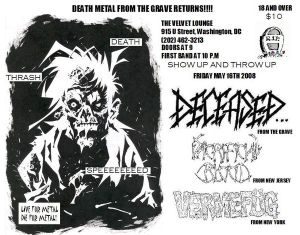
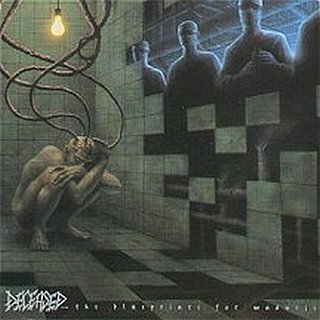
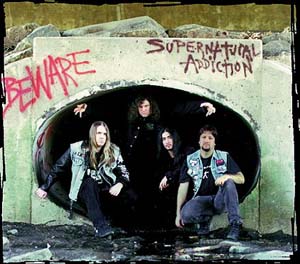
I’m sure there is! I personally like to call Deceased music supporters, ‘friends’! I don’t like the word ‘fans’. Makes you think you are ‘better’ then them! We are all ‘even steven’ in my eyes. We all get up out of bed, eat, drink, sleep, love music, got our hobbies, families, etc. That’s all it is to me. ‘Seperation’ between bands and their music supporters is pretty ‘high ego’ to me. No need! Let’s all just have fun and keep on laughing through as many good times as we can!!! Look out for each other and keep on keeping on!

People sometimes ask me if I feel I’m being disrespectful to the dead by celebrating morbidity through music. What do you think about this question?

Hmmm — good question! Morbidity through music. I don’t personally see any disresect in it. Death is imminent to all and we all have to challenge it daily, every day on earth. No one knows the exact moment they will leave this place and move on to life beyond. Is there life beyond? Is it peace? Is it despair that awaits? No one truly knows. It’s life’s biggest mystery!

As soon as you’re born you’re dying. I talk about it and ‘subject’ it cuz it too intrigues me as a human being. That’s why ‘deceased’ was such th eperfect name for our band. Being the lyricist of the band i know in my heart how i feel and what my words are being meant when i write them. I am a very ‘up’ guy in my living personality. But death is always looming in the back of my brain for sure. It’s just something that truly intrigues me! Death to some is sadness. To others it’s joy, a time of celebration. To me it’s just ‘death’ and it’s unknown what will be ‘next’!

Metal has gone through huge changes since the middle 1990s. With the internet and the personal computer, it now seems everyone has a label or a zine or a band, and there’s tons and tons of metal “information” with perhaps very little data. What do you think the next stage will be?

Well it is always ‘evolving’ with the times and technology. Some for the better some for worse. But that’s ‘life’! I appreciate anyone who sincerely sits down to write an article or passes on msic to a friend to possibly enjoy. It’s ‘word of mouth’ to me that still runs the metal ‘underground’. I dont like label created ‘hype’ and ‘buzz’, never did! Let the music do the talking is my motto. Too many people sadly fall into the ‘live for the press’ mentality. Bad reviews send off interest to some people. While a ‘shining’ review makes them instantly ‘love’ it. Too weird to me!

I got my own mind, and I think and choose for myself what works for me musically as a music supporter! Sure, take all ‘aspects’ into consideration. Cuz a review can ‘help’ in your selection, but in the end let it be no one but you who decides what ‘you’ like! As for ‘next stages’, hmmm?! It’s hard to say! The internet/computer is definitely running the show now. It’s quick, updated at any given time, right there for anyone to take in! I say that will run the gament for some time still!

I was talking with Ray Miller of Adversary, a band from Indiana, and I said that in many ways I respect most the styles from when the styles we have today were newly forming. He suggested I listen to early Deceased, and I did and heard many influences in the music. What do you think each style of metal (heavy metal, melodic heavy metal, speed metal, death metal, and crossovers like hardcore, etc) represented to the generation that produced it, in terms of both music and attitude? When you brought together these styles, could you recognize each distinct impulse in your work, or did they gel into a new language?

Well i’ve always loved music. I mean anything and everythnig that got me ‘going’ i loved! It is my life’s greatest ecstasy. Early on I fell in love with the Beatles,. I was literaly 3-4 year sold. The choruses… the ‘greatness’ was quite easy to understand to me. Then I got into the ‘hoopla’ of Kiss. The blood of Simmons on the covers, the ‘image’ and visuals. It’s perfect for an 8 year old to sink his/her teeth into! It got me into wanting and craving more outlandish and more ‘over the top’ music. Trying to conquer the ‘extreme’! What is now tediously ‘mellow’ in music standards of today (Van Halen, Ted Nugent, Heart, Benatar, etc.) was once ‘over the top’ and pretty darn ‘heavy’ stuff! I just kept poking my head around in mags, record stores, all of it to ‘find’ something to fix my craving. This got me to the ‘gory’ Eddie and Maiden, razor blade through fingers artwork of Priest, the ‘devils and witches’ of Sabbath! All of it! Which in turn got me to Motorhead, Ramones, Plasmatics, Venom, etc.
It’s all a big ‘turn of the screw’! It just continues to move on and no one can slow it down. So when i got into deceased and we formed the band we knew deep down all of us had a common bond for ‘muis’c first and formost. Sure, we were ‘caught up’ in th eheavy metal mania of the times. We died for sodom, exciter, venom, fate, manaowar, all of it! But we still had our ‘elders’ of musical uprise (The Cars, Kiss, Journey, Blondie, Foreigner, etc) in our hearts as well.

We were living the life style of ‘full blown heavy metal’ but we had our hearts set in music!

So when we started writing we just blew it out as fast and furious as we could. Beyond “caught up” in the times of aggression and drug- fed energy. The ‘attitude’ you speak of was just 100% ‘us’! It was ‘Deceased’! We just got in and ‘did it’! We took all of the aspects of music we loved, speed of hardcore and thrash, melody of traditional heavy metal, choruses and ‘structures’ of traditional kiss styled rock n roll, and the ‘zaniness’ and off kilter of punk and the ilk.

It ‘worked’ for us! Sure some ‘genres’ worked better for us. But it was still all just a big band blender and we kept feeding it with more musical vegetables :)

It seems to me much of the metal from 1978 onward would have lost impetus and extremity if it weren’t for the influence of hardcore music. How do you think on this issue?

Yeah, I can see that indeed! ‘Extreme’ standards have gone ‘haywire’ n the last 20 odd years. It is the ‘way of the world’ on all accounts. Everything is faster paced in the world. More ‘raw’ and much less ‘polished’. No one has time to ‘stop’ anymore. Alot less ‘love’ in the world, sadly so much hate and destruction. A total ‘kill or be killed’ mentality!

No one has time to ‘relax’. It’s just ‘go go go’! So obviously the people creating the music are gonna ‘release’ it in the same way. It’s all humans jsut ‘being human’! That’s just how it is!

Do you read any zines or websites today?

All the time! I’m always taking in the words and wisdom of others. Knowledge is man’s greatest gift, and at times our worse enemy.
But it to me is food for thought and impossible to not ingest.

As I said anyone who sincerely takes time to put up a musical related site or a fanzine, magazine and you read it and instantly fall in love with their ‘personality’ or the ‘charm’ of the crafted entity, that’s just a great feeling! More power to ya’! I know i’ll be reading and searching it all out.

Do you think the political climate in the USA will be more or less tolerant of death metal in five years?

I say it’ll be the same as of today. It seems to ‘stay’ under the radar al lthe time. It seems no one’s minding the ‘smaller’ people of the earth and globe right now, music or non music related. But i see a slow but steady ‘rising’ of this around the world and in time it will outnumber or truly challenge the ‘theories’ and practices and beliefs of alot of the world. Geesh remember when Dee Snider was ‘sooooooooooooo bad’ in the governments eyes?! Wow! How far we’ve come in 20 years!

Around Fearless Undead Machines, it seemed to me that your style as a band shifted from aspiring to a death metallish sound to more of what you were doing with Doomstone’s first album, namely making heavy metal using some of the techniques from death metal. Rhis to me was a brilliant move, as it put you closer in touch with your roots, aspirations and musical loves. How is it that you as a band can pull something like that off, and Immortal could, but virtually every other musician appears mediocre when they attempt something like that?

Well, that’s some nice words coming from you, and we truly appreciate it! All I can say about that ‘time’ is that we as a band had decided we needed to complelty build on our ‘musical strengths’! To sincerely cut the ‘fat’ and ‘extras’ of our sound up to then (‘Blueprints..’ l.p was very bizzare and ‘all over the place’ musically) and do what 100% worked for us! We were still ‘searching’ for our ‘perfect identity’ in music and we at that time, I beleive, found it! Guitarist Mike Smith came forth and said ‘i write guitar riffs this way and this is what i want to write in this band’. I took it into consideration as the band’s ‘arranger’ of songs. Mark and Les (guitar and bass) also put their ideas and words into persepctive and it really felt ‘right’. It was a sincere ‘bonding’ of the band both musically and spiritualy! We ‘got on wth it’ and delivered our finest record up to that point in our eyes. It was very well recieved by the industry and that felt good to us. Doing it completely ‘our way’ and being accepted for it! From there it’s all just ‘fell into place’ since.

I’m told that King Fowley is still a very active tape trader. How do you find the time? And what do you trade?

Well tapes are now cd’rs in our ‘technologically advanced’ world! Haha

I love to ‘pass on’ the music to others who care to listen!. I trade with anyone that wants to spend the time to burn and learn as much as I do. I got so much music I can not afford to buy at this time sadly. And I got tons of music I have collected through my many, many years in the music field in return.

There’s no greater feeling then passing over a Demon Flight cd burn to a friend and watching them get the same smile I got when i first heard it! Or the ‘cheer’ from the guy who says ‘man that fucking Griffin you sent me is bad ass’! It just feels ‘right’ and makes me smile every damn time. I find the time cuz there’ s always time for things you love to do. That’s one of my personal ‘life’ ways of the world!

Were there any other Deceased side-projects besides Doomstone?

Well, Deceased-related, no not really! Unless you count a few ‘one off’ sessions with silly named ‘projects’ me and Mark have done like ‘Masbah’, our tribute to Japan’s Casbah and early Master from Chicago. It was a jam session and we just went ‘silly’ haha. I got that on tape somewhere, and i believe that was 1991. Also there’s ‘talk ‘of me and Mark doing ‘rock brigade’ an all 80’s rock thing where we cover Aldo Nova, Gary Moore, Fist, and Triumph songs, etc.! Les Snyder was/is in Doomstone along with me and that was fun. Doomstone has gone all over the place using ‘session ‘guys and just ‘mixing it up’ to confuse us as well as others. Now I do have a side band called October 31. It’s not Deceased-related outside of me being part of it, but i really enjoy the times and music that band has created! ‘Traditional’ heavy metal is what we file that under!

Does metal exist in the mainstream any longer?

It doesn’t matter to me. The music is the same to my ears! The identity of the ‘captivating’ audience has long gone back to the ‘die hards’. And that’s how I personally see it fit. It’s not for everyone and it’s really by it’s own ‘musical law’ not to be concieved as very ‘commercially viable’. It has it’s ‘surges’ and it’s a rollercoaster love affair to some. But to me it’s just music and it’s always gonna be there for those who want it! I know i always will!!!!!!

What do you make of this hip-hop influence in nu-metal – artistic advancement, or tool of the labels to make music more like that which they have trained the sheep to buy?

Wow man! I really am the wrong guy to ‘invite’ this into metal music. That ‘style’ of art never did a damn thing for me. Outside or inside the genre of metal music. Just does’t ‘click’ for me in the least! Some took to it instantly, others it ‘grew on’. To me it just does not work!!! It tries to break down the ‘barriers’ that as I mentioned metal music kinda set its self in firmly many, many years ago! The ‘funkiness’ of it isn’t needed for metal. The ‘ghetto’ vibe is just so ‘out of place’ in the metal genre. Let it be its own ‘entity’ and stop trying to ‘heap’ it in with the trappings and undying spirit of heavy metal music and it wont be a problem with me!

Old metal records seemed to me to be a brilliant project, because each generation of metalheads ages and then the music they found meaningful, especially the rarities, is forgotten and all we know of that time are the bands with excellent advertising budgets. Is there a way to combat this generational loss in metal?

Well, I tried! Sadly human nature came into play again. And what was once a great dream and ambition of mine became tarnished with false promises and greedy people pretty quick. I tried in vain to keep the label going forward from day one. But too many ‘ex band members’ forgot what it was to play and record music and let it be heard by any and all they could. They wanted all of ‘this’ and all of ‘that’. Like I was to reimburse them for being shit on by their record labels of years ago. I’m just a dude into heavy metal music and I was doing all I could to ‘better’ the cult past by re-reelasing and upgrading formats of their music from a time ago. I’d get old band members of bands I loved names out of phone books and call them up and talk about putting their stuff out again. Some instantly ‘clicked’ with me and my ideas and some past and we went our own ways without a problem. But it was the empty promises and sudden changes of thought half wa through projects that got me ‘down’ on it all. I’d press a bands c.d and then they’d ‘change’ their mind. Or something or someone would surface with a not as enthusiastic feeling for the event!

You know if I was to please every person in every band I was in touch with I’d never have released jack shit! Every band has ‘differences’ and years later some could ‘give a shit’ and some don’t wanna know at all. It got old and I just tried to put it to rest. The label’s still around in small spurts but it’s never to be the same. Some bands appreciated my sincerity, and we still remain great friends, while others now knock me in their ‘revival’ interviews from nostalgic metal, retro- mags etc.

It hurts to see that sometimes, but I know what I did and how I approached it. And i can 100% always live with myself for that!

Is it true that most metalheads quit at 30?

Probably! Some call it ‘the music of youngsters’! And 30 seems to stop the youngster ball rolling for some. Not me! Gonna be 35 in a few months. And I find it healthy, life giving, and still 100% a part of every day I exist on! To me, it’s all in the way you look at things.

Do you think paranoia in this time of history is warranted on the part of the citizen?

Yes! Too many croonies and back stabbers, fakes, cheats, liars, out there. Who sleeps with their windows open anymore at night!? Sad isn’t it! Laziness, greed, the need to ‘stay up’ with another persons fortunes plays evil tricks on the mind of many. The ‘whoever dies with th emost toys wins’ mentality is fucking pathetic! I say take what you got and build on it. Some obviously have it easier in their means/ways to ‘survive’. Some deserve it, some don’t!

But the cards are drawn, make your own dreams! Paranoia is indeed ‘needed’ at this point in life. From this horribly, crummy war, to the indecencies and anger that most of the free world puts on each other daily. It’s fucking sad! Human beings, a dying breed! One day…extinction!

While your early material was urgent, it seems your newer work is more medium paced. What caused this change, in your view?

Urgent was the drugs and the ‘need’ to stay up with the speed factor. Our mentality was speed is ‘extreme’ and we were wanting to be part of the ‘extreme’! We don’t feel that ‘urgency’ in that way anymore! We love fast! Trust me im’ a hyper spazz ‘fast’ guy! Haha

But it’s now ‘called for’ when needed! I do say ‘its alive’ off our lastest e.p is still pretty frantic and indeed ‘fast’!

It’s all in the song and emotion of the day!

How did creating the Doomstone album For Those Whom Satan Hath Joined influence your outlook on songwriting in deceased?

In no real way really! It was just a project that took off in a real bigggg way for awhile. People really liked the ‘Sabbath edge’! The darker substance. The slower ‘brooding’ of the pace of the songs for the most part!

It’s got a great place in metal music. Cuz so many who listen to this genre have that ‘twisted’ underframe.

But as far as Deceased goes, it didn’t really influence me or the band in the least!

Do you listen to any black metal besides Venom?

Well what’s ‘black metal’ anymore? The gurggling, non heavy, non catchy crud of something like Darkthrone? I despise that horrible shit! To me it has to ‘brood’ it has to ‘lurk’ it has to create the ‘dark’ side of things in both atmosphere and personality. That fast insane blast, garage punk/electric shaver styled guitar, and unimpressive or convincing vocals stuff don’t so it for me! I just prefer the ‘trappings’ of a Venom ‘Sacrifice’ or a Mercyful Fate’s ‘Into the Coven’ anyday! I listen to tons of the newer stuff out there and often ‘hyped’ up. And I hope to hear something i can grab onto. But sadly it get sput to the side and discarded over time. Cuz it don’t have depth or stayin gpower for my tastes in music. I think the last great ‘black metal’ record I heard and sincerely appreciated was ‘Ritual’ by Master’s Hammer! And that’s at least 10 years old now! I’m still waiting and hoping for more ‘darkness’ to surface.

What were the handful of most influential bands during the 1980s? 1990s?

Do you mean for me??? Voivod, Venom, Fate, Slayer, Maiden, Queensryche, Motorhead, were big ones for my Deceased musical ‘ideas’ in the 80’s!

The 90’s brought me fewer bands cuz my seeds were set!

I wasn’t as ‘keen’ on ‘influential’ bands like Fear Factory or Deicide or that type!

I am set in the 80s for sure! Though I love tons of music made in the 90’s as well! Just not as ‘influenced’ by it as a player! One band I truly admire from the “90’s” is The Gathering. Beautiful people and gifted as hell musicians and song-writers!

Did these bands differ markedly from the bands of the 1970s?

For me it sure did! Cuz the 70s belonged to the radio for me as a kid! By the time I was into less known ‘album tracks’ by radio artists of my ‘childhood’ it was almost 1980! I was the ‘hit song’ guy! But I quickly learned there’s tons of songs the radio doesn’t play that really got my goose :)

What do you think bands in the 2010 decade will be like? Will there be a resolution to mainstream versus underground, black versus death, funk beats versus metal beats, etc?

Who really knows? I just keep watching this ‘segregation’ unfold from the sidelines and some of it is justified while some is just plain silliness. I really don’t care where it goes really. As i said earlier music is… Music!!! You like something, like it to death! Who’s up who’s down, who’s got the upper hand!

My advice is to just play from the heart with all that you’ve got inside cuz that’s all you have at the end of the day!

Referencing the previous question, it seems to me that metal uses percussion differently than most mainstream music: where mainstream music creates a bounce and an expectation of its fulfillment, metal creates a driving structure which encloses change in harmonic/melodic patterns (by other instruments). What ideas differ between these two groups?

Metal music is known as a driving force so you will find it staying on tap and ‘in the pocket’ most of the time! Metal has a great love for dynamics in the traditional sense ala Maiden or say early Queensryche! But i’d like to see more ’emotion’ in metal music myself! I love to feel and live the song. The ups and downs of the music. Th topics and choice of ideas could be so widely expanded on in music and tempos and all! Mercyful Fate in the early days were masters of this. The percussion of metal also leaves alot ot be desired at times for me as a listener. That’s why me as a drummer go to a Phil Erhart of kansas or a Carl Palmer of elp for my ‘identity’. Cuz that’s more ‘me’ as a player and where I ‘inspire’ from. Sure you got the influences of dave lombardo or a kim ruzz as well. But it’s sadly less common to see really ‘brilliant’ creators in percussion in more ‘extreme’ metal music!

Hope to see that change in the future!

What non-metal makes your playlists these days?

Well 10 things ‘non metal’ I’ve played alot lately include the new Guano Apes record, any and all No Doubt, Benatar, Berlin’s latest record, early The Fixx, Oingo Boingo, Planet P, Laibach, Einsturzende Nuebauten, and some Switchblade Symphony!

Tons of bands I been cranking lately! I’m all over the place for ‘listening’ pleasures! Haha just me being zany I guess!

If you could wish positive things for metal in these areas, what would they be:

A. Bands: to drop the egos alot of them have and be musicians first and formost! Erase the egos pleaseeeeee! To really cherish and hold in heart the honor of playing music!
B. Labels: to be more respectful to your artists. Treat them as hmans and not business cattle. We are all in this together so even up the angle already!
C. Journalism: to write from the heart and always call it the way you see it!
D. Philosophy: to learn by your mistakes, grow everyday, and challenge ‘challenge’ on every occasion!

It seems to me there are now several live Deceased releases, including a few that didn’t make massive distribution. which is your favorite?

There are? I only know of one! ‘Up the tombstones’ live from Thrash Corner! Unless you count the old cassettes we made in the later 80’s! :) I’m confused here. Or drawing a blank! You decide! Haha We are gonna have some live tracks surfacing soon though! As bonus songs for cd releases! :) As for ‘up the tombstones’, I love the live c.d! It’s ‘us’! It’s the energy, live attitude, and songs we played of that time! Thanks to ray at thrash corner for releasing it and ‘phantasmagoria’ club for having us!

Will Deceased ever do a massive tour?

It’s unknown to me truly! Jobs and home security come first with us. Family, rent, etc.

Yeah all bands on some level deal with it. But we are us and we gotta look out for us first off! If we can ‘arrange’ it then ‘yes’ we will indeed be there! Time off from work aint easy to some of the guys. And I sincerely respect that and understand tenfold. I know if we can we willlllllllllllll!

Mr Fowley, I have heard you are recovering from lung troubles that mean you cannot assume your customary position behind the kit. Will this ever change?

It’s doubtful! We have a new drummer in Dave ‘Scarface’ Castillo and to tell you the truth, he’s just perfect for the band and we will carry on with him as brother, family, and friend! It’s the ‘end of an era’ and the beginning of another! Chapter 1 complete! Now onto chapter 2! Wish us luck! We rise from the grave come midnight!
since you gentlemen have survived this long, where most metalheads are in their teens, do you have any advice about “growing up” and “life and how to live it”?
Do your best to keep your head about you! Have your spirit in hand at all time, wear your heart on your sleeve, and keep your elders’ good ways within you. Never look back and never give in! I wish everyone well in their journey!

How would you have me killed for asking so many questions? Or, more apropos to the interview: is there anything else I forgot that should be answered?

Great interview! It came from the heart and so did my answers! Thnaks for caring long enough to type this and i wish you only the best! Check out the website…

(official) Up the Tombstones

And email me at kingsley22@starpower.net for any info, etc. you may need!

Long live the loud!

Thanks a million and one
King Fowley 3/20/03

The normal question, the first question is, are these cannibals? No, they are not. Cannibalism in the true sense of the word implies an interspecies activity. These creatures cannot be considered human. They prey on humans. They do not prey on each other, that’s the difference. They attack and they feed only on warm flesh. Intelligence? Seemingly no reasoning ability, but basic skills remain from a remembered everyday life. There have been reports of these creatures using tools. But even these are the most basic, the use of tools as bludgeons and so forth. I might point out that even animals have been known to adopt the use of tools in this manner. These creatures are nothing but pure, motorized instinct. We must not be lulled by the concept that they are our family members or our friends. They are not. They will not respond to such emotions. They must be destroyed on sight!

– Dr. Millard, Dawn of the Dead (1978)

No Comments

Tags: , ,

Interview: Anders Odden (Cadaver)

Anders Odden is here with us from the band Cadaver, inc. He was an original member of Cadaver by its release schedule, and was with them on their two most popularly-known works on Earache records. He has now launched with others Cadaver, inc., which is an entirely different type of music within the same genre.

When did Cadaver form and what bands inspired the members at the time?
The first Cadaver was formed when a Black metal band called Baphomet split in 1988. We then got the bassplayer from Decay Lust and recorded the first album in 1989/90. The bands who inspired us at the time were Voivod, Slayer, Carcass, Celtic Frost and Morbid Angel.

Do any of you have strong political, religious, or philosophical beliefs, and what are they?

I’m a public enemy. I doubt that anything created by man ever will bring us to a higher level. I deny the church and all its powersymbols. Why is it that all the main religions come out of the middle east?! Religon and politics are there to oppress people. I feel the life we have today is basically without any goals and I’d like to own a little stuff as possible. I tend to get lots of shit piled up anyway, but I’m a fan of throwing stuff away. I dont know, maybe I’m full of BS…

If a drunken man falls down the stairs, he does not feel what would be painful for me. Some say the same applies to youthful indifference to death. How do you feel this influenced, if at all, your music?

I don’t think it had anything to do with what our music was. We just wanted to be able to play as good as our favorite bands, nothing more.

Did you have any favorites in the Swedish death metal genre? What did you think of God Macabre, Demigod, Dismember and Therion?

Not really. Of the bands you mention I’ve only heard Dismember and Therion. I like Black metal more than death metal.

Now that you’ve come back with Cadaver, inc., are people responding to the older material as well as the newer? Are you going to repress the first two albums?

We have played Innominate and Corrosive Delirium from Hallucinating and Mr. Tumour’s Misery from In pains… live. Those songs go down really well, but Earache has no plans for reissuing yet. It will be done some day with lots of extrastuff on it I guess. I have tons of live, demos and unreleased shit around my house, so it will be done.

It seems to me that …In Pains is from the same era as the first Darkthrone album, where metal experimented with mood and mellower textures in the death metal style. What inspired this album’s genesis?

This is easy to say now looking back. It’s never in your thought when you make stuff what the historic aspect of things will be. In Pains was released around the same time as Blaze in the Northern sky, so I felt we were very different band then. In 1992 I turned into industrial music for some time and didn’t follow black metal until 95 again. I saw the death metal era end in 92/93 when black metal revitalized everything, but felt it was my past and didnt care that much. You got to remember that the difference between death/black wasnt that obvious before 91/92. Mobid Angel is the best example of a band in between the genres. I always wanted to gain that sort of independent ground for my stuff and this is where I feel Cadaver Inc. belong. Along towards the genres and trends.

The first album had a tuba player as a member of the band. While some called this a gimmick, it seemed a natural experiment at thetime, since the tuba provides a gnarly low-end sound that could complement higher guitars.

What do you think of this when looking back upon it, and for what reason was this choice made?

It was trombone. You have to remember that Celtic Frost inspired us very much in the experimenting with things such as this. Into the Pandemonium and To Megatherion have lots of “brass” sections and weird things in it. It is still our intro when we play live, so it’s a trademark I guess.

Who are your personal musical idols?

In metal it’s forever Slayer, Celtic Frost, Voivod and Morbid Angel. These bands offer their own personal twist that you can hear on all their records. Apart from this I’m a big fan of classical composers such as Grieg and Mozart. They are true genius.

If you recorded another album in the worldview of the original Cadaver, what do you think it would be?
It will never happen.

What’s next for Cadaver, inc? Are you planning to evolve further in the direction that seems to be current, or taking a different step?

We have started working on the next album and I can reveal that it’s going to be much darker than this one. If Discipline is a agressive record the next will be more insane. I have left some of the writing to our drummer Czral this time, and his ideas are very sick. It’s very inspiring to have a band with such a high level of musicalityflowing. We are sure the next record will bring us a long step forward and that’s our focus all the time.

You mention that you like throwing things away. This touches a part of all of us I think that wishes to be unencumbered by material things. I’ve noticed many of the more intelligent people I know choose to live light given the unstable nature of the times and the tedious requirements of having stuff. It also resembles the destruction of memories and irrelevant or enslaving alliances, metaphorically and in dreams (from the relation of others). Do you think that removal or consolidation of stuffs, let’s call it garbage removal, is philosophically significant at this time in history?

You are probably right that this is something lots of people now are turning to. I think it’s a reaction towards the main-religion now, which is consumerism. Some people feel very attached to their stuff, and I think it’s a disturbing thing to be this way. We think what we have is important to us, but it’s all tools or necessities for living. The last time I moved me and my wife gave away 5 (!) big plastic bags of clothing. It’s ridiculous to have so much to wear, and we said farewell to a time in our life by throwing it away. It made me think, how the hell did I get so much stuff. I could not remember buying it all or anything. It’s more important to gain selfrespect by doing something rather than buying yourself status. Money alone makes no-one happy, and that’s the bottom line in anyones life. Happiness.

What do you think are the similarities between black metal and industrial music?

I don’t know how anyone see the similarities. It all depends on your perspective about what you think is black metal or industrial. Industrial to me is Skinny Puppy and Front 242. They are not very close to BM.

It seems to me that both have a similar approach to rhythm, relative to death or heavy or speed metal, and that both also focus on atmosphere and originate in a classically-influenced genre. Do you like the music of Kraftwerk, Tangerine Dream and Einsturzende Neubauten?

I enjoy Kraftwerk yes. I just have one Einstrutzene album which is great, but I’ve never sat down to listen to Tangerine Dream.

I’m going to rip off a line from Wrath of Averse Sefira (who could name songs from Hallucinating Anxiety in detail when queried at random, not having heard the album in seven years) who said that Celtic Crost in many ways were the first to unify visual aspect, and presentation, of their band with the content of their music and its raw, gnarly aesthetic. in many ways, they birthed grandeur in metal also. Is this something you feel?

Well, they had it all for themself for a long time and came up with very original concepts for album covers, lyrix and musical experimentation. They took metal places it had not been before with their avant garde style of composing. I admire their original style very much and they are the only band I really want to see on a reunion tour.

I agree that Grieg and Mozart are genius. How much of the effect of classical music do you feel is a result of its form, or the abstraction of artistic form in general (in view of jazz, Hendrix and progressive derivations of classical in modern popular music), where form is defined as the method of artistic presentation itself relative to the content, or unique expression within, each work?

Classical music from the 18th century (Grieg, Wagner etc. ) was a result of anti-darwinism and used to show that humans were special and not animals. I think the extreme metal has many of the same thoughts behind it as it’s normally very strict and concrete when it’s performed. The kind of metal we play has no room for improvisation in the way of music with blues/jazz roots. Form and content belong together to produce the music we make. I dont know what you are compearing jazz and hendrix to this for, but maybe I didnt understand your question..(?)

Do you compose with emphasis on rhythmic expectancy, or write riffs for conclusive melodic phrasing?

It’s too abstract to say it this way. I just play what sounds good and experiment alot with strange chords and melodic lines. I’m a riffmaker who needs a great drummer to complete my ideas. I view the overall sound first and foremost.

I asked earlier: if you recorded another album in the worldview of the original Cadaver, what do you think it would be? and you said: “It will never happen.” If we created a temporary reality somewhere where someone like you and the original members of the band somehow came together now, independent of this reality entirely, what would the next Cadaver album sound like? Imagine outside influences of tedium like job, mortality, items, etc.

What was will never be again. I have so different views on music to the rest of the original members that it’s nothing I would even like to do for fun. We have no plans for this and I’m pretty sure it’s never gonna happen…

You mentioned that Czral was writing more of the material on this round. Are you still influenced by black metal and industrial, or reaching toward a different sound?

We have written 3 new songs now. Czral has one song which is entirely with his riffs, and the other 2 have 1 riff from him and 1 riff from LJ in it. It sounds very exiting to us right now, but we dont know where it’s taking us yet. It’s more midpaced tempos now, but the blastbeats are still there too. I dont know what kind of industrial you’re taking about, but it’s got some more black metal to it than “discipline” so far.

How do you write songs as a band? Have you taken advantage of virtual songwriting (sending MP3s, tapes, WAVs, CDRs, to each other)?

We have 1 rehearsal a week were we try to complete 1 song each time. It’s a very ambitious project, but it’s forcing us to work on ideas all the rest of the week. We just meet now and then to check out riff and ideas with each other at home. We all live pretty close so that’s why it works.

I saw a little of your Milwaukee Metalfest performance last year (I think – I was wasted, and never visited the bar – it may have been a couple years ago) and it seemed like the music acquired a very linear quality with the tunneling dynamics of the hall. What would it be like to write music if you practiced in a huge thunderous concert hall?

That would have been useless. We play with volume down to hear all details and work towards recording in a studio, so the less noisy the better. I’m not 15 years old anymore…

I like the idea of practicing softly for better discernment. Do you play any acoustic instruments? By the same principle, they must also strengthen musicianship.

I play the piano and acoustic guitar too yes.

Do any of the members of Cadaver, inc endorse any lifestyles including drugs, cannibalism, sodomy, genocide, war, polygamy, polyamory or Judeo-Christian homegrown goodness?

We are so different people privately that I really don’t know that much about the rest of the guys in those terms. I don’t like bands that assure people they are normal all of the time. What is normal? I’m a creative person that seeks oppertunities for myself, and I work in the music-business fulltime. It’s lifestyle bound together by the music, all of the above is for people that needs a hobby. . .
very interesting. as a professional musician, you are here for musical reasons only. this explains the musical contributions of your works. what do you think are your largest contributions, as a musician, to the musical lexicon of death and black metal?

I dont know really. I find that the people who really remember what Cadaver did are mostly musicians themselves. It’s not easy for me to see what my contribution might be. Maybe it’s almost nothing so far, and that my real contribution will be in the future.

Anything else you’d like to talk about?

Another thing, I feel very much more in relation to the Black metal scene than the death metal scene of today. If you file Cadaver Inc. under anything, it should be black metal.

Thank you. Keep on buying CD’s so we can release as many as we can write!

This eternal accusation against Christianity I shall write upon all walls, wherever walls are to be found—I have letters that even the blind will be able to see. . . . I call Christianity the one great curse, the one great intrinsic depravity, the one great instinct of revenge, for which no means are venomous enough, or secret, subterranean and small enough,—I call it the one immortal blemish upon the human race. . . . And mankind reckons time from the dies nefastus when this fatality befell—from the first day of Christianity!—Why not rather from its last?—From today?—The transvaluation of all values! . . .

– F.W. Nietzsche, The Antichrist

Monotheistic religions alone furnish the spectacle of religious wars, religious persecutions, heretical tribunals, that breaking of idols and destruction of images of the gods, that razing of Indian temples and Egyptian colossi, which had looked on the sun 3,000 years: just because a jealous god had said, “Thou shalt make no graven image.”

– Arthur Schopenhauer, Religion: a Dialogue (1851)

1 Comment

Interview: Ray Miller (Adversary/Metal Curse)

Some people exist as unsung pillars of the underground, and Ray Miller of death metal band Adversary is one of them. First, he started up a zine called Metal Curse that is widely regarded as one of the few quality death metal magazines extant today; next, he began selling death and black metal through his label Cursed Productions, which has also released quality demo compilations from bands such as Varathron and Deceased. Finally, he’s in a death metal band called Adversary which could be described as a more late-night-radio American version of Asphyx. We caught up with him at his country villa in Chingadosmujeres, Mexico, as the first shots of a revolution rang out in the street.

When did ADVERSARY begin?
Just a little over five years ago, in May of 1994. Jack Botos (guitar) and I are two of the original founding members. Our drummer, Bob Burns, is fairly new – he’s been damned with us for about a year-and-a-half.

What’s the distribution of the creative work in songwriting, lyrics, artwork, and concept/pot smoking?
Anyway, in the beginning we had another guitarist, Thom Benford, and he wrote a couple riffs back then. But since he quit (before our first demo was released), Jack and I have written all the music and lyrics. However, when Ed was still in the band (on keyboards and drum programming – before we had a human drummer, of course), he created all the drum and keyboard arrangements. How that would work is that Jack or I would present some riffs, or sometimes a “complete” song (the riffs in the “right” order – we sort of tweaked stuff a lot as we worked on it, so a “finished” song would probably still mutate somewhat), and Ed would listen to us play it a few times and get some ideas.

Then we’d record the riffs on my 4-track, and Ed would work out the programming at home, and at the next practice maybe have something we could play along with. Now that Bob is in the band, we just show him a riff, and he starts playing behind it. Right before Ed quit (he got married…), he had written a few really great riffs for a new song, but we decided to not use them after he left. Not that we parted on bad terms, or anything of the sort.

metal curse magazine has been a longstanding feature of the black and death metal undergroundAs far as the artwork goes for the band, it’s been different on every release. On our new demo-CD, We Must Be In Hell, Bob brought over few books of photos and paintings, and we basically swiped one. I altered the colors and so on, and did the actual layout myself. I’ve done CD packaging designs for a few underground labels, in addition to my own releases on Cursed Productions.

I also publish a zine called Metal Curse, and Bob has done 99% of the art for that for the last several issues.

Concept… Well, I suppose our general sound was more or less my idea, being inspired by “simple” Death Metal such as MASSACRE, ASPHYX, (early) GRAVE, UNLEASHED, IMPETIGO, (early) DEATH, AUTOPSY, and onward into countless others. Of course Jack has done his fair share (or more) to shape our sound since. And now, with Bob, we have the added power of human drumming, but we have also lost our keyboards.

So, I suppose our sound is almost constantly evolving, but still hopefully memorable Death Metal. If that’s what you mean by “concept” at all…

As for pot smoking, I leave that to Jack. I don’t smoke, or even drink unless it’s a “special occasion.” So, Jack gets my share. Bob has been known to partake every now and then, too.

The surest way to corrupt a youth is to teach him to hold in higher regard those who think alike than those who think differently.
– F.W. Nietzsche

adversary are a band of much potential in the old school simple doomy death metal style, like an american asphyx with Are you guys touring?
I wish! That’s exactly what we would love to do, but Cursed Productions is too small to support it. That’s one of the reasons we would like to get signed to a larger label: So we can go out and see the world. And the sluts, of course. We do have some shows lined up during the summer, and there is a really slim possibility of us going to Brazil to play some shows with some bands (NERVOCHAOS and INSANITY) on Muvuca Records.

What kind of instruments do you play, and why?
I have a Washburn bass, and a Fender Bassman amp. I like my Washburn because it does not have all that “active electronics” bullshit. It’s old, but I’m attached to it. And speaking of old, my Bassman is nice and fuzzy, and I really like that sound. I think it adds a lot more depth to our live sound than a clean bass tone would. However, when we recorded our debut album, _The Winter’s Harvest_, I was talked into plugging directly into the board, and got a really clear “Steve Harris” kind of sound. That works pretty well for IRON MAIDEN, but I think it made the album sound more “clean” than it should have. Well, and the keyboards and drum machine also added to the “clean” sound… Believe me, I learned my lesson about that, and will stick with my “warm” Bassman sound form now on.

Jack has had a couple different guitars over the years, and he just got a new one. I think he may finally be satisfied with the guitar, but now he’s looking for a bigger, meaner amp.

And my drum knowledge is pathetic, so all I know about Bob’s kit, is that it’s like nuclear explosions going off whenever he hits the snare.

Do you feel it matters, or matters only for aesthetic (“sound” quality, texture, timbre, “feel”) qualities?
What else would it matter? Just to be like B.B. King and his beloved guitar? No, I’m not that attached to any equipment I own, so if I could afford to get a bass and amp that I thought sounded better, I would. But “sounding better” is obviously extremely subjective, and after many years of using this same gear (I’ve had it and been in bands for a lot longer than ADVERSARY has been around), I guess I’m so used to it, that I’m not sure what would sound better. So, maybe I *am* a little like B.B. after all.

The Christian resolution to make the world ugly and bad has made the world ugly and bad.
– F.W. Nietzsche

What are you guys like outside of the band? Do you suffer under the Judeo-Christian pestilence known as “day jobs”? Tattoos? Historical heroes?
Bob and Jack do have “day jobs,” but my full time job is running my label, Cursed Productions. It may seem odd, but none of us have any tattoos. I think we may be the only ink-free Death Metal band in the world! I’m not sure I really have any heroes other than the guys in MOTORHEAD. And, as my pal Psycho would say, “the guy who invented lesbian pornography.”

scheitan is the hebrew/jewish god known as adversary, and is the ancestor of the morally sanitized christian satanIs the ADVERSARY eponym an identification with Satan, the “adversary” of ancient Hebrew religion?
YES! Thank you. You are exactly the second person to ever ask me that. I had thought it was odd that no one had snatched up the name before us, but I guess not many people understand what it means.

What do you see as the difference between Jewish, Christian, Islamic and Buddhist views of “evil”/”suffering”?
I’m not really well enough versed in Islam and Buddhism to answer that. So, what I’ll do instead is say that mainstream (x-tian at least) religions seem to think that a lot of natural behavior should be considered “evil,” and that seems crazy to me. Fucking, well that’s evil. Killing, no matter what the situation, that’s evil too.

What forms of art, ideas, or actions inspired the inception of your artwork?
Early Death Metal, of course. But also other music, such as MOTORHEAD, VENOM, SLAYER (I believe that you consider them to be a Death Metal band, but that’s open to debate, if you ask me), ACCEPT, DEAD KENNEDYS… Non mainstream music in general. And I suppose that honestly, everything I’ve ever heard has inspired me in some way. Maybe not always in a positive way, though. I also read whenever I can, and have certainly been inspired by the authors I like, such as Charles Bukowski, Henry Miller, Vladimir Nabokov, Italo Calvino, Jorge Luis Borges, William S. Burroughs, Douglas Adams, to name just a very, very few. Plus, as geeky as it might sound, Godzilla movies. I’ve always been a huge fan (excepting the dismal TriStar attempt of last summer) of Godzilla and his monstrous pals. And, horror movies. Zombies, especially, seem to grab my interest. I appreciate the special effects, and I suppose like the thrill.

Do you consider your music a form of “art” (the academic definition, not the trendy one)?
Certainly.

What motive inspires your art?
To create something that will outlast us.To, in sort of a Shakespearean sense, live forever. The hope that someday we might be a source of inspiration for others to creatively express what they feel.And to one day take over for MOTORHEAD as the best, most respected, band in the world.

Or maybe just to meet chicks and take over the world.

drugs are a lot of fun, but they can TAKE OVER YOUR LIFE... be carefulDo you think drugs help/hinder art?
I can’t really answer that, since I don’t use any drugs. But I do think that drugs can be used as a tool to possibly help with creativity. However, they can also be detrimental. As I said, I think they’re a tool, and should be used as such, if at all.

Does religion help/etc?
Well, it sure seems like a lot of Extreme Metal bands these days rely on religious (or more accurately, anti-religious) themes in their lyrics, so I guess it helps them in that way. I think that organized religion is a great way to oppress and control the masses, so it “helps” us by giving us a focus on one of society’s problems: it’s easier to be a sheep than to accept responsibility for your own actions, think for yourself, and be your own person.

Of course, x-tian religions love to censor everything they can, from books to thoughts, so in that way, that kind of religion clearly hinders the creative process.

“They train them to drop fire on men… But they won’t let them write the word FUCK on their aeroplanes… Becuase it’s obscene!”
-Colonel Kurtz, Apocalypse Now!

Violence?
I don’t know if violence has any affect on art, but I suppose that as a society becomes more and more violent, the art it as a whole produces will reflect that.

Television?
Most of what’s on broadcast television is extremely dumbed down, so that even the most idiotic Joe Sixpack will understand it, so generally I see TV as sort of a filter that removes most of what is interesting about life. Even worse when a movie is butchered so that it can be “safely” shown without “offending” anyone.

In your personal lives, how do you understand and respond to the presence of corporate control and material need?
Of course you do need to pay the bills, and obviously I like music and books, so I do my best to bring in cash, and spend it just as well. It would be nice to not have to worry about huge companies like Blockbuster having more than a little control in determining the content of the movies they carry, or Meijer driving all the mom and pop grocery stores out of business, but when faced with the decision of having enough to eat if I get the shit at Meijer, or going hungry from trying to support a local store, I must choose to eat.

What do you think of “jobs”?cursed productions has released many underground works and continues to operate as a death metal label and mail order of great promise
I don’t like them. I am lucky enough to be able to make a very modest living at doing something that I enjoy (Cursed Productions, Metal Curse, and ADVERSARY), but I do put in a lot more time at this than Jack and Bob do combined at their jobs. Sometimes, just for a second, I wonder if it wouldn’t be easier to go work for someone else. Certainly it would be easier, and considerably less work. I could have more “free time” to read and relax. But at what cost? So I could go be a nameless cog in some huge machine that cares not at all about me, as I am utterly replacable? So I could “finally grow up and get a real job”? I don’t think so. To quote Jello Biafra, “I’d rather stay a child and keep my self respect, if being an adult means being like you.” But, then again, if one day Cursed Productions fails to provide me with enough to get by, I will be forced to take other actions. That’s not part of the Global Domination plan, though.

Do you blaspheme on a regular basis for dentological, aka done for the intensity of the action itself, reasons?
Maybe. It seems more appropriate to blaspheme for the reaction it generates in others, whether positive or negative, as both responces are extremely important at various times and in various situations. But just screaming “Fuck god!” in an empty room doens’t do much for me.

Are you moral? Do you believe in morality?
I suppose so, but I certainly have my own morality. What I think is “right and wrong” might not match up with what some people think. I’m fairly close to what LaVey says in the _Satanic Bible_ as far as morality is concerned.

Do you think ethics are separate from morals?
I hadn’t considered it before. Perhaps morals could be seen as a personal code of conduct, while ethics might be viewed as more of a code of conduct for groups or whole societies. Perhaps to remain with the given society, one would have to conform to the ethical “guidelines,” while still retaining his own personal morality that might only come into play in other societies or groups.

What is the most important factor for you in creating music that satisfies you at the deepest level?
Knowing that what we have created is honest and true to us.

If you met Jesus, what would you say?
“Until I see you turn this water into wine, you’re just a punk in sandals.”

Or, maybe upon seeing a “miracle” I couldn’t debunk, “Oh shit!”

Hitler?
If I were back in time, I might say, “Stay out of Russia.” But no matter when I saw him, I’d want to talk about eugenics. What else could you talk to Hitler about?

“God”?
Now that depends on what you mean by “God.” But, playing along for a moment, I’d ask why we exist, and what the purpose of the universe is.

friedrich nietzsche is considered by many to be the philosopher of metal Nietzsche?
Maybe I could get him and Hitler together, as the conversations would be pretty related.

Gandhi?
I’d tell him that passive resistance cannot always work.

Without music life would be a mistake.
-F.W. Nietzsche

How would you react if your daughter got breast implants?
Interesting. I’ll try to take this one seriously. From the perspective of a father, I don’t think I’d like it, but I would certainly have to have more information as to why she was doing it. Is it just the fact that she’s small chested and wants to fuck the football team, who will only fuck the big boobed cheerleaders, or does she think that she’ll be better able to control the weak sheep-wills of men and have legions to do her bidding? If she wants to get a boob job so that she can dominate the universe, then okay.

Do you feel society is evolved from the hominid state, aka “ape” social existence with inherent power games?
Evidently not. As George Carlin would say, “It’s the bigger dick policy at work. If they have bigger dicks, bomb them.”

Why do you feel that many experience a dark sense of foreboding regarding the millenium and significant times afterward, such as 2012?
Fear of the unknown, for one thing. And I don’t have to mention that most people are sheep, and that the media has been forcing “millennium fear” on everyone, so it’s only natural that the herd is worried about it. What’s significant about 2012?

2012 is the date the Mayan calendar “ends” an era, with the implication that what comes will be either total destruction or a new frontier. I however think it is the date when the genome of marijuana truly matures, and thus all earth will be unified in clouds of sweet smoke.
More like the number of bong hits you’ve taken during this interview!

Is ADVERSARY is exploring a new type of metal, and an old type of metal, like any other group of self-respecting artists in this age?
Yeah, it’s sort of like my taste in literature: mythological and postmodern.

A giant HAILS and BLACK VOMIT OF ETERNITY to the mighty ADVERSARY for this lengthy interview.Thank you for your time.
You’re welcome of course. I should really thank you for the interest in ADVERSARY.

…The one-eyed man will have one eye the stronger; the blind man will see deeper inwardly, and certainly hear better. To this extent, the famous theory of the survival of the fittest does not seem to me to be the only viewpoint from which to explain the progress of strengthening of a man or of a race.
– F.W. Nietzsche

No Comments

Opeth fans identified

The object of the bronies’ fascination is “My Little Pony: Friendship is Magic,” a remake of a 1980s animated TV show for preadolescent girls featuring plucky, candy-colored equines.

Bronies say their hobby has nothing to do with their sexuality or gender. “I don’t care about showing to the world that I am masculine,” says Jason Subhani, a 19-year-old college student in Astoria, N.Y. A Pony poster on his bedroom wall mingles with images of heavy-metal icons. – WSJ

We have found the great source of Opeth, Mastodon, Isis, Kylesa, DEP, Rage Against the Machine, Tool, etc. fans — they’re not gay, they’re sit-down-to-pee types.

Consort, summon my legion of rape-vultures. We must feast on the prostates of the self-enslaved.

No Comments

Most metal journalism is paid advertising

It’s easy to type words:

In tens of millions of reviews on Web sites like Amazon.com, Citysearch, TripAdvisor and Yelp, new books are better than Tolstoy, restaurants are undiscovered gems and hotels surpass the Ritz.

Or so the reviewers say. As online retailers increasingly depend on reviews as a sales tool, an industry of fibbers and promoters has sprung up to buy and sell raves for a pittance.

“For $5, I will submit two great reviews for your business,” offered one entrepreneur on the help-for-hire site Fiverr, one of a multitude of similar pitches. On another forum, Digital Point, a poster wrote, “I will pay for positive feedback on TripAdvisor.” A Craigslist post proposed this: “If you have an active Yelp account and would like to make very easy money please respond.” – NYT

Label sends stuff to blogs, blogs fawn, label reprints, and on it goes.

What gets lost? Any notion of music quality.

You can be a wank metal blog, and be popular for some time, but you’ll never touch the popularity of the metal that really made life more intense for people.

A repo man’s always intense. Come on, let’s go get a drink.

No Comments

The Lodge Fifth Edition

The new – and fifth – version of The Lodge webzine is finally online!

Version 5.0

After 4 years, it was high time to do an overhaul update: not only to keep it interesting for the reader,
both also to myself, as a motivational tool.

As you will see, I decided to set the new structure in a similar pattern to my homepage’s,
as the webzine is but a division of it to begin with: pursuing minimalism and simplicity ad aeternum!

Apart from this new version, there are also some goodies left:
an interview with singer-songwriter David Ferreira,
and 4 new reviews from the likes of 1349,
Nachtmystium, Pantheon I and Veil.

Also, bands, labels and promotional entities: should you like to get in touch or send some news, please update your address books with my new e-mail address: webb@webbworks.org.

To wrap things up, I hope you all enjoy this new update as much as me.

Keep it real,
Rui Webb

Webb Works
P.O. Box 87, 2796-901 Linda-a-Velha, Portugal
webb@webbworks.org | http://www.webbworks.org | http://www.facebook.com/webbworks

No Comments

The new Morbid Angel

No review of the new Morbid Angel is enclosed here; by the time you read to the end, you’ll know why.


First supposition: there’s no point wallowing in what you hate.

Second supposition: if a linear trend toward worse is in existence, it is most likely that the most recent products are bad.

Combine those two.

Morbid Angel was a great and promising band for the first three albums because they were cruising on the strength of material they wrote in their lean and hungry days. By lean and hungry days, I mean their time in Tampa, working in a car wash, living together in the same house, doing an assload of drugs and most importantly, writing and playing the material that would be on the first album. As in, playing it over and over again until they got it right. This is a lot like what Slayer did in the early days.

Abominations of Desolation was a great album, but a bit disorganized. Mike Browning offered creative and prescient material; David Vincent acted like an MBA or business manager, cutting it down to the bare essence. As a result, Altars of Madness and the non-frufru parts of Blessed Are the Sick are pure power and come across without any fat on them. Having reached a degree of musical maturity, they knocked out Covenant …but just barely. The instrumental was convenient, many of the other tracks were ideas capitalized on from rejected earlier songs, they threw in an incongruous cover of “Angel of Disease” and wrote a few new songs that were powerful but not connected as a unit like those on the first two albums.

That was their great creative output.

Do you really need someone to bash the albums after that?

Let’s try this: once you enter the music industry, someone else owns your rectum. They own the right to open it up and put something into it. The reason for this is that musicians are as a whole sloppy people who don’t read contracts, refuse to understand business, and pretend that this stuff doesn’t matter in order to compensate.

As a result, they’re ripe for picking by the music industry. There’s no point blaming the music industry; in fact, they’re the heroes here because they are taking the output of dramatic, over-self-indulgent, narcissistic perpetual adolescents and shaping it into a product so those same quasi-functional people can continue existing. However, as a result, they take over the role of parent… and have to remind the musicians to make output.

In the meantime, the musicians are looking at the market. Death metal sells fifty thousand records; Pantera, Slayer, Marilyn Manson, Metallica, Megadeth, Tool, Primus, Rage Against the Machine, Nirvana, Mudhoney and Sonic Youth sell millions of records. That’s what the market looked like in 1995. So with some urging from the record label, bands change. Here they make a fatal mistake: their fans like them because they’re not Nirvana/Pantera, and trying to be something you’re not is a good way to become an inferior copy of it. (The correct response at this point is to make your albums more technical, more passionate and more realistic, but that’s difficult and requires you to NOT buy the comfy townhouse, but go back to the shitty day job at the car wash and living in a house together, making music. You have to give your life to it, for the most part. Sure, maybe you could live elsewhere in a townhouse, but each step into comfort puts you further from being able to knock off work and race home, looking forward to jamming all night and getting the music really right. Not the product — the music. But I digress.)

A lot of death metal bands, about 1994, realized they were kissing cousins of the Nirvana/Pantera/Tool crowd, and that if those guys were making an assload of money, maybe the death metal bands could too, if they just changed a bit. They changed, became inferior copies of the others, and promptly stepped out of the history books. Had they just kept making quality music, they would have lived in shitty housing for another seven years, then suddenly had an Introduction to Microeconomics moment: when you have seven albums out, and they’re all really good, you don’t sell as many records as Pantera does with one album, but you have a constant stream of fans who see you as “the real deal” and while they buy fewer albums, they buy consistently. And they buy all of the albums, so your first album charts about the same as your most recent. (This was proven by Metallica, before they went fluff, having all four of their albums and one EP in the top 200.)

With all that in mind, you know what happened to Morbid Angel. It must’ve been ugly: lots of fighting over trivial stuff, lots of negotiating about contracts they never read before they signed them, lots of hatred between band members blaming each other for the failure. And almost no time spent thinking about the music, about making music that they (Morbid Angel) would be really excited to hear, not think was on par with whatever Tool or Pantera were puking out at the time.

Do you really want a review of the new Morbid Angel? Formulas Fatal to the Flesh was good; everything else has been a failure. Domination tried to combine grunge, Pantera and death metal; Heretic was pure Pantera-doing-Tool; the live album was decent but everyone wanted to hear Brunelle solos on the older stuff; Gateways to Annihilation was just confused between styles, and now there’ s a new one, which most likely continues this progression.

We’re not looking at a musical entity called Morbid Angel anymore; we’re looking at a business. This business succeeds by hoodwinking teenage morons into buying trendy crap. This is a workable business model only because our society values morons, protects them, and wants to ensure that we’re all equal so the morons drown out the smart people. The guys in Morbid Angel agree with this. However, right now, they either puke out another commercialish album and capitalism on the raped necrophile whore of their good name, or they go back to working at the car wash.

What would you do?

Yeah, I thought so.

by Steve Brettens, Lontinuak, Pijay Vrozak and L.M. Hencken

No Comments

Black metal as anti-modernism

From one of my favorite blogs, in the intersection between Men’s Feminism (sorry… men’s rights), right-wing futurist politics, and social mockery:

Metal is the modern music genre that is closest to classical music, capturing feelings of vastness, romanticism, and heroism that other genres simply don’t have. More importantly, metal is music with purpose. It’s music with a defined philosophy, an end goal, and a reason for existing – the exact opposite of pretentious avant-garde tunes that appropriate symbols, sounds and names for no other reason than to be “creative,” or because they’re “ironic”:

There are superficial reasons why metal compares so much to medieval music, to do with the lineage of the musical language it uses (metal started when Sabbath starting imitating horror movie music clichés – which themselves relied on a lot of ‘medievally’ sounding devices, because they sound ‘creepy’ to modern ears). More fundamentally, metal shares a dark but reverent worldview and mythic/allegoric way of describing life which is much more at home in the ancient world than it is modernity.

Metal’s sense of purpose makes it incomprehensible to superficial thinkers like hipsters, which is why when they try to make metal music, the results are beyond godawful.

[…]

Black metal first started in Norway in the late 80′s and early 90′s, roughly around the same time that new musical strains of youth in revolt were catching on in the U.S. The same era that gave us the misanthropic howls of Burzum and Mayhem also gave us Nirvana’s existential angst, Guns ‘N Roses’ violent machismo, and N.W.A.’s aggressive black ghetto pride. It was another great youth upheaval, not as big as the 60′s but still prominent in its own right. What’s the thin red thread connecting Kurt Cobain, Ice Cube and Varg Vikernes, and why isn’t black metal mentioned in the same breath as grunge and gangsta rap?

Answer – all these musical genres were pioneered by Generation X, the first generation to grow up in a world dominated by feminism, multiculturalism, consumerism and all the other lovely byproducts of the sixties. Feminism automatically made anyone with a Y chromosome an enemy of the state, tearing apart families and turning black America into a matriarchal hellhole, and anti-racism and multiculturalism made white men doubly marked for execution. Meanwhile, anything that was left of native American or Western culture was being crowded out by the consumerist cancer, its race to the bottom fostering nothing but cheap pop tunes, stupid movies and advertising. Gen X was born with one foot in the old world and the other in the new, giving them an acute sense that something was wrong with the world. Cobain’s singing about the pointlessness of life and Ice Cube’s rapping about getting revenge on the po-lice sprang from the same source – alienation from American society.

The same spirit of alienation fueled the birth of black metal, doubled in intensity because of the conformist nature of the society from which it sprang. We’re talking about Norway here, one of those Scandinavian countries that idiot liberals love to praise. “Oh yah, those Norwegians and Danes and Swedes are so happy. They’ve got paid daycare for working moms and they selflessly bring in hordes of refugees from the third world to give them better lives and they’re SO forward-thinking when it comes to women’s rights. How could anyone not love all that?” But while American GenXers were content to remain aimlessly raging against the Man, black metal musicians formulated an actual philosophy beyond fatalistic whining, and actually took steps to implement this philosophy. And thus, the people who claimed to be on the side of the “yoof” turned against an actual youth movement that rejected everything they held dear. – IMF

Black metal was the only outpouring of artistic or philosophical spirit in Generation X.

Everything else was a repeat of the past (Nirvana) or co-opted by commercial society, “canned rebellion” for teenagers thinking only of themselves and not about the consequences of their actions (all rap, Tool, Rage Against the Machine, Ministry).

If the answer were as simple as repeat what the hippies endorsed in 1968, kids, we’d be there by now.

Instead, black metal went to the core of conservatism — a conservation of culture, heritage, and natural environment, for the purpose of giving meaning to the individual through participation in a abstract yet realistic ongoing goal.

Liberalism offers more direct participation, in individualism. You, by being a brave individual, do your own thing — like everyone else. As it turns out, there aren’t many different things to do, so you end up a job-enslaved media sheep like the rest. But at least you were able to raise your fist for — what? feminism, civil rights, the oppressed, gay rights; heck, anything not really related to changing the course of history and humanity’s future.

Generation X grew up in the old America. We saw what 1950s-1970s America was like: somewhat boring, but honest.

Post-1968, America turned toward liberalism of the hippie type. Everything fell apart. The Glorious People’s Revolution turned out to have boring, Soviet-like consequences: cities of uniform blocks, jobs of slavery to incompetents, a failing government, an official dogma (of diversity, equality and democracy) that doesn’t work in reality, and thus a system eating itself out from within.

The same people did it, in France, Russia and the USA. No, I don’t mean a specific ethnic group from the middle east — if only life were so easy and brainless (though they always make enemies for their high participation rate). I mean the Crowd. The underconfident, dumb but not stupid, clever but not smart, stuck in the middle and raging egomaniacs. They’re damaged by broken homes, confused by a world where they are not God, and they want to rage and make an official announcement that we are all equal, so that the rest of us must respect them instead of casting them aside like the nobodies they are.

Hipsters are the same phenomenon. Boring-ass normal people decide to be egodramatic, get some social attention, and use socialization as an alternate path around reality itself. Politics can be used to the same end, as can money. But at the end of the day, you are your character, and being a hipster does nothing for that.

Black metal was a drift back to reality, as was death metal (“Only Death is True”). They cut through the fantasy world of a modern time and forced us all to wake up for a few moments. It’s important not to let that legacy die.

No Comments

Interview with Clayton Gore of Harkonin

Modern metal.

You can’t say those words in a room without dividing the audience. Some love you, and some want to feed you to the gators.

St. Louis’ Harkonin is the musical project of Clayton Gore, formerly of early 1990s Tampa death metal “best kept secret in the underground” Eulogy. Where Eulogy straddled the dead middle of the old school, Harkonin is modern metal of the death-metal-influenced style of later Kataklysm, Ion Dissonance and others. In other words, it’s technical metalcore with death metal leanings.

As someone who strives to be honest, I’ll admit that when modern metal gets mentioned at a party, I’m back in the cocktail line before you can say “fist Jesus.” The reasons for this are not important, but while it doesn’t limit my objectivity, it does limit my desire to listen to modern metal and thus, to write about it.

However, I’m a longtime Clayton Gore fan and, as someone who strives to be honest, haven’t hidden the fact that me and modern metal are incompatible. I don’t think that should be used as an excuse to ignore a talented musician and his output, so instead of talking about modern metal, I asked Clayton some non-trivial questions so you, our readers, can see why we at the Dark Legions Archive listen avidly to this man. Without further ado, here he is!

Eulogy – Consecration of Fools

What’s the difference between “modern metal” (2000s) and “underground metal” (1990s)?

Not just metal but music in general is necessarily different. Newer music is generally more well-polished and processed whereas music from two decades ago was generally more raw. This is not law – one can find examples of both in both eras. But generally speaking, this is what I observe. Metal back then was breaking new ground constantly. With each new album that came out, I remember being curious to hear what “new” had been done. Each new album had the potential to redefine and shape the genre.

In contemporary metal, rarely do I hear something that feels “new” to me. It seems most metal bands attempt to find “newness” in production values or post-processing sounds and frequencies. This can lead to a high degree of sterility. Now, what would have been a very advanced professional studio twenty years ago is essentially available to everyone with a computer and some knowledge and/or patience.

This is both good and bad. Like any tool, it can be easily misused or abused. Used correctly, it can enable a person to express themselves in ways they may never have been able to previously. Again, both good and bad.

Is the idea of an “underground” still viable, or necessary?

A term like “underground” implies some sort of unity or feeling of kinship between like-minded people, and I think that is long gone. When metal was really first starting, it felt largely positive. The subset of people to whom such music spoke would seek each other out to trade or just correspond about the music. Reviews would rarely be largely negative. Even if a reviewer didn’t particularly care for the album, they would generally try to find something positive to say about it. There was a feeling of being a part of something big, of something larger than one album or band, and each was at bare minimum a piece of a larger foundation. There was a “collective-good” mindset.

There are many factors that have brought about great change in this attitude since the early days. The early thoughts of nurturing and fostering a greater metal scene have caused complacency in some bands and relative newcomers, a perception that since innovation is difficult it is okay to stand on the shoulders of giants and mimic the movements. A proliferation of also-rans and knock-offs lead the parade to mediocrity. The underground was something special – a person had to take time, to go out of their way to write a letter, to produce flyers, to create tapes, to make a trip to post a package, etc. It felt like there were few of us and we should stick together.

The Internet has given everyone a voice. There is no journey of exploration which leads to knowledge – it’s all available at your fingertips at all times. Following the journey of Bathory from heavy metal fan to black metal innovator to Viking metal pioneer took a decade, with years between each album to study and absorb it. Now it takes minutes. Context is lost.

Forgive the digression… to answer more directly, there is no “underground” any more.

Every band – from bedroom metallers with their digital desktop studio and drum machine to the most skilled at their craft – all have equal voice and opportunity courtesy of the Internet. Word of mouth can spread faster than I can type this response. Everyone is a critic, quick to dissect and dismiss the stack of music they received this week alone if the first ten seconds of each song do not make sounds like they expected to hear.

As much as such a web of connection could be a great tool for a true collective “underground” in the spirit of the old days, it is just not so. Everyone is an island and is quick to judge. As such it’s very difficult for there to be anything “new” of value.

Also, the music industry as a whole seemed to realize in the mid-late ’90’s that metal has the potential to be commercially viable and has proceeded to milk the lowest common denominator to death, shoving it down the throat of the populace at large. I could walk into the nearest shopping mall and buy a Darkthrone shirt in a store. By no means am I suggesting that Darkthrone represents the lowest form of metal, not at all – I love Darkthrone – just using such marketing tactics as an example of the creation of “hipster metallers” or “mall metallers”. Marketers use brand recognition that bands have worked hard at creating over a few decades to sell the idea of metal. Such dilution is common when a power feels threatened – divide and conquer.

Metal isn’t “threatening” any more. The mysticism that once empowered the music and brought like-minded individuals together is gone. Now it is a perpetual seeking of the next trendy band or sound. Very little time is spent digesting what is in your speakers now or searching for quality among the masses.

Do punk and metal have an ongoing relationship and if so, what is it? How did it affect modern metal?

Absolutely. Look at some of the earlier “cross-over” albums (a term which doesn’t really exist anymore) from bands like Cryptic Slaughter, COC, Die Kreuzen, Life Sentence, DRI, Crumbsuckers, etc. Punk pre-dates metal and as such plays a role in the evolution of anti-popular music, music that is at odds with society in general. There are many common threads – the anger and aggression, neo-political and/or anti-establishment, anti-religion lyrics, etc. Any societal more that seeks to bind, limit or brainwash people was fair game to be attacked. It was/is an outlet for the unheard few.

There was also an element of “street”, “urban” or poverty in some punk. It was an expression spawned from life experiences at their basest, not just anger or “anti” for their own sake. It was true and pure, as was the earlier metal. But all innovators were eventually bastardized by those who were physically capable of mimicking the movements and sounds but who lacked the life experience or hunger to create meaningful art. Both genres saw a dilution.

Metal saw a fork where the music and ideology went more toward mythos and fantasy/fiction for some while others retained a foot firmly in the reality of “now”. This is where punk begot grindcore, with bands like Napalm Death, Extreme Noise Terror and Doom leading the way. Without punk bands like Discharge, there would be no Napalm Death I think. Musically there were other bands that had played such speeds prior, but I think the UK kept the punk spirit and ethos alive in grindcore. Some poetic justice for punk there, some geographical truth.

I think Slayer’s “Undisputed Attitude” album illustrates the relationship pretty well.

Is metal rock music? Is death metal? Is hardcore (punk)?

Insofar as we are cavemen, yes.

Music evolves but its lineage can easily be traced. Foundational rock featured the guitar and was guitar-driven with easy-to-understand song structures. From there you can pretty easily trace a direct route to punk rock to metal to hardcore to death metal to… ad infinitum. If one took, for example, an Immolation record back to the late 1950’s and played it for someone, would they see the similarities? Probably not, but we have the benefit of time and perspective with which to view the musical timeline. Lyrically, the themes are clearly different, but we have no way of knowing how much of that is influenced by external factors and how much is evolution of thought.

Do you think metal has a future at all? Some think it reached its apex, did all it could, and now we’re all living in its shadow. Others think the good days are just beginning.

I am not sure how to answer that question. I mean, take Lemmy as an example. He has been doing the same thing for decades and is more popular now than he has ever been. Same for Iron Maiden, Slayer, Cannibal Corpse, plenty of others. Not citing any of these as the pinnacle of artistic contribution to the romantic idea of metal, just pointing out that the appetite for metal remains strong. I do understand how some take this as a sign of critical mass and predict that metal will implode in the same way as grunge, but what some overlook – particularly newcomers – is that metal is not a “fad” or “trend”. Just because the major labels decided to really push it within the last ten years doesn’t mean it didn’t exist for decades prior.

I think there will always be the “wow” factor – metal is more often than not a very difficult genre to play and requires a relatively high degree of proficiency and mastery of one’s instrument, and this is almost always appreciated even by the casual listener. I also think there will always be an audience for hard, angry, aggressive, meaningful music.

There may be a feeling that there are just far too many inferior, lesser bands out there in the metal world. I can see that – look on the internet, there are thousands upon thousands of bands releasing self-produced albums and demos every day. I’m sure some of them are quite good, but the signal-to-noise ratio is far too high to ever hear them. I don’t think this is a new phenomenon by any means, I just think that the lens of the Internet makes it seem so.

Anyone who was around in what many now consider the high point for death metal can tell you that this has always been the case. Even in Tampa, the “death metal capital of the world” in the early ’90’s, there were a small handful of bands that were really good but there were also tens upon tens of other metal bands that were copycat bands. These are the bands that would play venues on off-nights to help keep the lights on and cut their teeth. They would come and go usually without much notice. But now with the Internet, those same types of bands have the ability to flood the market with demos or what have you, spam mailing lists screaming their existence to the world, etc. Simply because we hear of so many bands these days does not mean that this has not always been the case.

I do think, however, that what we’ve been witnessing the past few years could be another fork in the path of metal. As certain flavors of metal become more mainstream and accepted, there will be the other end of the spectrum that goes back beneath the surface and proceeds in counter-balance to what is popular. There will be a certain degree of “You think that’s metal?? I’ll show you true metal…” feeling. Maybe this will lead to a new type of “underground”, a new banding together of like-minded fans of metal that refuse to just let it die away when it feels like so much has been left unsaid and undone.

Did the audience for metal change between 1995 and today?

Certainly the audience changed. Some people who were fans back then “grew out of their metal phase”, others are still fans and still come to shows. But looking out from the stage it seems to me the core audience is still the same demographic – 15-35 year-old males are a majority with females of the same age group making up the rest. People that come out to shows still demonstrate the same passion for metal as fans did 20 years ago.

Shows are just as chaotic and unpredictable now as they were then. I will say that it seems metal fans are a much more discerning bunch as a whole, demanding a certain level of quality now whereas 20 years ago anything resembling other metal might have been acceptable. If you want people to surrender their hard-earned money to come see a show these days, there had better be some quality on the bill.

What for you defines a band or song being “metal,” and how is it important artistically?

It’s difficult to come up with some sort of qualitative description about what makes certain music “metal” without using very subjective terms. Not only because it is inherently difficult to describe such a thing – something akin to explaining the color blue to someone who was born blind – but because there are so many different kinds and types of metal.

I have an extensive music collection and I struggle with this all the time when filing. It’s something you immediately know upon hearing. It’s the feeling the music elicits from you when you listen. It’s the passion so obviously put into the creation of the music. Loud. Distorted stringed instruments. Bombastic drums. Dissonant, minor chord progressions. Angry, aggressive vocals. Many ingredients make up the stew that is metal, and each adds a unique flavor. Not all ingredients are always present, but it can’t be metal without at least one of those things.

Of course, taking any one or more of these ingredients and applying it to other types of music doesn’t necessarily make that other music suddenly “metal”. Many popular bands in recent years have adapted and integrated some of the elements of “metal” for various reasons and to varying degrees of success. None of this bastardization necessarily makes these other bands “metal”. To me it usually seems like a contrived attempt to reach a more broad audience or to make them seem somehow more “dangerous” or “rebellious”.

There are exceptions where I think the melding has succeeded, but the by and large it seems shallow. This further complicates defining “metal” to a newcomer, or explaining what I do to someone.

Metal was really guitar-driven when it started but over the last decade or so it seems to have moved to being more drum-driven, which is a shame. To me that perpetuates the idea that there isn’t a lot of true songwriting to be found in metal, that metal is largely just a collection of riffs. Metal can be about speed, yes, but the idea that it’s a constant competition to see who can be the fastest is asinine. I’d much prefer “interesting” or “moving” music to simply “fast” music or technical wankery.

And there you have it: food for thought from Clayton Gore. Thank you for being with us today, Clayton, and let’s let the videos roll so our audience can decide for themselves what they think of Harkonin and through it, modern metal. You never know… you might redeem the genre.

Harkonin – Cult Of Sin (Ghanima)

Harkonin – Lost Cause (Ghanima)

Harkonin – Exhauster of Souls (live)

Harkonin – In The Shadow Of The Horns (Darkthrone cover)

No Comments
Classic reviews:
A B C D E F G H I J K L M N O P Q R S T U V W X Y Z