We got slowed up by the hurricane a bit, because when the power’s gone and the water’s gone, there’s not much to do except kick back and play acoustic grindcore. But now that we’re back online, here are this week’s Sadistic Record Reviews, reaming the latest batch.

We live in a world of hype. We were told this CD would be a return to Metallica’s older form, something I oppose (why re-do the past? people want authenticity, and ripping yourself off is not it). What you get instead is a highly advanced form of pander. They sort of do the older style, by dropping to a muffled E5 chord, but that occurs between verses and choruses of their new alternative-metal-grunge-country style. There are surface attempts at extremity (squealy, shreddy leads from kirk, a few pick-ups and breakdowns) but they know their audience, and anticipate that they’re thinking slowly, so it has the pace of a heavy metal record with a few brutal downstrums. The problem with such transparency in a CD it’s that it’s obvious to the pand that they’re pandering, and so they make half-hearted attempts which mock good talent, notably in writing melodies that harmonize well between leads and rhythm guitar. If you find yourself enjoying this album, check over your shoulder, because surely an anal rapist is what’s making you smile. As with all things Metallica since 1987, the melodies are well-written but the songs are confused and go basically nowhere, so you end up with a catchy chorus in your head and then a muddle as you try to figure out where that great clarity from their first album went. Avoid this turd of a CD. You will hear it for two weeks before you figure out what a farce it is, and then out of shame, will continue to pretend to like it, just like you did with those neo-homoerotic Pantera CDs a few years back.

It takes one person in a room full of people to stand up and ask the question that shows the emperor’s new clothes, unravels the ball of yarn, sends the walls tumbling down, etc. In this case, I have to ask: does anyone listen to noise music except as backdrop? Some noise, like K.K. Null or Maeror Tri, has enough musicality to suffice, but other bands, like Lustmord, Lull and Final, who most resemble each other, are droning passages to nowhere built on the dubious concept of “layers” whereby different sounds are stopped and started at different times, creating a perception of ongoing revelation without really going anywhere. I mean, Final for example had some great material, if you were alone in a silent place listening for a very linear progression from rough sound to the origins of melody, but even that was somewhat one-dimensional. Lull was fun to put on shuffle and put fans up to guessing which track was which, a task they always failed. Lustmord is another neat experiment that will be bought mostly for its novelty value. Atmospheric noise, some wind noise, a few hilarious crashes and thuds, then a guitar gently strumming the same three notes, all zooming and panning through a sonic space that seems designed more to distract us long enough to complete than to bring revelations. I know they work hard on this, and try to take it seriously, and I can see that in the end product, but I think that like postmodern literature, it’s time to admit that noise as music had a few good basic concepts, but is an evolutionary dead end.

Auspicium – A Basilica of Black Stars
The introduction to this piece of later black metalwork takes after the Graveland “The Celtic Winter” introduction to the Gates of the Kingdom of Darkness, and then the demo launches onward into fast-strummed but slow-paced black metal with vocals cast upward like cats crying to an empty sky. Think of I Shalt Become and Xasthur in a feeding frenzy on the corpse of Burzum and you have the general idea, and this demo is comparable in quality to the better stuff Xasthur has put out. However, like most bands emulating the Burzum style, there is a lot of riding the drone and the harmony, and not enough dynamic change that makes enough oddball sense to inject meaning into each piece, meaning that we’ve got the metal wallpaper effect that reduces it to a soundtrack for any given thirty seconds of a mournful part of a forgotten Norwegian TV show. “Saltborne” launches this CD with a variation on the riff from Unleashed “Shadows in the Deep,” but slow and fibrously ethereal in the way that distorted guitar can be made by those who want atmosphere. This song barely changes riff cluster (Unleashed-drone riff, dissonant counterpoint, and reversal) and does some “Det Som Engang Var” styled layering, with Ancient-esque Tangerine Dream-inspired lead guitars layered over it, toward the end as it is about to fade out, making it quite linear. “The Crane” has Swans-y drunk on a rainy day chanted vocals, but goes similarly nowhere. Something indicates a Black Funeral influence to this track. The final song doesn’t massively deviate from the formulae enumerated above. Better than average / not enough that others will radically notice / we know you know how to write black metal, but what do you have to say with it?

Behexen – My Soul for His Glory
This sounds like Sodom around the time of M-16 put their brains around writing a black metal album, combining the uptempo Burzum moments with the plodding rhythms of Darkthrone, yet keeping the surging riffs and pumping syncopation of later Sodom. The first song does its take on the Burzum rhythm from “Det Som Engang Var,” complete with the dissonant harmony toward the second half of the song, but it goes nowhere we the adventurous want to go. Instead, it returns its energy to a loop from which it cannot escape. Where this album really shines is in the riff judo department, where it keeps up high energy like Angelcorpse and Merciless in a cage match. They should really stick to this and leave the black metalisms to others, because here, they don’t particularly complement the music. This band should just go retro-speed/death and call it a day. Like most things in life that are good but not good enough to search out, this album’s about a B and will amuse the upper quadrile of human intelligences for up to a week. These songs start with riffs that would make anyone want to fight but then drop into Abyssic Hate styled three-note Burzum-ish dirges, and then trail off. They are competent at fast three-chord rippers, and derivative with everything else. I would like to like this. But it would be hard to see it as having any permanence, even if it is a competent continuance of technique.

Throw Hatebreed, Pantera and Motley Crue into a think tank and have them come up with an album to motivate street snipers to resistance, and it would sound roughly like the Cancer Bats. It’s catchy, and chorusy, but just where you think it might get stupid some structural variation bursts forth with enough power to surprise you. One of its better innovations is what I’m calling the chorus majora, which is where a verse/chorus structure expands into another type of chorus, one that restates all its principles in a harmony of disharmony. Vocals sound like metalcore stalwarts Meshuggah or The Haunted, but there’s more punk in the rhythms and riff structures, which makes it less of a battering ram preventing you from even thinking about the music playing. It probably will not fit a metal audience since riffs are too close to known archetypes, but might please fans of Superjoint Ritual or later Cathedral.

As the new gold rush for the music industry, superseding hip-hop which was our last hope to escape the stale hipster repetition of freaky new same old from rock music, post-rock is a new age and yet still undefined enough that people can have fun playing with it. Unlike too many other bands to count, Helms Alee have not forgotten that “to play” music means “to play,” and they have created here a fun hybrid of Maudlin of the Well, King Crimson and older Filter, something that rocks and then breaks into pure chaos, through which it finds a non-linear path to resume its linear rockin’ along. Insouciant female vocals, buttermilk in a warm tinged with a yet unrealized sourness of outlook, waft through the music like dancers dodging night porters in speakeasies. Chaotic, deconstructed, it tries to leave us behind, but then comes back like a boomerang, needing to be heard even in its total secession from reality. This CD has an obsession with strategically placed silences and elision-as-transition which sometimes reminds me of 90s aggro-pop bands like Joydrop or Medicine. I liked this, even if it isn’t my style of regular listening, and if only postmodern prog rockers will really “get it” enough to get the logo tattooed on their flesh. It’s probably the best of this batch, living up to its starkly artistic cover.

Very reminiscent of later Darkthrone, around the Total Death era, or perhaps some of the middle-period Gorgoroth and Ancient material, this CD attempts fast black metal with an explicitly melodic but not rockish outlook, and achieves that fairly well for a solid but not exceptional album. Variations on riff patterns from many years of underground metal appear here, used to great effect alongside droning bass, in a high-speed attack like a black metal version of Centurian or a melodic version of Angelcorpse. It is basic; it is not profound; it is compellingly rhythmic; it is better than most doing this style. What is solid here is the tendency to write in the old school style of verse/chorus interrupted by interludes and transitions, and its ability to maintain speed and energy throughout without becoming redundant anger like some of the past bands attempting this aesthetic. Like many early Swedish melodic bands, Elite develop a simple theme early in the song and repeat it with layers until the song ends, which gives the song a certainty that other styles lack, but also locks this CD in one dimensionality.

A Storm of Light – And We Wept the Black Ocean Within
So if later Corrosion of Conformity and Skepticism were traveling to a gig together, and got thrown into a Vulcan mind-meld, this might be what it would sound like. Droning but artsy, it is Pelican as informed by underground theatrical metal from Therion through Agalloch, more indie than metal but just when you think it is going to veer into R.E.M. territory, it surges back with a metallic power in the conflict between its riffs. Like Skepticism, A Storm of Light know how to set a scene with keyboards and guitars intermeshing as a fuzz which finds harmony only in its most disassembled soundwaves, but like more modern bands they are able to bring their audience to a core handful of rhythms and riff shapes that are repeated despite interruptions. Like Neuraxis, this is a break from the worst of the *-core (metalcore, deathcore, mathcore) in that it aims for continuity — even if glaringly simplistic — where others try to keep the chaos in motion as a way of, like riot bullhorns shouting slogans, suspending our ability to think and judge while we nod our heads. This CD will appeal to post-rockers and indie metallers most but shows a better understanding of metal than most of these Only A Sentence Is Enough type band name bands.

It’s a good season for Thergothon- and Skepticism-inspired doom, probably spurred on by Sunn-goatse who took those and Winter as inspiration, and Diocletian mixes that into death/black of a NYDM-inspired variety. This trudges. It drones. It holds chords and then returns to its original impetus. Then it explodes into racing high-hat blasting mayhem with undertones of melody. It does this again and again, with jazz-like drum commentary in the background. It adds death metal passages and hints of black metal in the chording of its faster complements. There is some promise in the tendency to use bass to provide countertheme, and in its ability to manipulate tempo, but the whole enchilada is not yet ready. Its sense of tempo is reminiscent of Incantation, and its songwriting, of Emperor, but it frequently falls into a rapidly devolving mess. Clearly thought has gone into this work, for which I’m grateful, but it needs more development and more clarity for it to have a personality, a character, as makes classic albums distinctive.

Some will call this post-rock, I’ll call it postmodern rock or postmodern hard pop. Using sounds collaged from daily life, including video games and telephones and machine noise, sBach make quirky and playful pop that has a metal/hardcore sensibility in how it handles dynamic change. Warning: many of these sounds are irritating, annoying, even, and like a good postmodern novel, it’s a chore to get through, but every bite is packed with inventiveness and a sense of ludic absurdity that enjoys mocking the seriousness that shakes its fist at it from the sidelines of rock’n’roll pretense.

US Christmas – eat the low dogs
What is post-rock? It’s rapidly becoming rock, and in the meantime, there are bands trying to stake a place in the hybridsphere. If you ask this reviewer, post-rock is ambient rock music, with the drums set back and the standard pop format put on hold; it’s like what emo should have been but got sidetracked into buttery self-pity instead. US Christmas takes a straightforward approach informed by indie-alternative in the 1990s style, mixing at atmospheric Pelican-styled drone with Burzumish lush harmonization and Iggy Pop-styled naked whipper vocals. There is not enough dynamic change for metalheads, but a good use of harmony that calls to mind Agalloch or Kyuss, and Motorheadish rhythms that just about anyone can enjoy. Like all post-rock, it blends in a good deal of acoustic and instrumental breakdowns, which is one way this rises above the hordes of post-rock that are arguably just upgraded *-core bands with more drone and emo vocals. Sometimes this reminds me of the second and third Danzig albums, attempting to write an epic song that anyone can toe-tap to, but there’s a good deal of atmospheric lead guitar noodling that reminds me of the second Carbonized album or the later tracks from the Repo Man soundtrack. This CD is as much alternative as post-rock, but in doing so, it presents one way for post-rock to get out of the *-core ghetto which keeps it from developing any harmonic structure of interest.

This band takes the current state of underground metal, gives it proficient riffing and the kind of musical knowledge one gets from studying songwriting, and just about gets away with a very subtle indie influence underneath the kind of underground classic study that can only come from those who love it. Reminiscent of a slower, more musical Fallen Christ, this band throws in the riffs and stops short of making a true salad of them, preferring to return to melodic chord progressions for choruses and to round out their music with instrumental flourish. It holds together well, but does not in the contrast between steps reveal enough in negative space to convey an idea in the underground style, making me think these guys should take the Acid Bath or Superjoint Ritual path and write rock songs with metal riffs, as that lends itself more to their harmonic style. Although it would be more repetitive and less densely riff’d, the album would end up being a triumph because this style of riff is still terrifying to that audience. In the meantime, this technical death/black metal is enjoyable, highly competent, and while nothing new unpainful to listen to unlike the recent raft of new stuff from the “true underground” camp.
No Comments


 BLOOD lyrics are more like stories, using metaphor, or are insights into psychological and religious topics instead of political topics; why did you take this approach?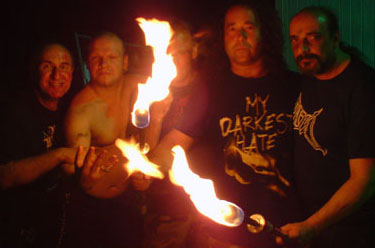
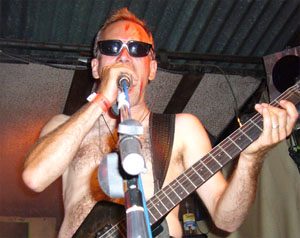 Dysangelium was released in 2003, and in 2007, Impulse to Destroy got re-released. What’s next for BLOOD? Are you going to tour Texas ever?
 No one has or will create death metal like Suffocation. Taking the muffled hard-stop strumming of speed metal, mixing it in with the structural cryptograms of death metal, and amplifying the intensity, Suffocation innovative the percussive death metal that spawned the goregrind genre and countless imitators. Drummer Mike Smith was kind enough to give us an interview on the state of the band and its future.
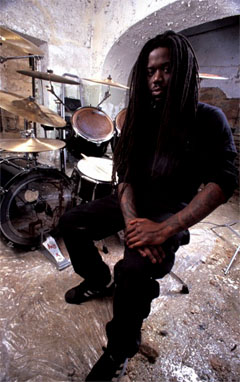 In the Effigy of the Forgotten group photo, a Morpheus (now Morpheus Descends) tshirt is visible. Did this band influence your style?