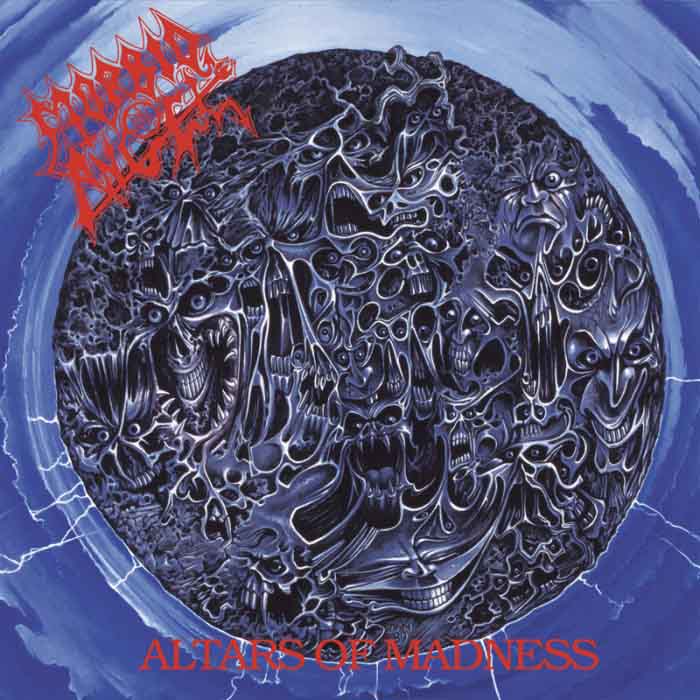
Earache Records is doing another one of their brief, ultra-limited record sales. This time, they are releasing Morbid Angel’s classic Altars of Madness on vinyl; they claim that this release will be one of their “Full Dynamic Range” remasters, which purport to not be afflicted by the brickwalling that took over popular music with the advent of digital recording. Needless to say, this is certainly a classic of death metal, although many on DMU prefer the versions of the songs here that appeared on Abominations of Desolation. Anyone who isn’t fortunate enough to grab this vinyl and wants a version of this album with improved dynamic range regardless will probably have to scrounge up some cash for an original pressing.
While Morbid Angel resolves its lineup issues and recovers from the public relations fiasco that was Illud Divinum Insanus, David Vincent is exploring a musical interest that until recently must’ve been churning under the surface. So far, Vincent’s excursions into country music have happened alongside Danny B. Harvey (who also performed in The Head Cat alongside the recently deceased Lemmy Kilmister), and besides the performance in this video he’s also penned an original song (“Buyer Beware”). So far, his contributions to that genre seem to be reasonably competent, but I don’t know enough about country to adequately judge this. Furthermore, David Vincent isn’t the first metal musician to make the crossover; Jeffrey Walker’s Welcome to Carcass Country comes to mind.
Afterlife Productions has recently released the latest issue of Deadhead Fanzine. This Malaysian label (calling themselves “Asia’s last stand for conservative metal literature”) has compiled an substantial quantity of metal literature into a package that’s apparently more like a paperback book than a simple magazine. Besides the usual reviews, articles, and etc, the major selling point is likely the dozens of included interviews with both well known and more underground metal bands. Morbid Angel headlines, with former members Mike Browning and Richard Brunelle talking about the band’s earliest days, and the latter also makes his way to the front cover. Deadhead Fanzine 6.66 also understandably devotes some space to Malaysian underground metal in particular, featuring interviews with bands from all over the country. The sheer quantity of content here could make it a very tempting purchase, and it is available from Afterlife’s website.
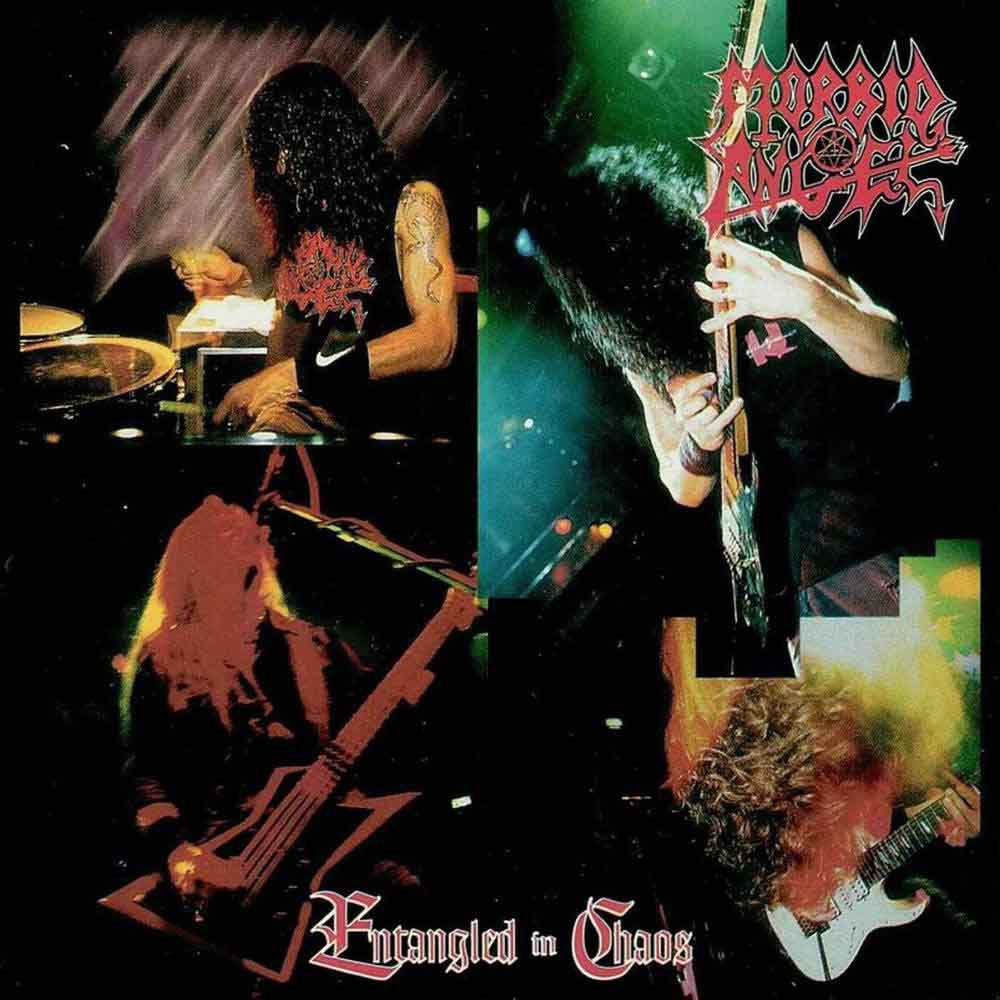
With Earache Records promising us a re-release of this live album on vinyl in October, and an otherwise quiet week of upcoming relevant releases, I thought it might be a good idea to give this a more detailed look. Live albums are fundamentally interesting on a few levels – their attempts to capture something of the experience of a concert, their value as documentation of a period in a band’s career, the chance to possibly hear reinterpretations of favored songs, and so forth. Entangled in Chaos came out at the tail end of Morbid Angel’s commercial golden age and before the band tried to reinvent itself with Formulas Fatal to the Flesh. The product is low on references to the previously banal Domination for whatever reason, although whether that’s due to timing or creative reasons is beyond my knowledge.
These rerecordings end up more polished and standardized than the originals for the second time in MA’s discography, as the long holdovers from 1986 already got the Lemon Pledge treatment when they first entered the studios. Sometimes, the end results are rather stripped down; for obvious reasons studio adornments aren’t available, and Trey Azagthoth’s guitar solos are consistently altered from their original forms. Hearing the band’s earliest material with a production closer to Covenant or Domination is mildly interesting, to say the least, although the concessions to a live environment often cost these tracks some of their power and more musically interesting aspects. The performances are otherwise faithful to a fault, as such strict reproductions leave little room for reinterpretation… with the caveat that this is difficult to do successfully in a metal context and in this case might’ve resulted in an undesirable Domination II or similar.
There are not very many essential live albums in the realm of metal, and you can probably do without Entangled in Chaos in most cases. If you absolutely need to hear Morbid Angel playing relatively faithful but not particularly passionate renditions of their first era or are otherwise a collector, though, this rerelease may be to your tastes.
Warfather has issued a studio update on the progress of the band’s as-of-yet-untitled sophomore album. Rhythm guitars, drums and bass tracks are completed. Vocals should be finished soon.
Warfather ‘s Steve Tucker (Morbid Angel) had this to say about the album’s progress:
“Working with Erik Rutan on this record is both an honor and an amazing experience. Erik knows death metal better than any producer or engineer on this planet! He knows how to get the best performance out of everyone who steps through Mana Recording studios’ doors. A true professional and a Legend!”
Producer Erik Rutan (Hate Eternal, ex-Morbid Angel) added:
“Recording with Steve and the guys on the new Warfather album has been fantastic! It has been a blast to be working on this monster album in the studio once again with my great friend and former band mate. The songs are heavy as hell and just outright awesome. We have some great tones and performances and I’m really excited about the whole process. We have just finished all the drums, bass and rhythm guitars. The massive foundation has been formulated. Now it is time to start vocals and solos and onward to the mix!”
On the heels of much conjecture, and his own denials that an expulsion had taken place, David Vincent has announced his departure from Morbid Angel with a softly-worded press announcement:
Austin, TX – June 19, 2015
DAVID VINCENT Encourages
Fans To Stay Morbid
I had good communication with Trey yesterday and we agree that there are incompatibilities with regards to us working together.
Trey and I have accomplished amazing things together over the past 30 years and I wish him the best with his future projects. Out of respect for the legacy of these accomplishments, I encourage Morbid Angel fans to not take sides because, I am not.
I look forward to sharing my new endeavors with all of you in the near future. Until then, stay Morbid! ~David Vincent
While this may be disappointing to many, it represents new ground for Morbid Angel, which just hired Steven Tucker again, lost drummer Tim Yeung and guitarist Destructhor, and appears to be re-organizing itself more toward its last good material produced, 1998’s Formulas Fatal to the Flesh. Given the immense dissatisfaction with the most recent Morbid Angel album which took the band in a more Rammstein/nu-metal direction under Vincent’s guidance, this re-organization looks like the band orienting itself more toward metal material.
On their first album, Obsequiae made use of very simple but consistent and creative melodies in a harmony emulating that of early western music from the late medieval period. Under the Brume of Eos consisted of songs that were essentially folk-heavy metal in the vein of Primordial with black metal vocals. Each few songs an interlude played in an acoustic instrument was inserted. The material was fine for the first fifteen minutes, after that it just boiled down to a collection of songs which were merely collections of riffs. Aria of Vernal Tombs unfortunately did not move beyond this same strategy.
It is important to go back to the just-mentioned style of Primordial. Primordial is one of those bands that is really ideology first, aura and image of the band first, and then music. The music itself is flat, only serving to carry a mood while the image that the listener has in mind (given by lyrics and song names — concept) is imprinted on it from the outside. Obsequiae work in a similar way, except that they take it a step further and actually make use of musical patterns that evoke the era they are using as theme. They also surpass Primordial in that in the short-term, songs are far more dynamic and in Aria of Vernal Tombs particularly coordinate wonderfully with the vocal pulse.
Obsequiae could still move beyond this “cool-riff” sequence approach and give us much stronger songs — and perhaps a conceptual album extending beyond the lyrical and well into the music. Inserting interludes is only the easy way to do this. Metal bands like Blind Guardian, Rhapsody and even Morbid Angel (on Blessed are the Sick) have done this light and easy concept album arranging, each going further in different ways. Obsequiae and any band looking for using relatively simple yet self-contained and solid songs as the bricks for a strong concept album can look up to Genesis’ The Lamb Lies Down on Broadway. Until now Obsequiae have only given us scattered ideas in an obviously consistent and distinguishable language. And if music is a language of some kind, Aria of Vernal Tombs is one message in a loop of synonyms and like-words drawn from a thesaurus.
Getting into underground metal styles has never been a straightforward thing for anyone. The exception might be the Cannibal Corpse crowd that approach this music as fix for a certain mood, but see little beyond the most sensual appeal of the music. For those actually trying to appreciate the music anywhere beyond the surface either in a technical manner, it’s significance or the experience it provides beyond simple monochromatic sensual indulgence, the path consists of several steps in not one path but a multitude of paths that conform to the singular state and journey of each listener.
The present list does not attempt to give a template that will fit all as that is impossible. It is simplistic in its attempt to generalize and exemplify. The most important starting assumption is that the listener is at least fond of traditional heavy metal or hard rock in the worse case. I tried to avoid using of overtly offensive gateway bands like Craddle of Filth, Dimmu Borgir or Arch Enemy but these should not be completely discarded as possibilities to enable a smooth and pleasant transition into death and black metal.
For this example of a road map towards understanding and appreciation of death metal I have distinguished five different steps with suitable albums as follows:
II. Welcoming and easy-to-understand simple death metal that is only complex on a local level and so can inspire a sense of technical wonder in the listener while maintaining mood.
Death – Spiritual Healing
Adramelech – Psychostasia
Demigod – Slumber of Sullen Eyes
III. Excellent, but mostly on a technical level, with raw power and refinement in style, solid and well-produced albums that do not transcend their technical aspects
Conceived in rehearsals between 1984 and 1985, Abominations of Desolation was completed and recorded by 1986, showcasing the most concentrated and solid (in composition) release either Trey Azagthoth or Mike Browning have put out until now (or likely to ever release, for that matter). I hesitate to use the word refined here as that would imply a correcting of minute details at every level, which this album obviously does not posses. The next three albums make use of this material and refine it in different ways and distinct directions, filling out the rest of the albums with some good ideas and mostly filler.
On Altars of Madness, the most significant changes to the music besides the studio production (including tone and what no) and vocals were to tempo. The composition of the songs themselves remained the same. Basically they were played much faster and the drumming was made more “tight”. The new songs that were not taken from Abominations of Desolation were essentially inferior filler, although the songs were not necessarily bad, just not as good as the earlier material. There are two things to be said regarding the tempo changes. On the one hand, Altars of Madness is mandatory study material for any true fan of the genre and even more so for the aspiring death metal musician because it is a textbook example of excellent technical accomplishment of flexible death metal compositions. On the other hand, accelerating so much destroyed the original character of the songs which no longer sounded mystically infused with darkness but rather comically colorful. The tempo also obfuscated the structural features rather than highlighting and exploiting them, lending a flatter and more pop-oriented sound that emphasized hooks in the middle of a maelstrom of madness.
In 1991, Morbid Angel released Blessed are the Sick, which sees the band attempting to regain the spirit they lost in Altars of Madness in search of a more professionally competitive tone and production. The early songs used in this album were not as distorted, retaining their original aura, but they were re-recorded with very soft and mellow guitar and drum sound. The new songs composed for the album also matched the dense atmosphere and dynamics of the older songs. A concept orientation was adopted and the result was the artistic peak of Morbid Angel, presenting the highest refinement of the material in balance with a whole-work oriented album rather than a simple collection of songs. Here we find the best of Azagthoth’s collaboration with Browning meeting the best of Morbid Angel’s later work. While Altars of Madness came out as slightly comical, Abominations of Desolation seemed dark and serious about its occult nature and Blessed are the Sick made a serious attempt at recovering that.
Then came Covenant, the last album to use seminal material from Abominations of Desolation. This album is a strong attempt at bringing the best from the two previous albums, it is Morbid Angel attempting to summarize, solidify their voice, carving a new path after having released their magnum opus. This is always the most difficult album in a classic band’s career. It often results in an emphasizing of technical aspects while the band tries to discover how they can continue after they have achieved greatness. The result is often undeniably outstanding material that lacks spirit. It happened to Yes after Close to the Edge, the greatest and most ambitious organic expression of who they were. Becoming self-referential in Tales from Topographic Oceans and then, not knowing where to go artistically, Yes used the best of their technical abilities to produce their technical highlight: Relayer. Covenant is Morbid Angel’s Relayer.
I am tempted to say that the best work these two artists ever did was together. It is a pity that personal problems had to come between them. Same sad story of Celtic Frost’s, who also never reached its early heights after the dynamic duo at its center separated. It is hard to tell how each of these artists complement each other, but judging from their projects away from each other we can observe that without Browning, Azagthoth becomes streamlined and even sterile, while without the latter Browning indulges in an adventurous music full of life that is unfortunately musically crippled by a lack of discipline and organization. Perhaps this is also related to a merely technical appreciation of Mozart by Azagthoth and the excited yet musically uninformed admiration of Rush on Browning’s side.
Complaining about the production and tone in Abominations of Desolation and overlooking the whole composition is like missing a great book of classic literature because you do not like the cover and the font in which it is written. You can complain about the font, but the font is not the organized information that literature is. So it is that production values do not make up what music is, only a medium. This does not mean that we should not criticize this, but it seems to me that it is over the top and superficial to say that, for instance, Altars of Madness is superior because the tone and production is better there. In fact, since the best songs in that “first” album are taken from Abominations of Desolation, and the rest are second-rate filler in comparison, I would say that in terms of content this early output is the best release to ever come out under the name of Morbid Angel.
The extent to which the artist’s belief in what he says and does, and how much he is actually familiar and imbued with the material, affects the final result of the music. While the young band fervently believed in the Ancients and the Arabic magic spells referenced in their lyrics, the more “mature” band only held on to these in a more tongue-in-cheek, ironic or perhaps metaphorical sense. Abominations of Desolation concentrates and summarizes all the power Morbid Angel had to give at that point which unfortunately only dissipated in future releases. This 1986 release, and no other, is the embodiment of what Morbid Angel is.
Chapel of Ghouls is a very interesting metal song to start with for several reasons. First of all, it is the epitome of the traditional death metal song and displays the marks of excellent composition by way of being balanced and maintaining perfect mood. Second and related to this mood evocation is the fact that this is a song written for guitars tuned to E-flat standard tuning and uses the open low string often but is not in the key of E-flat, giving the low-chug a very distinctive aura that comes from the sharpened leading tone being emphasized so much that is not the comforting home tonic we hear in commonplace metal. In general, this song also gives us a very special opportunity to see how attention to the use of scale degrees in the right places lends a very specific purpose to different passages with a very powerful effect.
My exposition and analysis of Chapel of Ghouls parts from the a posteriori premise that the key in which it is written is E minor. While making frequent use of chromatism, this piece is undeniably tonal and by that very nature it has a tonal center. It is up to the analyst to unearth just what that center is. The next most important assumption which applies to a lot of metal, is that the playing of fifths is decorative, making use of the sonorous effect this interval has when played on the distorted electric guitar. We do not consider this as an important element of functional harmony and we should only consider the main bass note as pertinent to our discussion of motifs and patterns.
We may observe that if we take riff-groups as sections and we ignore the variations in number of repetitions, the general structure of the song can be summarized in the following manner:
A-A’-B-C A-A’-B-C | D-E D-E | F | B-C-A
We can see the artistic abstraction and application of Classical-era concepts in Morbid Angel’s use of chromaticism for emotional effect within a clearly tonal framework. Even more telling and importantly, Chapel of Ghouls’ structure reveals an adapted classical sonata form. The sonata form is characterized by being divided into three sections: an exposition, a development and a recapitulation. An exposition generally presented the main materials that would be used to develop the piece. These were usually stated and then repeated once with small variations. The development traditionally implied a modulation into a different key and a development of the ideas into more foreign territory. After a flourish in the development section called a retransition that would bring the song back to the tonic area, the recapitulation was a restatement in an abridged way, of the main ideas stated in the exposition. Chapel of Ghouls fills all these requirements to the letter:
Exposition: A-A’-B-C presents the main ideas, and is repeated again with a small divergence in the number of repetitions of the riff. The second time around it is played, it is repeated more times, a simple and primitive way to echo an expansion.
Development: While part “D” is still in the same key, it starts a shift in the importance of the notes which can be considered a modulation. When we reach E, the song is in a different key than the rest of the song, and a different theme defines this section as well, even though we can hear an affinity with the motif of part “B”. Ironically, we call this type of development monothematic, although it may have more than one theme of its own (as this one demonstrably does).
Retransition: part “F”, a slowed down section treading the same some of of the tones (degrees 2 and 3, specifically) that have been used again and again in succession in this song, only to round it off by clearly stating the main motif and theme of the song decorated with an octave doubling rather than with the typical fifth used elsewhere in the song.
Recapitulation: re-use of “A”, “B” and “C” in different order and condensed number of repetitions. The final use of A incurs in a variation that heavily emphasizes the main theme as its final phrase.
Furthermore, the way solos run over more stable rhythm sections and moments when the rest of the music is quiet resembles the tutti-solo-tutti exchanges typical of works from the Classical era. The piece displays an adept of use of pauses and brief silences to enhance expectation and stress unstable tones at inflection points to promote forward movement.
Another little trick that is worth highlighting is that when they make tempo changes either to a faster or a slower, Morbid Angel will shorten or stretch average note length in order to counter the change (if we change to a faster tempo, the notes become longer, and the opposite in the same manner). This helps make transitions much more smooth sounding, pulling the length of the notes towards an central average despite the difference in tempos in different sections.
Lastly, every one of the riffs/parts we defined above with letters of the alphabet are written in period form. A period contains an antecedent and a consequent. The second one of these is a repetition of the first with variations in the end goal, the harmony or anything else that does not destroy the identity of the original idea. Traditionally, the antecedent ends in the dominant or a transition to the dominant and the consequent ends in the tonic, coming back to stability. In the case of Morbid Angel’s Chapel of Ghouls, all the periods’ antecedents, except those that make up parts “D” and “E”, finish on tones that are not part of the E-minor scale, while the consequents all end on in-scale tones. In the case of the exceptions just mentioned, this is inverted and D# is tonicized, effectively constituting a modulation to a different key.
Trey Azagthoth’s early infatuation with Mozart is often taken lightly even by fans of Morbid Angel but Chapel of Ghouls is a clear example of how this claimed influence went deep and affected the way motif, theme and development were handled. Trey did not just copy the classical style of Mozart, but adapted methods perfected by the late master to the needs of the budding death metal genre Morbid Angel helped define.