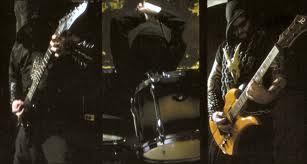
One of the most well known of the close-knit and virile New Zealand death/black scene, Kiwi act Diocletian‘s full length falls and fits clearly within the war metal sound as was pioneered by Blasphemy, and taken to a more nihilist, apocalyptic climax by fellow Canadians, Conqueror and their suceeding act, Revenge.
Structurally, the songs of Diocletian adhere to the musical formulas that define Canadian death/black metal hybrids, but the production whilst still raw, is not as lo-fi and has more streamlined engineering on the guitars and drums, with the bass guitar playing, an unlikely rarity in such high intensity music, thankfully audible. Barked, roaring vocals commonplace within this niche of metal predominate ‘Doom Cult’.
The tonal quality of the guitars whilst not trebly are less bass-heavy than what you would expect from an Revenge or Sacramentary Abolishment record, is of enough clarity to possess a harmonic distinction that has a similar quality to a less Norse-influenced Demoncy, and even draws a parallel to the first full length by Profanatica. To add to this, a similarity that vaguely resembles the ‘Cut Your Flesh And Worship Satan’ album by Antaeus is present, in that nuances of distortion and feedback, samples of a warlike nature are used to build and intensity the framework of the album.
Along with a savage execution and great understanding of the pattern language that informs this style of music, Diocletian put forth an excellent full length.
Filed under: Death Metal Music Reviews — Tags: Black Metal, Death Metal, New Zealand Death Metal, War Metal — Pearson @ August 18, 2010 00:14 — Comments (6)

For most death metallers, evil is not spread at the behest of a paranormal entity lurking beyond the horizon, demonic possession or a tempter, but instead there is a devious core of man’s unawareness, parasitic tendency and “blind leading the blind”, leading society to a vicious circle of uncaring mutants annihilating each other through various games and contrivances of modern culture, seen as necessities. Immolation, one of the most skillful yet direct conjurers of death metal art, organized “Unholy Cult” as a series of statements in man’s capacity to evil and the existentialist oblivion in realizing God’s falsehood, because despite the possible existence of transcendental unity the hypocrite “cults” of man wreck the vision into a disturbed dualism. Rarely has death metal sounded as subtle and smooth, yet nerve tingling, as the best line-up the band ever had utilizes its effortless sense of dynamics to “groove in” an approaching storm of apocalypse with subdued counter-rhythm of Hernandez against the dissonant riff, something their obvious modern copycats Deathspell Omega often fail to do because of flawed pacing. Distinct from “Close to a World Below” in fist-pumping doom and black metallic blastbeats interjecting the symphony of diminished intervals, making this probably the first step in the gradual descent of Immolation to “meet their audience”; however here the impression is not pandering at all but perfectly persuasive slithering of a mind-virus that awakens the listener to a moment of tumult realizing retroactively about five minutes of mental build-up having led to an indescribably intense resolution of themes akin to a musical Nibbāna where the tenets of both light and dark are annihilated in a moment of musical nihilism. As is shockingly customary for Dolan, Vigna and company, the songs are riddles and glyphs requiring a reasonable effort from the part of the listener to decipher and actually recombine the parts of the song in one’s mind and through the puzzle man is led to realize an impossible paradox of nature: evil as part of, yet beyond, theology. If blasphemous metal was ever made into a mental exercise, “Unholy Cult” is the crystallized moment of it.
Filed under: Death Metal Album of the Week — Tags: Brutal Death Metal, Death Metal, New York Death Metal, Philosophy, Progressive Death Metal, Religion — Devamitra @ August 17, 2010 12:20 — Comments (1)

The difficulty of maintaining a sense of brutality by balancing folkish melody with Death Metal’s deconstructionist tendencies is undoubtedly the reason behind the scarcity of such albums as this rare Danish classic that’s now enthroned within the golden halls inhabited by the likes of Unleashed and the previously hailed Asgard, as warriors of Viking Death Metal. Deriving their sound largely from the Swedish scene which housed the former band, Dominus additionally colour their music with the ancient, melodic sentiment of the memorable French beserkers, resulting in an album that sounds like ‘To a Golden Age’ as composed by Entombed from the ‘Clandestine‘ era. Steadily chugging riffs accompanied by a Bolt Thrower style of rolling percussion do battle with bouncy, highly pronounced rhythms in the manner of both Entombed and Seance, from which ominous shades of folk melodies emerge, initially encoded within the nihilistic rhythmic patterns, gradually becoming more independent as the album progresses, highlighting the journey of warriors and their struggles sanctioned by the gods, which reveal to man the true scope of his existence, within the continuum of cosmic action. Avoid all further output by and incarnations of Dominus, so that the memory of this carefully orchestrated saga stands proud over countless, unspeakable populist horrors.
Now as we ride in iron and steel
We know that this is the land of eternity

One of the older and more unsung extreme metal bands to come out of North America, Virginia-based Deceased issued ‘Luck Of The Corpse’ in 1991, playing death metal in the most primitive of fashions, in ways not too dissimilar to the likes of Autopsy and Impetigo. The common perception of a musical aesthetic often dictates to the more automative listener that anything that bares an adherence to or authenticity that speaks ‘simplicity’ this conveys the perception that nothing unique is to be expected, and in the case of death metal that it conveys no sense of originality or otherwise is quickly assumed to be something that breaks no ground.
Deceased’s full-length debut serves to shatter a couple of myths, and whilst firmly rooted to the aesthetical mould of death metal’s oldest school, drummer/vocalist King Fowley’s taste for eclecticism makes itself clear in abrasive compositions. The influence of progressive metallers such as Voivod and Prong come through in varied sequences of riff patterns that use a variety of strumming techniques, from low end death/thrash melodic motifs to discordances that have nuances of discordance that also was prevalent on the likes of ‘Killing Technology’ and ‘Dimension Hatross’. The drums are very impressive, sounding very upfront in the mix, and King Fowley’s vocals are that of an animated, puking corpse. His execution and hitting of the skins is quite direct and barbaric like his fellow instrumentalist Chris Reifert of Autopsy, though has a much more varied sense of rhythmic dynamism and interchange that works in solid cohesion with the dense yet flexible musical dimension that this band craft for themselves.