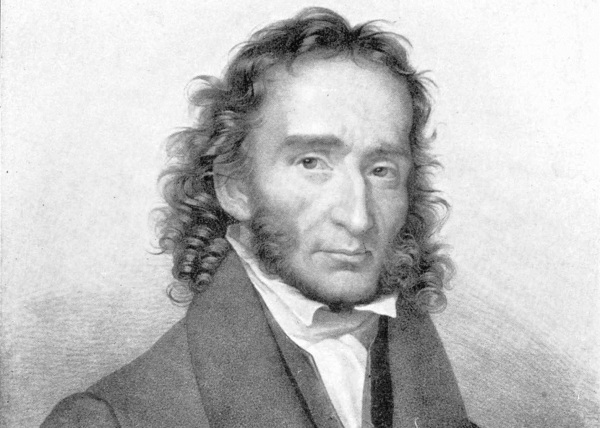
Niccolo Paganini: the name is well known among violinists. He belongs to the exclusive club of musicians known as virtuosos.
Sickly since his birth on October 27, 1782 in Genoa, Paganini’s virtuosity was astounding. He began playing the violin at age seven at the insistence of his father, Antonio Paganini. Antonio Paganini was a mediocre mandolin player who forced his son to practice long hours. At the age of thirteen, Niccolo was sent to study with a famous violin teacher named Alessandro Rolla. Rolla, upon hearing young Niccolo play, refused to take Niccolo as a student because he claimed he could teach Niccolo nothing.
Niccolo continued playing and performing in his native land, and soon received a reputation of being the best violinist in Italy. People began to speculate about Paganini’s great talent, and began to wonder about his gift. Paganini became known as a “Hexensohn” or witch’s brat (de Saussine, Paganini 113). Paganini’s demonic reputation became so widespread that his talent was often attributed to the belief that he had help from the devil.
Paganini began touring Europe when he was in his early forties. At the time, no one had ever seen or heard anyone, or anything, quite like Paganini. For a time, Paganini capitalized on this difference by encouraging the rumors of his supernatural abilities. It was common for him to arrive at a concert in a black coach drawn by black horses. Paganini himself would wear black. Schwarz states that Paganini would enter the stage late, like a non-terrestrial creature, and bow to the audience(Great Masters of the Violin 181). Paganini’s stage presence increased the rumors of his dark affiliations and the rumors soon became outrageous. One of the most popularized reports explained his extreme dexterity with one string. Schwarz explains that many believed Paganini had been imprisoned for a love affair with only his violin for company. One by one, the three upper strings broke, leaving only the G-string. Paganini soon learned to play on the G-string alone because of his imprisonment (Schwarz 176). Paganini tried to dispel these myths later in his career, but it was too late. Paganini became known as a “technical wizard” (Schwarz 179).
Paganini’s technique was outstanding and unusual, but it was his satanic bearing which caused great crowds to attend his concerts. Schwarz states that “It was more than technical wizardry that attracted the masses: there was a demonic quality as well as an enticing poetry in his playing” (Great Masters of the Violin 181). One instance of superb technique being mistaken for supernatural guidance was the “duel” between Lafont, a famous French violinist of the time, and Paganini. Lafont had volunteered to give a joint concert with Paganini; however, people gained the impression that the concert would be a contest. Paganini was the unofficial “winner” of the contest. Schwarz states that Paganini “won” by improvising during the concert by adding octaves, thirds, and sixths (Great Masters of the Violin 172-173). Paganini was always eager to showcase his technique. Sachs states that Paganini, at a concert in Paris in 1832, played his Sonata a movement perpetual at an amazing twelve notes per second (Virtuoso 33). Most people find it difficult to imagine twelve notes in one second. Paganini managed to play twelve notes in the same amount of time it takes for most musicians to read twelve notes. Paganini’s talent extended from the mere mechanics of technique to innovations in technique.
Paganini is the father of modern violin technique. One innovation Paganini began is the practice of memorization. Violinists before Paganini always used music during a concert. Paganini, on the other hand, would boldly walk onto the stage, shake back his long black hair, place his violin under his chin, and begin to play without the aid of music. Audiences were astounded. They marveled at the thought of one man memorizing an entire program of music. The current practice of memorization was attributed to Paganini’s supernatural abilities. Paganini’s innovations were recognized as early as 1829 by the German violinist Guhr. Schwarz summarizes Guhr’s theories on Paganini’s innovations into six categories:
- scordatura, which is the mis-tuning of strings to enable the violinist to play in another key without shifting;
- unorthodox bowing, such as bouncing the bow on the strings;
- left-hand pizzicato, which allows a violinist to create the staccato sound without using the bow hand;
- an extensive use of harmonics;
- using the G-string for entire works;
- bizarre fingerings (Great Masters of the Violin 196)
All of the techniques listed above were new and created sounds never heard before. These new sounds which Paganini created caused audiences to react favorably, even if they thought Paganini was possessed by the devil.
Paganini’s appearance completed the image of the satanic violinist. Paganini’s dark hair and pale face contrasted, giving him an ethereal aura. The loss of his teeth in 1828 gave his face a sunk-in appearance, which added to his ghost-like image. Few concert goers were left unmoved by a performance given by Paganini. Boerne, a German poet at the time, described his impression of a concert given by Paganini: “It was a heavenly and diabolical enthusiasm, I have never seen or heard its like in my life” (Schwarz 185). Paganini’s ability to entrance an audience can be attributed to his physical appearance and to his technique.
The myth surrounding Paganini lingered even after his death on May 27, 1840. Since Paganini had refused the final sacrament, he could not be buried. His remains were kept in a basement for five years until his family petitioned to have them buried. Many people speculated on his refusal of the sacrament. Some said he did not believe that he would die, while others said he was a non-believer (Sachs 32). The result of his refusal of the final sacrament once again raised the question of Paganini’s origin.
Paganini’s origin was not in Hell as the myth propagates. Paganini’s accomplishments were due to his diligence and hard work. Few realize the amount of practice required to perform effortlessly. Paganini had the gift to not only create beautiful music, but to create an entertaining performance. At the high point of his career, every concert Paganini gave was sold out. The sensation Paganini created in the 1830’s can be compared to the Beatles invasion in the early 1960’s. “Paganini Mania”, like “Beatle Mania”, caused a change in the music style of the time. However, Paganini can also be compared to Elvis Presley, who began to lose popularity during the last few years of his life. Paganini, at the time of his death, no longer created the image that he had earlier in his career. However, in spite of all the rumors, Paganini managed to originate a style of music which is still alive today.
A Selected Bibliography
Saussine, Renee de. Paganini. New York: Hutchenson & Co. (Publishers) Ltd., 1953.
Sachs, Harvey. Virtuoso. New York: Thames and Hudson, 1980.
Schwarz, Boris. Great Masters of the Violin. New York: Simon and Schuster, 1983.
No CommentsTags: Baroque, Classical, metal technique, music theory, niccolo paganini, technique