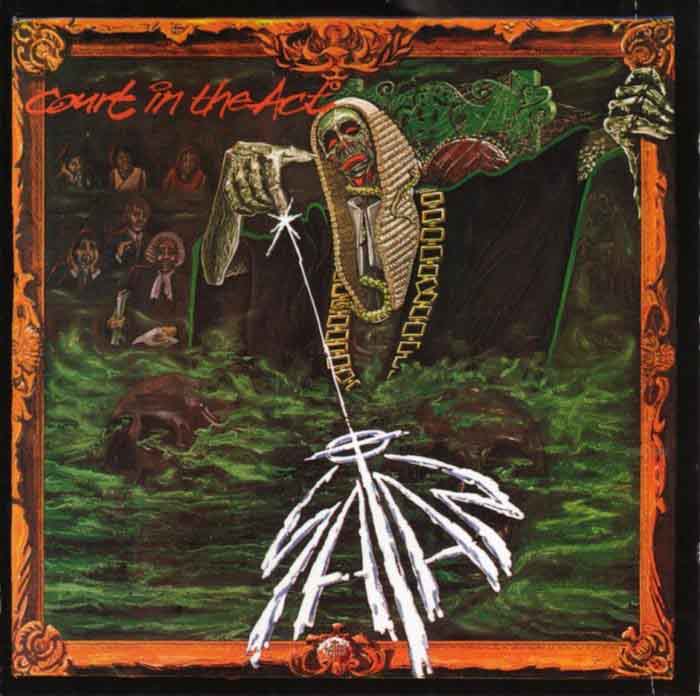
Satan‘s Court in the Act exists in a unique space between the New Wave of British Heavy Metal and speed metal. As a wholly metal album that attempts no pandering to mainstream radio rock unlike seemingly every other NWOBHM band, Court in the Act is by far the strongest studio album of that sub-genre/movement and incredibly influential to American speed metal bands Metallica, Megadeth, and Slayer.
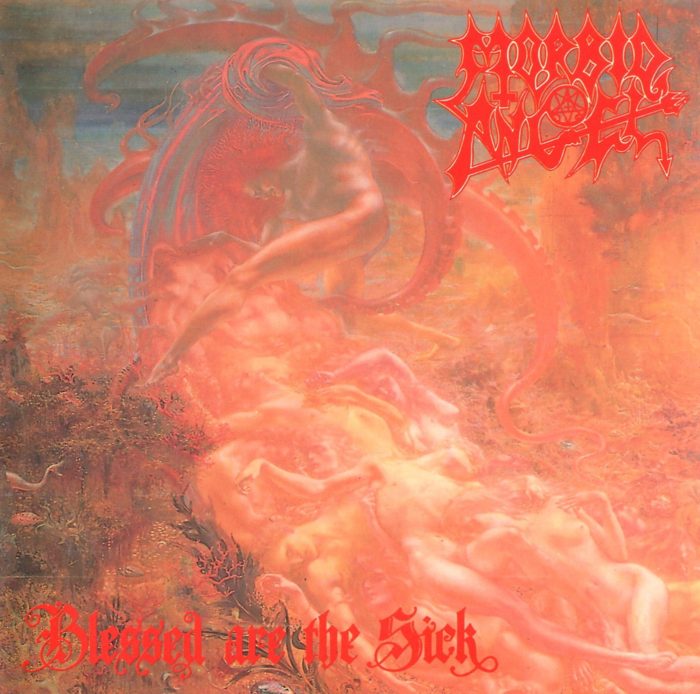
Nirvana’s Nevermind turned twenty five yesterday but since we at the Death Metal Underground condemn pop-punk Boston worship, we will celebrate a different anniversary today. Morbid Angel‘s Blessed Are the Sick was released twenty-five summers ago. Blessed Are the Sick was the last Morbid Angel record focused on inwardly improving the music rather than compromising it for commercial appeal to a mainstream market. The band had been obsessed with refining and expanding upon their compositions since Trey Azagthoth shelved the release of 1986’s Abominations of Desolation and fired then drummer/vocalist Mike Browning.
Lonegoat of necroclassical band Goatcraft issued the following statement today on, of all topics, Death Metal Underground itself. Read on for some clarification of the oddities of Goatcraft coverage for the past year or so, and the “no Goatcraft rule” implemented some time ago.
Brett Stevens is a controversial man. He’s made more armchair activists angry than anyone else on the internet. Founding the legendary Dark Legions Archive, as well as many other groups/websites/etc, his reviews were unmatched and were of the highest linguistic artistry. He created worlds in his reviews that paralleled the musical subjects better than anyone else who ever wrote about metal.
He’s been around since the nascent stage of the internet to this now populace, SJW Tumblr Tranny modern wankery that resembles dumpster diving more than anything else. It’s only suiting that he swapped to writing movie reviews.
For a while I aided Brett by helping out behind the scenes at Deathmetal.org. I wouldn’t really consider it “helping” as I’ve never been a writer nor cared to be one. Usually my contributions were drunken and juvenile. It was what it was.
In return for my contributions, Brett hosted this domain while I was in between jobs and had no spare money to pay for it. About a month after that we had a falling out over a mutual acquaintance and our stances regarding this person. Goatcraft.net was then nuked. Most of the Goatcraft material was pulled from Deathmetal.org at my request. There’s now a No-Goatcraft rule implemented at Deathmetal.org because of all of this.
About 8 months later Brett gave me the Goatcraft.net domain back.
I’m indifferent to what Deathmetal.org is nowadays. There are some good articles like the recent Abominations of Desolation controversy article, although he should’ve been more specific in the article instead of hiding its intent through multiple layers.
This should clear up any confusion regarding the friction between Deathmetal.org and Goatcraft.
Consider it a generous statement and a fair one, and wonder no more why our Goatcraft reviews went away. It is what it is.
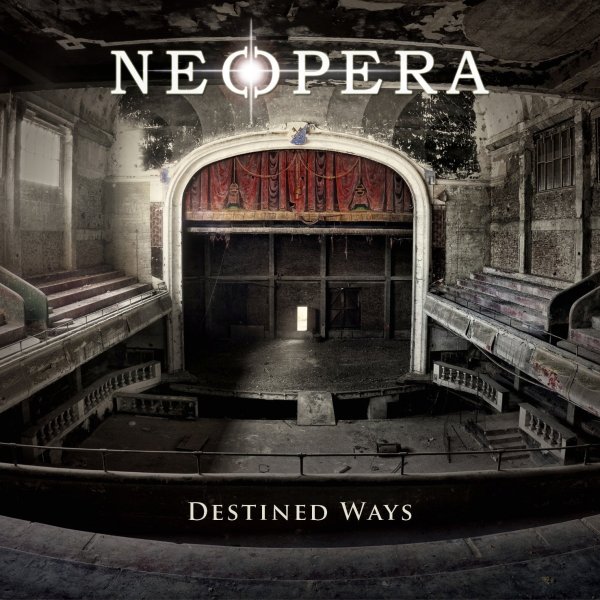
I’ll let you in on a dark secret from music reviewers: sometimes we write about stuff that is fun to write about even if it will quickly slip under the foamy surf of history. Neopera is one of these bands which is proficient in a terrible cheesy style but whose presence evokes so many observations on metal and society that it cannot be passed up. It is not an easy bash like the phenomenally boring Abysmal Lord, nor a making fun of chronic idiots like a Pantera or Meshuggah review would be, but an insight into human thinking about the uses for music and what it says about us. (more…)
The crossover between metal and keyboard music is vast and well-documented to the point that the well-dressed death metal site simply ignores instrumentation and picks the keyboard bands that sound as evil and nihilistic as death metal. Whether that’s works by Neptune Towers, Beherit, Jaaportit, Goatcraft, Burzum or Danzig, evil metal has crossed over to occult keyboards.
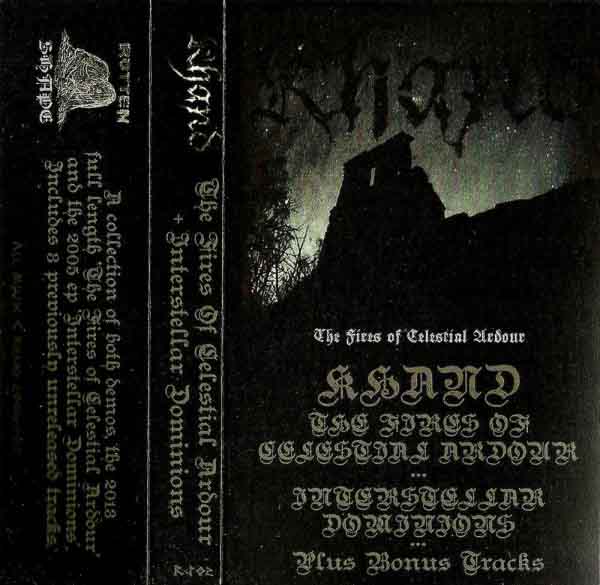
Another entry into this world is Khand, made by lifelong metalhead and now synthesizer jockey Arillius. Describing his music as “cosmic ambient,” which overlaps with black ambient and dark ambient and neoclassical, Arillius started Khand back in 1998. Influenced by medieval, space and fantasy themes, Khand’s demo “Interstellar Dominions” was released in 2006 and immediately attracted an unusual but dedicated audience. Seven years later, Khand released The Fires of Celestial Ardour which is now available on tape for those who wish to order it.
The Fires of Celestial Ardour shows Khand having refined its style and narrowed its focus, which enables the band to train its resources on a certain type of deep space exploration sound. For those who want to experiment, the album is available as a free download from hi.arc.tow records.
In the mainstream press, black metal has a reputation for being solely misanthropic, heavily distorted anthems of aggression and despair that are defined by their primitive minimalism.
While this may hold true for the majority of contemporary bands, this view overlooks the foundational bands of the genre, who possessed a deft sense of melody and the focus to create longer compositions that allowed for more introspection.
Just as black metal musicians created a more minimalistic form of death metal, some were able to apply the same approach to the ambient and neoclassical genres, crafting tracks that through the use of repetition, stirring melodies, and tonal variation reveal the genre’s primal elegance without need of layers of distortion.
Favoring simple but expansive compositions, contemplative melodies soar over mild arpeggios; in addition to a few tracks of industrial nihilistic deconstruction. Through the utilization of modern technology, Burzum makes narrative and meditative music that like its inspiration Tolkien, takes the participant on an internal journey to another realm.
A side project of Darkthrone‘s Fenriz, in Neptune Towers haunting melodies glide over dark drones while otherworldly noises color the backdrop. Evocative tracks signal the coming to Earth of a yet-unknown alien species or perhaps the future evolution of humanity, the soundtrack to the future.
This band fuses its earlier black metal style with the industrial, pop, and ambient genres, featuring melodies that would not be out of place on a metal album, but pairs them with repetitive trance-like drums, synths, and found sounds that coalesce into epic moments before fading away like the rays of a burned out sun. Fans of multiple genres should appreciate this one.
Elegant and skillfully composed tracks celebrating the beauty of nature in their simplicity reveal a greater depth of expression than would be possible with over-produced tracks. Just as he did with black metal, Ildjarn with compatriot Nidhogg reduces neoclassical music to its most basic form and builds from it an enchanting structure.
A side project of Graveland, with Lord Wind martial drumming and heroic melodies bring to mind the battles of old, while synths and choruses expand the project’s horizons, providing reach to contrast with the grounded and earthy rhythms. Well-crafted neoclassic folk music, this is the further continuation of Graveland‘s second stage.


 In the mainstream press, black metal has a reputation for being solely misanthropic, heavily distorted anthems of aggression and despair that are defined by their primitive minimalism.