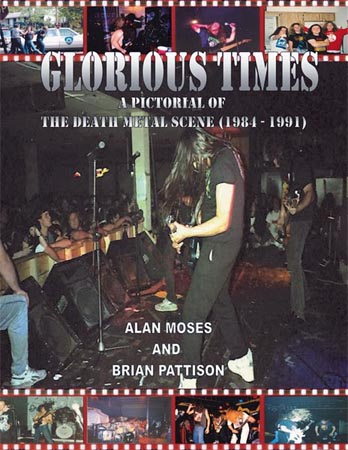
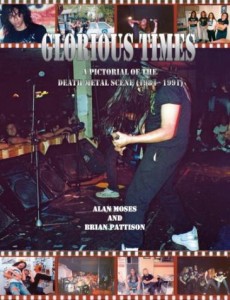
Alan Moses (Butterface zine) and Brian Pattison (Chainsaw Abortions zine) are the death metal zine editors who compiled Glorious Times: A Pictorial of the Death Metal Scene (1984-1991). They also promote the A Day of Death series of concerts and have been active in the death metal underground up through the present day.
Glorious Times: A Pictorial of the Death Metal Scene (1984-1991) covers the formative years of the death metal underground in the words of its participants and as a result, is not a slick product designed to hype the drama of the scene but an in-depth exploration for those who care to exert themselves to learn.
We are fortunate to get a few moments of their time and to hear how Alan and Brian got into metal, ended up starting their zines, and almost two decades later resurrected it all with Glorious Times: A Pictorial of the Death Metal Scene (1984-1991).
When did the idea hit you for this book, and when did you think, “this might actually work”? I understand that both of you published paper zines, and that you Alan worked for Morbid Angel (gods among men) and that you Brian had a radio show and promoted live shows, including the infamous A Day of Death. Would you have undertaken this book without that background?
Brian: The idea came about in an off the cuff remark Alan made in an email to me in May or June of 2009. He mentioned having a photo album on his coffee table with old pics he had in a collection. I like that idea, then just thought it would be cool to have something like that in actual book form. In later discussions we agreed it would be even cooler to have stories from friends (the bands and ‘zines of the era) to go with the pics. I would say by possibly early Sept of 2009 we thought the book might sell some. We had begun getting emails from bands we didn’t contact ourselves and other people who had heard what we were doing and wanted a copy for themselves – originally we intended to print two copies, one for Alan and one for me and that was to be it. it’s hard to know if we would have done this without having the backgrounds we do. it would have been a lot tougher for sure. doing what we did back then made people remember us so it was easy to get stories from Chris Reifert, Kam Lee, Henry Veggian, etc.
Alan: I was probably a world more skeptical than Brian about it. After all it was an off the cuff statement I’d made in an email to him, a single email among I don’t know how many others. I forgot about the subject, but Brian went away and mulled it over for a while. He doesn’t just step into things blindly so he’d been thinking of all the hypotheticals before he came back to me with his thoughts of actually making a physical book, beyond just 2 overpriced copies via an online publisher, which was the original idea.
My mindset was way more cemented to the ideas about digitizing our combined audio tape and video collections, than any book concept, at first that is. When he came back to me with “oh I have been thinking about….” and went into details, I remember thinking “holy f%!k the guy’s gone nuts” haha but the more he argued the case (so to speak) the more I warmed to it.
It’s hard to say whether those things from our pasts played any part in it or not, I don’t know how much background the creators of any other books had in this music – so I have no idea what their drives are. In the past I’ve often been asking about doing a book of some kind – but laughed it off, or even if I may have entertained the idea for a couple minutes at best, my life was not the sort to support any such endeavour until recently.
Maybe our collective contacts proved helpful in doing this, but then again many old friends have ignored or turned down the chance to be a part of GT as well, and some times it seems to me that an unknown newbie off the street has better success these days of reaching OUR old cronies than we do, especially if they have tits and whorish looking myspace profile photos haha.
What advantages does a cut-and-paste or photocopied zine have over its electronic counterparts? What disadvantages? Are paper zines still relevant in the same way, now that we have blogs and mp3 trading to make life easier?
Brian: A big advantage is price. Making a ‘zine the old way you didn’t have to print thousands; you could just run off a few copies and assemble them yourself, sometimes as needed. Biggest disadvantage to me would be all your pics would be in the lack of color for cheaper copying. Paper ‘zines could still be relevant if people bought them. The paper ‘zines of our day were often put out by people who became fans of their local scene first, so those ‘zines were great ways to find out about bands that didn’t get national exposure.
Alan: Well, for a start, paper zines can be brought to the shit-house, so for most men, that’s the place they get to read in peace anyways hehe – if they have a family anyway.
They can be brought back out at leisure, wherever, and don’t dictate the need for all this extra technology or internet connections to read – especially in countries that have the system dictating how much bandwidth you can have and at what speeds you can use it, such as Australia and other third-world-internet-countries.
In many ways the print zine might be making a comeback, or seems to me to be making one, as people are beginning to leave the textureless internet and return to a more biological physical based enjoyment of all the trappings that come with this music. On the other hand though, as many print zines as I see flyers and adverts for – how many do they sell? Is it the same concept as when we made them, the concept being that we didn’t even care about sales, it was a labor of love and devotion.
The disadvantages of printing and postage costs and garnering physical mailing addresses as opposed to email are the main issues I guess, whereas today anyone can be a blogger and start a webzine or start trading mp3 with little to no background in this music. Contacts were hard to come by back in the day, and it was an investment to buy cassettes and establish a good stable of quality traders – it was based on hard work and faith, and that was evident from the list you had to offer trades from.
The bottom line is though that for the most part, only glossy magazines get the business and they cater to the borderline or fully blown corporate bands and their fans, that’s where the money is. That type of fan would snub their nose at a photocopied zine without a doubt – they only know glossy music and images, so there’s not much to be done on that front but leave them to it. To transcend the money issues on an underground level, ofcourse digital means greater speed and coverage – but we are sacrificing an entire facet of the experience in so doing.
Do you think mp3 trading is superior to tape trading? Does it help people find music, overwhelm them with too many options, or both?
Brian: HELL NO, mp3 trading is not superior to tape trading! For one thing you’re dealing in crap files, anyone who truly loves music would not listened to their stuff in a crapped down format like mp3. Tape trading was great, you’d get the stuff you requested and then usually a little bonus material as tape filler. In ’89 that bonus stuff could have been short demos (like Immolation’s ’89 demo) or live stuff or rehearsals of new bands like Mortician and Incantation who didn’t have demos. With mp3 downloads you just get the tracks you’re looking for. MP3 trading may make it faster to get stuff, but it has help destroy the scene. The personal touch and friendships that were made through tape trading just don’t exist in mp3 trading.
Alan: No, I don’t think it’s superior per se, not for the most part.
The exclusiveness is totally gone now. Grandma can plug her dentures into any USB port and now obtain live audio which was reserved on trader lists as “not for trade” like the old Genocide recordings (pre-Repulsion) were and is instantly metamorphosed into an old school Genocide fan. Now that exclusiveness has been sacrificed, yes, it certainly does immeasurably help people find bands they really like, whatever the style is. I wouldn’t have found totally kick ass bands like Punch or Question otherwise (both amazing hardcore punk bands) – stumbling into a blog lead me to “try” them out, like you would that unknown band on a trader list, or put on a trade at the end to fill the blank tape and see if the recipient liked it or not – that’s the same concept, so it does works.
It’s only when they start mass messaging you to “vote” for them to become the next reality-concepted band and “win” a Myspace or whatever label contract that it gets abnormal. Conversely – from a corporate mentality you want to market what the plebs want to hear, so you want that newest Kelly Clarkson or Mr. Hanky band brought to the table, by the very plebs you want to fleece with it anyways.
Then we get to the whole push-pull thing, and face the issues of whole albums being ripped and copyright and the rest of it.
It has the capacity for both effects though, no matter what, and the serious adventurer into this music better be prepared by wearing a shit proof suit – because they are going to swim in shit before they find the gems.
What kind of audience does old school death metal and Glorious Times have, and how many of them are carryovers from the original days?
Brian: Old school death metal seems to be regaining favor, thankfully. As a guesstimate I would say roughly 1/3 of the people who bought our first printing were people from the old days. Our sales pretty much ran the full spectrum of fans, we sold to a few in their early teens and a few that were over 50 yrs old.
Alan: We have people from our era and younger, although the younger are far less represented. Mainly, we gather, because we haven’t had any corporate mechanism behind us to promote things – only the really attentive youngsters caught on so far, because we are out of their more cashcow oriented world at this time. Unless you really use myspace ALOT or saw a quick blurb at Blabbermouth one time, we would have missed GT pretty much, that’s because we had no money to promote and people are guarded about what they throw their money at.
If we had Shane Embury ‘endorse’ the book, haha, we would have been picked up by most of the publishers of metal oriented books probably before the thing was even out of the draft stage haha.
Musically speaking, there’s so much more folks drifting back to the old bands and the old feel of things, since they’ve got a bit wise to the genericisms of the music today. Don’t get me wrong, some of the bands coming out with stuff these days are phenomenal (cough Malignant Tumour cough Master cough) – but we see letters every single day from a vast array of age ranges wanting a return to the Glorious Times, and there is an undercurrent of feeling disatisfied with what the state of affairs has become.
No matter what, death metal fans have always been really die hard. I think most people realize that there’s more dedication in general, compared to other music styles. Hardcore and the derivatives is the same ofcourse. They might have dropped out of sight due to life’s circumstances, or come back and become more active, and the old classics are still classics to them. Some may continue to venture forth to try to find good bands from the newer generation, which is what Brian and I do (although we are both as into hardcore as well as other extreme music, not just death). But we are not so sure the new young bloods adopt a similar philosophy because the whole shebang is different for them. They have ease of access but the exclusiveness is tainted by their having been spoiled by the technology.
We rest well, in the knowledge that so many old hands at this have stated publicly that GT is something no true death metal fan should be without, and so far only the hardest core have it. We have yet to be able to change that, and give other people, with as keen an interest, a chance to check it out. Most of GT’s appreciation base understands the importance of hearing the individual memories from the very people who lived them rather from a stale 3rd party who either wasn’t really active back then, or was simply too young or not even born. I am the sort of person that would rather read an autobiography than a biography, and GT fans respond to the concept really well, they are whom we made this book more available for anyways. Nobody else.
What’s the difference between then and now in terms of what fans expect, how bands act, and what people expect from the music?
Brian: Most fans today expect everything for free. They won’t spend $3 to buy a band’s demo because someone else will and that person will upload it to a blog. Bands act differently, some just stay backstage and don’t mingle with the fans forgetting that they are nothing without the fans and that they too were once just fans. Some bands don’t though, Alex Webster (Cannibal Corpse) still goes out and mingles with the crowd and will talk to anyone. Nowadays with the rise of digital recording people expect every recording to be of great quality, which is a shame. There’s some special about getting a rehearsal tape or poorly recorded demo, you know the band is in it for the music/for the fans, not to try to get signed and make money.
Alan: I can think of a few major household names today, from the old days, whom have made a 360 degree turn around from their former mindsets, and have totally turned their backs on their old fan bases, in favour of the adorations of a generation raised on rock star worship again – like the thing got killed by the underground and has been brought back in some sort of grandiose version of itself. Similarly, others from the same fold are still as grass roots as ever in their mindset and haven’t been poisioned. Then there’s some that are just as indifferent to their fans as they were then, and have atleast remained consistent on that level.
The fans I think, have made a major political shift – because the bands are more accessible to them, yet the rock star worship has been elevated – you’d think that would be the other way around? It wasn’t like that before, there was more of an even playing ground between a band and the fans usually.
I guess that is a symptomology of having years and years of success that eventually there is another generation born that sees things with a different set of eyes, with different value systems. Entertainment-wise anyways.
Do you have any insight as to the relative importance of fanzines in different parts of the world, if any? Who were/are your favorite foreign correspondences?
Brian: Fanzines back in the day were hugely important. those were the early years of death metal so it didn’t get coverage in the glossy music mags. If you wanted to read an interview with Immolation, Prime Evil, Insanity, Nokturnel, etc you had to find it in a ‘zine. You didn’t just want ‘zines from your area or your country either, you wanted them from all over so you can discover new bands, remember it was before the internet and myspace so to discover a band like Death Courier from Greece you had to either read about them in a ‘zine or happen to get a flyer of them from a tape trader. now of course my favorite correspondence is Alan, back then it was probably Walter Garau (Ass Ache) from Italy.
Alan: Certain zines were vitally important. Blackthorn from Denmark, Uniforce, Total Thrash etc from the USA, Decibels Of Death and Ultimate Speedcore Dislocation from France, and the legions of zines from South America were vital in exposing bands from everywhere yet still had enough from their own countries to be interesting – well there were an abundance of interesting bands though back then too. I had penpals in so many countries and it was always magnificent to hear from them all, I used to hear from most of the editors from the zines above, and traded with a number of them directly – and they are just the tip of the iceberg. My favourite correspondences would have been Lars Sorbekk (Vomit (Norway)) and Trey back then, but that’s a bit unfair because I truly reveled in hearing from EVERYONE. It’s the same today really, but Brian is the doss because we are doing so much together there’s usually something exciting or frustrating or whatever every single day.
Did you expect the exposure to bands you received when starting your respective zines?
Brian: When I started my ‘zine I just wanted to expose local bands to people elsewhere and have something of my own to put out to give me access to bands from other areas to interview and to expose to my locality. In the end my ‘zine did much more than that for me, it created life long friendships.
Alan: Yes I did, because most of the contacts were already made well before I started Buttface. Things were really taking off in 89 and 90 but by 1990 everything was put on hold because I relocated to the US and Buttface was never kept alive either there or in Australia by my co-editor Stuart Maitland. It’s been funny explaining to 3 kids why people still call their Dad ‘Buttface’ haha
You’re planning on mailing a live CD with bands playing the A Day of Death festival to people who pre-ordered the book. Can you tell us more about this CD, what it sounds like, and what these performances will reveal to those who hear them now, especially fans who weren’t there for the original underground?
Brian: We had several ideas for CD companions to the first pressing of the book, all of which fell through because we were never able to get material from the bands. we did the A Day of Death download to go with the blog, not every band from the show, but a solid five. We were provided DVDs that John Verica recorded that day, since he only recorded some bands that’s all we had to work with. If we had every band it would have made one hell of a CD. Fans who weren’t there could have expected to hear bands that became legends playing in their infancy.
In other interviews, you’ve mentioned the negative presence of corporate labels, of glossy magazines and hype machines — in short, the nasty end of consumerism as it turns music into a product. Do you think it’s harder for bands to be authentic, sincere or legitimate when they go corporate? With people raised on corporate rock and slick radio pop, is there an “awakening” process as they leave behind that world? Do you think corporations will simply buy out the anti-corporate movements and make them “niche” markets?
Brian: The big labels have always done that. They find a fad, latch onto it then just kill it. In their view if one Entombed is great then 30 is even better. If one band makes it big after using Scott Burns as a producer then every band starts using him. It all became a big machine, bands getting signed that should not have been. Lots of cheese being passed off as the latest greatest when they were just shabby clones of the original. Some people are just sheep and don’t want to be awakened to what is out there; they’re perfectly happy being told what they should like. It’s hard for some bands to stay sincere after signing with a big corporate label because of a few things…they feel the pressure to sell more, they start writing stuff in studio instead of in rehearsals, they have people (A&R guys) to answer too, etc.
Alan: Definitely, if they were sincere at all to begin with, which really 99.9% of the founding fathers WERE. There’s definately an awakening process to be had, if the person has the right mental dexterity to unlock it though, alot of people simply don’t possess it and have to be told what to listen to or how to think on every single issue, it’s the nature of the sheep that must be herded. There’s a small percentage that slip through the gaps and they tend to crave more direct expression and more enthusiastic music – like extreme metal or punk. While I don’t think corporations could buy what the youngin’s call “d-beat” now days and have grandma shopping in a Besthoven shirt like she does a Slipknot or Morbid Angel shirt today – anything is possible, and with the correct conditioning and the appropraite funding they could possibly do it – let’s face it – they can convince people to buy and eat a s%!t sandwhich if they put their minds to it.
One of the topics bands seemed to mention in the book, but only directly, was the rarity of these glorious days you describe. After all, death metal was then like a young child growing up, and now it’s a well-known and accepted adult, so it can never be “re-discovered” in the rise from obscurity like it once was. Were those glorious days singular and limited to that time, or will they happen again?
Brian: You can get something similar to those days, but it can never be the exact same. It can never revert to being as fresh and uncontaminated as it was. It was a singularity: 1984 was the big bang with the next few years of dramatic growth being the formation of the heavier elements and then the years up to 1991 would be the planets forming and so on. Late 1991 and into 1992 would be the birth of man and as he did with the planet man ruined a good thing.
Alan: There’s no returning, and that’s not what we call for either. We’d simply like to see a recognition of the era, no different than all the weenies running about and calling this “classic rock” today. Personally I am gun shy of all the bands that the glossies really push and have been anyways – they spat at Morbid Angel back in the early days, but now stop short of getting on their knees infront of Trey’s pants. Makes me sick.
Alan, you talk about leaving the mainstream as a gradual process, like a seduction. What is it like to live with a mainstream consciousness, and how does your outlook on the world change when you go underground? Is mainstream music different in consciousness, spirit or idea, and is that what makes it “sound” different and have different effects on us than underground metal?
Alan: I don’t think mainstream music as such is the same since it’s created with an alien mindset to begin with. Music created by a bunch of kids today – or 30 somethings even – that is written with, how do they state it in their bios? “looking for a recording contract and world wide touring support” – that is laughable. What’s worse is that the label’s consciousness has infected them into thinking they are even remotely good enough to create such music. It’s feeling, and you have to wade through alot of junk to get anything of substance. The process of leaving the mainstream is usually gradual I think, or else it’s jumping on another band wagon. As much as “sound” is importan t I think it’s feeling that’s as important – music of any kind without feeling is piece work, and shallow and therefore mainstream.
Is death metal music different in consciousness/spirit/idea, so that when different people hit on that same idea, they make music that sounds similar, even if they haven’t heard each other? Did that happen in the underground (parallel evolution)? Do you think people have to be ready for metal before they find metal, or vice-versa?
Alan: There was definitely evolution and hybriding – out of respect and pure influence, like the infamous Scot Carlson bass on Shane or the Kam Lee wipeout on Barn to name 2 influences. It was pure though and not a contrived means to cash in, like viewing a cupped vocalist in a photo today and knowing that 99.9% of it will be Suffocation’s 2nd generation music, clone based upon a band’s success 20 years after they made a ripple in the waters. They definitely need to be craving something on a deeper unconscious level I think – much of what we enjoy appeals to the baser instincts, and those lay in the Id. On the other hand so many of the bands, whilst being into whomever they were really into, still evolved to their own standards and were not clones at all. So there was evolution but being paralleled can be argued I guess. Perhaps we can say no to that statement since nothing is equal or the same in nature, evolution embraces difference not similarity and clones are not evolved, they are premeditatedly produced.
You’re planning to re-release Glorious Times in a wider fashion. When’s this going to happen, and are we going to see it in bookstores across the world? Why did you decide to release it in a limited fashion first?
Brian: We don’t have a set date yet. I’m getting a new publishing program and we’re redoing every layout, changing some pics, adding some bands to improve the book. We’d love to see it in book stores, but given it will still be just 2 guys doing it that’s not likely. We will print more this time so people will find it at places like Century Media and other metal distros. The first pressing was so limited because it had to be. We had $0 starting balance and to get it printed at all we had to take pre-print orders and the money from those orders paid for us to print books for those orders. So, we had roughly 150 pre-print orders and that gave us the funds to print 153 books. This time it will be much different, no pre-print ordering, wewon’t make the books available for sale until we have them. Now we just have to raise the cash to reprint it.
Alan: Brian has hit this on the head and there’s little I can say to complement it other than indeed, it was limited out of sheer having to be since we had no money and we were turned down by every single publisher. Period. We’ve heard every rejection reason in the book now. We owe everything to our contributors and supporters – without them, there would have been 2 books nobody saw but me and Brian. I personally do not forsee any reprint in the near future.
I remember this being something talked about a lot: how musically literate were the early bands?
Alan: Most bands were self taught. That’s a fact. Self taught and on a learning mission. They pulled it off though, you can have some kid sent through private music school for 10 years and grows his hair out, buys a trendy t-shirt from Hot Topic and they still produce garbage.
Brian, A day of Death was in my view the ideal death metal concert; how did you get up the gumption to organize it, and death with the business side of things, and get the bands to agree? Do people ever contact you who were there?
Brian: First I have to say, my old friend from those days almost always gets overlooked for this and he should definitely get his credit – Joe Pristach (Mosh Central ‘zine). It didn’t take much gumption at all, remember at that time most of those bands were still just demo bands. The idea Joe and I had was just to get a show of out of town bands that we wanted to see and that we were for the most part friends with. I didn’t deal with the business end, the club did that. Joe and I just handled the promotions side of it. Getting the bands to agree was no problem at all, any band of the day would have killed to play with Autopsy on the east coast. I don’t get people contacting me out of the blue about that, but once they find out I did Chainsaw Abortions ‘zine and hand a hand in the show they ask a few questions or make a few comments.
One of the big fears I have, as a death metal freak, is that the record of our glorious times will perish. CDs are going out of print, and memorabilia and documents fade and disappear into attics or worse, dumpsters. Is there any way to keep the spirit alive?
Brian: The old spirit is still alive, it’s just on a much smaller scale. bands like Fondlecorpse, Swamp, Druid Lord and some others still do things in the old school ways. There are still a few ‘zines that do things like the old days – Deathrasher ‘zine as one example. It would be great if there was a sort of museum or storage facility where people could send their pics and flyers and memorabilia that they no longer wanted, that way it would be preserved for future generations – people could donate or lend materials to it (a sort of death metal smithsonian) then everything document could be scanned to a high resolution and saved to multiple discs, then as if it also acted as a library people could do research there or ask about things in the catalog.
Alan: Brian has hit this too – and all I can say is GT stands amongst the real few striving for rememberance the way we feel it should be, not just a few pages in a magazine as a result of us doing the book.
Brian, you say you haven’t heard any bands that grab you the way those 1980s bands did — is that because they have a different consciousness/spirit/idea? What about the late 1980s and early 1990s made that consciousness or idea so clear for these bands? Was it something random, or were they responding to the time around them? Do you think this spirit will rise again?
Brian: What made those times special was the music was new. Each area, each band providing a new take on extreme music. The 1st and 2nd generation death metal bands had different influences than the bands of today. todays bands are influenced by death metal, but of course the original bands weren’t influenced by that because it didn’t exist before them. I don’t know if i’d say it was clear for the bands of the late 1980’s and early 1990’s, they just all wanted to go heavier or faster or slower than their idols.
The spirit is still there; it’s the scene that’s gone. The internet has made some things easier and perhaps better, but it has also done a lot of damage. Almost all of the personal relationships that happened back in the day don’t happen now. Kids today will visit a myspace page and download songs so they don’t get to build relationships with bands like we did way back before the internet. I still have letters from bands from back then, will kids today save their emails and myspace messages to look back upon in 20 years — I don’t think so.
Do I think things will become as great as they were? With all honesty, I would say no. Is it possible, sure, but it requires a lot. The bigger bands have to stop doing 4 and 5 band package tours and go back to doing 1 and 2 band tours, leaving room for local openers at every show. Bands have to stop making their stuff available for download for free and either just release CDs or charge for the download (made available in flac and empty3), they have to wean fans off of expecting free stuff.
The free stuff should be a bonus, not a given. People have to start realizing that supporting a band doesn’t mean just friending them on myspace or hitting the “like” button on facebook, you need to buy their demos, shirts and other merch, you need to go and support your local scene, not just when the nationals come through.
1 CommentTags: a day of death, alan moses, book, brian pattison, death metal, glorious times, zine


Power metal riffs in a death metal production would later experience a horrible mangled mutilation death in Children of Bodom’s excessive rock stage theatrics, but the sharp minds of Sentenced treated their source material with such profound affection that heavy metal, thrash, death metal and black metal weave into each other as interminable patterns of tangled paths amidst hypercosmos – a Northern Finnish shaman’s spell. The careful production recalls the most biting moments of Kreator while the technical skills of the guitarists are on par with the hallowed “prog” moments of Atheist and Death. The songs hardly suffer from any useless repetition (the anthemic verse-chorus structure of “Awaiting the Winter Frost” serves a specific purpose in exclaiming the satirical “heavy metal victory” over the forces of light, while it is deliberately obscured whether the narrator is a man, a beast or a spirit). That North from Here was never Sentenced’s most popular or esteemed moment is a total wrongness, as Amok followed on the footsteps of this work adequately, but only that. One of the strongest candidates for the best Death Metal album in the history of Finland, the bewitching maledictions of North from Here, from “Capture of Fire” to “Beyond the Wall of Sleep” (and practically any piece since there is no filler), achieved the aims of “Gothenburg” much more effectively and impudently than the horde’s western neighbours.


Structurally, the songs of Diocletian adhere to the musical formulas that define 
A refreshingly explosive album, the intensity of Blasphemy Made Flesh reveals an unrelenting desire to exhume much of the prerequisite spirit necessary to create a genuine death metal record. Exuberant, joyful and multifaceted Blasphemy Made Flesh employs indefatigably demented and blistering motifs and phrases to create omniscient and nihilistic visions of the perennial struggle between victim and victimizer. In so doing the listener is effectively reminded of this one eternal fact- that wolves lie in wait among the unsuspecting. Exploited down stroke technique combined with the resulting texture compounds this experience leaving one with the impression of being violated both physically and mentally with a blunted weapon. Left battered and bruised the listener is urged to synthesize and understand the presented raging struggles and their psychological implications.
However, despite the pummeling and crushing riff-work an acknowledged necessity of contrast is utilized to create ambiguous moods of contemplation from whence the deranged seemingly view the hideous work wrought upon their most recent victim. In addition to this, the rhythmically dynamic nature of this record fosters the development of a structurally complex album as Cryptopsy utilize a tactful rhythmic precision that through its capacity to delicately change the complexion of motifs, somewhat rivals the expert precision of Suffocation. It is in fact here that we discover much of the vaunted complexity of Cryptopsy, where motifs are manipulated via rhythmic dynamics, and while this may come across as tedious and perhaps overused to some, such technique creates an interesting layer of ever shifting context which listeners are challenged to follow and to interpret. These elements combined with an esoteric yet absurd and morbid sense of melody make this album a twisted and cryptic work whose seemingly contradictory elements point to higher level from whence this work must be contemplated. Although some tracks lack a consistently coherent narrative and may seem erratic at times, expert use of technique, brutality and vision combined with a haughty and commendable sense of ambition makes this work enduring and enjoyable.
Most would think that a bassist is an indispensable component of any metal band; Inquisition disagree. Far from the average live band, these two Columbians consider themselves quite adequate at performing between themselves, minus a bassist, despite their reliance on a strong rhythm section, something which was notably present during their ‘ritual’. The music of Inquisition is fairly straightforward, with a steady, pulsing rhythm occasionally giving space for an eerie melody to shine through the tempest; it is simple, almost formulaic, but the key timing and the pure quality of the melodies are what really gives life to the compositions. Anyway, the most important thing for Inquisition to accomplish in the live setting is to invoke a real sense of the ritual, to make manifest the strong feeling of darkness prevalent throughout their post-thrash metal albums. With an identifiable aura of black villainy (achieved using only the scarcest amount of corpse paint), and with a loud, flawless manipulation of their respective instruments (irrespective of the audience’s cries of ‘get a bassist!’), Dagon and Incubus succeeded in demonstrating the nocturnal power of their music through the medium of stage, conquering any doubts that might have been made along the way. On a more personal note, I was most pleased to hear a favourite of mine played, namely, ‘

Ghoulish, ethereal and enwrapped in a magnetic tape production reeking of ancient tombs and broken 4-trackers, Helheim’s vision of industrial black metal is far more elemental than the connotations of that description during the last decade. As with the primitivist throbbing drum machines of Mysticum and the ambient blankets of Sort Vokter, the aim is ritual-hypnotic music which does not try to spice up black metal in order to make it more comforting or exciting; instead, it challenges one’s concentration by looping, returning and rewiring little fragments and pieces of riff in powerful early Norwegian black metal language, conducted by the raging screams of the now-deceased vocalist Jon A. Bjerk. The svastika simulacrum depicted on the cover highlights the natural difference with the smoother approach of the other Helheim of the same era, famed mostly for the vagrant mythological epics of “Jormundgand” – this Helheim rather spits in the face of the observed tradition in order to bring forth the subconscious terror of life and death that has been embedded in the mythos of all ancient cultures and bring across a pertinent message to the civilization (macrocosmically) and the black metal of our time (microcosmically). –Devamitra
Remember how disappointed you were the last time you heard a new Varathron or Rotting Christ album? If the same lack of consistency and effort permeates other areas of Greek society, them having descended from the mythic glory of Athene into debts and poverty needs hardly the prophetic eye of Cassandra to fully explain. As in Neil Gaiman’s fantasy novel “American Gods” the lost European deities are found prowling the Wisconsin backwoods, Chicago based Alioth’s mystical and sensual tribute to Hellenic black metal ca. 1993 is admirably not only a continuation of the electric technoid dynamo drumbeat and an application of the palm muted speed and doom riffs in esoteric underground context; it’s also a highly logically strung sequence of moods as if the physical organization of pain and pleasure in a Dionysian ritual theatre, succumbing with the heavy held back moments of “The Channeling” and “Apocryphal Dimensions” and rising through the interludial “Invocation” and “Invocation II” to softly expire orgasmic relaxation. So much could be created out of this basic concept that it’s a pity the full-length album has remained cloaked in the depths of the primal sea, while Wargoat Obscurum iterates far less subtle (and far less interesting) metal with Cult of Daath. –Devamitra
Goreaphobia’s debut album wouldn’t have been quite so eagerly anticipated without a strong back catalogue of minor releases such as the ‘Morbidious Pathology’ demo, which provides an unexpected listening experience if Mortal Repulsion is the only recording you’ve heard from the band. Where the full-length communicates visions from the abyss through the blank eyes of an old mystic locked in a lucid dreaming state, this demo is full of enough youthful energy to express the paranoia of a thousand souls trapped within the claustrophobic confines of their own mortality. Variations in riffs reflect these tightly packed structures, seeming to progress with not so much a linear logic than the re-arranging of parts of the whole, like limbs being removed from a body and sewn on to somewhere else entirely until the true grotesqueness of humanity is revealed. As with Mortal Repulsion, despite the physical connections to Incantation, there is a stronger similarity to the craftsmanship of Immolation and albums that would come in later years, such as the complex and disjointed but melodically evocative Here in After. The lead guitar work, though highly restrained, possesses a sense of neoclassical refinement that bridges some short-burst riffage with eloquent but totally disturbing solos. This demo shows the beginnings of an all too rare experiment in Death Metal where you can observe the maturation of a consistant idea as it goes through the turmoil of a tortured, temporal existence. –ObscuraHessian
It’s not difficult to understand the distaste that Darken has for the recordings commited to tape during Graveland’s infancy in the light of his recent catalogue of pristine, epic and Atlantaean creations. Some distance away from the expansive scenes of battlefields and expressions of Romantic nationalism, this ancient offering from the living master of Pagan Black Metal is totally shrouded in a necrotic production, like ghostly shadows moving through oaken forests, casting a spell within more cloistered and Druidic surroundings than the output of Graveland from the past 15 years. Alongside the visions that created the force of Scandinavian Black Metal in the early 90′s, this demo represents the reclusive and misanthropic esotericism of that era, especially the primality of the lowest fidelity cults, Beherit and Ildjarn. Sounding like the work of a punk ostracised by that increasingly over-socialised group for being too idealistic and inhuman, Darken conjures a lurid interpretation of hypnotic Bathorean riffing that develops through the echoing of majestic, synthesised voices that open this recording as though a prologue to ‘The Celtic Winter’. The experimentation with primitivism in ‘Drunemeton’ is so deconstructionist that the guitar technique becomes fragmented completely and subordinated to reveal gloomy ambient moods that amplify the silence of a forest at night before the dawn of battle. There’s a similarity to the Beherit song ‘Nuclear Girl’ in how the guitar is used more like a sample, reverberating it’s texture through the keyboards to emphasise a cloistered sensation, accompanied by monastic chants at other times. Culminating in the ambient classic, ‘The Forest of Nemeton’, this demo is the successful beginnings of Graveland’s exploration into unconventional and nihilistic territory beneath the folky phrasing of guitar-led melodic work, which would shape the dynamic of his entire discography to follow. –ObscuraHessian
Fifteen years ago, we were too proud and lofty to listen to it, our sensory devices soothed and inflamed by Panzerfaust, Battles in the North and Høstmørke, while the new generation of neo-progressive and mainstream black metal bands sought to enrapture even wider audiences with movie soundtrack influenced keyboards and angelic female voice conjured by fat-bottomed gothic tarts. For the atmospheric maniacs only, as it’s hard to argue for its musicality against the likes of Vikingligr Veldi; but the epic wanderlust and distorted pagan death ritual of this demo’s centerpiece, “Fimbulwinter”, unfolding like a flower at dawn or the psychedelic mandala of LSD invading brain receptors, is one of the pure innocent and mesmerizing gems of underground black metal in this sacred and forsaken era. The primal Isvind-esque melody dance like ripples of waves on a forest pond, the hissing tracker production complete with the macabre clack of a drum machine and the dampness of a Nordic bedroom cellar permeate the recording to such a thickness of adolescent black metal fury that it’s hardly palatable to generic audiences then and now. Barely a trace of the fast norsecore of the more familiar debut album Kill For Satan is noticeable here, the only similarity being the guitarist Draugluin’s technique of bricklike tremolo chord architecture where rhythm plays little importance. While primitive, this compositional method bears an intrinsic beauty which is worthy of recapitulation when the pure augustness of early Norwegian black metal has mostly become forgotten in favour of seemingly more rich and elaborate indie stylings. –Devamitra
Summoned forth to rage fury upon the unsuspecting but no less innocent, Pestilence, on each of their first three albums ushered in a predestined Apocalypse of the mind and struck at the heart of the dark forces of the Kali Yuga thus completing their microcosmic responsibility as “Kalki”, and providing the foundation upon which a new golden age and conciousness would hopefully arise. On their uncompromising and frenetic debut album, Malleus Maleficarum, Pestilence as corporeal manifestation of death and conqueror, harnessed the power of becoming to destroy the destroyer that is illusion and ignorance, and defiantly placed themselves within the torrential stream of becoming in a quest for truth. We as listeners are thus treated with no less than a passionate and structurally free form album that through its fluid, intelligent and precise use of riff craft probes and attacks on multiple fronts the lyrical themes tactfully explored by Van Drunen and Co.
Although one may be quick to argue that that the addition of socially conscious lyrical subject matter such as genetic manipulation and religious strife defines Malleus Maleficarum as a strict Speed Metal album, it is nonetheless better characterized as a highly refined and progressive speed metal album that straddles the death metal fence. Indeed, indicative of their speed metal roots is the common use of hysterical and staccato driven guitar technique reminiscent of bands such as Exodus, Destruction and Slayer that, coupled with an emerging yet competent sense of dynamics, melody, development and recapitulation of themes, successfully places “Malleus Maleficarum” outside the realm of pure Speed Metal and onto a pedestal of its own thereby providing the impetus for not a few debates regarding the essential nature of this album. Not to be missed of course is the embryonic vocal performance of Van Drunen, who while courageously exploring the memes that have driven modern society into calling forth the forces of plague and death to precipitate the end of this current cycle of humanity, opts for a hoarse rasp like yell in contrast to the later visceral death metal growl he is better known for.