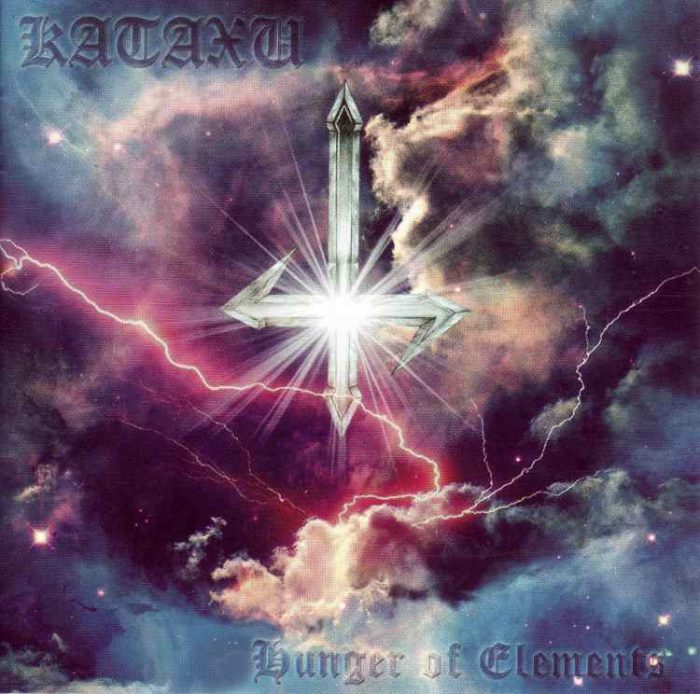
Kataxu play a style of black metal in which the keyboards appear to lead, while the guitars follow a complementary role that enhances and sustains. In maintaining activity in the melodic movement of the phrases, and a distinct harmonic progression between sections, Kataxu avoids relaxing on the guitar riffs avoiding a meandering feeling that is common to bands utilizing this type of approach. Guitars in distorted power chords are always behind the keyboards in the mix, but are given prominence in between sections or in certain passages in ways that enrich textural variety accross the pieces. Percussion is ever present, but one can rather sense their bulk in the spectrume, rather than actually hear drum patterns. (more…)
Remember back in the mid-1990s when every black metal musician of repute boasted involvement in at least one dark ambient project? Although the move away from metallic ground towards previously uncharted territories comes across as a farseeing maneuver in hindsight – black metal had after all reached its creative zenith at this point – the lion’s share of resultant products left a lot to be desired. (more…)
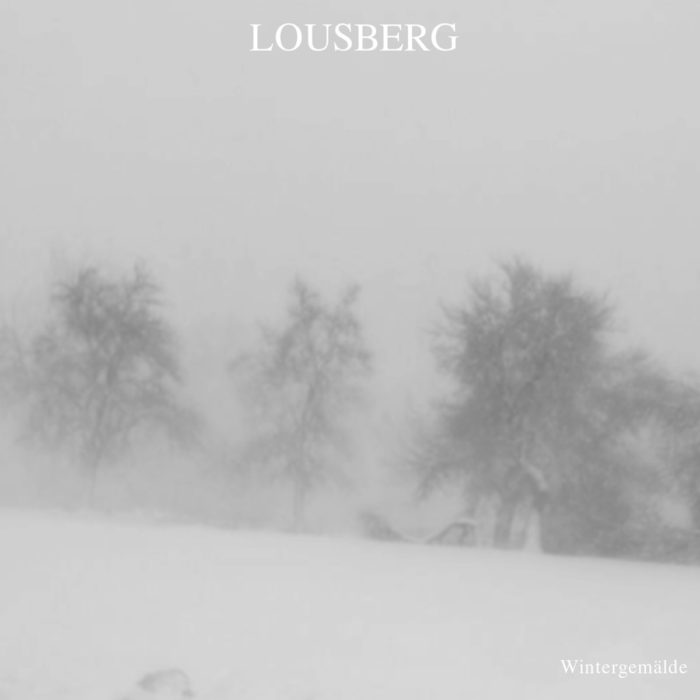
Now here is a recording I am really quite enjoying, by Lousberg. This captures the spirit of the desolate winter-time, but not in a dreary way. Rather, the elegance of nature shines through. Low drones set the landscape, while tip-toing keyboard patches enunciate the mid and higher ranges. This has a nice balance between droning and suggesting a melody, which does a very nice job creating a virtual landscape. I prefer this to the other black metal I saw on this label such as Goat Semen, which was pretty cool too, since it reminded me of Norz Norz Norz. There is a sophistication to this particular composition, which reminds me of Maurice Jarre’s score to Runaway Train, which is a wintertime classic. Also, the Mosquito Coast, about leaving society for nature, is another majestic score by Jarre that this harkens. It seems easy to the passive listener to create such an album. As a keyboardist myself, I can tell you that it actually takes a lot of inspiration to write an album like this.
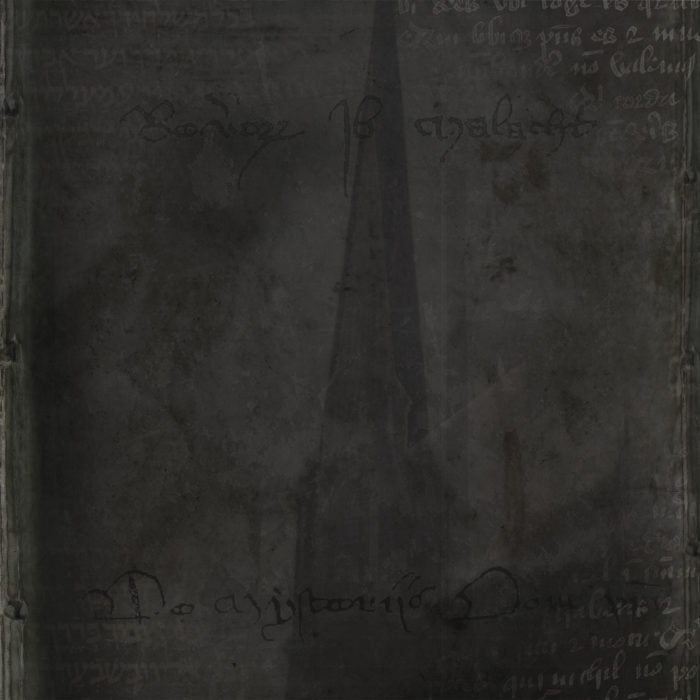
Dark ambient and raw black metal have always held a close relationship in shared attempts to create dark, haunting and visceral music experiences. Euronymous once claimed Abruptum were the ultimate perfection of the black metal sound despite the band being more accurately defined as a venture into the mysterious world of dark ambient. This trend continued onwards over the years as we’ve seen black metal musicians venture into dark ambient projects such as Stallagh or Moëvöt. Yet despite many years of this alliance, no band has ever formulated as perfect a marriage between black metal and dark ambient to create a chilling, epic masterpiece in the way that Reverorum Ib Malacht has on their 2014 work De Mysteriis Dom Christi. And- much has their title suggests- they did so by boldly defying everything dark music was known for. (more…)
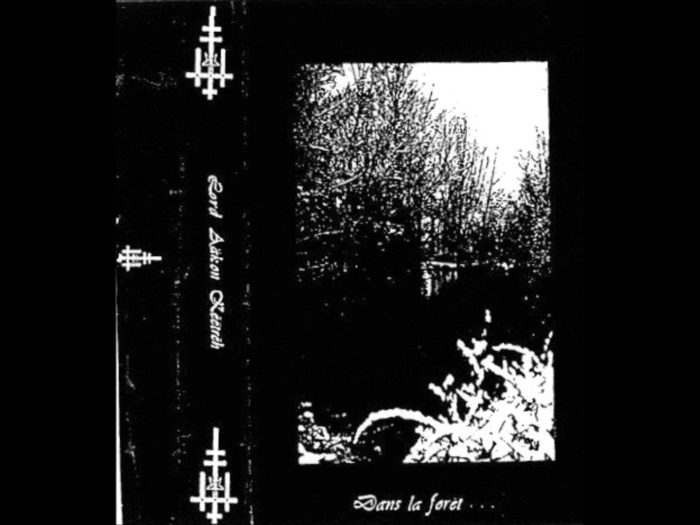
Aäkon Këtrëëh was an eponymous dark ambient/black metal-project created by Lord Aäkon Këëtrëh, a central figure within the French black metal collective commonly referred to as Les Legions Noires. (more…)
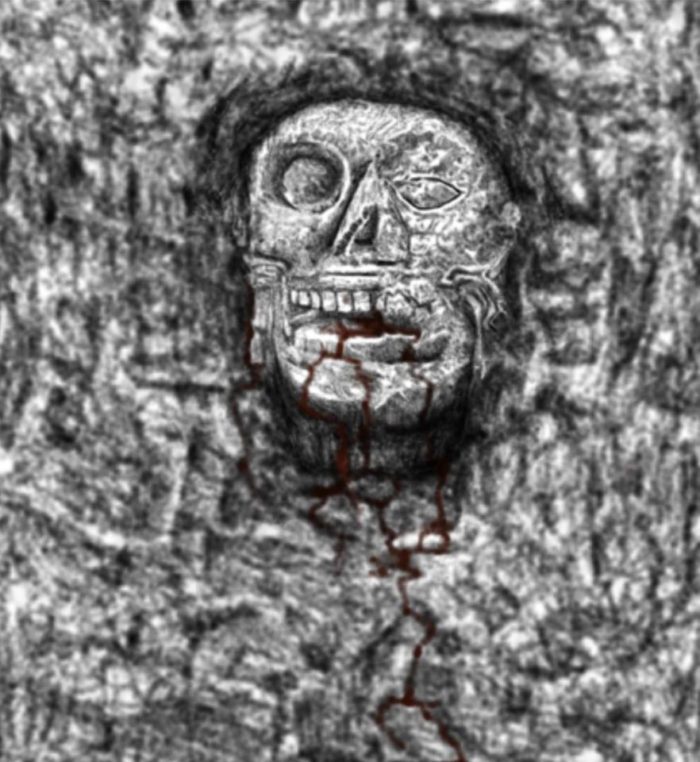
“Detail shows the face of Stela D which rises 12 ft beside the altar of sacrifice with a death god effigy. The stele represents the 13th ruler of Copán, King Waxaklajun Ub’aah K’awiil (in English, Lord 18 Rabbit), showing half of his face as it was sculpted, and the other half stripped as it would look in Death.” – Akherra Phasmatanás
Article by David Rosales.
Desolation is a full-on ambient project that blends simple and solid harmonic backgrounds, repetitive phrases of a dark coloring, with recorded lamentations both human and otherwise. The aim seems to be to produce the whole array of impressions encapsulated within that single word: desolation. The music’s structure is progressive and appears to be segmented in an episodic manner, which normally implies a loss of continuity between sections. This unwanted effect is expertly avoided by providing smooth transitions, interleaving ambient soundscapes, nature sounds, vocal improvisations, all of which bring variety within a strongly directly concept that never loses content density or a strong sense of purpose. Furthermore, the album being simply distributed between two long tracks reinforces its unity and the requirement that the audience listens to the whole work as if commencing a mental journey, which once begun must be seen through to its very end.
Cuando decimos que el metal llegó a su cúspide en 1994, después de una breve época dorada, y que lo que siguió no fue sino un declive clarísimo, esto no significa que no hubo absolutamente nada bueno. Por definición, lo que le sigue a una cúspide es un declive – aunque la decadencia sólo sea aparente debido a la perspectiva. Aún más importante es aclarar que cuando hablamos de esta manera, nos estamos refiriendo a un promedio a través del género, y no señalando a nadie específicamente. Después de todo, tenemos un Summoning publicando su clásico de clásicos en 1996 y más música grandiosa a finales del siglo. En Centroamérica, siempre un paso (o más bien diez o treinta pasos) atrás del resto del mundo como resultado de procesos históricos que podemos identificar, lo poco que su reducida población, recursos y cultura permitieron desarrollar al metal local, floreció entre los últimos cinco años del siglo pasado.
Since ancient times man has looked into both himself and nature around him as a portal into dimensions our species’ abilities are not adequately or readily prepared to perceive let alone understand. This is why and the sciences developed their theory and instruments which became increasingly specialized and compartmentalized, to the point that the ulterior workings of, for instance, chemistry and physics are not even truly understood by any single person but that have been recorded and detailed so that theories can be devised to model them. This is both a weapon for more precise understanding and a blindfold that prevents us from seeing the big picture. The ancient occult sciences attempted something contrary to this, which was to grasp at the phenomenon as a whole, not by measuring bits here and there, isolating them and attempting to harness them for mundane tasks, but rather seeing how everything interacted and describing it through metaphor and accepting that knowledge concerning reality cannot be taught or communicated: the path can only be hinted at but it is for each person to take. (more…)
When we say that metal’s golden era peaked in 1994 and that everything went downhill, it does not mean that there was nothing good after that. By definition, quality after a peak must go downhill in comparison. More importantly, when we say such things, we are referring to a genre-wide average, not to specifics. After all, we have Summoning releasing their classic of classics in 1996 and more great music before and around the turn of the century. The same is true of several black metal bands and a very few death metal ones. In Central America, ever one (or ten or twenty) steps behind in everything as a result of traceable historical processes, what little its reduced population, resources and culture allowed for metal to develop flourished between 1995 and 2000. (more…)
An interesting project emerging from the murky Texas underworld, Lech makes music of nearly pure noise and calls it “doom music” rather than a form of metal, but its similarities to metal (as well as electro-acoustic and other forms) cannot be denied. After reviewing the first album from this project, we wanted to hear more and were fortunate to get in a few words with Lech.
Who “is” Lech? Can you tell us band members, your history in music outside of Lech, and how you came together to form Lech -or- decided to do so?
We come from various experimental band backgrounds.
After some time away from music we decided to get together, and put out an 8 track ep.
You describe your music as “doom music,” although others might say electro-acoustic, drone or organic ambient. What inspires your choice of words to describe the sounds that you organize into music?
Doom in our opinion is the fear of impending threat or danger, but it can be taken out of context when describing music genre.
A lot of people think of Black Sabbath as being the godfathers of doom, and no doubt Tony is the Riff master but we believe Screamin’ Jay Hawkins was the true originator.
Doom music describes us best.
Is there a connection to heavy metal, or underground metal, that informs how you compose? Or is this an entirely different style? Do you have influences from any of the following ex-metal projects: Lull, Neptune Towers, Final, K.K. Null, Suuri Shamaani?
Actually the influences of the 8 tracks we have out now come from dark classical. Requiem, dirge, and Walter/ Wendy Carlos.
How do you create your music? Are these found sounds, digital manipulated, distorted or some combination of the above?
Our stuff is all original recordings.
No sample, found, or computer manipulation sounds.
What you hear that doesn’t sound like guitars are in fact guitars. The beginning of Waterwalker is a guitar run through an Eventide Space.
The experimentation that went into our sound would have to be seen to be understood.
When you compose, what do you aim to create? Do you hope to provoke a reaction or recognition in the listener and if so, what is it?
The first thought is probably “what the hell is this?”
Which I think we accomplished without saying, and the other is the true dark side of music.
Music is sometimes misunderstood, and when it is questioned you are usually on the right track.
Is this self-titled release your first recordings? What others are present? Will this be released on a label, or is it already out?
Yes, there will be another album out this summer under the Forlorn Group Label.
Why did you choose the name “Lech”? Does it have a particular meaning?
The name LecH was chosen because of the many different connotations that go along with it.
From the perverse, to the river in Austria.
It’s the unknown.
What are your future activities — will there be touring, more recordings, promotion or collaborations?
As for touring, and live shows we can’t wait to get a road crew together, and smoke some amps.
If you could play live with any Texas metal bands, which ones would you choose?
One would be Ryan from Howling Void out of San Antonio, and the other would be Annie Clark from St Vincent out of Dallas. She’s not exactly metal, but like us she has her own sound, which we like.
If people are interested in your music, where should they go to find out more and stay in touch with Lech?
We are taking a different approach to getting our music heard, so the best way for now is links on our Youtube stuff through our PR guy Kyle Lee.
Other than that we are working on a website, and hope to get out on the road to play live.