Interview: Goatcraft

April 5, 2013 –

goatcraft-all_for_naughtThose of you who’ve watched Prince of Darkness or other John Carpenter films may be aware how powerful the sound of a keyboard, hammering two notes in an ominous cadence, can be to the telling of a story.

Goatcraft takes this intensity to metal music, inspired by the manic early days of chaotic solos and twisted song structures, but played on a piano.

A piano?

Like guitar, the piano is a highly versatile instrument. It can serve in a pure rhythm role, or apply melody, and can easily chord and shape an atmosphere out of harmony. However, it can do one thing the guitar cannot: stand on its own while amplified and be a credible one-person band.

Solitary musician Lonegoat, who has recorded intros for Druid Lord and Demonic Christ, mounts the stage in isolation to create singular pieces of piano music that reflect the infinite loneliness and emptiness of existence. From this nihilistic background, the music branches to a dark storming Nietzschean vibe balanced by a sense of demonic playfulness.

Although not the usual fare for a death metal show,
Goatcraft delights many with its ability to manipulate mood subtly while maintaining a hammering, surging rhythm that evokes the most violent days of death metal. The best name we can come up with for this style is “neoclassical dark ambient.”

We are fortunate to have a chance to interview the reclusive and cynical Lonegoat.

Why did you create music in the style of Goatcraft, and not start a conventional metal band?

When I first started the project it was in an experimental phase. I had tried my time with other bands and I came to the conclusion that I had to do it by myself.

In 2010, I envisioned a fast ‘blasting’ and ‘dark’ piano project. I enlisted a drummer that I played two shows with, then he relocated to Washington.

Since then the response has been better doing the project by myself. I have grown keen to working alone as my abilities and compositions have evolved. I don’t foresee anyone else contributing to the music in the future. This will be a personal journey in developing the sound as time progresses. When I look back at certain times in my life, there will be a distinct sound that went with it.

Why do you use only one piano voice and no percussion? Why are there no vocals?

In this style of music, the piano is the percussion. Being there are no outside influences to keep time, there might be a slight tempo increase or decrease here and there; however the way I approach the instrument there is no need for a drummer. For vocals, I think the music would be hindered by screams and growls. I also don’t think clean vocals would be a benefit. There is enough going on in
Goatcraft to not have these other elements.

On what prior music, genres, etc. do you base your work? Is there a form to it?

When the project first started, the piano phrasing was executed by ‘riffs’, however the debut album All For Naught goes past riff structure to a nearly classical sense of structure. It’s not really classical, nor metal — that’s why I call it “Necroclassical.” There are only slight comparisons to other established mediums. Some people can draw a death metal correlation, while others pull classical themes.
Goatcraft is really no-man’s-land. It’s some strain of neoclassical that has just been tapped. It’s difficult to base my work to already established mediums.

What do you hope to communicate with your music? If you don’t hope to communicate, why make music — and why sell it? If you do hope to communicate, how do you want the world to change after receiving the message?

Unfortunately, no pianist in the world can change the way the world is run. However, they could write music that would appeal to a certain demographic. There is some slight communication in the CD inlay, as well as song titles. It’s up to the listener to come to their own conclusion Most of the titles and themes are based on Nihilism in the album. If there was a message, it’d be for the listeners to embark on self-realization if they haven’t.

Where do you think your music stands relative to these: Phillip Glass, Autechre, Lord Wind, Kraftwerk, Dead Can Dance, Arcana, and Winglord?

When I first delved into classical music, it was through the rear end (i.e. Phillip Glass and Arvo Part) in which I did like a few pieces, but their styling got old pretty fast. I think having influences of Baroque/Romantic/Good Modern (Wagner, Bruckner, ect) would be more beneficial than more of the pop compositions of Glass and Arvo Part. The project has grown with my musical taste. I’ve been into extreme metal since I was 12. Unfortunately I hadn’t accepted classical until these last few years. It’s been as rewarding as listening to early Morbid Angel, Deicide, Acheron, Emperor, ect when I was a kid. Classical is the closest thing to metal that I’ve been able to find. I do enjoy a great deal of Kraftwerk, but in small doses. The main project you listed that I’ve been listening to over a decade is Lord Wind. I’m glad Rob Darken has taken the project further and molded a great album with Ales Stenar. Hopefully Graveland gets going again.

You know Alan Moses and Brian Pattison of Glorious Times fame. How’d you come to know these gents? You must have seen some crazy death metal history — can you tell us some war stories?

Alan Moses used to work with Morbid Angel and he introduced me to extreme metal when I was a kid. It was more of a learning experience listening to the CDs that he offered, as well as reading the lyrics. I read the lyrics to Morbid Ange’s Blessed Are the Sick when I was 12 in a private Christian school in Tampa. That pretty much changed everything. Brian Pattison invited me to New York to play the death metal festival ‘A Day of Death’, which was a really great time. I had downed enough booze on the flight to kill an elephant, and the end result was waking up the next morning while hungover, taking a shower, then walking out and talking to Kam Lee about old school metal while I was still naked. He didn’t make any moves on me, so I’m pretty sure he’s straight (the smear campaign and rumors his former band mates in Massacre spread around are rubbish). There were some quite attractive women in New York. I wanted to take a few of them back to Texas with me.

If metal music were to take a new form tomorrow, what would you want it to be? Does it need a new form?

I think Goatcraft might be good for others to be inspired. I think going back to the roots of extreme metal, as to why it was started, perfected and displayed in such a manner is essential to understanding it. The kids that started death metal came from the Cold War era in which the world could have been blown to bits by nuclear war at a moments notice. I think the realization of our mortality being exaggerated by throwaway pop medias and other mediums is important. As well as understand our mortal presence in existence — why others are drawn away from the mainstream rubbish. People need to go back and see why the music was formed instead of creating xerox copies of the past.

What do you think of metal out there now?

I think most of the old greats have lost touch with what made their music special and are cashing in on their former successes. The last couple of newly formed bands that captured my attention for an extended period: Grave Miasma and Cruciamentum.

You improvise, correct? How do you decide what you’re going to play? Can you sense your mind thinking about what it’s going to do, or is it all subconscious?

I look at my music as more of off-the-cuff… I have a set idea, then the ‘record’ button is pushed and I play. Sometimes the result is a few minutes, other times it’s 80+ minutes depending on my coffee intake. On the album there are a few composed pieces note-for-note, but there are a lot of off-the-cuff pieces. I think an understanding of what is presented to you and what you want to express is more important than sitting down and dwelling yourself to death over how they’re molded. I captured the moods that I wanted to convey.

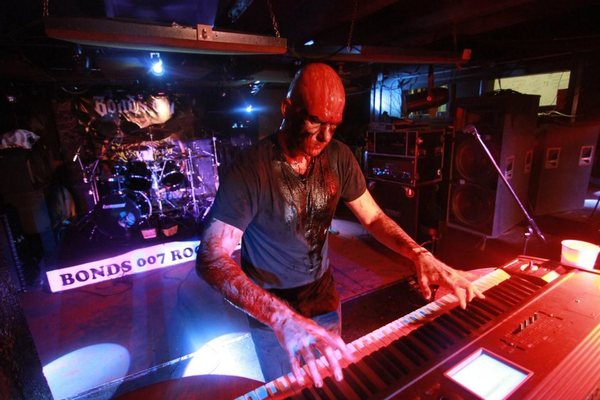
How have people responded to a lone goat dragging a keyboard on stage and playing whilst covered in blood?

It’s varied. I’ve mainly played extreme metal shows. The “Brutal Gore Deathers” tend to hate piano. So, those shows were (all) for naught. The black metal and old school death metal scene has accepted the project well. Further, those that haven’t seen anything like
Goatcraft might be more stunned than anything else. There are people that confront me in appreciation and awkward underhandedness on a regular basis after seeing me perform.

Goatcraft – All For Naught streaming from Forbidden Records

March 13, 2013 –

Necroclassical band Goatcraft, recognized for its origins in the death metal underground and the type of dark morbid soundtrack that death metal fans enjoy, releases All For Naught on March 20, 2013.

Today, Forbidden Records began streaming the new album in its entirely through its Bandcamp site, embedded below. This new album showcases a more compact and varied style for Goatcraft, which demonstrates more of the compositional skill and variety of moods for this band.

Goatcraft album to be released this spring

January 10, 2013 –

goatcraft---all-for-naughtOn March 20th 2013, Forbidden Records will release All For Naught, the début album of “necroclassical” band Goatcraft. Its sole member, Lonegoat, was relieved to have it finished:

From passing around recordings that were sporadic, created from boredom, to becoming a formidable musical act, it’s been a challenge to create and mold an album that’d encompass all that Goatcraft should be for its debut.

Initiated in 2010, Goatcraft released a self-titled demo on Pale Horse Recordings in 2011.

Goatcraft – Goatcraft

December 4, 2011 –

Genres form when they break away from their origins by specialization, and then are either re-absorbed through norming or develop themselves to the point where they feel safe commenting on their inspirations. Goatcraft appears within a newly-emerged genre that is in part informed by underground metal, and in part by a mix of neofolk, soundtracks and Gothic dark ambient music.

Continuing the line of influences like Endura, Black Aria, Dark Sanctuary, Winglord, Sophia and Lord Wind, Goatcraft takes up the form of dark ambient that borrows from neofolk and metal the spirit of gravitas, or a contemplative, and thus morbid, outlook on life that embraces the larger process and denies the individual. This worship of raw power and human negation is the most terrifying thing your average ego-bound individual can confront, but it presents itself through a soundtrack that would be at home in a Steven King film or plane crash documentary.

All songs are semi-extemporaneous, working from a lead riff of a few notes to wrap it into different configurations and by thus varying its endings, leading to new phrases which eventually return to the same themes but in mutated form. Its inspiration thus is closest to the soundtracks that borrowed the modern music of Wagner and Bruckner and fused it with Hollywood drama, creating a heightened sense of suspension of disbelief and emotion that can be truly transporting. All of this emerges from handily sparse keyboard riffs repeated with background chording in layers, much like Glenn Danzig’s Dark Aria and the Burzum albums it spawned.

What is most interesting about Goatcraft is the lack of showing off; the music flows together, like only something that is simultaneously off-the-cuff and the result of long general contemplation can be. The result is like curtains closing on a stage and then turning transparent: gauzy shadows moving through resonant sound. If metal is to mutate, and dark ambient is to endure, it is optimal that what survives should be the ancient spirit and sense of isolation that silhouettes an order to the universe that dwarfs humankind.