#Metalgate explodes: Maryland Deathfest denies, then confirms SJW censorship

maryland_deathfest_-_carlifornia_deathfest_-_full_SJW

Maryland Deathfest went full SJW by announcing that it was severing ties with death metal band Disma for its California Deathfest event. This comes only a day after the MDF organizers denied any connection between their act and SJW beliefs, blaming it instead on the departure of guitarist Daryl Kahan from the band.

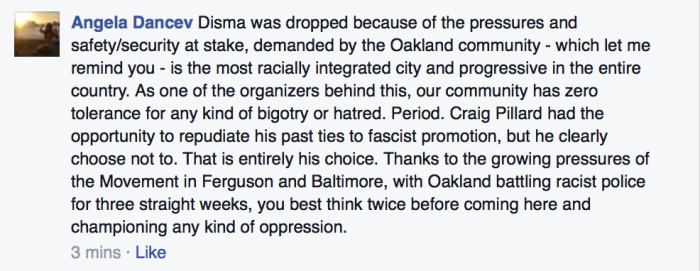
Disma was dropped because of the pressures and safety/security at stake, demand by the Oakland community – which let me remind you – is the most racially integrated city and progressive in the entire country. As one of the organizers behind this, our community has zero tolerance for any kind of bigotry or hatred. Period. Craig Pillard had the opportunity to repudiate his past ties to fascist promotion, but he clearly choose not to. That is entirely his choice. Thanks tot he growing pressures of the Movement in Ferguson and Baltimore, with Oakland battling racist police for three straight weeks, you best think twice before coming here championing any kind of oppression.

Disma fired back a response that was predictably irate, seeing how the band has lost time and money in preparing for its departure to this fest:

maryland_deathfest_-_california_deathfest_-_disma_response

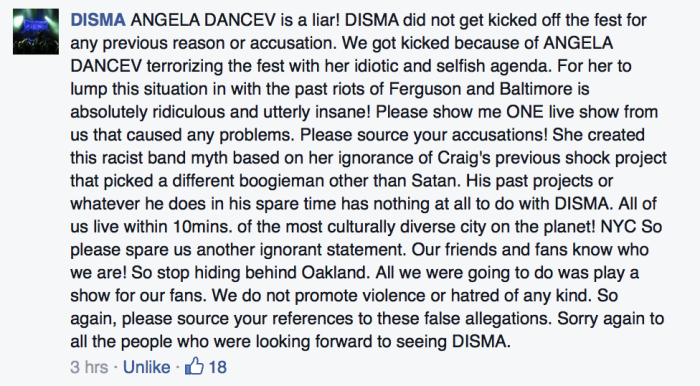
ANGELA DANCEV is a liar! DISMA did not get kicked off the fest for any previous reason or accusation. We got kicked because of ANGELA DANCEV terrorizing the fest with her idiotic and selfish agenda. For her to lump this situation in with the past riots of Ferguson and Baltimore is absolutely ridiculous and utterly insane! Please show me ONE live show from us that caused any problems. Please source your accusations! She created this racist band myth based on her ignorance of Craig’s previous shock project that picked a different boogieman other than Satan. His past projects or whatever he does in his spare time has nothing at all to do with DISMA. All of us live within 10mins. of the most culturally diverse city on the planet! NYC So please spare us another ignorant statement. Our friends and fans know who we are! So stop hiding behind Oakland. All we were going to do was play a show for our fans. We do not promote violence or hatred of any kind. so again, please source your references to these false accusations. Sorry again to all the people who were looking forward to seeing DISMA.

Yesterday, Maryland Deathfest organizers reacted with denial and insults when confronted with their actions. Today, they confirm what was said here and then denied by MDF, and even more, double down on the vitriol and defensive posture. It seems that MDF does not like being recognized as SJW-run and pro-censorship, but they can’t find a way out of the corner they have painted themselves into. No sympathy here.

17 Comments

Tags: , , , , , , ,

Ore.fm launches underground heavy metal discovery platform

orefm_promotional_banner

As the music industry adjusts to the rise of online music at a glacial pace, streaming services have taken over from the traditional model of radio. Into this field leaps a new competitor, Ore.fm, a “heavy metal only music discovery platform” that hopes to connect fans with bands — in the underground.

We were lucky to get a few minutes to chat with Vincent Minichiello, a founder of this new service.

Ore.fm claims it targets the underground. Why do you think this is a viable market, considering that most metal is rather “above ground” now?

All members of the ORE.FM team are either metal fans, musicians or music lovers in general. We feel that the underground scene is where we wanted to throw our support behind because there is such genuine, untapped, raw talent in a place that gets overshadowed by the bigger “above ground” bands and since no one else seems to want to showcase them, we took it upon ourselves to do so.

The metal community has proven itself time and time again to be the most supportive and tightly knit groups of any genre of music.

Are you a heavy metal fan? What do you (and/or your staff) listen to?

I am definitely a fan of heavy metal, as is most of the ORE.FM team. I grew up playing guitar and listening to bands like: Pantera, Slayer, Black Label Society and anything else that involved double bass, distorted guitars and bad-ass lyrics. Some of the music currently being listened to by the rest of the staff ranges from bands such as: The Sword, Havok, Mastodon, Jim Croce and YJY. ORE.FM has also exposed us to bands like: Ferium from Israel, Darwin’s Theory from LA, Strict Vincent from Australia and Archaeologist from San Jose.

How hard was it to get Ore.fm started? What did you have to do?

At this point, we have been working on ORE.FM for just shy of two years. We started where most bands start, in the basement of our parents’ house and it’s just been a steady climb up since then. There have been battles and obstacles along the way (as to be expected with anything) but overall I’d say the process has been not as difficult as we thought it would be. We lucked out and found a great developer who really understands our vision of what ORE.FM should do for the community. We all work very well together, bouncing thoughts off each other, working out kinks, evolving ideas, etc. It’s been a fantastic and exciting experience so far.

Why do you think heavy metal fans are a desirable audience? Most people think we’re dirty, smelly, uncouth and loud.

Having grown up with metal, going to shows and playing in bands, it was fairly easy and obvious to us that the metal scene is where we want to continue to be a part of. We are the people we are making this platform for. We are the fans looking for that new band to follow around and support. We have been called, “dirty, smelly, uncouth and loud” and frankly, we don’t care. The metal community has proven itself time and time again to be the most supportive and tightly knit groups of any genre of music. After having done so much for us and shaping who we are as individuals, we wanted to give something back to the metal community and ORE.FM is the perfect way of doing so.

We are the people we are making this platform for. We are the fans looking for that new band to follow around and support.

What music and experience can a user expect to find on Ore.fm? How does it compare to other services like Spotify and Last.fm?

There are so many sub-genres of metal that exist today and we want them all to feel welcome and included on ORE.FM. Listeners can expect to hear sounds that they’ve never heard before, from places they may never thought to look. Before starting ORE.FM, I would have never thought that the Middle East would have such brutal and technical metal bands. Now I find myself using ORE.FM’s Discover map to scan the globe to find new music daily from literally anywhere on Earth. This is what makes us stand out against competitors. Features such as this help bands get their music out to a world-wide audience, through a range of devices and platforms. Where they might be a drop in the vast ocean someplace else, on ORE.FM they stand out like gold.

3 Comments

Tags: , , ,

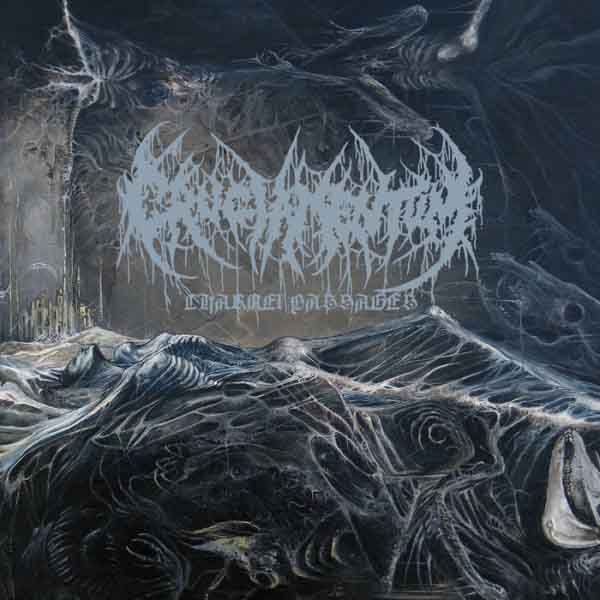
Cruciamentum – Charnel Passages (2015)

Cruciamentum - Charnel Passages (2015)
AKA Unholy Cult II. I suppose it would be unreasonable to ask Cruciamentum’s full length debut after several years of formative demos, EPs, and a brief period of disunion not to be instrumentally refined and polished as crystal clear as death metal allows; I reference Immolation’s 2002 effort not because Charnel Passages is a clear aesthetic match for it (although both are more melodic than the usual straight-ahead DM while not quite qualifying for the “melodic” buzzword), but the sense of rising formulas that could very well strangle any band.

What bugs me most about Charnel Passages is that Cruciamentum is competent. The members know how to construct lengthy, relatively varied death metal songs that avoid the worst excesses of the random and nonsensical. This puts them far ahead of most of the disorganized or simply flat acts out there. Presumably, their study of various greats in the genre has taught them how to construct riffs, drum patterns, song sections from their various influences and recombine them as desired. While they lean primarily on the percussive, rhythmically complex style of the old New York death metal scene, there are tinges of so many other contributors to death metal scattered throughout. These are minuscule at best and don’t draw much attention to their incongruities unless the listener is actively searching for them. Ultimately, it works in the band’s favor, and these incorporated influences showcase them as knowledgeable musicians passionate about their beloved death metal recordings and able to assemble new tracks with no major flaws in their construction.

However, Charnel Passages fails to rise beyond this level of stewardship. It is as if they are so devoted to imitating the great moments of the past that they are unable to build off them. In the process of listening to this album for review, I was constantly bombarded with moments where I found a transition slightly jarring, a breakdown slightly overblown, a blasting section more out of obligation than of narrative strength. Were I less attentive, I would probably not notice these, but they would still gradually push me away and towards proven classics. As a result, while it probably meets the average listener’s standards and will force its way onto many a best-of list of 2015, I expect it to be condemned to obscurity in the long run, popping up occasionally in internet discussions of “lost gems of the 2010s”. If it weren’t so close to being a good record, this wouldn’t be as much of a tragedy.

To be honest, it’s possible I may end up giving Cruciamentum the benefit of the doubt in the long run. Critics have been known to double back on their old opinions from time to time, and considering its level of quality, Charnel Souls seems like the sort of album I could change my position on very easily.

6 Comments

Tags: , , , ,

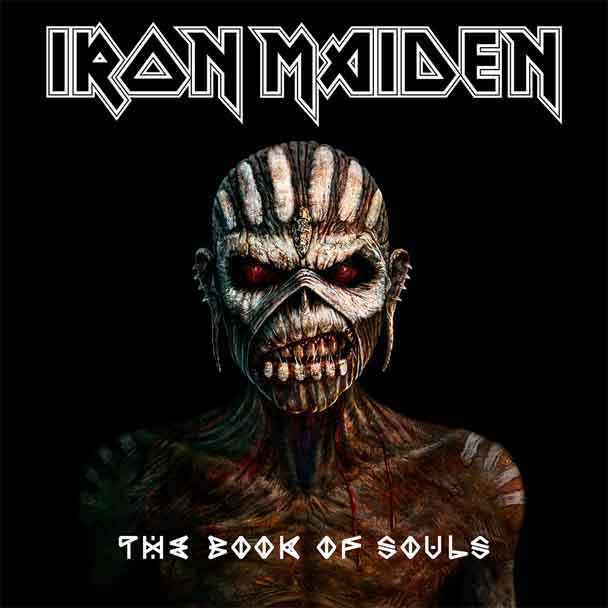
Iron Maiden – The Book Of Souls (2015)

Iron Maiden - The Book Of Souls (2015)
Iron Maiden’s main strength in their 1980s heyday was their ability to incorporate progressive rock tropes (and therefore useful techniques for song variation and extension) into what was otherwise a fairly standard, if well executed poppy heavy metal sound. Not the rarest trick in the book, but more than enough to turn the band into a commercial juggernaut whose influence can sometimes be heard even in the deepest dregs of the underground.

On first impression, The Book of Souls ages gracefully, offering an aesthetic mostly similar to the band’s earliest recordings with Bruce Dickinson if understandably and obviously brought up to modern production standards. Like the rest of the band’s latter day material however, it leans ever closer towards its prog-isms, resulting in several enormous tracks and inflating the content into a full-fledged double album. The unfortunate weakness of these epics is that they are replete with filler of questionable value to a track, and as the length of these albums and tracks grow ever longer, so does the tedium, as Iron Maiden’s ability to extend a track beyond 7-8 minutes or so has not advanced along with them. Tracks end up overwhelmed by moments stunningly reminiscent of old hooks and hit singles (for instance, the intro of “Shadows of the Valley” seems to channel “Wasted Years” from Somewhere In Time), and the true nature of the band’s recent weakness reveals itself.

Iron Maiden has become a band split between two souls that they are unable to effectively reconcile. Their urge to extend their songwriting and write metal epics is held back by their need to continuously sound like Iron Maiden and the corresponding need to push hit singles. Paring down some of the worst excesses would probably be the most profitable option, since the band has demonstrated many times through their career that they can handle some degree of extension. Even then, Iron Maiden is competing with their own past; a past that is more virile (if not as slickly produced or musically experienced) and still easily experienced at their live concerts. I expect this album to jump off the shelves of record shores for still being recognizably Iron Maiden, for having some memorable and well-written moments and for being a valid way to financially support the band, but as a work of music, I don’t expect it to retain much listener interest after its marketing blitz subsides.

14 Comments

Tags: , , , ,

Unibroue – La Fin Du Monde (2015)

unibroue_-_la_fin_du_monde

This Belgian ale from Quebec has found itself a permanent place in American stores for two obvious reasons: first, most American beer is horrible because it is both utilitarian and junk food, sugar water soda with beer flavoring. Second, most imported beers have also made themselves terrible, and none quite as bad as the Belgian witbier which increasingly resembles a bilious corriander-beer soda.

Witness, for example, Shiner White Wing. Only a marketing genius could take cheap beer from central Texas and sell it at import prices, and that same twisted intelligence has been applied here to make a “Belgian ale” that tastes like the overflavored teas that women buy in malls. The main reason people like this beer is because it is sweet, bridging the gap between beer and soda yet another innovative way. But in the wake of the success of Belgian ales in America, numerous contenders have popped up. And yet here is La Fin Du Monde which has been pumping out this particular ale since the 1990s at least, and has kept both quality and price consistent. In other words, these people are not marketing geniuses, but they may be a greater form of intelligence: people who realize that if they make a good product consistently they will have an industry from now until the end of time, unless they screw it up. So they watch against screwing up, including the form of greedy screw-up that is marketing genius. Smart, those Québécois.

La Fin Du Monde smells and drinks like a German medium lager but has the light corriander flavor and muted sweetness of a Belgian ale. It retains its yeast, so is cloudy if the bottle has been moved much within the last few hours, but pours in a light golden color with a good foamy head and delicious yeasty smell. It is also worth noting that at 9% alcohol by volume and a heavy amount of carbonation, this fizzy beer will take no prisoners among your brain cells. Drinking one of these babies is like pounding down four of your favorite “import” beer (usually concentrated syrup/ferment imported from Europe, and made into beer American-style here for double the profits) bottles and then doing a couple jumping jacks. Luckily its flavor serves an excellent balance, with the hay-like notes of a good ale surging in behind the slightly bitter forward taste of the Belgian-style corriander-induced sensation, followed by overtones of light fruit — it has been compared to citrus or peach — with a strong yeasty goodness in the background. Thus this beer walks a fine line. It will not please the newly minted Belgian ale fanatics who only buy beers with fancy packaging and pretentious names, but it will rumble the tummy of anyone who appreciates a good beer with a flavor of its own.

****/*****

7 Comments

Tags: , , , , , ,

Heavy metal is not a blank slate

skull

People do not realize that our society is in the midst of a war. A memetic war, in which one ideology will win out over the other. As we see time and time again, the different worldviews are entirely incompatible, causing the type of internal conflict that destroys empires.

Heavy metal is caught in the middle of this. Those who want to push their ideology on you have discovered it, and try to use it as a “blank slate” on which to write their messages. We found out in the 1980s that Christians did this, in the 1990s that the far-right tried, and now in the 2010s, that an echo chamber of “social justice” agitators wants to use metal as its personal billboard. Mainstream metal media — staffed mostly by such people — agrees with them. The variety of hipster known as SJWs are hoping to take over metal and use it for their own ends.

As Old Disgruntled Bastard writes:

The modern state of metal writing, as is the case with much of modern metal, has to do with the wrong kind of people being attracted to the music. Those who don’t identify metal with a higher ideal will only think of this subject as so much faffing and will continue drowning themselves in anodyne cliches, self-referential and flippant by turn. Worse yet, in a show of incredible egotism, they will expect the music to fall in line with whatever personal agenda they might be touting at that moment. It speaks of a stunted, unadventurous, and dishonest bent of mind to outright dismiss ideas that may be pariah to our own and then to run down, ad hominem, those that dare think differently.

He hits on a vital point: their goal is not to crusade against a specific evil, but to eliminate everyone who does not dedicate their life to advancing the same agenda the SJWs do. As many people have pointed out, SJWs are a bit hypocritical. They whine about injustices to women and minorities, but night after night they are in front of their computers, putting other people down instead of working in the ghettos or middle east where women are being raped and executed en masse.

This reveals the agenda of SJWs, while it surely overlaps with their left-wing political views and hipster lifestyles in which activism is ironic and fresh, is actually to make themselves appear to superior to others. SJWs are the new master race, in their own minds. By day, they are cubicle drudges with unimportant jobs who live in expensive city apartments and spend themselves into debt buying organic free-trade wine and artisanal wall hangings. By night, they are transformed into warriors, heroes, Anne Franks and Mother Theresas combined. They find their importance in “social justice” because it allows them to pretend they are better than other people, and to experience the delicious revengeful joy of forcing others to be silent and apologize. That is the thrill of SJW: subjugating others with words from the comfort of your computer, with a glass of Malaysian Anisette Merlot and a rare live Deerhoof set on the radio.

What obstructs them is the very fact that metal is not a blank slate. It has its own beliefs, which deal with the world and its problems from an entirely different angle than SJW solutions do. Its basic rule, non-conformity with society for the purpose of discovering the raw unfiltered power of nature and truth, opposes the very notion of collective action for some slogan or political issue. Metal is against politics itself. It sees politics as an outgrowth of social thinking, not an end in itself. In the metal world, politics is a distraction and SJWs are more nagging nannies who distract us from the real problems. As MetalReviews writes:

Let’s lay it down as law, if in the confines of this editorial only: Black Metal ist krieg, waging war on all, and Black Metal that isn’t krieg, that doesn’t wage war on man, god, musical boundaries and every living creature whatever colour or creed isn’t proper Black Metal – there’s more spiritual closeness between Transilvanian Hunger and La Masquerade Infernale, between De Mysteriis Dom Sathanas and 666 International than there is with something like Panopticon’s Collapse or Eldrig’s Mysterion. They may all be great albums, but the spiritual difference is greater than that of the music itself – Arcturus and Dødheimsgard are no more trying to convert you to Anarchism or Ariosophy than Darkthrone and Mayhem are.

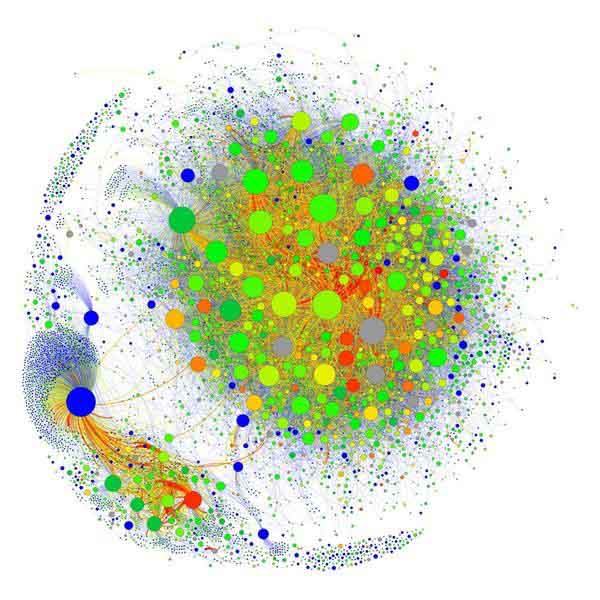
Metal has a culture of its own. SJWs are attempting to genocide that culture and replace it with the watered-down indie rock to which metal riffs have been added that the mainstream media media have been pimping for some time. They achieve this by coordinating among themselves. Someone once plotted the communications between two groups, GamerGate and its opposition. The opposition show a trend toward conformity, where GamerGate was more chaotic and open. The SJWs of today were the authoritarians and Nazis of yesterday. A short demonstration follows.

gamergate_plot

Krieg frontman Neil Jameson — who like Decibel editor Albert Mudrian unfriended our previous Editor on Facebook for what can only be assumed to be political reasons — recently wrote a piece in which he opines on the condition of women in metal. Like most SJW articles, it begins with a justification for its demands on your attention, and threatens you with guilt:

I recently realized that I’ve been having more and more discussions with people about how women are treated within the metal scene, and music in general. Turns out my knee-jerk reaction to throw jokes at the problem wasn’t the best way to address it. This goes a lot deeper, and regardless of how it may make people uncomfortable, it’s a discourse we need to have—and keep having—because the problem isn’t going away; in fact, it’s getting worse.

This is politician-speak like might be used for the wars on terror, drugs or drunk-driving. There’s this problem, see, and it requires immediate attention. Not only that, but it’s getting worse the more we just sit here. Leap into action right now and do whatever I tell you! He goes on from there to make his big point:

As a man, I’ve never gone to a show worried that someone was going to grab my dick or give me a drink with some bullshit drug in it. It’s not because I don’t think I’m pretty; it’s because this is shit that doesn’t happen to men (I understand someone in the comments section will have a story saying that it does, but for the sake of argument, please shut the fuck up). It’s just not something we have to worry about. Women have to shrug this behavior off because they’re afraid if they speak up that it’s going to be turned around on them due to what they’re wearing, or their sexual history, or the simple fucking reason they have a vagina and guys are taught from a young age through marketing and media that we’re entitled to that. Movies and other forms of storytelling glamorize women going to shows to fuck and nothing else. The idea that they’re there because they love the music seems as absurd as a cop telling the truth during a trial.

In addition to the type of terrible writing that thinks throwing in the word “fucking” for unnecessary emphasis somehow makes it edgy, this piece shows us a lot of guilt — and no facts. We all know that there are some badly behaved people at shows, and their bad behavior takes many forms. People throwing beers, pulling non-participants into the pit, fighting with bouncers, or just being general doofuses are common enough, but not accepted nor the norm. In my experience, metalheads have generally stood up for personal boundaries to anyone transgressing them, without checking to see if the victim was a white male first. But in the Jameson piece, the rambling story goes on with reasoning about how we should stop everything to fight a problem he supposes is somehow very serious, despite no assessment of how wide of a problem this is or even whether it is a problem with metal or simply dickheads being dickheads at rock shows.

But really, the plight of women in metal is not the point. The point is that Jameson has joined the SJWs and wants their approval so he can sell them the “new” version of Krieg, which takes pride in being “open-minded,” a term that means not metal if you analyze it. As he says himself:

“We were one of the first geographical groups to really tie in non–black metal inspiration, like my covers of the Velvet Underground/The Stooges, etc., Leviathan/Lurker of Chalice’s Joy Division and Black Flag influences and covers, Nachtmystium’s interest in psychedelics and more blues-based ideas, etc.”

In other words, innovation by devolution. These bands are much older than metal and fit more into the rock paradigm than metal has. This is like stepping backward a generation and claiming “progress” as a result. Why would he pick this approach? In the SJW world, metal is bad and anything that pretends to be metal but is not is good. Therefore, bands that claim to be innovators for re-hashing older genres — which most metalheads want to escape — are to be praised, and anyone who makes metal for metal’s sake is bad and should be avoided. They need this argument to advance the illusion that metal is a blank slate, instead of the vibrant culture that it is.

What else might Jameson be doing here? Others have defined this pathology before:

A gaming term used to describe a male gamer who, in a desperate attempt to get himself laid, will attempt to woo or impress any female gamer he comes across online by being overly defensive of her and giving her special attention, such as playing as a healing class and only healing her.

That is White Knighting. In other words, men who publicly proclaim themselves sensitive to women’s issues are doing it to get laid or be accepted by a new social group. You may remember this from high school or college. At the mid-point of freshmen year, guys figure out that they can attend feminist workshops, get misty-eyed about how oppressive they are, and go home with a new girl each night. This has little to do with ideology and everything to do with human behavior. People who want acceptance into a group will memorize and repeat the appropriate chants to get what they want.

Is this what the former Lord Imperial, now short-haired Neil Jameson of The Velvet Krieg is doing? Let’s look at some of his statements from the past.

Wikipedia recalls an interview by Jameson in which he expressed a different viewpoint. Although the Wikipedia article was edited mysteriously (moderator notes: “Unexplained removal of content”) on July 5, 2013 at about the time Jameson started writing for Decibel, it can be found at the Project Gutenberg wiki. Jameson — who had just gotten out of his band Weltmacht which had pro-Nazi themes, even getting signed to pro-far-right label No Colours — was heading in an entirely different direction just seven years ago:

Krieg were boycotted in Switzerland “because I freely use offensive words like ‘nigger’ in regards to the disgusting double standards and politically correct nonsense that has spread through the world black metal scene. This is a scene that encourages violence and hatred, but if you say something against anyone besides Christians it sends a lot of people into crying fits. There was one person who wrote me saying he didn’t approve of my life ‘affirmation’ on the Satanic Warmaster split in which I, I felt very blatantly, criticised both the life loving movements and the politically correct movements, but I guess these people are too fucking involved in down syndrome to notice IRONY. Well fuck them, I don’t want the support of people who cannot read the entire idea, but rather pick at ‘dangerous’ words. When the fuck did this stupid concern for hurting people’s feelings become an issue in black metal? […] ALL PEOPLE ARE SHIT […]. As for Switzerland, we got banned from the country for using ‘nigger’ on this 7 inch, which as I stated before, was anti political correctness, NOT PRO FACIST.” Imperial added that “[u]nderneath the abrasive offensiveness lies a much greater meaning that many would take the time to inspect and study. Beneath such a bitter shell lies enlightenment. IF you can fight through my venom, then you will find truly what I am spreading through the words of Krieg.”

This viewpoints sounds like those in GamerGate and MetalGate, except that we do not use racial slurs to denigrate other groups to make our points. We just speak up for what is true against the onslaught of SJWs. Jameson’s case is probably quite normal; he has simply joined the hive mind so that he can meet more people, be cool with the other SJWs at Decibel, and advance his own career, in defiance of the heavy metal genre he once found inspiration in. In other words, SJWs in metal are simply another form of selling out and assimilation into the mainstream herd.

11 Comments

Tags: , , , , , , ,

Temple of Baal details new album Mysterium

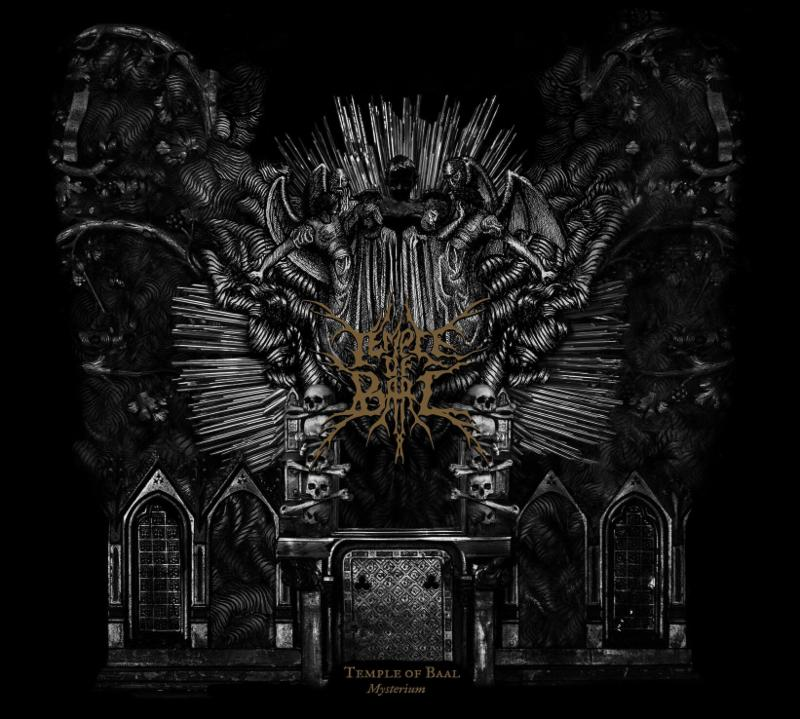
Temple of Baal - Mysterium (2015) cover art

Active since 1998, Parisian black/death metal band Temple of Baal will release their next album on October 2nd, 2015 in CD and 12” vinyl format. The current lineup has performed and participated in many other French metal bands, perhaps the most notable of which would be Anateus. They released the following statement:

PARIS, France – French black/death metal veteran, Temple of Ball, has announced its next album, Mysterium, to be released on October 2 via Agonia Records. The first single, “Divine Scythe,” featuring guest vocals by Georges Balafas (Drowning, Eibon, Decline of The I), is streaming on YouTube at: https://youtu.be/gi2yqmKvUtw.

As the album’s title suggests, Mysterium dwells on the topics of spirituality and religiosity. “From the opener, ‘Lord of Knowledge and Death,’ to the closing number, ‘All in Your Name,’ every inch of this record drips with it,” the band commented. “Mysterium can be seen as a collection of meditations and prayers over the mysteries of faith, directed towards the gods of the left hand path.”

Musically, Temple of Baal’s black metal roots are back in full force, allowing the atmospheres to develop through songs of epic proportions, mostly clocking around eight or nine minutes each. Mysterium covers a wide musical specter, from slower ritualistic parts, to furious blasts and thrashy riffs or the surprisingly melodic choirs of “Magna Gloria Tua” and “Hosanna,” each song taking the listener into a spiritual journey, evolving through various climates, keeping the listener’s mind awake. “I never got that much into monotonous, uniform albums,” said band leader Amduscias. “I like music to take my mind from one point to another. Even if I have a strict view of what Temple of Baal should be, stagnation is not something I’m very fond of.”

Paying tribute to its old school roots, Temple of Baal covers Bathory for the second time, with the song “The Golden Walls of Heaven” closing the vinyl edition as a bonus track.

The recording of Mysterium took place in Hybreed Studios with long-time sound engineer, Andrew Guillotin (Glorior Belli, Mourning Dawn), who managed to capture the band’s trademark massive sounding, magnifying it through a warm and organic production. Cover artwork and layout have been prepared by David Fitt (Aosoth, Secrets of the Moon, Svart Crown) and Maria Yakhnenko.

Mysterium will be available in: six panel digipack CD with 16-page booklet, regular gatefold double black vinyl, and limited to 150 hand-numbered copies double gatefold vinyl (including one picture disc and one black vinyl). It can be pre-ordered now through the Agonia web-store at: https://www.agoniarecords.com/index.php?pos=shop&lang=en.
1. Lord of Knowledge and Death
2. Magna Gloria Tua
3. Divine Scythe
4. Hosanna
5. Dictum Ignis
6. Black Redeeming Flame
7. Holy Art Thou
8. All in Your Name
9. The Golden Walls of Heaven (Bathory Cover, vinyl bonus track)

In its 15-plus year career, marked by four full-lengths and numerous split releases, the highly respected French coven, Temple of Baal, has evolved from a primitive black/thrash outfit into a monstrous black/death metal entity of epic dimensions. Verses of Fire, the last album (2013), was acclaimed worldwide as a milestone in the band’s career, allowing Temple of Baal to perform at notable festivals such as Hellfest, Motocultor, Summer Breeze, Kings of Black Metal and Speyer Grey Mass. The formation also played selected shows in France, Finland, Germany, Switzerland and Austria, sharing the stage with the likes of Watain, Antaeus etc.

Stay tuned for more information on Temple of Baal and Mysterium, out this fall on Agonia Records.

5 Comments

Tags: , , , ,

Altar / Cartilage split re-issued as 2CD on XTREEM Music

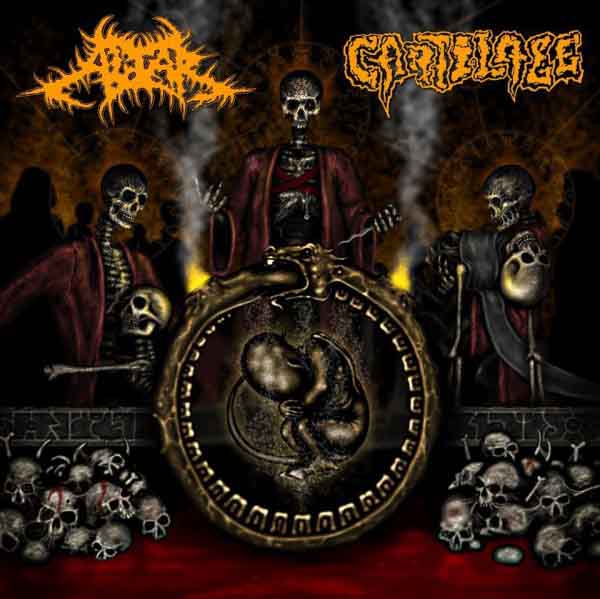
altar_-_cartilage_-_split_reissue

During the heyday of death metal, Swedish band Altar and Finnish band Cartilage banded together to release a split album entitled Ex Oblivione / The Fragile Concept Of Affection . Long sought-after by collectors, it is being re-issued by Xtreem Music as a 2-CD set with other early recordings. The label made the following statement:

It was in 1992 when two promising bands from the swedish & finnish Death Metal scenes, released a split album, that now, 23 years later, it’s one of the most cult splits ever released in the early 90’s. Unfortunately, CARTILAGE never recorded anything after that and although ALTAR did a few demos later on, they disbanded shortly after.

But the legacy still lives here and this split album originally released through former Xtreem Music label Drowned Productions, gets a re-issue in form of a double CD with 7 bonus tracks by each band taken from their early demos, a total of 14 songs (60 min.) from each one.

All songs have been remastered (not remixed!) for an optimal sound, preserving the essence from the originals and this release comes with a new cover artwork, a remake of the original one made by cult finnish artist Turkka Rantanen. Of course, original cover art is included on the release and booklet comes with extra photos, flyers & demo covers to complete this cult re-issue. However, we know that purists won’t be satisfied with this release, so they can always go and pay a fortune on eBay to get the original (if they can). No hard feelings! For the rest, here you have a new chance to get this gem in an improved and extended way at a reasonable price. A vinyl version with the original split album tracks, will follow in the future.

Release date for the ALTAR/CARTILAGE “Split Album” 2-CD is set for August 20th and in the meantime, you can listen to one track by each band on the following links:

ALTAR

CARTILAGE

7 Comments

Tags: , , ,

Invention versus novelty in metal

gig_wise_and_hip

There is an experience like deja vu which feels more like parallax motion. This sensation is that of seeing parallels between two things which, visually at least, seem to have nothing in common. And yet it also feels like racing over open ground in a landscape of discovery. Consider this observation from a pipe collecting writer:

Some innovations are not innovative at all. They are ideas that have been explored–and even made–long before. That the current experimenter is ignorant of previous attempts does not make the effort novel. It also does not make revising an idea or revisiting a solution unworthy. But don’t make untrue claims. Socrates’ observation that “There is nothing new under the sun” is almost always true.

Other “innovations” are transparent attempts at attention-getting. Putting products out there that exclaim “Look at me! I’m SO leading edge! I’m an artist!” might work for Miley Cyrus, but the average pipemaker’s target audience is somewhat less naïve nor impressionable, but you wouldn’t know it by looking at some of the work being touted on Facebook pipe groups these days.

What amazes me even more is that the work on the ridiculous end of the sublime-to-ridiculous continuum attracts its champions, and they seem eager to whoop and hurrah without engaging in any critical discourse at all. It’s hype, hype, hype. In my view, hyping isn’t helpful because it inhibits thoughtful conversations that might contribute to improving or at least refining the innovations being touted.

He draws a distinction between what we might call invention, or application of new ideas to a realistic use, as distinct from novelty, which is the creation of “new” ideas for newness’ sake. In metal terms, it takes some brains and guts to create a sublime form of a metal genre, but any idiot can add ska, jazz and rockabilly to Pantera and come up with something “new.”

Metalcore in particular is consumed by this view of novelty as a target. Since its songs are built in the post-hardcore random collage style, just about anything fits into a metalcore band, which is why it has aesthetically-diverse but musically-similar acts like Animals as Leaders, Obscura, Behemoth, The Haunted and The Red Chord under the same genre banner. Each riff is like a different act in a variety show. This is why it has the “carnival music” approach: its compositional structure is verse chorus with an extended musical appositive in which the random is prized more than the coherent, or that which flows from one point to another in a sensible narrative.

Some would say this is its artistic appeal, that metalcore expresses the randomness and purposeless directionless consumption of our time. That may be true, but the best art does not merely protest, but forms beauty out of sense and makes it compelling in a new way. Others might defend metalcore as “open-minded,” as was popular with bad gimmick death metal bands in the early 1990s, and even early mathcore experiments. Yet randomness is not open-mindedness; it is refusal to make up one’s mind, and by burying the audience under different elements, essentially hiding what one thinks and hedging one’s bests. How do you criticize a band that has a riff from every imaginable style in each song, except to note that greater randomness produces greater proximity to background noise? Andy Warhol might sell metalcore as an avant garde representation of the background noise of the city.

And yet, we had two-riffs plus breakdowns bands back in the day. Metalcore itself is an extension of post-hardcore, which was a late 1980s thing. None of this “innovation” is in fact new; it is merely recycling the same old sad elements, like the clichés in movies where every rebellious character has to ride a Harley, drink Jack Daniels, smoke Reds and listen to heavy metal. Generally the pattern for metalcore bands is that they find something that people want but do not understand, then make a simplified — in this case, random — version of it, and then pimp it out. Opeth for example made their career off the idea of being too deep for most people, but were basically a re-hash of what Cemetary and Tiamat did five years before. Meshuggah took what Exhorder and Vio-lence did with speed metal riffs but made it more obvious, simplified and put it to a jazz-style complex offbeat structure, but added nothing new musically, and in fact took away most of the musicality. Cradle of Filth figured out that if someone made a heavy metal band that sounded like black metal, it would outsell the original. And so on.

Here is a useful definition regarding metalcore:

A blend of hardcore and metal music that evolved in the mid-to-late 90’s with bands like Unbroken, Earth Crisis, Harvest, Endeavor, Poison The Well and Unearth. There is a liberal use of breakdowns in the music and the lyrical themes range from the political to the personal.

Compare to a similar definition for deathcore:

Deathcore is a style of extreme music often confused by its fans with death metal. Deathcore draws heavily from the “malcore” style of metalcore in the sense that elements of its sound, both in composition and production, are rejected by the more conservative metal culture (ex. death/black/thrash/sludge metal). Deathcore differs from metalcore in the sense that it is generally faster, more heavy, and tending toward darker themes such as are present in death metal. Deathcore is also notorious for the excessive use of breakdowns, an element also present (but less frequent) in death metal and other ‘true’ metal genres. Hardcore dancing, a dance style in which fans swing their arms and legs violently in rhythm, has become hugely popular among deathcore fans, and is a trademark of live deathcore shows.

Despite many fans’ beliefs, deathcore is vastly different from traditional death metal. Musically, the deathcore song structure is generally much more formulaic than that of death metal; songs tend to have one or two guitar riffs, several breakdowns, and possibly a chorus. Deathcore composition is also much less complex, many songs featuring doubled guitar parts or simple guitar harmonies, with the bass guitar being almost entirely indistinguishable.

Our normal impulse is to say “Well, you listen to what you like, and I will listen to what I like.” That is the socially correct answer at least which is one reason why it is wrong: social preference selects for the unreal because people prefer illusion. The problem is that when idiot music shows up, idiots show up, and they outnumber anyone competent. If they can appropriate the style of your genre and make a dumbed-down sugar, salt and fat added version of it, they will replace you. You will not keep listening to what you like because no new versions of it will come out because no musician will touch a genre infested by idiots unless he or she wants to profit from idiots. Your genre will be assimilated and replaced. That is exactly what happened to metal since 1994.

Some people moan any time a person wants to connect metal with social trends, history or other traditional forms of analysis. that is because those people want to keep metal as a hobby, a product and something special removed from everything else that is just there to be enjoyed. But on the other hand, many artists have given up more comfortable lives cranking out alt-country, indie rock or rap to spend their time trying to make quality metal, and it seems pointless to disrespect and ignore that. If we look at metal through the historical development of an artistic movement, it becomes clear that it offers not just another version of the same rock ‘n’ roll idea, but an entirely different idea. Rock is, like all post-Enlightenment thought, about the primacy of the individual. Metal rebels against that with hard realism.

Perhaps the hard realism is right. After all, this society is miserable — another one of those things that metal reminds us of daily — and besotted with lies, committing ecocide against nature, forcing people into miserable jobs, and specializes in tearing down beautiful things to replace them with strip malls and endless rules. I would go so far as to say this is the worst age of humanity, except for the mindlessly selfish, who sure love that 500-channel cable and easy jobs and fast credit that make them feel like kings in the tiny little fraction of the universe that they notice. Over time I have come to observe that the smarter someone is, the more aware they are not just of particular ideas or facts but of space, area, time and their own smallness. An idiot thinks he is the sole occupant of the planet; a medium-intelligence person is aware of his community; a genius is aware of the cosmos, the past and future of humanity as a whole, and the people even far from him. Metal rebels against our society both on the basis that it is formed of affectionate-sounding lies, and that it is ugly, pointless, boring and crass.

But that is “alternative history” to the majority of people. They believe — because they want to believe — that our time is the apex of humanity. And technologically, surely it is, although most of this stuff seems like fumbly-fidgety rehashes of 1970s inventions like UNIX and networking. They ignore the vast misery not just among the impoverished, but among the successful, and the utter boredom of the purposeless nature of modern life. Every generation, social order decays further and people become more like witches, of dishonest, selfish, petty, and oblivious character. Each generation can say to the one after, “Stuff’s worse than when I was a kid, so have an iPod and we’ll call it even, OK?” As long as we stick with official history there is nothing we can do with that. As others have noted, perhaps the root of invention as opposed to novelty is a willingness to leap off the platform of official history and look into other reasons, not new but realistic and truthful instead of merely socially popular ones.

Speaking of alternative history, I encountered this passage today. You might call it Libertarians for Monarchy. It takes an economist’s view of the change in history, and shows how alternative history might have been right, after all, and how we might all just be living in denial and cruising on the wealth of the past (Hans-Hermann Hoppe via Outside In:

A king owned the territory and could hand it on to his son, and thus tried to preserve its value. A democratic ruler was and is a temporary caretaker and thus tries to maximize current government income of all sorts at the expense of capital values, and thus wastes. […] Here are some of the consequences: during the monarchical age before World War I, government expenditure as a percent of GNP was rarely higher than 5%. Since then it has typically risen to around 50%. Prior to World War I, government employment was typically less than 3% of total employment. Since then it has increased to between 15 and 20%. The monarchical age was characterized by a commodity money (gold) and the purchasing power of money gradually increased. In contrast, the democratic age is the age of paper money whose purchasing power has permanently decreased. […] Kings went deeper and deeper into debt, but at least during peacetime they typically reduced their debt load. During the democratic era government debt has increased in war and in peace to incredible heights. Real interest rates during the monarchical age had gradually fallen to somewhere around 2½%. Since then, real interest rates (nominal rates adjusted for inflation) have risen to somewhere around 5% — equal to 15th-century rates. Legislation virtually did not exist until the end of the 19th century. Today, in a single year, tens of thousands of laws and regulations are passed. Savings rates are declining instead of increasing with increasing incomes, and indicators of family disintegration and crime are moving constantly upward.

In a time when popularity determines success, appearance is more important than reality. This is what gives rise to novelty, or essentially — as our pipe smoker above reminded us — re-visiting of old ideas in bizarre new forms that entice the herd because they are different and unique, which is how all of those bonobos view themselves and want to assert as their reason for having importance. We call most of them hipsters, but the phenomenon is broader than that; we live in a time that is appearance-over-substance, and as long as metal panders to that demographic, its fortunes will not improve.

16 Comments

Tags: , , , , , ,

The Forgotten Role of Drums in Metal

darkthrone

Fenriz as the archetypal metal drummer is perhaps a puzzle to most, perhaps considering his status to be a mere by-produt of Darkthrone becoming an icon. The status of most worthy personalities of metal tends to be double sided in that way. There is the respect for what came before, usually a blind fanhood of what is not understood and is only explainable in terms of some kind of historical relevance and then there is the underground ackowledgement of the musical talents of the artist in question that stand the test of time. The difference in perception arises from the fact that these artists’ greatest merit lies in subtletly. The Subtlety of where to use a specific technique, however rudimentary, so that the music is better enhanced, completed or open to being built on (say the drums got written before everything else).

In drumming in particular, the lack of appreciation for proper arrangement has been greater than in the vocal or guitar departments, perhaps because the only antecedents in this type of percussion come from rock and jazz. In rock, the drums are merely a time keeper and groove-adder. In Jazz, it is typical that they serve that function plus, like all the other instruments, allow the musician to keep masturbating on the instrument with little thought to how this adds to the music as concept and not self-referential indulgence. But in all fairness, there is an old school of jazz in which the music is kept together more neatly and in which the drums play a much more constructive role.

In metal, the drums are not only a support instrument but should blend in into a whole. In fact, ideally, the guitars should be doing this too. The point is so subtle and hard to grasp that even the musicians that acknowledge it have a very hard time translating it into practice. As with all great things coming from a simple concept, it is easier said than done. The most prudent drummers and bands limit the percussion to a function (that in metal is more prominent and important than in rock) rather than the spotlight, and this is at least a first step.

It was the increasing distance between all rock-like perspective in music that made metal approach a more purified and important integration of drums into its frameworks. Works such as Hvis Lyst Tar Oss or Transilvanian Hunger are inconceivable without percussion. That is not to say that the rest of the elements are not good, but they are incomplete without percussion. And so are their corresponding drum patterns without them. Metal had to go back to an extreme minimalism, stripping down every layer to realize the importance of every little element. This Burzum album belongs to end of black metal as an era, but I will place it here even if it appears counter-chronological.

After an initial dive into this primitivism driven (Celtic Frost, Bathory) by gut instinct of the most authentic kind, death metal proper developed and quickly escalated in its use of technical arrangements that went overboard in the sense that they were unnecessary for the point of the music itself, though not necessarily bad. Technicality was set besides essence and communication in importance. The formal music tendencies that are so prominent in classical music started to surface in metal.

https://www.youtube.com/watch?v=rZU_uta6Ows

A great overlooked exception to this rule was the work of Adrian Erlandsson within the framework of arrangements and indications of Alf Svensson for At the Gates The Red in the Sky is Ours. The fact that these integral arrangements are unmatched in death metal to this very day is a testament to how little understood they are. The fact that the drumming here twists, bends, propulses, stops, counterpoints in a great variety of different drum patterns that while theoretically rudimentary are often technically demanding, especially when performed as  a whole, indicate that a sense of continuity in expression must be kept by the drummer through changes of tempo, time signature and character. What makes this superior to other progressive-oriented albums is that for all this variety, the style of expression is tightly restricted. The reduced repertoire of guitar and drum techniques to the minimal from which it builds its complexity in a language of its own endows it with this distinct personality. Without the guidance of the architect Svensson, though, this band completely floundered in mediocrity soon after his departure.

Today, few bands grasp the importance of the integrated drums let alone being actually capable of translating the concept to a concrete plan and then puting it into practice. As far as I have seen, with very particular exceptions, the most sober drumming comes from the modern tradition that has branched from (old, the only real) black metal. First of all, it may come to those learning it by virtue of studying the past, this makes the grasping of a concept much easier. This does not include the nu-black or post-black camps which represent a departure, regression and deconstruction of metal, a reflection of decadence.

It is rather in the work of Abyssum’s Akherra that we see the role of drums as an essential part of the music. For this, the rest of the instruments must accomodate the drums, not only run on top of it. The naive layering of instruments most bands are used to is precisely what makes them amateurs in this. In proper metal, the drums are inside, not under the music. This is part of what the metaphor “drumming in counterpoint” reflects. Drum patterns that are relatively independent in the sense that they aren’t just there as a support, but come into contact at every moment with the music, bending, yielding and transforming along with the rest of the music.

Such attention to detail goes far beyond just playing slower or faster, stronger or softer when the rest of the music does so. It is not only a matter of intensity or speed in correspondence. The drums must live in symbiosis with the guitars, and not like a running pair of athletes besides each other. Silences and types of drum patterns specifically tailored to different sections are exemplified in Abyssum’s “The Illusion of Pan” in which we see important  decisions taken about the smallest details such as ride strikes in the rhythm of a particular keyboard melody speed, the variations between soft blast beats and other less forward-moving patterns as great inflections and indicators of the song’s pictorial journey that are not as clearly reflected in the rest of the music alone.

This entry is not about judging this or that band over another. The point is the study of drums for the future of metal. The recognition of the evolution in the use of drums throughout the genre. Surprisingly, Black Sabbath Master of Reality shows the kind of thinking that would go into Celtic Frost To Mega Therion in terms of the reduction and powerful use of elements into highly-personalized expressions. In this Black Sabbath showed how far ahead of their times they were. It took metal more than a decade to catch up to them. These musical transpirations in their music were refined through the black metal tradition going through death metal. The best we can hope for is bands today piecing out elements in this way, and being able to identifying what great drumming consists of in metal. But this must start out from the vision of metal as a proper music, as highly-integrated elements which conspire within an indissolubly dependent complex set of relations.

22 Comments

Tags: , , , , , , , , , , ,


A B C D E F G H I J K L M N O P Q R S T U V W X Y Z