Interview: Nidhogg

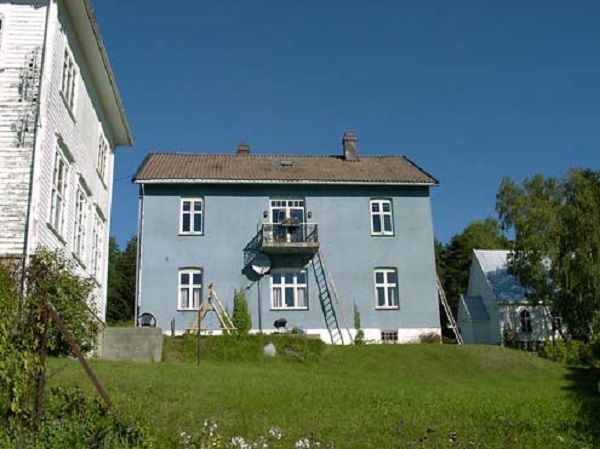
gamlebanken-nidhogg

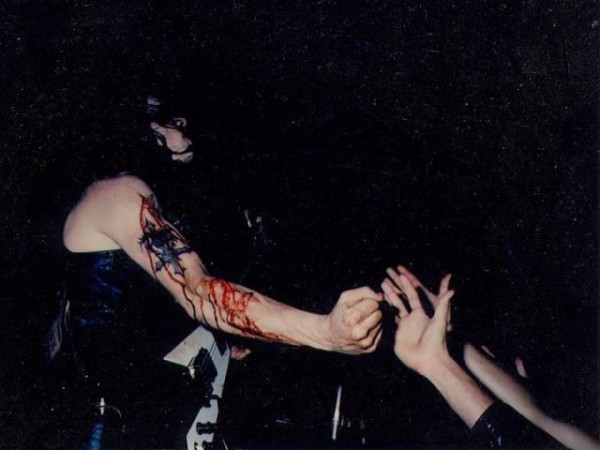
History reveals little about Nidhogg, the musician known for his contributions to Ildjarn, Sort Vokter and Ildjarn–Nidhogg. These projects, while initially rejected by an increasingly faddish black metal “scene,” quickly gained fans for their use of elegant short melodies within ambient songs of abrasive noise fused with aggressive Oi rhythms and black metal riffs.
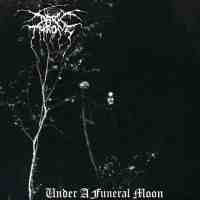
Using short songs structured around the transitions of song inspired by lyrics, Nidhogg creates albums that immerse the listener in a dark world of excitement: like the primeval forest come alive, this music pulses with the poetry of life in the wild. It embraces the world as a living organism in the pre-Christian tradition and brings out the fierce natural instinct for survival and power as well as the ambiguous lack of safety inherent to the frontier. Expansive and transcendent, like all good black metal from the Norse tradition, it transports the listener away from a failed functionalist time into a mindset of possibility and exuberant cosmic exploration.

Much of black metal would benefit from seeing into the mind of this primal artist concerning his contributions to the aforementioned nature-metal projects and his own artistic endeavors. Read on for the thoughts of one of the last embodiments of a genuine black metal mentality…

How did you first meet Ildjarn, the person?

Me and Ildjarn met when starting secondary scool at Bø Gymnas, Telemark in 1988. We had the same interest in metal and started hanging out together and experimenting musically in different directions in the basement at Akkerhaugen where we recorded “Norse” and “Svartfråd“.

Can you describe the formation of the musical project, Ildjarn, and how you became involved?

Ildjarn is his own project, and he started recording under that moniker in the early 90’s. Me and Ildjarn had played together in different constellations, and Ildjarn also played with Samoth and Ihsahn in Thou Shalt Suffer. After doing all sorts of stuff, even some noise/experimental, me and Ildjarn focused on the Black Metal sound, as it was where our hearts lay. I found some old lyric sheets which indicates that we initially called ourselves Nivlheim, but at the time of “Norse” we had landed on Ildjarn — Nidhogg, because Ildjarn had already started using the Ildjarn-name.

Nature is a big part of my life, and I’m not comfy living in the city. I’m lucky enough, now, to live right by the forest, surrounded by small lakes and mountains. Nature evokes most of all awe and calmness.

We recorded Norse in two sessions in 1993 which is discernible on the differences on my vocals between the a and the b-side. Samoth liked it and decided to release it on Nocturnal Art Productions. Ildjarn continued releasing his own records, and me and him then sporadically made music together, culminating with “Hardangervidda“.

What sort of guiding influence did you have on Ildjarn, and how was this different from your role in Ildjarn–Nidhogg?

I didn’t have any guiding influence on Ildjarn. He is very much his own man. But we had the same love for the proto-scandinavian black metal sound, shaped by athory and picked up by Mayhem with Dead, and so on.

Ildjarn — Nidhogg was a 50/50 collaboration, and we always had clear idea of where we wanted to go, both with the metal and the ambient stuff. The demos I uploaded were my concepts, like the Ildjarn stuff was his, so they were planned to be released as Nidhogg-demos.

Regarding vocal duties, what were your contributions in this area to Ildjarn–Nidhogg?

I did the vocals on all Ildjarn-Nidhogg recordings and also on Sort Vokter except for on “Hatefulle Tanker…” where I, Ildjarn and Harald all sang, and “Bak to Lysende Øyne” where both me and Ildjarn sang, but he did the prime vocals. The last song also appears on Svartfråd and I did the vocals on that version.

You previously mentioned that you were the collaborator with Ildjarn for the visual elements of various projects. What album covers did you create and is the impetus and process of creating them distinct from the musical process?

We did the layouts for many of Ildjarn’s albums on a computer I had access to. I mainly did the layout and was only artistically involved in the creation of Ildjarn transforming into a boar on the Strength and Anger-cover, Nob of NOB Art, did most of that, though. Nob was a friend of ours from Notoddden, and is the artist featured on albums such as Nocturnal Visions, “Minnesjord – The Dark Soil” and “93.” He also did the graphics for Forest Poetry along with another outstanding artist by the name of Javier Guerra who did the frontcover and at least two other illustrations Ildjarn used.

I’d also like to mention a fourth person who were also a close friend in Notodden at that time, who wrote the poem that was used for lyrics on “Eksistensens Jeger.” KK, as I’ll call him is now an established and published artist and writer. In Notodden me, Ildjarn, Nob and KK used to hang around, as three of us attended Telemark Lærehøgskole (teachers college) there. The pictures on the Sort Vokter-cover were taken in the forest behind the school, an area that stretches several miles. It was a place where especially me and Nob had many excursions, often in drug-induced states. I’m not exaggerating if I say I had some semi-paranormal experiences in that forest. This was also a feeling we tried to transfer to the cover.

What attracted you to metal in the first place?

Like all over Norway in the 80s, we were some kids in school who started listening to metal, copying tapes and borrowing music from each other. The energy and aggression was the appeal, of course. It was a rapid progression via Twisted Sister, Accept, AC/DC and such, to Metallica, Megadeth and Motörhead and then on to the more aggressive thrash as Slayer, Death Angel, Dark angel and Sabbat.

How did you first become entwined with the “black metal scene”? What was that time like, and what do you think of current “black metal” bands? What is missing from the present crop?

I was never involved in the scene, other than through Ildjarn and knowing members of Emperor. I met Ihsahn and Samoth, or Vegard and Thomas, first at a regional music talent show. They were playing as Xerasia and I was doing vocals with a band I sang in before me and Ildjarn did anything together. Later, we met in the basement at Akkerhaugen youth club, were Vegard and Thomas did all their initial projects. Besides some early exploits me and Ildjarn did together, we started started jamming as a hardcore/grindcore band with Thomas and Thorbjørn Akkerhaugen. Then when the Emperor concept was developed I was really blown away hearing them rehearse in the basement. It was clear they were on the verge of something. This was before all the ruckus started happening in the media.

When I got a tape copy of Vivaldi’s “The Four Seasons,” I played it repeatedly, and it’s amazing how it is really such a spot on musical interpretation of the progress through the year. Hardangervidda reflects a progression of time as well, from morning to night. The second half of “Sunrise” is very much inspired by Grieg’s “Morning mood.”

I think there are plenty of good acts around today, although one has to sift through more music now than before. I guess as with most genres that establish themselves, there are going to be waves and declines, but great stuff still gets released and will be released. The major challenge I guess, is to make something original in a genre that has been very much explored already. I think there are plenty of bands still around worthy of a listen, but now it’s of course a global thing, so one can just as easily find good bands anywhere else besides Norway, which is also stimulating to the genre.

What was the genesis of Sort Vokter? Were you involved from the beginning?

Sort Vokter was a spur of the moment idea and an opportunity between me and Ildjarn and two guys I knew from Notodden. Me and Harald (Heiinghund) ended up living in the same dorm and jammed some together on synth. He was a natural musician as was also Kyrre (Tvigygre). Sort Vokter was a concept we thought up in my flat, and as far as I can remember, we were all four there at that particular time.

The concept was doing very necro forest metal, or Folkloric Necro Metal, as we called the album. Kyrre worked as a studio technician in Grenland (Not Greenland ; )), and his boss granted him the studio for a weekend when we could do what we wanted. Sort Vokter was more a recorded jam session, than anything else, and most of the songs were composed/played through once and then recorded. Second or third takes would have greatly improved the album, but we were on a very tight time schedule. So “ignoring technical details” as the cover states, was more out of necessity than anything else.

Why has there been only one Sort Vokter album?

It was never meant to be anything more. We had known each other for some years before, and we stayed friends and connected until we one by one relocated from Notodden, but there was never any intention of making any sort of follow up to that one album.

You additionally worked on a synth album with Ildjarn, which was dedicated to the glory of Norwegian nature. What was the process of composing and recording this album? What does your experience of nature evoke?

Hardangervidda is a celebration of a particular mountain region in Norway, yes, where me and Ildjarn have been many times, both separately and together, since childhood. It’s vast and relatively flat, and trekking across it takes several days. The album was written in my flat in Notodden and recorded and mastered a couple of hundred meters down the same street, with help from Tore Hansen. Because it’s very layered it was never considered to record it live in studio. I had put away all the money I earned during one of those summers and bought a Roland XP-80 synth which also functioned as a 16-track midi recorder. Me and Ildjarn started working on the album in sessions, gradually tweaking the songs, doing both composition and production together. Some songs are my original ideas, some are his. There was a very clear idea from the onset of where the album was going to go, and it was really just a matter of doing all the work. The XP-80 was very easy, but time consuming to work with, as we didn’t hook it up to a computer. When we had finished the album we sent demo-CDs out to a couple of record companies. Origo sound actually said they’d consider it if we made alterations, which was of course out of the question. Ildjarn ended up releasing it on his Norse League Productions some time later.

Nature is a big part of my life, and I’m not comfy living in the city. I’m lucky enough, now, to live right by the forest, surrounded by small lakes and mountains. Nature evokes most of all awe and calmness. There’s nothing like the view after you’ve trekked up a mountain.

Last fall, Ildjarn released a split album with Hate Forest, entitled Those Once Mighty Fallen. You’ve recently been active on youtube and have released the demo recording which that recording was based from. What’s your reaction to this situation? Will you be releasing any more recordings in the future?

Well, like I’ve also stated, I was just surprised to realize it. It didn’t dawn on me until I actually checked with some old tapes laying in my basement, but how Osmose came to mislabel them, I don’t know. I think the songs may have been copied onto the same tape as some of Ildjarn’s stuff, years ago.

No, I don’t have any plans to release anything else, although I have lots of riffs and ideas laying around. I might pick up music again, since I still have the old synth, but hat will be when I’m less busy. I started on a concept-album in Notodden about the time of Hardangervidda, under the name Shadow Hungry Onto God (S.H.O.G.). This project was purely classical music, and is what I would start up with again, if anything.

Do you have any recordings of your own, separate from Ildjarn-Nidhogg, that you will release in the future?

I only have two proper recordings, one of which I don’t know where is at at the moment, from the S.H.O.G. project. The other is an edit of the B-side from a 7 inch I intended to release on my own, self-financed. The A-side was already finished, but I lost it due to an equipment failure. Since this meant that I lost weeks of work, I didn’t pick up on it again, after I relocated out of Telemark. I’ll upload the edited B-side on my YouTube-channel when I get the time. It’s quite psychedelic and nothing like anything me and Ildjarn did, except for the rhythms which are quite punkish.

Most striking within your music is the level of refined aggression sublimated through strong melodies. In our interview with Ildjarn, he told us that grindcore/industrial band Godflesh was a major influence on you. In particular, the album Streetcleaner seems to embody a similar spirit to your work. What is it about that band that resonates with you? What other bands provide the same state?

In terms of any direct influence Industrial Metal had on me, it would have to be on an industrial band me, Ildjarn and Thomas played as briefly, using the basements Oberheim drum machine for rhythms. The name was Fast Breeder. We recorded some rehearsals but never released any first demo.

Yeah, Godflesh is pure genius, in my opinion, and I actually got to speak with them when they played in Kristiansand. I liked Godflesh from the moment I heard them, Justins grinding guitar and use of feedback is perhaps the foremost appeal with Godflesh for me, but of course the whole soundscape. I highly recommend the double CD reissue of Streetcleaner and the release of old Fall of Because recordings.

I was also very much into Pitch Shifter until they changed their style, and their debut “Industrial” is amazing. SWANS is, of course, a band that one has to mention, and their “Cop” is a favourite of mine. Saw Throats “INDE$TROY” is also a classic. And the industrial/crustmonster Sonic Violence of course.

At the time I was listening much to these bands, I was also listening to the Young Gods, Foetus, Minister of Noise, Skinny Puppy, KONG, Front 242 and In Slaughter Natives. G.G.F.H. is one of my all time favourites.

What influence does classical music have on you? Are there any specific composers who inspired you?

I grew up in the 70s, which was a time when classical music was still always played on national broadcasting TV and radio. When I got a tape copy of Vivaldi’s “The Four Seasons,” I played it repeatedly, and it’s amazing how it is really such a spot on musical interpretation of the progress through the year. Hardangervidda reflects a progression of time as well, from morning to night. The second half of “Sunrise” is very much inspired by Grieg’s “Morning mood.”

For the S.H.O.G. project I’d say music that would evoke the same feeling as I was after with that, would be Peteris Vasks, Arvo Pärt, Randall Meyers and Berlioz. Just talking about the inspiration now, of course, these are untouchable composers working with symphonic orchestras. I was using dark synths underlaying the classical instruments.

Another composer that may not be very known or revered in metal-circles that had a huge impact on me is Michael Nyman. Being a member and also running film-clubs in Bø and Notodden, the movies by Peter Greenaway caught my interest in particular. Michael Nyman wrote the music to four consecutive films (and more later on), and these four film/music collaborations are often referred to together. “The Draughtmans Contract”, “ZOO”, “Drowning by Numbers” and the epic “The Cook, the Thief, the Wife and her Lover.” Greenaway also made “The Belly of an Architect” with Wim Mertens doing the music equally good, and in somewhat the same fashion.

But everything is corrupt, obviously, and I suppose the more you learn about the world, the more disheartened one gets at society. I have great faith in nature and animals though, as nature have adapted catastrophes unimaginable to us.

On that note, I’d like to mention my friend of Yayla of Türkey. If you want to check out his works here is his homepage: http://www.merdumgiriz.org/ and YouTube: https://www.youtube.com/user/merdumgirizworks

What do you think the purpose of art is? When you make music, do you have a conscious intention or goal driving you beyond the finalization of a piece?

I can’t speak for anyone else but myself, but for me it’s just an urge to express oneself through music. I started singing with a thrash band in ’87 and was hooked.

Looking back, there was always a clear intention with the music, and never any doubt as to what elements to include or exclude in the various concepts. I went in many different directions, by myself and with Ildjarn, although the metal and ambient stuff was the only released (except for a drone/folk demo I did). For instance, me and Ildjarn started working on a project we called “Myristic” which never came to fruition. The direction was very different from the metal stuff from Ildjarn — Nidhogg, but was nevertheless fully formed as a musical concept. At least for me, a composition or album is more like a road waiting to be discovered and mapped, rather than something one has to toil to invent. Once you start with an idea, everything rolls by itself, and reveals itself as you progress.

A drone/folk demo sounds fascinating. What was it entitled and when was it recorded? Can we expect this to ever surface again?

Well, I’d rather not reveal the title of it since it’s a totally unrelated project with Ildjarn session on bass. I recorded that one demo, which was also just meant to be a one off in 1994. It was a 9-track post-apocalyptic vision with references to Alfred Hitchcock’s “The Birds,” where scavenging birds were now the rulers and terrorizers of man.

I don’t think I’ll upload it as it was a totally unrelated thing.

What role did THC play in Sort-Vokter’s music? What value do you find in altered states of consciousness?

Yeah, we put that on the cover as a spoof. Ildjarn didn’t smoke, of course, like he has already stated, but I guess music and drugs were the common interests of the rest of us. It added a certain feel to the whole weekend, so to say. How much it influenced the creative side to the music, I don’t know, but it certainly makes ideas pop up easier.

Altered States of consciousness has been a lifelong interest of mine, and I currently live in place where the surrounding fields are littered with magic mushrooms in the autumn. I find psychedelics can reveal a lot, and can also possibly be a door opener to unseen realms.

I have a great regard for Terence McKenna and Rick Strassmans works, and there are also many other previous pioneers which could be mentioned. In England there were some very early nitrous-philosophers. Ken Keasy said: “I believe that with the advent of acid, we discovered a new way to think, and it has to do with piecing together new thoughts in your mind. Why is it that people think it’s so evil? What is it about it that scares people so deeply, even the guy that invented it, what is it? Because they’re afraid that there’s more to reality than they have ever confronted. That there are doors that they’re afraid to go in, and they don’t want us to go in there either, because if we go in we might learn something that they don’t know. And that makes us a little out of their control.”

Do you find anything valuable in human society? What about individual humans?

While I don’t share Ildjarn’s nihilism (for lack of a better word, Ildjarnism, perhaps) I share some of his misanthropic attitude towards humanity. It’s obvious that we are, most of us at least, dependent on each other for food, lodgings and so on, so, on a practical level, saying fuck you to society and introducing full anarchy would feel pretty uncomfortable for most of us in the end. Some structure is required if we don’t want to go back to the stoneage. But everything is corrupt, obviously, and I suppose the more you learn about the world, the more disheartened one gets at society. I have great faith in nature and animals though, as nature have adapted catastrophes unimaginable to us.

On a personal level I do find value in other people, although I don’t consider many people close friends. One good friend outweighs ten bad ones tenfold, as have been said. And family will unlikely ever fail you.

Your first love in metal was thrash. How did you discover this genre, and what did you like about it? Were you able to carry over any of its ideals to black metal?

After listening briefly to the more commercially established metal for some time, I became a Metallica die-hard fan when I discovered Master of Puppets at about the time it came out. I’m from a rural area, and Metallica wasn’t heard here until Master. Ride the Lightning and Kill ’em All were gems I discovered subsequently. Before I left for the States, I had bought Reign in Blood, The Ultra-violence and Darkness Descends, and Slayer just ruled. Stll I was a Metallica-head. I lived in the States when Justice came out, and although it’s a great album, I, like so many others, started to smell something fishy. At the same time I bought Bathory’s Under the sign of the Black Mark which was one of a kind back then and still is my favourite black metal album. Back then I guess the only prerequistite was that the music was hard or edgy and I also listened to punk and such. Ildjarn introduced me to all types of music, like The Exploited, Napalm Death (love “Evolved as One”), Misfits and many others. Thrash and black are very different, for example in vocal style. It takes a lot more to be a good thrash-singer. I did the vocals on Ildjarn – Nidhogg, and the standard “witch-scream” of nordic black metal suited my voice and not least, my capabilities. So I can’t really say we took anything from thrash to the music we made, other than sheer energy, of course.

How much of an influence have other genres, such as classical music or punk music, had on your listening and your work?

Classical music has been an inspiration, although not consciously. There are some pieces on Hardangervidda, for instance “Night” (Ildjarn’s composition), which are more or less classical compositions and not ambient. Punk has been a more direct influence, which many people have also commented on. The drum machine I used back then were pretty basic, but there’s definitely a lot of “Ompa” (European term, perhaps) going on in the rythms. Combined with Ildjarn’s distored strings and my voice, our music displayed a certain punk-attitude. In norwegian Black Metal circles this was not necessarily a good thing, especially since the scene at that time had become very dogmatic, hence the term TRUE Norwegian Black Metal.

What are your favorite classical subgenres and composers?

As for classical subgenres, I’m not familiar with the terms on that. I’ve listened a lot to Arvo Pärt, Michael Nyman, Wim Mertens, and Ennio Morricone, as well as the old masters. I also like Peteris Vasks a lot. I listen to all kinds of music, though, and after Vidar bought Juno Reactor’s Transimssions, I got into Goa Trance. I’ve been a convert for many years, and I warmly recommend the afforementioned album and Hallucinogen’s Twisted. I guess I have to blame it on the drugs : P

Still love metal, though, and I also very much like bands who carry out their own unique mission, like Foetus and G.G.F.H.

Where did the concept of “forest metal” come from? Do you identify strongly with the forest? Why?

Norway is sparesly populated, and as you can guess, pretty cold. Nature is all around us. We also have a strong tradition of folklore in Norway, and tales of such creatures as “huldra,” “de underjordiske,” “tusser,” “troll” and others are deeply ingrained in Norwegian culture. I would suggest you do a Google image search on “Theodor Kittelsen”, and you will no doubt get an impression of what I mean, and you’ll also see where many black metal covers came from. Being non-satanic, this cultural tradition of the supernatural and the old Norse culture were the inspiration behind the themes and attitude in my approach to black metal.

I feel a strong pull towards the forest, and one of my favorite things to do is venture into native forests, and observe the natural cycle of decomposition and new life springing forth. The atmosphere in such a place can often have a feel verging on the supernatural, especially as night sets in.

How much do you think forest-worship is integral to black metal as a whole? You mentioned the proto-Scandinavian sound of black metal as seen in Bathory; was there forest-worship or something like it there?

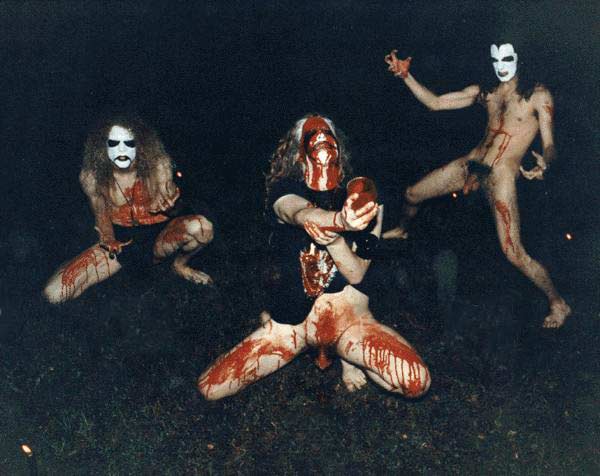
Forest-worship was primarily important to the imagery of black metal bands in Norway, and the esthetics of an old forest is totally fitting the genre. An example would be the cover of Djevel’s “Besatt av Maane og Natt.” Of course, venturing into a forest in corpse-paint to take promotional pictures and such, I guess it was inevitable that the feeling of a dark forest would also influence the feel of the music. As for Bathory, no, I don’t think Quorthon was to prone to such, at least not on his black metal albums. Later, perhaps a little bit, I’ve seen some bloody good pictures of him and his musicians in battle gear in an overgrown forest, but that’s about it, as far as I know. I guess Darkthrone were the first to incorporate forest aesthetics fully into their concept. Also lyrically.

Based on the sound of some of these demos, I sense a kinship with some Oi punk music especially in the percussion. Was this an influence, or coincidence?

Yeah, I touched on that a little before. It was no intentional thing, but I liked rythms that made me want to move, quite different from most black metal. When pacing the drum machine to Ildjarn strings, I guess you could say we tried to make it “swing,” so to speak. I think Norse accomplishes this best, and is the one of the two EPs I’m most happy with. Ildjarn liked Svartfråd better.

Do you think black metal has a spirit, or a set of values to it? Where do you think these came from? Are there any historical antecedents?

It’s hard for me to make any valid statements about this. The music itself carries a spirit, yes, but where ideology fits into the music, is an answer best put to someone else. What united all Norwegian black metal, Norse metal or Viking metal bands was a hate for Christianity. As has been realized as years have passed, this has to do with the opression of the people the church has been guilty of for the last thousand years here in Norway, more than with any wish to carry out “Satan’s cause on earth.” We still have a state church in Norway, and I think about 76 % of norwegians are members. When I grew up “Christianity” was part of the curriculum at school, and the church still has a great hold on the population through the rituals of baptizing, confirmation, marriage and burial. So the genres in question held the same basic attitude towards christianity. It was forced upon us, and now we expressed the discontent through music.

Have you noticed any similarities between black metal and its values or imagery and that of Romantic literature, art or music (from the 17-18th centuries)?

There may well be similarities there, but it’s not something I have the knowledge to comment on. There is of course a strong element of classical and progressive composition from the more symphonic bands in the black metal genre.

I don’t know if I’ve ever listened to individual songs, just put the whole thing on like a classic symphony and let it rip. I don’t know how to ask, but I wonder how you achieved this effect of albums as a whole.

I can only speak for what me and Ildjarn did together. He had a different vision for his Ildjarn solo-project than I had for mine. At the time we released Norse, we had already played both hardcore/grindcore, industrial, drone/folk and noise/expertimental. Mostly just jamming and sometimes recording an obscure demo or performing at local talent shows. Thomas Haugen also played with us in two of these bands, as well as on the last demo I uploaded, as the demo states. So already when we recorded Norse we had known each other for about five years and there wasn’t anything uncertain about where we wanted to go with that recording. As the flyer also stated: “Raw and primitive Norse metal.” Thankfully Thomas liked it and put it out as his second single on Nocturnal Art Productions.

What united all Norwegian black metal, Norse metal or Viking metal bands was a hate for Christianity.

I don’t know if you are familiar with the old rehersal studio where we recorded “Norse” (an old bank vault, no less)? This is where Emperor went through its various stages and also where Ildjarn recorded his albums, using one mic. for the whole drumset. His metal-albums and “Norse” and “Svartfråd” where recorded there. It was basically like this: If you showed interest in using the vault for rehersals or demos, you were pretty much given keys, and you could lock yourself in and out as you pleased. An article in norwegian about the place is here: http://www.akkerhaugen.no/Heavy%20Metal.htm

Hardangervidda was a totally different vision, and at the time I was attending the teachers college in Notodden, where music was one of my majors. Hardangervidda was guided totally by nature (and the instructions for the synth ; )), and there was never any doubt or disagreement about where we wanted to with that album either. The nature is overwhelming there and it has a lasting impression of most people who visit the place. Ildjarn, Nob and I went there for a pilgrimage in the closing stages of the making of the album, ventured for some hours into the area, enjoyed the sunset and slept there in nothing but sleeping bags. There’s always a lot of commotion when album covers are changed, but I really think the artwork on the vinyl edition does it more service than the original would. The pictures on both editions are by me and Ildjarn and he’s also been up there again shooting pictures for another edition. As far as I know, this edition is intended to be in colour, I guess that makes some people cringe. I’ve seen the pictures, though, and they look great. I don’t have any details about that release as of yet.

Also, are you aware of the ressurection of “Helvete” (where Euronymous ran his business)? “Neseblod records” (Nosebleed Records) have recently moved in there and a museum of Black Metal is now emerging. I’m sure you’ll find the pictures on the web-site interesting. Check it out, here’s the link: http://www.neseblodrecords.com/

I can inform you that I’m currently in contact with a small record label for the possible release of the Nidhogg demo and a future extended version of “TrollTripp”. I recording the B-side of the demo now (bass and vocals) and then we’ll turn it the right way around and hear if it’s usable. It sounds good so far.
Here’s a link to the label. Like the sound of the WROTH-demo, btw. http://intotheshunnedhouse.wordpress.com/

We were also able to get some words in with Apelseth, one of the members of Sort Vokter who participated in recording Folkloric Necro Metal. While his answers are brief, they reveal his mindset about the recording and the nature of the band.

How did you get involved with the musicians who became Sort Vokter? Did you share any interests? Were you into metal, or black metal?

Metal and some black metal

I am told you are responsible for “Tårers Sang.” Did you compose this alone? What helped you come up with the unique blend of emotions on this piece?

“Tårers Sang”; melody and guitar on “Fra Kilden til Tjernet”; sound-engineering on the whole album.

The melody came to me one full moon night, I was in the forrest. Inspired by the shades and special light that is in the forrest at those times.

What kind of atmosphere do you think this band produced? Does it correspond to any real-world events, places, or emotional blends?

It is a soundscape based on the different landscapes and emotions in the norwegian nature

Thanks to all members of Sort Vokter and Nidhogg himself for making this interview possible.

12 Comments

Tags: , , ,

5 albums that invented death metal

morbid_angel-live

When the new genre of death metal emerged, no one knew what to call it at first. It grew out of a time when metal was just managing to break out of its last assimilation by rock, the late 1970s and early 1980s glam, through speed metal bands like Metallica. As soon as those broke through, others followed with an even more alienated and disturbing sound with what came to be called “death metal.”

Since that time, advertisers and marketers have descended on the phrase. Outsiderness means authenticity and authenticity sells products. Every product that wants to tag itself with rebellious, “fun” and nonconformist would benefit from using the term. But before it became another media tag-line, death metal constituted the most vital genre that existed outside that form of social control.

Its origins remain in murky obscurity, but can be tracked through the bands that innovated the sound. Read on for the five albums that invented this sound.

sepultura-morbid_visions

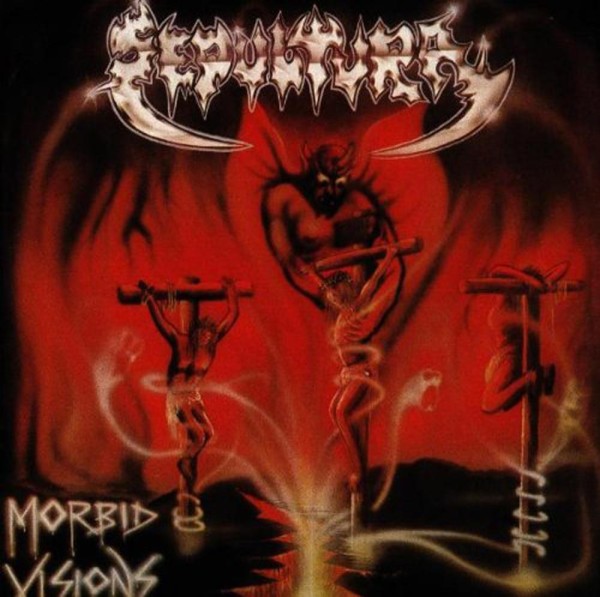
1. Sepultura – Morbid Visions/Bestial Devastation

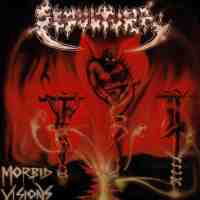
Way back in 1985, Sepultura released Bestial Devastation as a fully mature death metal album including unorthodox song form that fit to content and Slayer-style introductions with related motifs to new riffs. Fast and furious in the style that Morbid Angel, Massacra and Vader later developed, this tremolo-picked fury joined Morbid Visions on a release to commemorate these early and massively influential works. Notably this band also spun off guitarist Wagner Antichrist to Sarcofago who later kept black metal alive in the intermediate years between Hellhammer/Bathory/Sodom and Mayhem. Although this early release was recorded with borrowed instruments in what sounds like a dungeon with DC power, many of the elements that became central to death metal presented themselves here: complex riff changes fit together by theme, abrupt breaks, layering by repeating at double speed, use of chaotic guitar highlights, and vocal drops over transitional riffs. For its primitive origins, Morbid Visions/Bestial Devastation demonstrates death metal entering its maturation process after early years of using loan-techniques from related metal and punk genres.

possessed-seven_churches

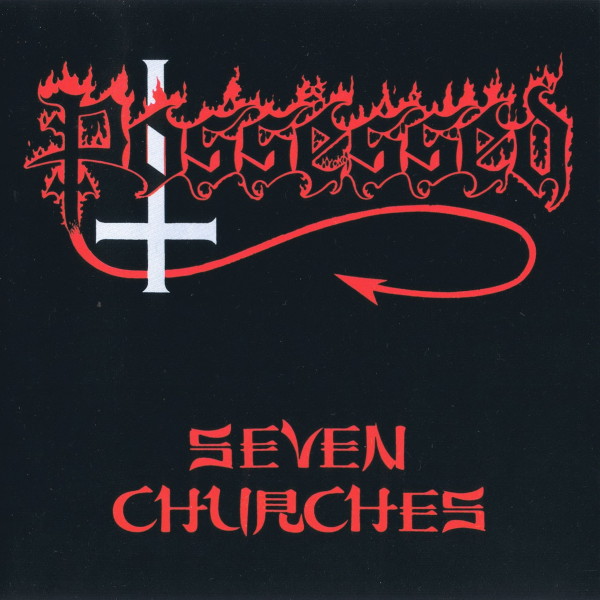
2. Possessed – Seven Churches

Like many early albums attempting to forge a death metal path, Seven Churches borrows much of its technique from earlier styles of metal. In particular, much of speed metal persists here in song structure and rhythmic sensibility, but Possessed nailed the infernal voice that would become an easily noticed characteristic of the genre and gave it its name. This album slashes through songs that mostly follow riff-chorus song format but interrupt it with discursive passages such as the famous melodic riff on “The Exorcist.” Riff shifts generally occur at significant points in the song rather than as extensions of the standard format, which gives this release a chaotic and uneven feel fitting its subject matter. Its song titles embraced outright positive feelings about Satan, which in the 1980s was enough to cause a listener social problems. The lyrics no longer warned of the possibility of evil, but the certainty of it and the necessity of embracing it to avoid the rotted and calcified lies of the “good.” Its pacing and riff forms often resemble those of speed metal as well as its tendency toward bouncing rhythms which favor the offbeat, where later death metal bands might have adopted a more downbeat approach. Despite spanning these genres, Seven Churches lent so much to the new death metal genre that it forever seems appropriate to associate it with death metal.

death_strike-fuckin_death

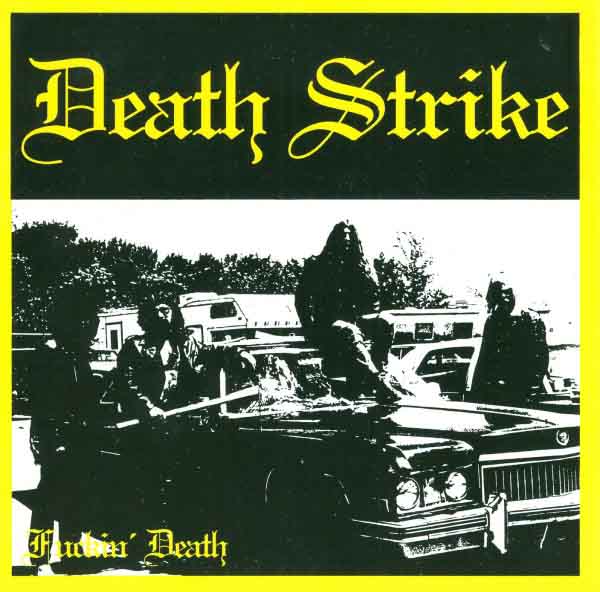
3. Death Strike – Fuckin’ Death

Paul Speckmann contributed much to the rising death metal movement under a bevy of different names: Master, Death Strike, Funeral Bitch, Abomination and Speckmann Project. His basic approach took 1960s protest rock, violent punk, and early dark heavy metal and mixed them into what basically sounded like rudimentary metal with punk rhythms. Death Strike emerged in 1985 with death vocals and grinding riffs but Speckmann’s demos had exemplified these attributes for at least two years at that point. While the result sounds spacious for modern death metal ears and uses variants on standard song format almost exclusively, this early embrace of the aesthetics of violent chaos and radically simplified riffing set many on their path down to the fiery depths of death metal.

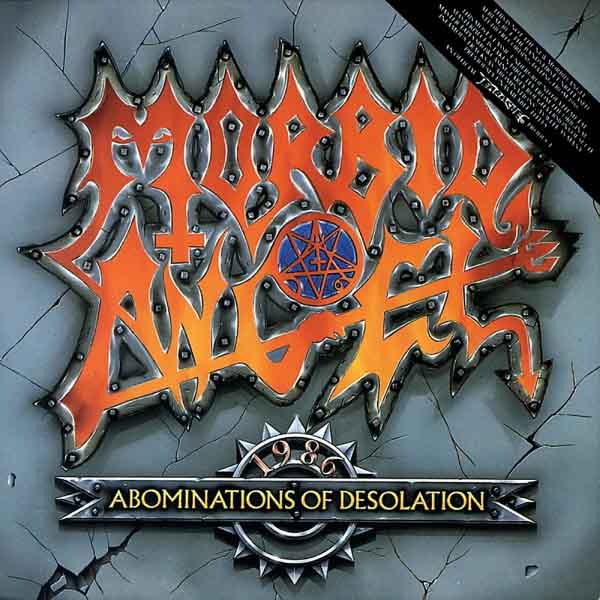
morbid_angel-abominations_of_desolation

4. Morbid Angel – Abominations of Desolation

The first Morbid Angel album made it to a limited release only on a small label in Tampa, Florida, and so was lost to time until Earache re-issued it in 1991 as a full release. Featuring the drum and vocal talents of Mike Browning (Nocturnus, After Death) this early powerhouse showed the unique and progressive rock influenced songwriting that would appear on later Morbid Angel but without the similarity of aesthetic. Abundant lead guitar spills out all over, songs vary tempo widely, and riffs span many more forms than the solidified final Altars of Madness — which shares most of its songs with this album after three years of refinement while band members worked at a car wash — would demonstrate. Some of lead guitarist Trey Azagthoth’s most creative and psychedelic playing adorns this release, as well as songs that stray into doom metal and progressive metal territory. While this album followed a battered and twisted path to release, it made itself known to the tape-traders who were the backbone of non-mainstream metal in the 1980s, and from there influenced the entire genre.

necrovore-divus_de_mortuus

5. Necrovore – “Divus de Mortuus” demo

Speaking of demos, some of death metal’s most profound work never made it to vinyl or polycarbonate. Traders passed around demos and most band members were traders or had zines and got copies of demos in for review. “Divus de Mortuus” appeared in 1987 after some years of rehearsal and live tapes circulated among the demo circuit and immediately galvanized many. In particular, its influence can be felt on Morbid Angel, whose David Vincent adopted the more aggressive vocals and warlike posturing of vocalist Jon DePlachett. While the riffs on this demo focus more on abrasiveness and less on phrase, many of the elements inherited through Hellhammer and Slayer shine through here on what might be described as the first atmospheric death metal release. While this demo may never make it into stores, its influence spread outward from Texas to Florida and Europe beyond and it lives on in the death metal that followed it.

16 Comments

Tags: , , , , , ,

Heavy metal as music of rejection, not rebellion

metal_rejects_civilization

The conventional media narrative regarding heavy metal is that heavy metal is the music of adolescent rebellion. Like the Puritan attitude toward sex, this double-faced approach allows media to both trivialize metal and use it as the basis of product branding, or the identification by consumers of the product with an attitude or social group. This attitude reflects the needs of the media more than what heavy metal actually is.

In branding, metal joins a cluster of products like Jack Daniel’s whisky, Marlboro cigarettes, Harley-Davidson motorcycles and other products that are used in mass culture films, books and music to symbolize rebellion. Much as the media sells sex ambivalently, rebellion is also sold as a duality: it is portrayed as bad, yet fun, and so often the compromise is to avoid it on a regular basis but to cut loose on weekends. Smart observers might realize that’s a great method of control, because by “capturing” the impulse toward anarchy and controlling it, you keep the workers showing up regularly every weekday. Similarly, it’s good advertising because it implies a safe rebellion: the rebellion is there, but it’s a product you can buy anywhere, so it’s socially approved and thus there are no real consequences to face.

But what about those who are dissidents? These see our society as going the wrong way entirely and refuse to participate. Much of this infuses metal through the people it attracts, who are either drop-outs or cutting-edge dissidents, depending on who you ask. As Jeremy Wallach reveals in a post to the Music, Metal and Politics mailing list:

The notion that metal is a cause or a symptom of adolescent psychological development gone awry has been roundly criticized for the last 20+ years not only for its practically nonexistent empirical justification, but more importantly. for its unstated ideological assumptions. Too often the “problem” turned out to be insufficient socialization–of working-class kids who refused to be docile, obedient, and unquestioning, and of middle-class kids who refused to be conformist and hardworking. But rock and roll kids have always been, in Simon Frith’s words, working-class kids who reject work and middle-class kids who reject success.

Zoom in on this: working-class kids who refused to be docile, obedient, and unquestioning, and of middle-class kids who refused to be conformist and hardworking.

In other words, if your parents were expected to work as entirely subservient to the system, you reject that subservience; if your parents were expected to lead within the system, you reject the attitude that allows them to do that without questioning the system.

What we’re seeing here is not rebellion, or disagreement with method, but rejection. These are people rejecting civilization as it is so constituted. This started with Black Sabbath rejecting the idea of “peace, love and happiness” — a once-removed proxy for egalitarianism and coexistence — peaked in speed metal’s warnings of nuclear war and apocalypse, and finally in death and black metal saw acceptance of the apocalypse and subversion of its methods of control and emotional passivity, respectively.

Heavy metal does not tell society that its methods are wrong, but that its approach is wrong. We are those who dream of a different world… one where intangible values triumph over those that are material, social, economic or political. Different generations of heavy metal reflect this dream differently and few seem to be able to articulate it, but it remains beneath the surface, peeking out periodically like divinity in an avatar, hinting at the invisible narrative pervading what we know as “normal” life.

13 Comments

Tags: ,

Death metal albums of which I will never tire

morbid_angel-live

Early death metal (Bathory, Slayer, Hellhammer, Sodom, Master) emerged as an aggregate of the past, comprised of speed metal (Metallica, Exodus, Nuclear Assault, Testament, Megadeth), late hardcore (Cro-Mags, Amebix, Discharge, The Exploited, GBH), classic heavy metal (Judas Priest, Iron Maiden, Motorhead) and thrash (DRI, COC, Cryptic Slaughter). As a result, most death metal bands exhibited some tendencies more than others, although the founding early death metal bands tended toward the type of tremolo-powered phrase-based riffing exemplified by Slayer.

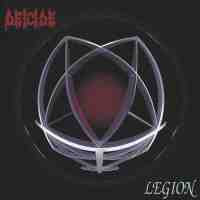
For example, Deicide on its second album Legion arguably made the album that …And Justice For All wanted to be, with lots of choppy percussive riffing forming intricate textures from which a melody emerged. Early Master sounded more like a punk band with its simple song structures and emphasis on droning, protest-like vocals. Second-wave death metal like Death and Possessed had a tendency to apply speed metal song structures and riff styles. Even advanced death metal like Pestilence often sounded like a more technical and complex version of early speed metal.

But focusing on death metal requires we look at what was unique to it. Getting past the vocals and the intensity, what distinguishes it musically is its use of that tremolo-strummed phrasal riff. This in turn forced bands to escape from riffs integrated strictly with drums, and to as a result put more riffs into the song to drive changes that previous would have been done by the drums. That in turn forced bands to make those riffs fit together, what Asphyx call “riff-gluing,” so that songs avoided the “riff salad” plague that captured later speed metal.

These bands exploded onto the world from 1983-1985, inspired in part by Discharge’s Hear Nothing See Nothing Say Nothing which hit the ground in 1982. Slayer in particular stitched together classic heavy metal and ambient hardcore like Discharge and GBH and ended up with its particular formulation, taking the tremolo and riffs independent of drums from Discharge and matching them to the complex proggy structures of Judas Priest and Iron Maiden with Motorhead speed and aggression. This was what launched death metal free from the shadow of speed metal, which was the first metal genre to break out of underground status despite being — for the time — fast, aggressive and dark.

If you want to get to the core of death metal, these albums might help. They’re albums I keep returning to year after year because they have enough complexity and that unquantifiable quality of having purpose and being expressive, perhaps even emulating the life around them and converting it into a beast of mythological quality, which makes them interesting each time I pick them up. Without further ado, ladies and gentlemen, the players….

Slayer – Show No Mercy

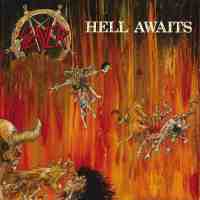
While Hell Awaits has more expert composition, South of Heaven better control of mood and melody, and Reign in Blood more pure rhythmic intensity, Show No Mercy captures Slayer flush with the fervor of youth and the belief in big concepts. As a result, it is an intensity mystical album, uniting a narrative about war between good and evil with the actions of people on earth. It is not like Hell Awaits more solidly situated in a single mythology, nor like Reign in Blood and after an attempt to explore the dark side of modern existence in a literal sense. Instead, it is a flight of imagination mated to an apocalyptic vision of a society crumbling from within. As a result it is musically the most imaginative of Slayer albums, creating grand constructions of visions of worlds beyond that stimulate the fantasy dwelling within our otherwise obedient minds.

Massacra – Enjoy the Violence

Another early album in very much the style of Slayer but with intensity cranked to the ceiling, Enjoy the Violence shows a band intent on conveying intense energy through their music. To do this, they rely on not only near-constant breakneck speed but also vivid contrasts between the types of riffs that are used in a song, welding a rich narrative from riffs that initially seem simple like the scattered twisted bits of metal left after a battle. The result is closer to epic poem that punk music and blows conventional heavy metal and speed metal out of the water with the sense of unbridled aggression and lust for life that surges through its passages. In addition, it carries on the mythological tradition of Slayer but adds a Nietzschean spin whereby constant war for supremacy and domination is the only path not only to victory, but to personal integrity.

Morbid Angel – Abominations of Desolation

Most prefer the more refined versions of these songs from Altars of Madness and Blessed Are the Sick, but my ear favors these nuanced and unsystematic detail-heavy songs which feature more of a blending of textures into what sounds like a communication from another world heard underwater or through the croaking voice of a medium. Trey Azagthoth’s solos were best when he used his half-whole step leaps to make solos that sounded like the creation of gnarly sculptures, and these songs powered by Mike Browning’s drums and voice have more of an organic jauntiness to them than the later mechanistic tanks-crushing-the-shopping-mall sound of the full albums. In addition, this combination of songs strays from the later more interruption-based riffing this band would attempt and instead brings out their inner desire to rip all ahead go at all times, creating a suspension of reality like war itself.

Incantation – Onward to Golgotha

When the idea comes to mind of death metal at its essence, this album will be mentioned because it creates a sound unlike anything else. Incantation took the Slayer riff and song formula and slowed it down, doubled the complexity, and focused on alternating tempos and riff styles to create a building mood of immersive darkness. The result was not only aggressive, but melancholic and contemplative, like a warrior looking out over an abandoned bullet-pocked city. Detuned riffs collide and deconstruct one another, resulting in a sound like the inexorable flow of black water through underground caverns as civilizations collapse above. This rare group of musicians achieved a triumph here that none have been able to repeat individually, suggesting this album was born of a magic confluence of ideas more than a process (ham sandwiches on a conveyor belt).

Carnage – Dark Recollections

If you want “the Swedish sound” at its most powerful, Dark Recollections offers every component synthesized into a package that has not yet had time to become self-critical and neurotic, and thus is an unfettered expression of the thoughts of precocious adolescents translated into sound. The components of Swedish death metal are the modified d-beat, the use of melody to expand song development, a gritty electric explosion of guitar sound, and a tendency to write songs that are half searing budget riff and half horror movie sound track.

http://www.youtube.com/watch?v=fjhRi4uJ-5c

Sepultura – Morbid Visions/Bestial Devastation

The first EP in this two-EP package is the more classic death metal version and packs a solid blast of inventive riffcraft staged with theatrical precision into songs that form narratives of the topics denoted in their titles. But the riffs are instant creations of their own, shaped from raw chromaticism and whipped into fury by two levels of rhythm, both in the change of chords and the texturing of the sounding of them. The result owes quite a bit to Slayer, Bathory and Hellhammer, but also to the punk hardcore underlying those acts and a good knowledge of dark metal of the time, and yet is still its own animal. Nothing sounds like this except it, and by giving itself a unique voice, it conjures a power of revelation that endows these songs with lasting enjoyment for the listener.

62 Comments

Tags: , , , , , , , , , , , , , ,

The danger of obscurity bias

terminal_death-terminal_death

Obscurity bias arises from our desire to discover hidden essential influences in the past. In metal, it is the search not only for concealed gems but for lost ancestors of our favorite music.

This thinking is a variation on our perpetual quest for more alternatives. We look at what’s there and think we want something better. This ignores the basic rule of life that usually what’s wrong is a lack of quality, not need for another alternative.

When we look back for historical alternatives, we are seeking to avoid the obvious historical truth: there are few ancestors because few necessary steps lie between 1969, when Black Sabbath recorded the first proto-metal record, and today.

Metal, punk and prog evolved in the 1968-1969 period in parallel, and since then have been trying to find a hybrid equilibrium that preserves the heavy worldview of metal, the intensity of punk and the complexity of prog without falling into the bluster, one-dimensionality and incomprehensibility that are the downfall of each respectively. With underground metal, arguably the last genres with any intelligence in metal, we ended up with metal riffing, punk strumming speed, and progressive rock song structures with underground metal, and that worked pretty well.

What happened after the initial invention was a hiccup. The music industry invented proto-glam by trying to make Deep Purple/Led Zeppelin bands “heavy” enough for the new Black Sabbath audience. What happened was that they made rock-metal, and while it was popular, it didn’t satisfy the core audience. After the hiccup metal retaliated with NWOBHM, most importantly Motorhead, Iron Maiden and Judas Priest. The next generation combined those to make speed metal; the generation after that mixed in the punk that arose after Motorhead, hardcore punk, which was far more extreme and less musically related to rock music than anything which had come before.

In 1982, Discharge released Hear Nothing See Nothing Say Nothing. The following year, all hell broke loose. Metallica unleashed their first album, starting speed metal. Slayer took off on a separate tangent. While both these bands were partially inspired by Venom, it was more in an aesthetic sense than a musical one, because if you remove the rough playing and bad production, Venom is basically Motley Crue. Slayer in particular took more from the punk side of things and made chromatic riffs and elaborate internal song structures where Metallica followed more of the rock format harmonically and used fairly standard song structures, except for their prog-influenced instrumentals.

Thus by 1985 we had Slayer, Hellhammer, Sepultura, Bathory and Sodom making proto-underground metal; by 1986, Morbid Angel had formalized the style. If anything, the Death and Deicide assault of the next two years brought death metal back toward the speed metal — Metallica, Exodus, Prong, Nuclear Assault, Overkill, Testament, Megadeth, Anthrax — of the previous five years. Death metal took on a life of its own when it escaped that with releases like the first Incantation, Massacre, Morpheus Descends, Massacra, Carnage and Pestilence releases with the turn of the decade. These brought metal back to its Slayer-Hellhammer-Bathory nexus, with tremolo strumming and labyrinthine song structures, and away from the more speed metal song structures of Death and Deicide. Black metal grew out of the melodic death metal bands who started structuring their songs using melodies, not riffs alone, and thus needed less of a drum-dominated approach. That brought them closer to the original punk sound, but kept the metal method of making riffs.

So what’s with the search for missing ancestors?

Black Sabbath creating proto-metal in 1969 was no accident. The band sought to find a new sound. They also realized the hippie movement was in the process of grossly selling itself out, having gone from a form of protest to a lifestyle of dissolution through mental obesity. It was time to kick over that false figurehead and do something new. Coming from a prog-tinged background, they invented something that sounded a lot like progressive rock, if it weren’t addicted to a dark and foreboding approach.

The message of Black Sabbath more than anything else was that truth is staring us in the face. People make a lot of noise to cover everything in flowers, sex and brotherhood, but really underneath it all a darker reality threatens. Most people are crazy. Most ideas form mass delusion of the herd. And these people have nuclear weapons, and control of economies, and other methods of taking these screwups to an exponential level. Every teen rock ‘n’ roll band sings about how the world is crazy, in part because it is crazy. Punk bands expanded upon this with an outlook of total nihilism at first, and later a kind of comfortable anarchism combined with genteel progressivism. These outlooks helped drive the evolution of genres to express a sound that was more rootless (punk) and more apocalyptic (metal) as time went on. This made it clear to each generation what the next would sound like.

The scary fact is that we can navigate metal based on a few nodal points. First, Black Sabbath, King Crimson and Iggy and the Stooges; next, after the proto-glam years, the NWOBHM triad of Judas Priest, Iron Maiden and Motorhead plus the punk music that simultaneously wracked the UK (Discharge, Amebix, The Exploited) and US (Cro-Mags, Black Flag). Death metal would have arisen from these alone, but Venom accelerated the process aesthetically, although took a step back musically toward the bad old days of proto-glam. It was natural that death metal bands would experiment more with melody, and so black metal was an obvious outgrowth of this.

All of that leads me to today’s topic: Terminal Death, whose 1985 demo and other recordings have been released as Terminal Death by Shadow Kingdom Records. Their press release states:

TERMINAL DEATH: One of the first DEATH METAL bands 1985!!!!!

When you talk about the earliest Death Metal bands, we think of SEPULTURA, DEATH, POSSESSED (all stemming from VENOM) right off the top, but there were a few ripping bands that quickly fell into obscurity and TERMINAL DEATH is one of those bands. This is not just an obscure band; they could have been a HUGE Death Metal band if they were signed to the right label back then. They certainly had all of the talent the aforementioned bands did. Their 1985 Demo tape screams with energy and intensity! This is a re-mastered collection of their complete and very short-lived career. The CD booklet is massive with a very in-depth and lengthy interview done by Laurent from Snakepit Magazine. There aren’t that many Death Metal bands can come close to how amazing these songs were. This collection is another snapshot of that amazing early Slayer-esque Death Metal. Co-founder Shaun Glass, whom also co-found SINDROME later joined the more well known classic Death Metal band BROKEN HOPE in the early 1990’s. Shadow Kingdom Records teamed up with Hells Headbangers Records to release this lost gem as a Double LP. If you’re into vinyl, keep your eyes peeled for it will be a glorified presentation.

Let’s look at this historically. By 1985, the big three of death metal — Slayer, Hellhammer and Bathory — had already recorded. Then we listen to Terminal Death. For the most part, this is simplified speed metal at a punk pace, more in common with early Sacrifice than the death metal to follow. Not only that, but Deathstrike had already beat it to the punk/metal hybrid of that era. OK, so what? I don’t consider that important, other than that it somewhat contradicts the marketing. Let’s look at the music. It’s not terrible, but it’s also not very inspired. Lots of chromatic riffs, drums kind of struggle to keep up, and heavy repetition with standard song form. There’s a reason this band took a back seat to the other influences on the rising death metal movement. It’s not bad, but it’s not great.

The DLP doesn’t look bad, but it’s unnecessary. It’s basically the 1985 demo plus three unreleased songs and several other versions of the demo songs. It might make more sense, since the album is appealing to people who want early proto-death metal, to release the 1985 demo with the three unreleased songs for a CD that presents this band at its best. Hopefully SK will do that in the future. But the question for metalheads now is why to buy this. Its historical significance is not really that great, and the music is not exceptional either. With that in mind, I’d say Terminal Death is something we can bypass.

11 Comments

Tags: , , , , ,

Interview: metal academic John Sewell of the University of West Georgia

As part of our exploration of the ideas behind the metal, we take frequent peeks into the world of academia, where a number of metal academics are writing, teaching and evangelizing heavy metal as a cultural and artistic force. This is one mechanism for metal to rise above mere “product” status and be understood as a phenomenon with something to contribute to our understanding and society at large.

Today we chat with metal professor John Sewell, author of “Doing it For The Dudes”: A Comparative Ethnographic Study of Performative Masculinity in Heavy Metal and Hardcore Subcultures and the University of West Georgia’s resident metal analyst. We’re grateful to him for sparing us the time to chat about the meaning behind metal, and what it is that makes this genre quite difficult to pin down.

How did you become an academic? Was this something that you aspired to your whole life?

The academic thing kind of happened by accident. I wanted to be a musician — and I kind of was. For around 20 years I played in bands while supporting myself as a pizza delivery guy and, after finishing my BS in Journalism in 1997, a freelance writer for alternative newspapers. Most of my bands did OK, meaning that I toured a good bit, played on several independent releases, and had a little bit of regional notoriety. But I (finally) had my midlife crisis and accepted that music wasn’t going to happen for me. I enrolled in a Master’s program in Journalism, mainly because I didn’t know what else to do with myself at the time. And then it got interesting.

Do you identify as a metalhead? Or maybe I should ask: is there a pattern of metal music listening in your past?

I have always listened to metal, but I consider myself more of a punk rocker who loves metal than a metalhead per se. In the early 80s I discovered Venom and Motorhead, and then the metal/hardcore crossover thing. I especially loved Black Flag, who had a definite metal influence on their later albums. I listened to a lot of metal in the 80s and 90s, but it was kind of an addendum to the punk and hardcore music I really loved. During that period the metal bands were really macho and seemed too focused on getting mainstream success, which turned me off. But metal has always been an important part of my musical menu.

In 2006 I moved to Atlanta to be in Georgia State University’s Ph.D. program in Public Communication. I’ve always gone to a lot of shows, and Atlanta’s metal scene is huge, and there are tons of excellent bands right now. So I ended up going to a lot of metal shows and really digging it. By this time, metal, hardcore and punk had kind of morphed into this big ugly thing that I loved. I found myself being able to relate to the metal crowd better. The metal shows gave that unified-yet-dangerous feeling I used to get at punk and hardcore shows. Seeing these bands live made it click for me. Metal is best appreciated at shows. I’d see these crazy-ass, discordant bands I’d go home and listen to the music on my own. The noisy, extreme stuff started sounding more like music to me.

What do you find interesting about metal, both (a) individually and (b) as a research topic?

Metal is interesting because it’s never going to go away. Metal has the most ardent fans of any rock music subgenre. What’s really interesting is that metal has become more underground instead of being absorbed into the mainstream. In this way, metal subculture has had kind of a backwards progression. Diehard metal fans know their music isn’t going to get wildly popular and their scene isn’t going to be coopted per se. The bands just get more extreme and the scene gets more alienated from the mainstream. It’s perfect.

Metal is interesting as a research topic because there’s all this crazy stuff going on. Metal is not just music, it’s a collective identity. And this identity has a lot of implications about power, race, class, gender and sexuality. There’s this perception in the mainstream that metal is kind of dumb — that it’s this “trash” culture. And metalheads almost embrace this proud pariah thing. Being a metalhead might have negative impact on social mobility, but metalheads really couldn’t care less.

Your research indicates that black metal finds importance in “transgression.” What is transgression?

I’m a little bit wary of this question because I don’t want to establish some static definition. What seems transgressive for one person might seem like conformity to another. Kahn-Harris does a great job of addressing this with his concepts of transgressive and mundane subcultural capital.
Anyway, I think of transgression as purposeful refusal and/or inversion — finding beauty in ugliness, power through alienation or embracing the queer, for example.

You say that, “Black metal’s self-maintaining categorical imperative produces a constituency strictly demarcated and alienated from the mainstream” and suggest that black metal’s subcultural rules serve to further separate its members from mainstream society. Why do you think this behavior has evolved, and has it succeeded in what it was an attempt to do?

Black metal is interesting because its progenitors (well, the few surviving ones, that is) keep rewriting their histories to fit grand artistic and ideological schemes. From the onset, the early black metal guys like Dead, Euronymous and Varg Vikernes probably just wanted to make the wildest, heaviest music possible. They were kids who were playing around with dangerous stuff.

The crazy stuff like murders and church-burnings, well, that seems like adolescent one-upmanship to me — kind of a contest to see who could be the most hard and evil. But the murders and church-burnings were the grist for the hysteria, and the hysteria drew worldwide attention to what was before a sub-underground phenomenon that may well have otherwise frittered out.

Here we are over 20 years later and the progenitors (Hunt-Hendrix terms this bunch “hyperborean black metal”) are still, more or less the archetypes in terms of sound, self-presentation and at least to a degree ideology. I think USBM has backpedaled on the Norse/Aryan/Nazi stuff, which is bullshit anyway. But that ideology of transgression/refusal remains a linchpin of black metal. In this way black metal (like all other long-running subcultures) is a thing that cannot be: Can a collectivity of rebels really rebel? And if black metal’s categorical imperative is the annihilation of the self, why has it stayed around so long? “Success,” as the annihilation of the self, would have impelled an end to the subculture. And black metal is not going away.

I think the difference here (and the reason for the persistence of black metal subculture) is that we are talking about artistic and symbolic transgression — not transgression in the lived world per se. Dead and (especially) Varg Vikernes, among others, crossed the boundaries between symbolic transgression and transgression in the lived world, and ended up dead or in jail as a result. There’s not so much idiotic behavior associated with black metal today, or at least it’s not as idiotic. And so it goes.

The filmmakers of the black metal documentary “Until the Light Takes Us” refer to their film as a study in the decay of meaning. Does meaning decay? Is there any way to stop it from doing so? Does this correspond at all to the in-group behaviors you have observed?

It’s been a few years since I’ve seen the movie, and I think I should go back and watch it again. I only saw it once on cable, and I was probably playing guitar, eating dinner and working a crossword puzzle at the same time. When I saw it I thought it was pretentious and slow.

This is a tough question because I don’t know exactly what the filmmakers meant by “decay of meaning,” and I don’t know whether this decay of meaning was what they really intended to convey in the film — or if that was just a hifalutin concept to tack on in an interview.

Anyway, I don’t think meaning decays as much as it evolves. Meaning is polysemic. Meaning is relative. I think it’s most productive to look at black metal music and subculture as discourse. Meanings, within discourse, are not static.

A better way to understand black metal might be as an evolution of myth instead of as a decay of meaning. Black metal is in its way ideological, and thus subject to semiotics. Black metal subculture is — like it or not — a collective phenomenon. And subculture is the terrain upon which shared meanings are contested and policed. In black metal (or any subculture), meanings evolve through interaction. “Decay of meaning” sounds more badass, and thus more black metal. But I don’t think meaning is decaying in black metal. Meaning is actually fertile in black metal — especially the meaning of myth. And the collective negotiation of meaning in black metal is where the action is.

Further in this paper — this is Pure Fucking Armageddon — you say “Black metal atomizes the ‘I,'” — forgive me if this is redundant, but are you sure that black metal did this? Are some people so constructed that their spiritual, social, philosophical and mental needs are incompatible with our current civilization?

Black metal at least symbolically atomizes the “I.” And this brings us to another of black metal’s many paradoxes. Black metal’s refusal/transgression is in its way individualistic, but the identity of the individual in black metal is oftentimes atomized — or at least obfuscated. I mean, look at the interchangeability of people with corpsepaint! Look at how similar (and similarly unreadable) the band logos are! And when Joe Smith changes his name to Sardonicus, well, Joe Smith is symbolically annihilated.

Sure, some people’s spiritual, social, philosophical and mental needs are incompatible with our current civilization. This is nothing new. Subcultures are collectivities that exist within the greater culture — and these collectivities, even black metal, operate as havens for the proud pariahs. Black metal indeed fulfills spiritual and philosophical needs for the alienated — and it also offers an identity and a sense of belonging. So in some ways people actually find identity through the conduit of black metal. It’s strange.

Do you think there’s a point to academically chronicling black metal past the 1993-1994 watershed era? Is the music today even from the same genre?

This is another yes and no answer. Today’s black metal is far evolved from what Mayhem and Emperor did way back when. Personally, I don’t think the music of any of those bands associated with murders and church-burnings was that good, anyway.

Every subgenre of rock music undergoes continual redefinition. For example, today’s hardcore is nothing like what hardcore was in 1982. Today’s psychobilly is not the same as the psychobilly of 1990. And of course the same goes for black metal.

Genre classification seems a necessary evil, though. The meanings of genre and accompanying subculture classifications evolve semiotically, and today’s meanings are never exactly yesterday’s or last year’s meanings. Scholars from the symbolic interactionist camp would probably have a lot to say about this. I think that genres and subcultures should be conceptualized as continuums with permeable, ever-evolving boundaries.

Today’s music and today’s scene is not the same as, aargh, “back in the day,” but the archetypes of hyperborean black metal are still hugely influential.

You say that maintaining boundaries is a key function of subcultures. Why is this?

This questions brings me back to Kenneth Burke’s idea that identification is an act of negation. By identifying as one thing, we negate the other. By saying what we are, we are also necessarily saying what we are not. To have an insider group, you must also have an externalized other. Maintaining difference (or some might say faux individuality) is a categorical imperative of any subculture.

You also mention that the kind of acts that succeed in a subculture environment are those which set the individual apart from the herd, and include criticism of the subculture itself. Wouldn’t that make a subculture self-consuming? Are any of them post-individualist?

Subcultures are kind of things that cannot be — or at least they become things that cannot be as they balkanize. This is to say that yes, subcultures are in a way self-consuming and/or self-negating. Such subcultural self-negation is especially prevalent in rock music subcultures. For example, there are scads of scrawny male musicians with that dyed black comb-over haircut who play guitar-driven, post-pop/punk songs about longing and heartbreak and insist that they are “not emo,” when they are exactly that.

More often than not, music subcultures that purport to be individualistic are in fact post-individualistic in that the act of joining the subculture actually negates one’s individuality in a process of conforming to the norms of expression, behavior and self-presentation of that enclave.
And then there’s the black metal bunch, of which some participants claim to be post-individualist. For these folks, black metal negates the “I.” Still, this negation of the “I,” of obliterating Joe Smith’s identity in the process of becoming Sardonicus, paradoxically provides a means to set oneself apart — even sometimes operating as a portal to small scale rock stardom. Many black metal musicians decry fame and popularity — unless and until the potential for said popularity becomes a possibility, that is.

You mention another thinker (Butler) who says that black metal is comprised, to an extend unmet by other forms of music, of references to “the enduring, the abiding, and the transcendent.” Why do you think black metal values these things? Can you think of any other philosophies or belief systems that value similar ideals?

When I was a kid, KISS was my favorite band. After one of their shows, I was talking about the experience with one of my friends. He was saying that a KISS concert was like a religious revival in that it was a cathartic, theatrical experience where a group of people worked themselves into a collective frenzy, led by a charismatic leader. That was a pretty perceptive analysis for a 12 year old. It blew my mind at the time, but I knew it was true.

While black metal (as Butler contends) indeed references “the enduring, the abiding, and the transcendent” most overtly, I think it is a bit of a stretch to say that black metal is in fact more spiritually transformative than other genres. I’m sure that fans of jazz, classical music and techno, for example, would all tell you that their preferred form of music operates as a portal to other realms of consciousness — much in the same way that black metal (or football, for that matter) does for its adherents. Any form of music, any form of ritual, surely, offers an entrée into the realm of the ecstatic — for someone.

In this way, all music (black metal included) operates as a portal to the numen, the ur-mind. I daresay that all philosophies or belief systems value similar ideals. They just have different ways of getting there. Loud music is my way of getting there.

In your paper Pure Fucking Armageddon, you repeatedly refer to the black metaller as the “sin eater, a pariah who finds spiritual illumination through the excess for which he is damned.” Do you see a parallel in this to the writings of William Blake, who notably said, “The road of excess leads to the palace of wisdom.” Is there some reason that all us post-moderns are trying to break through mundanity, trying to get back to the real underneath the surreal “real,” as if we trusted the “subtext” more than the “text” in our modern existence?

I’ve heard that Blake quote several times, but I’ve never actually read his work.

I also find the use of the term “real” somewhat problematic here — mainly because I’m intimidated by “real” in a Lacanian sense. I could keep reading Lacan for the rest of my life and never be exactly sure that I got it.

Anyway, I think that all forms of ritual and creative expression have always sought to break through the mundane to some degree. Baudrillard, Bakhtin, Huxley, Nietzsche and Marcuse (among countless others) have theorized this forever.

So, in a postmodern sense, one could capably argue that genres such as black metal seek to shatter the hyperreal (see Baudrillard) in an attempt to “get real,” as it were. And what could be more “real,” more shattering, more pre-cognitive, more pre and post symbolic than death itself?

In Doin’ it for the Dudes, you define heavy metal as being centered around “power.” What is this power, and why is heavy metal obsessed with it? How does this correspond to heavy metal’s fascination with all things dark and evil?

There is nothing about heavy metal that isn’t contradictory in some way, it seems. There is a lot about heavy metal that I’m uncomfortable with. There is a lot about heavy metal that is downright dumb. But the wrongness and the dumbness of heavy metal is, for me, part of its allure.

There are few, if any subtleties in heavy metal. The “power” of heavy metal is blunt force. The shows are as loud and physically punishing as possible for fans and performers alike. A metal show is something to be endured as much (or more) than enjoyed. Lyrically, metal is about war, the occult, torture, dismemberment, totalitarianism and death.

Ultimately, heavy metal is masculine power, performed by and for males.

You write about how heavy metal is hypermasculinized, yet doesn’t challenge conventional genre roles. Do you see a parallel between those two?

I’m not sure I understand this question. Why would hypermasculinity challenge conventional masculinity? I see hypermasculinity as the amplification of conventional (hegemonic, heterosexist) masculinity.

What I have found through my work is that the performative (hyper)masculinity of heavy metal bolsters the hegemonic masculinity of the culture at large in a way that, nevertheless, is not empowering for heavy metal males in an extra-subcultural sense. Heavy metal masculinity is double-edged masculinity.

Heavy metal links the performativity of masculinity with the performativity of working classness. This is to say that heavy metal males, quite often from middle or upper-class backgrounds, enact archetypes of working class masculinity. These symbolic enactments of working class masculinity by metalhead males function to render a disempowered heavy metal male subject. In other words, by participating in a proud pariah subculture that is considered by many to be “white trash” or “low” culture, heavy metal males become “white trash” or “low” culture.

Of course, it would be wrong to paint the heavy metal experience for males in a single, broad stroke. Heavy metal males also experience their subcultural participation as empowerment. They don’t care what society at large thinks of them. And if they experience participation in metal subculture as empowerment, then, for them it is empowerment. After all, however we experience something is, for us, reality.

By enacting a mutated, caveman-style masculinity that is so over the top it’s almost satirical, heavy metal males support hegemonic masculinity — which is a hierarchy of males in a heterosexist hierarchy. The male power exerted in heavy metal’s male hierarchy does not translate as power in the masculinist hierarchies of the greater culture, however. You’ll rarely see heavy metal males becoming senators or corporate CEOs.

So, in a nutshell I’m saying that heavy metal dudes, in the process of becoming heavy metal dudes, join an outsider enclave and are relegated to the fringes of society. And they celebrate this. They don’t care what people think about them, their music and their subculture.

What have been the consequences of your heavy metal research? Has it led to you being thrown out of fancy restaurants and ostracized by your peers? Or are people opening up to this art form?

I rarely go to fancy restaurants and have yet to have been thrown out of one for my metal scholarship.

That said, I do sometimes get the impression that some (by no means all) of my peers in academia think that heavy metal is not something that is really valid and that, in turn, metal studies is not a valid pursuit, either. Some folks think the academic study of metal is about as worthwhile as the academic study of professional wrestling, for example. (There are many parallels between metal and professional wrestling, by the way. And I think professional wrestling is a worthy topic for academic study as well.) I’m guessing this all somehow comes back to the distinction of “high” and “low” art.

If metal became acceptable for the mainstream, that would mean the genre had been rendered toothless. If metal didn’t offend somebody, well, it wouldn’t be metal anymore. Metal (and therefore metal studies) will probably remain to a degree relegated to the low art ghetto, and that’s just fine.

Where has your research taken you since the two papers, Pure Fucking Armageddon and Doin’ it for the Dudes, that launched your career as a heavy metal academic?

As you know, academic publishing is a painfully slow process. I submitted a couple of articles based on chapters of Doing it for The Dudes to academic journals and am waiting for the reviews. I expect that I will have at least one metal studies article published this year. I am attending the Heavy Metal Music and the Communal Experience conference in Puerto Rico this spring. I hope to make some important contacts at that event.

I don’t limit my research work to metal studies, however. All of my work somehow merges cultural studies and critical theory traditions to examine the interplay of gender, race, class and sexuality in constructed group identities. I have written an article examining the evolution of the term “queer” using Ernesto Laclau’s logic of equivalence that will be published this October. It’s a provocative piece, I think. I’m proud of that one and looking forward to seeing how that is received.

My metal studies work would be useful for anyone studying how gender is enacted as a collective identity. Likewise, my gender studies work might be useful for someone who is studying metal.

What do you think a study of heavy metal has to offer the wider society around us?

Studying heavy metal allows scholars the opportunity to examine the interconnectedness of (here we go again) gender, race, class and sexuality in a particular art form/subculture. So the study of heavy metal offers clues — on a micro level — as to how gender, race, class, sexuality and (yes) power are deployed in the whole of society.

If you are an academic with related interests to Mr. Sewell’s, he welcomes communications via email at johns@westga.edu.

16 Comments

Tags: , , , , , , ,

King Crimson spinoff group The Crimson ProjeKCt releases Live in Tokyo

the_crimson_projekct-live_in_tokyo

A supergroup composed of King Crimson musicians, The Crimson ProjeKCt, will release Live in Tokyo through InsideOut Music on March 18, 2014. To commemorate the announcement of the live album’s release, the band have issued a video of their live performance of the 1974 King Crimson classic “Red” off the album by the same name.

“Red is one of the pre-80s instrumentals that has remained an integral part of King Crimson’s repertoire up until the early 2000s. Our interpretation of this classic piece is uniquely energetic and always ‘on-the-edge’, especially the double drumming from Pat and Tobias. Markus is doubling the main guitar part in a baritone register, which adds a subtle new pushing element to the song. The roar going through the audience when we start playing this is one of the highlights of our shows for us,” said the band in a statement issued collectively.

The Crimson ProjeKCt is organized in the “double trio” lineup that King Crimson popularized from 1994-1997, and features Adrian Belew, Tony Levin, Pat Mastelotto, Markus Reuter, Julie Slick and Tobias Ralph, all of whom have played with King Crimson during the past. The band mostly focuses on later King Crimson work that was popular from the early 1980s through mid-1990s.

Tracklist

  1. B’Boom
  2. THRAK
  3. Frame By Frame
  4. Dinosaur
  5. Industry
  6. Elephant Talk
  7. VROOOM VROOOM
  8. Sleepless
  9. Larks’ Tongues In Aspic Part II
  10. Indiscipline
  11. Red
  12. Thela Hun Ginjeet

Tourdates

  • 5th March – Heichal Tarbut, Tel-Aviv – Israel
  • 6th March – Bingo Club, Kiev – Ukraine
  • 7th March – Usine A Gaz, Nyon – Switzerland
  • 8th March – Amager Bio, Copenhagen – Denmark
  • 9th March – Cosmopolite, Oslo – Norway
  • 11th March – Ziquodrome, Compiegne – France
  • 12th March – O2 Shepherds Bush Empire, London – UK
  • 13th March – Trabendo, Paris – France
  • 14th March – De Boerderij, Zoetermeer – Netherlands
  • 16th March – Arena Club, Moscow – Russia
  • 17th March – Palace of Culture Lensoveta, St. Petersburg – Russia
  • 19th March – Palladium Club, Warsaw – Poland
  • 20th March – Klub Studio, Krakow – Poland
  • 21st March – Neuberin Halle, Reichenbach – Germany
  • 22nd March – Konzerthause, Karlsruhe – Germany
  • 23rd March – Frankfurter Hof, Mainz – Germany
  • 25th March – Grughalle, Essen – Germany
  • 26th March – Z7, Basel – Switzerland
  • 27th March – Archa Theatre, Prague – Czech Republic
  • 29th March – Auditorium Supercinema, Chieti – Italy
  • 30th March – Auditorium Manzoni, Bologna – Italy
  • 31st March – Auditorium Verdi, Milan – Italy
  • 1st April – Auditorium Parco della Musica, Rome – Italy
  • 2nd April – Viper Theatre, Firenze – Italy
  • 4th April – Kongresu Nams, Riga – Latvia
  • 24th June – Auckland – the Studio – New Zealnd
  • 26th June – Melbourne – The Hi-Fi – Australia
  • 27th June – Sydney – The Hi-Fi – Australia
  • 28th June – Brisbane – The Hi-Fi – Australia
  • 2nd July – Fremantle – Fly By Night – Australia

1 Comment

Tags: , , , , , , , , , , ,

Sadistic Metal Reviews 02-09-14

apocalyptic-flames

What are Sadistic Metal Reviews? When people decide that life is worth living, try to make good music. Unless they hope to make a quick buck, in which case they disguise bad music as “innovation.” We separate the good from the bad — with a machete. Come for the misery, stay for the occasional exception…

divine_circles-oblivion_songsDivine Circles – Oblivion Songs

The mainstream assimilation of metal continues. This is basically coffeehouse femme-folk-rock like Jewel would have spun two decades ago when metal was still doing something relevant. Instead, it sounds like a Taylor Swift/Janis Joplin hybrid on piano while someone strums a lightly distorted guitar in the background and some bell-bottomed burnout bangs a cowbell. I can appreciate the similarity to neofolk bands, especially Hekate, or even the folk-rock tradition of the Americas. But it’s most similar to the goddamn crap they play in Starbucks or our local “alternative” (read: clean every other Tuesday) coffee shack. A girl sings about fanciful things, there’s some guitar and a lot of slightly exotic rhythm. But when you leave and drive home, you’re thankful for the silence. This has nothing to do with metal and should go back to the coffee shops.

slipknot-slipknotSlipknot – Slipknot

For people who thought Korn was too musical, Roadrunner has saved the day. ANGRY MAN babbling over death metal riffs reduced 100 levels of complexity, with random vinyl scratching noises and sampling thrown in for…some reason. These riffs were lifted from a White Zombie album which lifted them from a Metallica album which borrowed them from a NWOBHM 7″ which probably borrowed them from the rantings of cavemen etched into sandstone near the local juvenile detention center. To these basic speed metal riffs, they have added abundant bounce and doubling the internal rhythm on the offbeat, which gives the illusion of complexity for about ten seconds, and they’ve wrapped them around rock melodies. Speaking of wrapped, why aren’t we calling this rap/rock? It’s obviously rap music sanitized for the people too uptight for even backpack hip-hop, thus it gets injected into rock and to disguise the obvious lameness of this combination they cover it in heavy metal stylings like melted chocolate poured over a corpse. Lyrics are moronic, riffs are moronic, album art is moronic…is anything in this band appealing to functional humans? If a vengeful god were to rain napalm on America for producing this album, it would be justified.

eva_polgar-sandor_valy-gilgameshÉva Polgár & Sándor Vály – Gilgamesh

Art music faces one ultimate test: will people listen to it on a regular basis, in regular lives? I’m not talking about the heroin and cigarettes crowd in Williamsburg with their postmodern degrees from Brown, but normal people. Thoughtful, intelligent, realistic, well-adjusted people. Do they listen to it? Or is it something they think is neat, maybe would be good in a movie, and then politely clap and never hear it again? Gilgamesh qualifies as some of the better art music I’ve heard. It is an sonic backdrop to the famous tale, rendering in quickly played piano riffs while other instruments fill in background chording. This has more in common with industrial music and avantgarde jazz than rock, but each track creates a series of emotional sensations corresponding to its chapter of the Gilgamesh saga. It is artfully done and powerful but is too abrasive and repetitive for every day primary listening. Further, it is too arty and conceptual to find a place in the balanced life. It would make a killer soundtrack for a silent film however.

fear_of_domination-distorted_delusionsFear of Domination – Distorted Delusions

Music designed to pander to newer listeners is often excruciating. First, it must have an obvious novelty in style that usually defeats common sense. Next, it must appeal to people whose first instinct is essentially disruption and chaos. As part of this, they favor weapons like repetition and garish aesthetics. This album will not disappoint on those points. Mixing clubby techno (itself suspiciously like disco) with metalcore and crowd-positive industrial like Rammstein, Fear of Domination spit out music that is essential keyboard-led but has background guitar and bass which are entirely obliterated by the harsh, chanty and repetitive vocals. There is not a single metal riff on the album. There is also nothing new to people who have experienced even Ministry, but a form with novelty gives this some of the appeal of more austere industrial bands. Still the repetition level and degree of obvious manipulation makes it excruciating for people who have heard more than a dozen albums.

benighted-carnivore_sublimeBenighted – Carnivore Sublime

In the absence of Nu Metal, everyone is rushing to take over the territory of Limp bizkit or Korn. From bling bling tech-core band Despised Icon to recent Napalm Death to streamlined Unique Leader sounding Morbid Angel palm muting riffs, Benighted blend everything that’s hip and br00tal in the scene together as the perfect sonic weapon for the frustrated school kids. This whole album is full of preachy and overreacting jerking noise. The band’s new music video reflect all of these: attending school is bad and teachers are evil, the world is insane, so buying this album is the right way to the first step of revolution. The hilariously out of place cleared-throat howling choruses sound like any metalcore rather than death metal, they make me want to put on the Korn records instead. Nothing from Benighted’s album is remotely exciting to the ear of a longtime metal listener. The volume is louder than Grammy performer Metallica, but the music is just as bland. Benighted and their far relatives Insane Clown Posse and Fleshgod Apocalypse are definitely worth exiling from the metal world.

LP1037_RECHTS_tem_de.pdfFluisteraars – Dromers

What is problematic about post-metal/indie-metal, and rock music itself, is nto that it’s distinctive. Rather, like a good product, it’s created by audience surveys. What do they respond to? — put that in. What got bad response? — take it out. What was neutral? — reduce it. The problem is that you need all the colors of the rainbow to paint a picture, so just because audiences prefer blue over yellow does not mean yellow should be removed. In fact, it aims to create a monotone picture where all of it is the color audiences want in their living room and none is the less favored colors. But art is a communication of a mental journey between two points. It shows us someone emerging from a state to a higher realization and then acting on that for triumph. It reveals a mixture of emotions that signal an ultimate resolution, or at least a clarification in the mind. But what we call “modern metal” — itself a clone of the late hardcore, post-hardcore, emo and indie movements of the late 1980s through middle 1990s (Jawbreaker, Rites of Spring, Fugazi) — is like rock music designed to just be that perfect wallpaper for your life. The right shade of sweater, the right ironic frames for your glasses, the purse that makes you look like a wandering boho hippie who might just happen to have a degree in art history. It’s the cult of the ego, and the ego demands only what serves it in full and denies the experience required to get there. This is because the ego wants nothing to do with the external world, and prefers that which is “human,” namely itself and those it socializes with. Fluisteraars is 2/5 old school black metal like Enslaved and Darkthrone, and the rest the newer material in a dronining long form that uses multiple riffs derived from a single theme, like Pelican. The result is very pleasant to listen to but when it is done nothing has changed in your life. You are back shopping for wallpaper, ignoring anything outside of yourself, and consequently, missing out on anything that can be called soul.

woods_of_desolation-as_the_starsWoods of Desolation – As the Stars

Most of people can’t tell the difference between shallow light-hearted commercial product and art, therefore the conformists can always make some metallic indie rock to troll the underground. Woods of Desolation is the black metal version of Explosions In The Sky; both of them use the highest notes of the guitar chords to outline the weary lie-down-and-die pentatonic melodies while songs build around the sweeping textures. Just like the prototype of this sub-genre Alcest, Woods of Desolation’s music is nice and sweet and flawless, it make one hard to criticize them. But the reality is, three months after the hype, those who praised it like hell initially would throw this album away for these spun sugars annoying them just as the morning wake up cell phone jingles.

towers-iiTowers – II

Post-rock and post-metal generally mean attempts to recreate emo through expanded minimalist sound. Towers takes an approach more like Swans where they build a drone and then layer it with interesting textures. The result is rhythmically motivational, like a march, but ultimately can’t go anywhere because like the notion of “concept music” it can’t go anywhere but to its furthest extreme. Thus what we have is interesting, but not something you’d want to repeatedly listen to except in the background or as part of a movie soundtrack. It is not terrible in any part, and on the whole it is bland and inoffensive once you get past the “extreme” style. Arguably, Towers is the best example so far of how to make post-rock/emo into something that is not terrible. The problem is that listening to it feels like being driven over by Friday 5 pm NYC traffic, and so it’s unlikely that anyone will turn to this for repeated listens that bring out some positive aspect of being alive.

sunn-ulver-terrestrialsSunn O))) and Ulver – Terrestrials

Background drone of distorted guitar vibratto and feedback. Foreground slow chords, standard post-metal. Melody slowly layered, then repeats. It goes on in a big loop. Any given second of it is inoffensive and seems like something cool might be happening, but then, if you listen to the whole thing, you realize its fatal flaw is that it’s boring. Nevermind that Lull and Fripp did this years ago but better. Nevermind that these bands were both wrecking balls to metal’s integrity. Just listen to the music: it’s repetitive, doesn’t development, and basically does nothing but establish a drone and a half of a mood. What would you do with it? Listen to it? No, this is music for you to explain to your friends. The point is that you know something they don’t and you can thus explain how profound it (and you) are. It’s no different than people going to rap concerts to pose at being gangsters or young girls who cry when Shakira sings about her hips. It’s just more pretentious.

tiskoviny 1.cdrDodsferd – The Parasitic Survival of the Human Race

Despite the ideologically-correct title (for black metal), this band shows us the true death of black metal: it has been assimilated by punk music. This sounds, with the exception of a couple black metal open strum riffs, exactly like the same droning hardcore bands were pumping out in the early 1980s. That music was the source of the stagnation that launched underground metal. I’ve listened to this thing three times and it has no negatives. There is nothing wrong with it. There’s also nothing compelling about it; it’s just more void. Technically, it all fits together. It’s just boring and expresses nothing. It is essentially hardcore punk music from the early 1980s with better drumming and production, maybe a black metal riff every seven riffs. But if you already own Discharge and Darkthrone, there’s utterly no reason to listen to this. Even if you don’t, it makes no sense to try to listen to this instead.

gris-a_l_ame_enflamee_l_ame_constelleeGris – À l’Âme Enflammée, l’Äme Constellée…

Oh wow. Titles in French, looks misanthropic, maybe Vlad Tepes has returned! Second coming of Loudblast, even? No, it’s emo. Riddle me this: if emo isn’t like the fat girl addicted with meth that you woke up next to in the basement and felt great shame for the next, why do people keep trying to hide it? This is the same droning yet bittersweet minor-key background noise that Jawbreaker put on their albums and before that, that emo bands kept trying to insert into punk. What is emo, after all, but the very basic tonalities of rock music translated over an upbeat groove into power chords with dissonant voicings? When you look at what can’t be used, you see what is left. In the same way that the blues scale is the classical diatonic major scale with the key-centric notes removed (and a blue note for color-note rhythm comp fudging), emo is what happens when you take all the life out of music and translate it into rules to keep an audience in suspense. It doesn’t ever go anywhere, just shifts between these same few interval progressions. And yet, there it is. And people who apparently know nothing about thinking keep buying it. This is very frilly, dressed-up, entertaining variety, but underneath all the stupid pet tricks and gaudy clothing is the same old tedium. This is the sound of a genre dying.

frost_legion-death_of_mankindFrost Legion – Death of Mankind

Crossing punk and heavy metal styles with a black metal aesthetic of constant high-intensity drumming and droning riffs, Frost Legion make black metal that often sounds like it is assembled from spare parts but tries to keep a focus on the melody and savagery of black metal. Vocals are a constant rasp that varies inflection as little as possible, over active double-bass drumming reminiscent of later Ancient Rites. Riffs are often drifting melodic constellations formed of a few chords which work through permutations of loss and re-acquisition of a root note. Often the riffs are very similar to each other which causes an unsettling loss of orientation, and frequently they bring out melodies which resemble music from the 1930s, but the effect is to create a sense of longing. One thing this band could do better is dynamics; it uses nearly constant intensity most of the time which is exhausting. While song structure is essentially riff-based, these riffs may need to correlate to something else in order to make the composition memorable. The constant melodic riffing is reminiscent of Carcariass and bands of that ilk who are deeply invested in guitar creativity and sometimes lose sight of memorable songs. This is a good start and it will be interesting to see where these guys end up after they’ve had a chance to contemplate the results of listening to this album several dozen times.

demo_tapeAethereal – Faceless Messiah

We walk among you. We are legion and yet can travel unnoticed in the midst of your cities. We are those who try too hard, and many of us ended up in black emtal. Aethereal brings many strengths but suffers from trying too hard. Coming from the wilds of the USA, the amazing thing about this demo is that it attempts to shape the melodic architectures of a European band. It seems caught between a more vicious Behexen-style assault and a traditional melodic metal attack shaped around Sacramentum, Dissection and perhaps even Sentenced. Most would argue this into the black metal camp on vocals alone, but it has aspects of many genres of metal. Technically precise and musically coherent, these longer songs more resemble the ambitious music before the Great Partition in black metal which set the classics in the past and brought a deluge of imitators to attempt to pollute the genre. The first track, “Scornful Skies,” launches from a battering assault of melodic chords resembling rainfall in sheets to a neo-Celtic style intricate lead riff, fading into a Dissection styled mood piece before evaporating into an interlude of gentle strumming without distortion and a return to a contortion of its origins. The second track, “Qliphothic Reflections,” resembles much more of the black metal of the post-initial era, with low use of dynamics and high intensity blasting with transitional melodic riffs leading us through a semi-circular structure. Both tracks show promise if developed. But again, the problem is trying too hard: looking at what all the great songs have, and trying to make your own version without knowing what connects them. If these guys trust their gut instinct and what they like to listen to rather than what they think they should be creating, they would do better. Take it from a guy who tries too hard in his biggest failures as a writer.

asking_alexandria-stand_up_and_screamAsking Alexandria – Stand Up and Scream

If any of you were to discover that your testosterone levels were too high, and your doctor advises you to take estrogen injections: before doing that, consider listening to this album – in approximately 3 minutes, you will feel immediate results. An album like this could be created only by the results of a CIA project designed to make people believe malls are desirable. (Somewhere, Bill Hicks is turning over in his grave.) For the rest of us, upon hearing this we wish that we were in that grave. This band has the uncanny ability to not only make every song sound identical, but also every riff. Then again, most people listening to this are undergoing “spiral learning” – the repetition is something they’re used to. Please don’t listen to this. If you don’t have enough respect for yourself to avoid this, just go all the way: go to Starbucks, pick up a la- oh alright, that joke is overused. This band sucks. That’s all.

35 Comments

Tags: , , , , , , , , , , , , , , , , , , , , , , , , , , , , ,

Dead Infection – A Chapter of Accidents (2002)

dead-infection-a-chapter-of-accidents

The simpler the music is, the harder it is to execute in an interesting way. The best of grindcore rises to this challenge by inventing ways of making texture expand upon a simple riff idea. Like grandmasters Carcass before them, Dead Infection use a gurgling bass deluge to convey a hidden complexity.

A Chapter of Accidents benefits from its concept, which is anchored in lyrics, and gives to each song a different set of needs because each is a short narrative or story relating an unfortunate and often miserably ironic incident. This bends the song structure to the story, which consists of a setup, a quandary, a revelation and a conclusion, and thus allows the band to adapt its grinding riffs to a simple but not simplistic process of development. As in most grindcore, the main riff repeats with interruptions; some of these are offsets, which are like counterpoints formed of different shapes or rhythms, but others are deviations to small motifs which represent parts of the story. As a result, most of what you hear when listening to Dead Infection is one powerful, thunderous and bounding riff that breaks for contrary views, thought-detours and development by layering, where drums or guitars either double-time or vary texture to add complexity.

Where Carcass is slower and is based on what sounds like 1930s-1950s music translated into power chords and made ironic with grotesque lyrics, Dead Infection is more like a troupe of mercenaries backpacking through the mountains on their way to set up an assassination or coup in that it is self-contained and for its own purposes only. It sometimes plays with riff motifs from the past, like heavy metal riffs reduced to their simplest essence, but essentially it is its own thing: a vocabulary of grindcore adapted to this type of worldview. Combine that with the vocals that sound like a dog guarding the gates of hell, and you have a formidable but thought-provoking package.

http://www.youtube.com/watch?v=8oASEW0QZlI

4 Comments

Tags: , , ,

Interview with Janne Stark, author of The Heaviest Encyclopedia of Swedish Hard Rock and Heavy Metal Ever!

overdrive-janne_stark

As far as books about metal go, there’s nothing more hardcore than an encyclopedic reference because by nature these attempt to include everything. Janne Stark wrote The Heaviest Encyclopedia of Swedish Hard Rock and Heavy Metal Ever! to keep track of the Swedish hard rock / heavy rock / metal scene, but we found it even harder to keep track of him.

For example, Stark is listed as participating in three dozens, including Overdrive, Overheat, Faith, M.O.B., Flash, TNT, Alyson Avenue, Sir Lord Baltimore, Thalamus, Chris Catena, Audiovision, Vii Gates, Narnia, Grand Design, Blinded Colony, Spearfish, Audiovision, Tower Of Stone, Teenage Rampage, From Behind, Planet Alliance, Balls, Constancia, Locomotive Breath, Mountain Of Power, Zello, Nicky Moore Blues Corporation. This is only a small slice of his participation in music, however, as he’s also a music journalist and author.

Stark was good enough to give us the time for a mid-length interview, which was conducted over coffee in the fashionable Swedish borough of Östermalm. Err… we wish. Stark was good enough to conduct this interview through old-fashioned 7-bit email, but we got some interesting answers.

Sweden has fewer people than the city I live in, yet produces more quality heavy rock, hard rock and metal bands. Is there something in the Swedish outlook that is responsible for this disparity?

I’ve had that question a lot of times. I think it has to do with several different things. Music has always been important in Sweden, folk music, singing in choirs etc. ABBA came along in the seventies showing Swedish musicians it was actually possible to break through on a big scale outside of our borders. We also have a really good (and cheap/free) tradition of music schools and the ability to learn an instrument in school. We also have the possibility to start a study circle, within a band, where you can get free/cheap rehearsal space, the possibility to record and even arrange gigs. I also think Swedish bands in general are about the music and learning to play, that getting an image and just pose.

Sweden may have partially invented death metal and black metal through Bathory. Are there are other contributions on the road towards death metal that you found interesting?

Yes, Bathory were definitely the forefathers of primitive sounding early black metal in Sweden. Later on there’s of course also the Gothenburg sound and bands like In Flames, Dark Tranquillity and At The Gates, where they started mixing more melodic and traditional metal influences with the traditional death metal sound. Swedish bands have always looked to the UK or US for influences, but I think a lot of the bands have managed to put a slightly different twist on it. Take for instance progressive bands like A.C.T or Pain Of Salvation, and then you have classic heavy metal bands like Hammerfall and Wolf who have mixed the German and UK styles of metal with a Swedish twist to it.

There’s something about the way Swedish bands write music that seems to lend itself to heavy metal, and it’s broader than the legendary Swedish melodic sense. Do you get the feeling such a thing exists?

I think it’s basically that we borrow a lot of influences from outside and blend it with the quite traditional Swedish folk touch that is in our mothers milk, whether we know/like it or not. On another note, it’s also quite interesting how several Swedish hard rock/metal musicians have become very successful in writing for pop and dance acts. People like Thomas G:son (Masquerade), Peter Carlsson (Bedlam), Anders Wickström (Treat) and not least Max Martin (It’s Alive) and Johan “Shellback” Schüster (Blinded Colony) have all become highly acclaimed pop composers who have written hits for N’Sync, Britney Spears, Pink, Lady Gaga etc.

You refer to this book as “the heaviest” encyclopedia of Swedish heavy rock and metal, and it definitely is heavy in two senses, both content and the physical weight of the book. How long did it take you to compile this monster?

It’s the heaviest in many senses. It’s definitely the heaviest when it comes to its sheer weight, 3.7 kilos (8.5 lbs) and the amount of bands featured in it (3,600), but it was also the heaviest one to get out of my system, to decide when it was time to wrap it up and get it out. When the second book was released in 2002, I simply continued compiling information. Not detailed information, but more like making notes to check this band out, check this site out, I made continuous notes of special releases and such. Then, a little more than three and a half years ago I decided ­ Now it’s time. Then I started following up all the leads, compiling all info of the bands, took all the info from the first two books, updated and corrected and all the stuff I had noted about these bands. I made one document for each letter and just started all over again, from A to Z (well, actually the last letter is Ö in the Swedish alphabet). When I felt I was finished I started doing layout, but waited with the band pics etc until last as I was still adding last minute information and bands. I then had three people proof read it, an Englishman and a music nerd friend, plus my wife (also a hard rock nerd). In September 2013, I sent in the final PDF files to the publisher and it was off to the printers, and nothing more I could do. Sheer agony at that point!

What kind of research resources were available to you? Is there much printed information on rock music in Sweden, or did you have to spend most of your time interviewing people?

When I did the first book in 1996, there was no Internet and it was all phone calls, contacting bands, music clubs, record stores etc. Now the information is all over the place, the problem is to collect, find and sort out what is the CORRECT information. Anybody can write anything on sites like Wikipedia etc. and suddenly it’s the truth. It’s been as much about checking and double-checking this time around. I’ve listed the sources I’ve used in the book, but it’s anything from www.metal-archives.com, www.musikon.se and www.rockdetector.com, to Ebay, Tradera, Discogs and bands/labels sites to find all catalogue numbers, different pressings etc. There’s a couple of metal magazines and webzines here as well, plus books and websites covering local scenes, where I’ve found some additional information. I’ve also contacted a lot of people through Facebook etc. I’ve tried to get in touch with as many bands as possible.

From the looks of this massive book, you got every heavy band that Sweden has ever produced. Did you miss any? How did you find out?

I’m sure I’ve missed some, even though I do think I’ve covered 95% this time. There’s always going to be the local metal band that printed 250 copies of a single, sold it to some friends, tucked the remaining copies away in an attic and went on with life. These things pop up now and then, still! Plus some bands, especially when it comes to black metal, are intentionally secretive and only sell their limited vinyl release to “true” fans. But, that’s the beauty of it. Trying to find those hidden gems!

Swedish death metal won me over the minute I heard it. Do you normally listen to death metal? Did the sounds of Swedish death metal tempt you to go over to “the dark side”?

The thing is, when I wrote the previous books I wasn’t into death or black metal at all. But, for this book I’ve listened to ALL bands in it, and there’s a LOT of death and black metal. As a result I’ve actually come to like a lot of these bands, the more melodic stuff like Soilwork, The Haunted, Sterbhaus, In Flames and Unleashed, but also stuff like Watain I’ve come to like. My first choice of music is however still seventies influenced heavy rock/metal and bands like Spiritual Beggars, Mojobone, Grand Magus etc.

Can you tell us about your background as a writer and in music? This obviously isn’t your first project.

I got into music very early on and started playing guitar around the age of nine, made my first demo with the band TNT back in 1977, recorded my first single with the band Paradize in 1979 and formed Overdrive in 1980, with whom I’ve made a bunch of records. I also started doing some reviews for a local zine in 1982-83. My writing got more serious in 1989, when I started writing and reviewing for Backstage Magazine and since then I’ve written for a lot of magazines such as Hard Roxx, Kool Kat News, Sweden Rock Magazine, FUZZ Magazine etc. I did my first encyclopedia in 1996 and the second one in 2002. At the same time I’ve also made records with bands like Locomotive Breath, Mountain Of Power, Zello, Planet Alliance, Constancia etc. I still play in Overdrive, Constancia and Grand Design.

How did you get the confidence to tackle such a massive work? (It can’t all come from the writer’s famous “courage in a can” — coffee — itself, can it?)

Well, to be honest, it’s a combination of sincere interest for Swedish metal, being a music nerd and, yes, lots of strong, fine Swedish coffee. Besides beer and booze, it’s the only “drug” I’ve ever touched!

If you had to select five heavy and/or metal acts from Sweden to convince a newcomer that this scene is vital and worth investigating, what would they be?

As there are such a variety of styles within the Swedish scene I’d pick accordingly, so to check out the melodic death metal scene go for Soilwork, get some classic heavy metal with Grand Magus, some high class AOR with Eclipse, doom with Avatarium and progressive rock with A.C.T. To start with.

What’s next for you? Will you continue music journalism? Where do readers go to find out more about your work?

I still write and review for FUZZ, Metal Central and Metal Covenant when time allows it. I also have my own reviews blog and I’m now working on my next book entitled The History of Swedish Hard Rock and Heavy Metal, which will be as the title says, a more history-based book on the Swedish metal scene from the late 60s and until today with stories, interviews with prominent Swedish bands etc. Not sure when it will be finished, but I’m working on it. I’m currently also working on two new albums by Constancia and Grand Design for release in 2014. We’ve got lots of gigs booked for Grand Design as well as Overdrive. High Roller Records are also re-issuing the first Overdrive album on vinyl with an entire bonus LP of demos. No rest for the wicked!

http://www.youtube.com/watch?v=y4avfZnEDyQ

No Comments

Tags: , , , , ,

Classic reviews:
A B C D E F G H I J K L M N O P Q R S T U V W X Y Z