

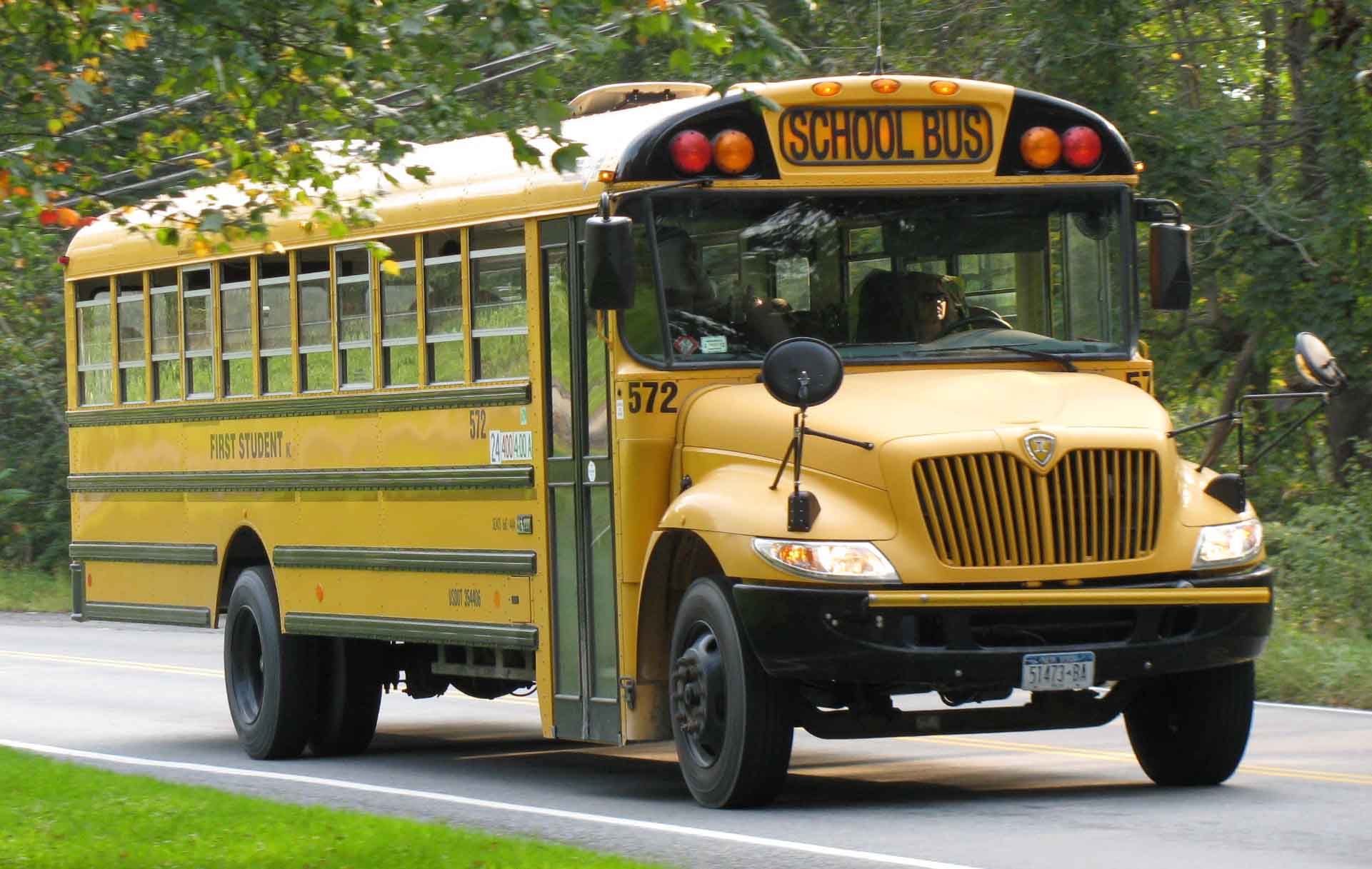
The forest warmed as the late afternoon sun stroked it from above. Insects rose out of their protective hiding place in the underground and ascended thermals into the high trees where birds pursued them. Far from the solar fire too bright for humans to glance into the sky at all, a school bus surrounded by dead leaves hid under the canopy of light-absorbing leaves.
“Christ on sandwich bread,” said Dennis as he vaulted into the bus. He looked around and realized he was speaking to an empty space. Shrugging, he began preparations for the ritual. He took one of the wax-streaked dimestore candles from the ad hoc plywood shelving where the driver used to sit, and put it on an old kitchen table that was propped up in back between sofas. Lighting it, he cleared the leaves and bugs from one seat, and perched on it to enjoy the ninth cigarette of the day. As he was finishing, the emergency door at the rear of the bus batted open.
“World’s gone crazy,” said Mark Reissdorf, with his inseparable best friend Thomas Nagel in tow. They each took seats on one of the four sofas that formed the seating area at the rear of the bus. Dennis and Thomas gathered dead and fallen branches, cramming them into the fire pit as Thomas wedged a newspaper from his pocket between them. Soon a fire blazed and smoke leaked from the bus into the woods.
Finally they heard more footsteps through the leaves and Mark leaned out the door to give Sam a hand in. Sam stood taller than any of them, but also carried extra weight, the consequence of being both the bullied youngest sibling in the Bormanns household and as a result, the one his mother soothed with treats. He dug around in his insulated vest and found a plastic sandwich bag which he flung onto the table before them. “It’s from Canada,” he said. “Where’s R?”
Thomas shrugged, and Mark and Dennis made me-too motions with their eyebrows. Sam grunted, then began rooting around in the bag.
“It’s not time,” said Thomas.
“Shut up,” said Sam. He towered over Thomas, but the smaller boy held his ground. “We have to stay true to the ritual. Defenders of the Faith.”
“You’re right,” said Mark, holding the syllable for just long enough to crucify it with a short word as if punctuation: “Fag.”
They all started giggling at that point. Then the front door of the bus opened — only R used that one — and he stepped in, chilly in his sweater and jean jacket. Where the other boys had long hair, R had none whatsoever. He had in fact shaved his entire body only because he discovered that it freaked out over 85% of the people he encountered on a regular basis, where tattoos and piercings hovered in the 60s, drug use in the 50s, and casual sex in the teens. When R stepped into a room, most people recoiled in fear. He loved that.
Mark threw more wood onto the fire, which now blazed up in the fire pit and filled the bus with smoke. R took a bong and a bottle of Old Valley Road bourbon out of his backpack. Sam tossed in the bag of weed. Mark pulled out a handful of pills and a knife, and Thomas tossed in a bag with traces of cocaine. R — his real name was Ron Carpenter, but he told everyone in freshman year that his name was actually DLANOR and he was from Sumeria, so no one trusted any name he gave — pulled out a key from his pocket and unfastened the padlock on the plywood box. Inside was a portable stereo. He plugged in his off-brand MP3 player and cranked the volume to ten. No one mentioned the week they had spent burying wire to snake a line off the nearest streetlight, nearly a half-mile away, but they all swelled with pride at the ability to have their music in this remote place.
The sounds of Hellhammer filled the bus. They simply did not trust any music or — well, anything — from any more recent time. The 1980s was when it fell apart. People like to talk about what a great decade it was, but really it must have been a terrible decade, like looking out your window to see a tsunami of Ebola-infected sewage coming your way.
The ritual had begun.
“Today was unbearable,” Thomas said, taking his privilege as the physically weakest in what had become a combination support group, revolutionary meeting and occult rebellion. “Let me tell you all about it.”
***
His day began, he related, with going to his high school and sliding into his first class in a stupor of boredom. The teacher did not even notice, having a rubric which demanded she cover a certain amount of material per minute, and confronting late students only interrupted that. He performed the minimum, being half-awake at the time, since he had spent most of last night roaming the empty places of an adult world he did not understand or wish to enter. When his parents settled down after a few mixed drinks, and his brothers and sister were camped in front of the TV, he grabbed the packet of cigarettes they kept in the kitchen drawer and headed out. He just walked: through the parking lots, across the empty roads, trying doorhandles in buildings, down the alleys. If anyone had a problem with it, he had his flick knife and used to be a star on the track team, so it would be a fair combat at least.
“You can’t sit there,” said someone in his second-period English class. Still groggy, he asked why. “All the football players sit here.”
“Fuck off,” he said. It was his favorite retort to people, who he would like to murder with great pain and cruelty, but in his inner heart he knew what he really wanted to murder was the world. The all of it. The ugly parking lots everywhere, stupid triplicate forms, waiting in line for morons to tell you what to do, brain-dead churches and politicians and the people who followed them like sheep, and everyone else strung out on booze like his parents or heroin like his friends from the past year. They were all cowards. Thomas was a small kid and he knew that if one of the football players made an issue of it, he would be at a major disadvantage. But he always fought back, leaving them with enough wounds that they thought twice about trying again, a wisdom he learned during the early years of bullying in elementary school.
Instead, Danny the Irish-Polynesian football player came into the room, took one look at Thomas taking up the first seat in the front table, and turned to the kid who had warned Thomas and punched him in the shoulder. “Good job keeping my place for me,” he said and stormed off.
More football players came in. A couple threw books at the kid who failed to guard the place. No one else sat at the table. Thomas shrugged it off, and sat through the class. He heard whispers behind him but ignored them as the usual screwing around of idiots. Then Mr. Danforth heard a knock at the door and went into the hall to talk with the fat piggish administrator who had a form for him to sign. Thomas had just settled into the lull of the background hum in his brain when an unstoppable form hit him from behind, knocking the table forward against the wall and sending Thomas crashing into it. Right before he smashed his head against the edge, he tightened his hand around his pencil and instinctively stabbed upward. A howl came in response and more books and papers crashed to the floor as the table slammed into the teacher’s desk.
“What the hell is going on here?” said Danforth, coming back into the room with a sheaf of papers to muddle over later during a bottle of discount white wine. Two students stood covered in blood in a snarl of wrecked furniture and ruined papers.
“I, uh, fell,” said the kid who had warned Thomas, with Danny standing right behind him. But Danny had blood pouring from a wound in his armpit that looked suspiciously like a pencil.
“He stabbed me,” said Danny, pointing at Thomas. Danny eyed him warily. Thomas wanted him to attack again, so he could strike with the pencil. Again and again. Murdering his parents, his teachers and the people who designed this ugly, boring, codependent place.
“I didn’t move,” said Thomas. “You must have fallen on me. I guess you just stumbled on a pencil too.”
“Well what were you doing sitting in my seat?” Danny finally managed.
“There are no assigned seats. Get over yourself,” said Thomas.
“Thomas, why don’t you ever just go along with what people want?” asked Danforth. “Go to the office. Marsha will take you. Danny, go to the Nurse.”
The nerdy kid who had warned him scoffed. “Told you so,” he said.
“At least I’m not a suck-up to jocks because I’m a mouth-breathing nerd,” said Thomas. “You’re as dumb as they are. Just math-dumb not football-dumb.”
“Fuck you, Thomas,” said the kid.
“You go to the office too,” said Mr. Danforth.
Marsha walked ahead of them carrying the yellow slip of paper which said they were rejects. “You really know how to make a small incident a big one,” she said. “Why didn’t you just do what other people want?”
Thomas sighed. “Because other people are usually crazy. Most people wanted the new dam built that flooded the woods, most people wanted the new road that makes town loud, most people actually like that stupid class, and most people watch football and drink Coors Light. I can’t do it,” he said, and suddenly felt a little bit weak.
She turned to him and he saw her eyes, a gentle blue, had faded. “You better get to the Nurse,” she said. “I’ll tell Danforth you were bleeding. That’s true, at least.”
Lunch had been no different. Some guy in a Polo shirt wanted to take his chocolate milk, and Thomas used one of the jiu-jitsu moves he studied on the weekend and threw him. That was a problem, since behind him was a chair and behind that, a glass window. Both shattered as the unlucky dumbshit went sprawling. Thomas did not get to finish his chocolate milk. As the campus cop escorted him from the premises, he caught Marsha’s eye. It looked worried and amused. He shrugged and bowed ever so slightly, which caused laughter at her table. Most likely they were making fun of him.
He went to his job at the movie theater after that. Clean the floor, they said. He took several dozen wet floor signs, found a movie that would not be out for another hour, and swabbed the whole floor then began drying it. A woman exited the individual theater and Thomas took her arm and guided her around the wet floor. “It’s tricky,” he said.
“Is that blood all over your face?” she asked. Thomas shrugged. He noticed she did not go into the theater and the next thing he knew, the manager was tapping his arm. “Why is so much of the floor wet? We’ve had a complaint.”
“I swab it down first, then get it all at once with the bucket,” said Thomas. “That way I’m not putting dirty water back on the floor to swab the next section.”
“Why don’t you just do it–” said the manager, but Thomas finished his words. “– like everyone else. My way is more efficient. I can show you — ”
” — No, no,” said the manager absent-mindedly. He was short like Thomas and Thomas always liked him for that, and hoped he had found a beautiful short wife. This guy was better than most.
“You know what, I don’t give a shit,” said the manager. “You’re going to have to go home because we had a complaint.”
“Even if it’s a… uh… ah… not really true one?” said Thomas, searching for words.
“Yes, because if someone else complains, I look like a stupid asshole,” said the manager. “Your whole goal is to not make me look like a stupid asshole.”
“Even if it’s less efficient?”
The manager threw up his hands. “Yes… I mean, no. Do what is efficient. Just don’t cause complaints. Like, next time, use an empty theater.”
“Right,” said Thomas. On his way out, he passed Marsha. “Going to a movie?” he asked.
“Going to visit my Dad,” she said, and pointed to the door he had just left. Thomas slapped his palm over his face and when he looked up she was gone.
The only saving grace came as he exited the kitchen area behind the concession stand. “Hey, Tom, wait up,” said Mikey, who wanted to be called “Mike,” the longest-haired of the crew. “Can you swap a bud for some blow?”
“Better be the real deal,” said Thomas, feeling for a moment more grown up than his milktoast parents who never did anything dangerous like drugs, crime or violence.
“Hell yeah it is,” said Mikey. “Hey, I heard you served that Danny guy in class today…”
***
“Jesus, what a lot of drama,” said Mark.
“Jesus would have hated all of those people,” said Dennis. As the token Christian in the group, or so it was suspected, they tolerated him like they might a homosexual: warily. Dennis was pretty sure he was not gay but sometimes he wondered about Sam. Not like it mattered, he thought. A gay guy who was not a stupid asshole would be OK, but most gay people would be stupid assholes, because most people were stupid assholes and no one got a pass.
Sam shrugged, busy packing weed into the bowl of his custom modified EZ-rip bong. First he painstakingly separated weed from stems, the fresh herbal scent enveloping him like a memory of flowers, and reduced the weed itself to dust. He then intermixed this with blonde tobacco he got at the local tobacconist by swiping it and then buying enough lighters to cover the cost, paying for them, but leaving the lighters behind. He wouldn’t steal from Mr. Walton. The guy was OK — he actually looked up what Sam could buy at his age and applied the letter of the law. “If you ask me,” Walton had drawled, “We don’t need any of these frickin’ laws. But they don’t ask me.”
“What about you, Sam,” asked Dennis.
“Long day at the computer store,” said Sam. He had dropped out of school, then taken the GED, then gone on to work at a local computer parts store. Now he fixed computers for little old ladies and businessmen alike, and was generally appreciated for his attention to detail — forestalling future secondary complications — although it was universally noted that his manner was diffident, almost standoffish, in the way of people who distrust socialization itself.
Mark passed over a joint he rolled with some of the dirt-cheap weed he got from his cousin who grew it in the hills. It would get you high, like a 40 oz malt liquor would get you drunk, but it was such a blunting and numbing experience that it seemed to replace fun with a grinding duty to be wasted.
“Theme of the day was barriers,” Sam began after a few moments. “I fixed a computer, then all of a sudden, things were wrong.”
***
“Did you get that laptop set up?” asked his boss.
“Yeah,” said Sam. “Needed a memory upgrade. Got it. Want me to install the usual anti-virus and repair software?”
“Sure,” said the boss, and disappeared between the shelves. Sam got to work. This one was more interesting than usual: two layers of security, and many cryptic files named only with alphanumerics in incremental form, like 1C5AFE3C0D1F.docx, stored in a generic folder. This one looked like a mess. He set about making a system backup, then preparing to install the suite of software that shielded the machine against hacks, spoofs, viruses, subversions, and errors.
He was about halfway done when his boss reappeared. “Ah,” Sam heard over his shoulder.
“–what?”
“Not that one. You can’t look in there. Just package it up for delivery.”
OK, thought Sam. He slid it onto the thin metal shelves and filled out the ticket, then turned back to his other tasks. But the memory tormented him: all those files, obviously inscrutable for a reason. Why? And the high security — for what? One did not lock doors beyond which lay only the mundane. His mind spit out a plan before his ego could approve it, but then he found himself drawn to it, cursing his lizard brain for having come up with such a perfect attack.
He dashed through the next computer, filled out the form, and slid it on the shelf, dallying next to the cryptic laptop which he plugged in to the wall, linking a network cable to its port. Then he re-arranged some bags, dropped his keys, straightened up again and left before the boss could get off the phone.
Back at his workstation he quickly fixed a point of sale machine in from a subscriber, then used it to sneak along the network and send a wake-up signal to the laptop. Then he ran a program that snaked past its security and showed him the file system. He began to download the mystery files. As he was opening the first file, he heard the door chime on the front door, seventy feet away. He paused as a voice burbled at the counter.
Walking as if heading to the stash of tools near the front, he got a glimpse of the check being handed over. His mystery laptop. The guy who owned it looked boring, reserved, maybe even a little bit withdrawn, but not paranoid as he expected a spy or criminal mastermind to be. Sam had other problems however. Within a half-minute his boss would reach over to the laptop, and have to unplug it and possibly explain to the customer why. Sam stepped back into the doorway of the loading dock, where he knew no cameras were, and lit a cigarette, blowing smoke into the fire alarm.
As the boss racked up the cost and entered the credit card, an ear-splitting siren blared through the store. Sam ditched the cigarette in a nearby flower pot. As employees rushed toward the door, he walked to the counter, then dropped his wallet. Straightening up halfway, he hunched over the machine and yanked out both cables, letting them drop, then joined the others outside.
“Weird,” said the boss. “Must have been a smoke test.” As it turned out, one of the new employees had inverted a power connector and popped a capacitor, which was accepted as the source of the smoke. The customer left, happy, and Sam wandered outside to pitch out the cigarette. When he came back to his desk, the boss was waiting for him. “We have lots of these high security jobs,” he said. “Here are another four that need doing today.”
It became a longer day than Sam intended. Toward the end, as he waited for one machine to restore its operating system, he peeked into the files he found. Columns of figures, debits and credits, on a weekly basis. He shrugged, but then looked closer. There were duplicate files for each week, but the numbers were not the same, and even without much life experience Sam knew he would rather pay tax on the second set than the first.
The boss came back inside. “Listen team, we’ve had a bit of a shakeup. I need you three to take weekend shifts, and shifts during the week are getting halved.” Sam realized his only chance to keep his salary was to take weekend shifts, so he doubled up on those as he penciled himself in to the sign-up sheet. Still, it felt unfair. The stroke of a pen and his weekend was obliterated. The voice of his boss and someone at least would be out of a job, since the total hours might support two workers but not four. And he thought they had been doing well?
His eyes slid down the counter and to the open door of the office. The computer in there might have answers. Maybe even double sets of numbers. As if sensing his discontent, the boss walked over and pushed the flimsy door shut, locking it.
Indirectly, the lowered hours brought him great fortune. Arlo sold him a fat bag of Canadian weed for a good low price, since he now needed money to hit the clubs and he would not get it from his four-hour shifts. These guys are all screwed, thought Sam, as he walked into the parking lot. He nodded as he passed the boss getting into his car. “Thanks for taking those shifts,” he said.
***
R stoked the fire. “Those are some of the most bum-ass days I’ve heard of it,” he said. “All I had was a short day at work, then wandering around looking for drugs for you guys, and playing guitar.” He showed the calluses on the ends of his fingertips.
He worked at a place that installs solar panels. When he got really stoned, R (his mother called him Ronald, before she passed on from unspoken-of ailments) talked excitedly about solar cells. How they work by allowing photons, which are particles of light, to knock electrons free from atoms, and these then form a flow of electricity. How much energy is stored in each. But then the moment fades and R is back to his sullen, defiant self, like the rest of them both detesting the time he is in now and fearing them more obligatory adulthood to follow.
“I thought you were studying for your license?” asked Thomas.
“Not today,” said R. He shrugged and Thomas returned the gesture.
Inside the bus, the cheap portable stereo blared on, both more background noise and a focal point which like a string running through random objects, tightens and pulls them together into a story, with each piece revealing the reasons for its presence and the action implicated by its effect on the other objects in the string. As twilight settled on the world, it turned all colors to gray, as if it were revealing the actual lack of interest, sincerity and purpose to it all, Dennis thought.
The bong came around again. Thomas and Sam did a line, then dropped the dust into the bowl and inhaled it with the smoke. A glass of vodka floated from somewhere. “Good stuff,” said R. “Tastes more like rubbing alcohol than diesel. That’s how you know it’s quality.”
“About the same for me,” said Mark. “Went to school, fell asleep in all but two classes, then went to work where I stocked groceries for four hours, then I’m here.” He reached into his backpack and pulled out a bottle of cooking sherry, then added it to the table. He had scored that from a heap of expired goods.
“The best drink is a free drink,” said Dennis, eyeing the bottle. “I’ll tell you mine, but you have to promise not to laugh.”
***
Dennis got schooled at home. This was a condition of his parole, involving an incident with a car going too fast with alcohol, marijuana and underage women in it. He was proud of the arrest, really, and hoped to wipe it from his record at 18 and go on to, like his father, settle into a comfortable business and make an unchallenging life for himself. One night late in the evening, surrounded by the cathedral shapes of the campfire, he had wandered into a lysergic chasm and faced his inner self, and realized what he found was more like the shuffling obedience of his father than the wild maniacs he imagined he socialized with.
First chapter was photosynthesis. Dennis liked this because he found it fascinating how light could fuse together carbon and water molecules to make sugars, the building blocks of all life. The leaves in these trees came from a diet of sugar created by sunlight, rain and the carbon dioxide he and other living things exhaled. He got too into talking about that, because his mother cut him off and changed to a different subject.
His mother, embarrassed as always by her son’s failure to be a responsible citizen like his older brother Randall, made him recite the material he had memorized and then presented him with the least of life’s delights, the pre-printed test from the back of one of his history books. He had an OK grasp of the material, he thought. “Now?”
“It’s a weekly test and I won’t be able to give it tomorrow,” she said.
OK. He gave it his best shot, and felt pretty good about it, but when he came back from the kitchen where he got a soft drink, his mother was shaking her head as she ticked red marks down the page. “This isn’t good enough,” she said. He saw the grade: 61, or a D.
“Can’t you just, uh, give it a little bump?” he asked.
“No,” she said. “If I do that and you go back to school and fail, they will think I acted against the court’s instructions and I could get in trouble. You just were not good enough, Dennis. This will set you back a week before you can get back on track.”
He knew he was supposed to panic. There were a dozen weeks remaining however. “Fine,” he said. He sat there until she gave him something else to do, and when she petered out at about the same time Mrs. Taggart came by with the latest gossip from church, he slipped out the back door.
The court ordered him to stay busy, a state policy being “idle hands do the devil’s work” but not officially so, and this mandated his appearance at a job for life burnouts like himself. The Helping Hand thrift store hired people like Dennis to receive and sort donations, then sell them to well-meaning suburbanites for money that went into a hilarious anti-drug program that Dennis had suffered through, laughing and groaning in equal doses internally as choked his way through interminable days of videos and group activities.
Dennis wanted to get on register. At the register, he could listen to the radio, even if it was just alt-country, and stay away from the dirty back yard where they heaped up the stuff they could not sell before shoveling it all into the dumpsters that would get towed to the county landfill once a week. He asked Maisie, but she said his skills were not up to speed. “You need to be at least as fast as David on the keys,” she said. “You’re just not doing well enough.”
Grumbling a bit, but not too much, he spent his shift unloading stuff from the cars that stopped in the front driveway and sorting it out. He had gotten pretty good at it when Sean his supervisor flagged him down. “You’re not including children’s clothes in the instore pile? Because we can’t use those anymore, new state law.”
“I didn’t hear about that,” said Dennis.
“It’s on a circular in your box,” said Sean. “You know, in the employee area in back. Except I can tell from looking at it that you haven’t checked it for a week.” Sean was a few years older, definitely bigger and stupider, but always seemed to do things that pleased the adults, so he was super and Dennis was… well, gopher. Odd jobs man. A guy you trusted to do only really simple stuff because otherwise he would screw it up.
Dennis shrugged. “Are you sure you’re even cut out for this job?” said Sean. “I mean, asking as a friend, maybe you should be doing something else. Something where you’re able to keep up. I wouldn’t want you to, you know, feel left out.”
Left out. That summarized the sensation well: standing alone in the heap of junk, cast off from the lives of people who had matured past it or died or moved, looking for children’s clothes to cast aside and just knowing that Sean or Maisie would stare at it for ten seconds and find the one set of My First Non-Waterproof Pants or whatever and they would tell him again how he was no good at it. Dennis worked the heap until his shift was over instead, then took his final break to overlap with the passing of the hour, and left over the back fence, his box still stuffed with all the printed notices and neurotic whining these people felt they had to send to everyone even though fully half the staff could barely read.
He sneaked into the lot surrounding the school. Mark was on the roof, smoking a cigarette when he was supposed to be sweeping up the gym, a punishment for a prank involving a firecracker and a toilet several days before. Dennis waved, but Mark did not see him. Dennis as usual experiences the cold shiver of sensation that perhaps here he is not good enough either, or that they know he is either slumming it with them or they are slumming it with him, the nerdly dork who has done many things in life, none of them right. He sighed and walked until he was just about beneath the outer wall of the school.
“Dennis,” came a voice from behind him. He turned. Sean bore down on him with wide strides. “You forgot to clock out,” he said. “Maisie sent me to make sure you weren’t doing anything you’re not supposed to.”
As the lecture went on, Dennis shrugged at Mark on the roof, who by now has taken notice. Mark pitched aside the cigarette, and gestured with his hands: closer to the wall. Dennis backed up so that he and Sean were parallel to the wall, then stepped to his right until his should nearly touched the brick. Unconsciously Sean did the same. Dennis looked up to see Mark inching closer and lining up, then tossing over the water bucket he used to mop the gym. The heavy plastic bucket pitched forward as if ready to soak Sean, then straightened so that its bottom faced downward.
I should warn him, thought Dennis, but something inside him shrugged. Not good enough, Sean. The bucket hit Sean on the top of his head and although only a quarter filled with water, knocked him out cold.
“Give me five and I’ll be out of here,” Mark called on down.
As they went through the woods toward the bus, Mark rubbed his cold hands together. “Sure was good to see a friendly face. You guys are the only ones who understand just about anything. That school is so retarded it thinks it’s a genius, when really it’s a fat blob waving its flippers at the sun.”
***
Inside the bus there was silence. Then: “Heavy,” said Thomas. R agreed, passing over the joint.
“So,” he said. “I lied. I took my commercial license exam today, and I totally failed it. Too much smoking weed, not enough boring book. I took a walk along the river after that, looking for floaters, but as usual this town let me down.”
“Sucks, man,” said Dennis. He punched up the stereo with something new, an old recording by an obscure Finnish death metal band. The energy pulsed through the bus just as the beer, liquor, wine, dope and coke flooded their bloodstreams. But even more, they had finally forgiven each other for the failings each had exhibited that day.
Above them the roof of the bus made small metallic sounds as it gave up the heat of the day. Now that the sunlight had diminished and people could again look toward the sky, the trees emitted a cooling mist and scent of earthy wholeness created from the conversion of water, carbon dioxide and sunlight into sugars. The forest takes in the sun that would kill them if exposed directly to it for too long, the water the rest of the world cannot use, and makes them into new life with the breath of people like these lost boys and angry men in the bus.
The alcohol and drugs converted tension into relaxation, if not hallucination. But as the music gained power, it converted their rage into a love. First of metal itself, then of the world that can produce such music, and finally of truth itself — the truth they find in this music, and imagine must exist outside of it somewhere else — that reduces the lunacy and irrelevance of their days into a nuisance occupying its proper role, like that of ticks and leeches, not the most important thing ever as authority figures want it to be.
As the forest quieted and hallucinogens seeped into their brains the music seemed louder. They were travelers in a world of icy power chord riffs and gurgling roars, temporarily passing through a clearing where a 1950s schoolbus rusted under the ancient trees. Its light spread farther as the light faded from the day. R fell out of the bus first, laughing with intoxication, pulling Mark after him. Thomas leaped out next, then Sam, with Dennis almost piling on top of them.
Soon they were circling in the light cast from the opaque windows of the bush, swinging each other in circles and colliding like atoms transfering electrons, passing energy along in a new form as it escaped the ashen world where all momentum dies.
6 CommentsTags: hellhammer, spinoza ray prozak