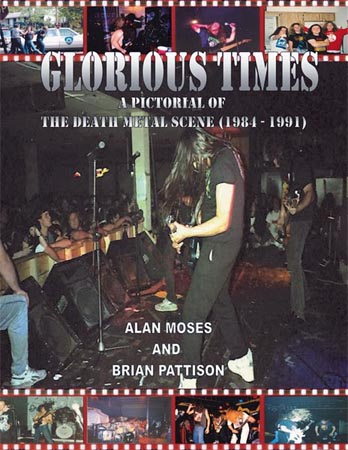
When the stars are right, when the planets of alien coordinates align in perfect syzygy, when the arcane progress of dark matter warps the cosmos into gravitations of sinister consequence, the Dead Gods may once again rise from their eonian slumber… but only if the proper rites are set in motion by those giftedly prescient of mortals. Chainsaw Abortion-ist Brian Pattison was one such a prophet who had succeeded before in the act: 1990′s Day of Death, an atrocity survived by none but a fanatical few, and the tale obscurely recounted within the scripture known as Glorious Times. Now 21 earth-years after that most notorious of receptions in the death metal saga, a wiser but no less maniacal Pattison determined the time was ripe for another extra-dimensional conjuration, with no less a death-god than Kam Lee in mind as his ultimate summoned entity. Naturally, the Buffalo territory of New York would again provide the setting, with the chosen temple for this installment being the rather profoundly-named Club Infinity.
An unprecedentedly cavernous venue, Club Infinity can house up to 500 or so bacchants before it becomes a legal deathtrap — yet attendance for the day must have been less than half of that numeral. Apparently, the local Buffalonians who would normally haunt the premises for their fix of alcohol and loud noises had absconded to a different corner of the land, lured up and away by the promise of an outdoor barbeque/live music festival of some sort. As it were, only the blackest-hearted diehards heeded the call to this cursed slice of suburbia, where memories from beyond time would once again climax in a lurid celebration of the horrific, the macabre, the rapacious and warfaring facets of existence from which fleeting mortality truly derives its meaning. Our lives — and indeed our deaths — would bear the distinct and indelible imprint of this Day as a scar that never heals, and whose free-flowing ichor blazes a sanguinary trail across ages…
Lethal Aggression: New Jersey’s crossover-thrash godfathers themselves had been the honorary headliners for the pre-Day of Death celebration, which of course had been successfully realized the previous Friday night; but for Saturday’s Day of Death proper, Lethal Aggression actually re-emerged from their dens — bleary-eyed and wracked with raging katzenjammer — at an ungodly brunch hour to be the very-fucking-first band in the proceedings, which was a display of tenacity mostly lost on the scant gathering of earlybirds. What followed was a forthright little blitzkrieg of their trademarked “drugcore” anti-anthems, which was made all the more special for the occasion with the return of classic-era guitarist Dave Gutierrez (though he may have been initially unrecognizable due to his new blue-dyed and bespiked hair), who additionally was commendable for drawing the wicked Lovecraft-inspired design for the Day of Death T-shirts. Towards the end of their timeslot, though, it became clear that vocalist John Saltz had most anticipated getting to the last song on the list — “No Scene” — as he had accidently launched into that whole vocal line during the beginning of penultimate song “Spooge”, causing the band to screech to a stop and start all over. In retrospect, the mixup should not have been too surprising, as the apathy-decrying, poseur-scourging lyric matter (the key verse being, “All you do is come to shows, sit around and stare”) was uncomfortably relevant enough to boil our blood. And this was an absolutely necessary kick-in-the-ass to start everything off on the right track.
Hubris: Being the first of four local bands to open up a 13-band procession is a task about as unpleasant as serving in the infantry during a foray into an uphill battle, and yet the cadre known as Hubris still mobilized for their set like the hungriest of mercenaries — corpse paint, wicked demeanors and all. Though they are a relatively new constellation in our Northern skies (to wit, all of their embryonic recordings thus far feature a drum machine because they could not, until recently, secure a faithful skinsman) Hubris’ style of black metal extrapolates directly from the most abrasive entries in the classical Scandinavian school, falling into a nebulous scape between Marduk’s Opus Nocturne and Immortal during their soulraping halcyon years with Demonaz. But at 4 p.m. in a sun-baked, poorly ventilated enclosure, the band’s blizzarding invocations of carnage-strewn battlefields and holocausted settlements were all but guaranteed to a tepid reception. Frontman Hellskald vehemently refused to let the standers-by off easily, however, and at numerous intervals demanded choruses of quasi-fascistic fistpumping from every slouched, beer-nursing figure in the near and far vicinity. It would be difficult to not be impressed by the young band’s charisma, and Hellskald’s exiting exhortation to “Rape angels! Drink their blood! Castrate God!” would basically set the tone for the remainder of the rituals to follow.
Seplophile: Attribute it to that everflowing stream of youthful vigor if you will, if that would most efficiently explain how Seplophile had the mettle to burn through one of their own setfuls of brutal death, just a few hours before they would entirely re-animate the godlike monolith of morbidity ‘From Beyond’ with living legend Kam Lee. Despite Seplophile’s ostensible “newcomer” status, they are a band that follows “The Old School Spirit” as their unshifting lodestar, and their drive is incited by memories of the vital role that the Buffalo scene had once taken in the death metal genesis (that is, before everyone and their grandparents emigrated to Florida). Their discography to date apparently features none but a single demo ‘…And Death Shall Have His Dominion’, so the boys did not exactly have a hell of a lot of material to choose over, but their formulas exhibit a certain potency of form and execution that echoes the advanced blastations formerly mastered by the early incarnations of Cannibal Corpse and Cryptopsy. If anything, the set was a reassurance that this fledgling local band had talent in abundance for the daunting role of Kam Lee’s backing band, and that would only further whet our bloodlusts for the Massacre to come.
Resist Control: Reportedly one of the all-time favorite newer Buffalonian bands of Brian Pattison himself, Resist Control followed swiftly on Seplophile’s heels with high-octane, classic hardcore-thrash madness that veers more towards the vehicle of purposeful, distinct narrative rather than uncontrolled paroxysms of angered words and misplaced epithets. This is the type of band that would incite violent, all-consuming pits amongst any gathering of punks and skins on a normal night, but of course since Resist Control were haplessly saddled on the first quarter of a 12-hour-long engagement, they were mostly just gawked at by those who weren’t caught up at the bar or the merchandise tables with all the luminous death metal celebrities. Still, the band gave voice to outrage as sonorously as a good “canary in a coalmine” ought, and it would be well-off if they could soon branch forth from their hometown Buffalo circuit and reach more disenchanted ears out in the rest of the Amerikan wasteland.
Sam Biles: Caught in similar circumstances with antihero-of-the-day Kam Lee, Sam Biles is an illustrious frontman who for some reason or other stands separated from his classic backing band — Hideous Mangleus, in this case — and so performed his best-loved songs at Day of Death eponymously, with the aid of youthful and capable hired hands. Somehow, Biles had managed to secure and implausibly import a star-crossed trio of Texan luminaries to stand in as his henchmen: on guitar, Francisco of HRA; on bass, Dave of PLF; and on the drumthrone, Matt of Blaspherian. This ad-hoc convocation had actually never before rehearsed with Biles, and yet their set for the evening came together with such natural beauty that a blind man would no less envision the old gang of Feev and the Brothers Bonde back at their respective spots (except — dare we say it — with tighter musicianship?). Preposterously outfitted with all of cast-iron armbands, leather pants and a fucking Ratt T-shirt, Biles prowled the peripheries of the stage like a caged beast whilst animating every disturbingly hilarious lyric with guttural prowess — and of course, the Tejas Squadron behind him did not once skip a stroke, faithfully re-enacting the catchiest death-throes behind material like “Question Your Motives” and “Burning Children” (“Remember kids, don’t play with matches! Aaaaaargh!“). If the audience gathered for the night had any doubts about Biles’ solo appearance, their apprehensions were completely quashed before the first song even ended; and by way of analogy, it could be correctly assumed that Kam Lee wouldn’t need Rick Rozz, Terry Butler or Bill Andrews to pull off the old Massacre songs with masterful [dis]grace.
Avulsion: The final of the local marauders to be showcased for the Day, Avulsion are elder guardians (est. ’92) of the Buffalo death metal tradition, though their essence is thoroughly imbued with eclectic dosages of hardcore and grind. Shrewdly tongue-in-cheek yet convicted in their anti-humanist manifestos, this band effectively mimics the torments of alienation through truncated songs patched together from ambiguously buzzing tremolo riffs. But perhaps their most distinctive asset is the uncanny throat-power of their frontman, who is able to switch so rapidly between a strident punk shout and a rattling growl that it was easy to be fooled into believing there was more than one lead vocalist at work. After completing a formidable listing of original compositions in record time, Avulsion thought well enough to conclude their set with a cover of Carcass’ “Empathological Necroticism”, which certainly tweaked the ears of all those yakkers in the vicinity who were only half-listening otherwise.
Goatcraft: The horned and cloven-hooved brainchild of keyboardist Jason “Lonegoat” Kiss, Goatcraft is purest piano metal unbounded from the conventional backdrop of screaming strings and timekeeping clangor, essentially comprising foreshortened sonatas that weave narratives and paint airs with bleak minimalism — obviously, this performance would be the one looked upon as the “oddball” on the bill by a large portion of the audience, if only for their bewilderment over aesthetics! Matters were not made much more agreeable due to the fact that The Lonegoat did not have access to his personal keyboard for the night, and thus had to make do with a rented piece of junk that would hiss and sputter at loathsomely frequent intervals. Though the technical difficulties as well as the piss-drunken interjections of certain audiencemembers shot through any semblance of good ambiance for this listening session, the one-man-band remained steadfastly transfixed at his post, only uttering a few words of exposition when necessary, or still more rarely betraying a glare from beneath a heavily corpsepainted and bloodsoaked brow. It may be a sad inevitability that those few ambitious souls who elect to play solo, ambient Metal in a concert setting will never have the right kind of audience, as people who walk the hessian path between Classical and Metal appreciations are still unmercifully uncommon, especially in regards to the U.S front. But for any matter, Goatcraft is still a promising work in progress; expect to hear more from this satyrid maestro in further compositions both personal and collaborative.
Druid Lord: The newest creative vehicle of former Acheron axemen Tony Blakk and Pete Slate, as well as their skin-hammering Equinox comrade Stephen Spillers, Druid Lord is a death/doom affair that draws its most prominent tributaries from the sludge-tainted fountainheads of Winter’s Into Darkness and Autopsy’s Mental Funeral, with perhaps the faintest hints of vintage Cathedral coursing noxiously through the solution. But whatever feeble combinations of band names one chooses for describing Druid Lord, it remains that this band gathers its purpose in delineating true imageries and sensations of Horror: the same inspiration for all music branching from the germinal genius of Black Sabbath. For their Day of Death appearance, Druid Lord had driven up north nonstop from their vantage point in the opposite pole of the country (Orlando, Florida), which might have added an honest dimension of bodily-excruciation to their already torturous live show. Though their 2010 LP Hymns for the Wicked lists Druid Lord as being a three-piece, they have since added Ben Ross as a rhythm guitarist, allowing The Great Slate to solo to his evil heart’s content whilst dense riffing frequencies are maintained. Bassist/vocalist Tony Blakk, already bedecked with plenty of frontman’s credentials for his years in Equinox, was practically thespian here in his snarled descantations of grisly fates. But for the song “All Hallows Evil”, he stepped aside to allow Kam Lee to take over on vocals — a very honorary guest appearance that would only be shared for the night by Derketa. Speaking of which…
Derketa: As of late, reunions in classic death metal have occurred on such a frequent scale that even the over-sanguine among us are becoming rather desensitized; an entity like Derketa, however, is so improbable a phoenix to rise from the ash that only the ignorant could fail to take notice. Formulated in the foundational ’80s era by Sharon Bascovsky and Terri Heggen, Derketa holds historical leverage alone for being the first female death metal band; of course, they earned their musical leverage by their demo recordings and the ‘Premature Burial’ EP, which featured decelerated-tempo, incredibly growly songs that sounded somewhere deep within the realms of Hellhammer and Nihilist. But the immediate intrigue that the band’s output garnered seemed to cause the very pressure that broke them apart, although Bascovsky put forth several honest attempts to keep Derketa’s name alive over the years, finally succeeding in a full reunion by 2006. Only five years later did the revitalized cult feel strong enough to begin live outings: the first three in their native Pittsburgh, and the forth to be Buffalo’s Day of Death 2011 — significantly, the girls (minus current bassist Robin Mazen, who was busy with Demonomacy back in Florida) had been in the audience for the fest’s 1990 edition. When it was finally time for Derketa to commence with their first out-of-state appearance and the opening sequence for “Premature Burial” was sounded, practically the whole fan-populace in the venue came flying to crush in front of the stage. Guitars sounded appropriately huge and menacing (although in the beginning only Sharon and Robin could be heard, as Mary Bielich’s distortion pedal had shorted out), and it’s apparent that over the years Sharon has trained her vocals to be even more fearsome. It was especially uplifting, though, to see Terri reprise her role as the original female death metal drummer — still the rarissimus avis of the genre — and as she was able to borrow Rottrevore’s massive drum kit, her blows were as sonorous as they could be. A brand new song called “Rest in Peace” (dedicated to Seth Putnam and others in a growing list of “dead metal guys”) was showcased: it could be the most doom-influenced track they’ve composed yet, which probably hints a lot at the overall aesthetic to expect on the imminent debut LP, In Death We Meet. And, as mentioned before, Kam Lee made one more guest appearance for the song ‘Last Rites’, growling along with his brightest female disciple for what must have been a very high point in the band’s lifespan.
Rottrevore: After Derketa and Sam Biles-technically-Hideous Mangleus, Rottrevore were the last in a series of revitalized Pennsylvanian cults to preside over Day of Death with their characteristically Northeastern, bowel-wrenching odes to the evil in man. Known best amongst the underground for their solitary full-length opus Iniquitous — an onerous, eldritch epitaph crafted after the most primeval echoes of the Stockholm and New York schools — the band almost inexplicably vanished from the scene shortly after the release, issuing no signs whatsoever from under their official banner save for the ‘Disembodied’ compilation pressed by Necroharmonic some time ago. This being so, their sudden resurgence back into action this year — signing with Spain’s Xtreem Music, dusting off unreleased songs, logging studio time with Erik Rutan for a new EP — is more than remarkable, and Day of Death would be honored with the first Rottrevore performance in nearly two decades. Frontman Chris Weber did not at all contrive much fanfare and flamboyance about the distinction, however, and preferred to be businesslike in his dispensation of aural punishment. Their set of course included all the choicest bits from Iniquitous (this humble narrator was partial to ‘Unanimous Approval’ and ‘Incompetent Secondary’, but everything honestly sounded true-to-form), and there was also a peppering of the new material which sounded to be very close in spirit to the classics, which is a very good thing indeed. This reunion show turned out to be a success in any respect, and the fact that it was all only a preview of what is to come can only confer the best of prospects.
Deceased: Who could have imagined that our most beloved Virginian bizarro-deathmeisters Deceased would be the only holdovers from the first incarnation of Day of Death? Granted, in the 21 years that have elapsed since then, the band has metamorphosed into an almost entirely different beast: the latest album Surreal Overdose features a tightly-crafted continuation of the ripping speed metal that has become their standard since the mid-’90s; and of course, King Fowley now vocalizes at the helm rather than behind the drumkit, backed by a quartet of mostly drafted-for-the-live-show mercenaries (including, for the very first time, guitarist Danzo of New York City-area hilaritythrashers Vermefüg). With a varied listing of the old savage classics mingled with everything up to the newborn creations, Deceased had a canonical time-travelling drama to offer their audience, although their stage time had to be disconcertedly hurried along due to some fascist schedule-policing on the venue’s part. This constraint was especially bogus for a born raconteur like King, who barely had an adequate moment to address his audience between songs, yet he still strived for those full Deceased theatrics we’ve all come to expect, complete with fucked-up monster masks and all such related tomfoolery. Perhaps, in recognition of the spirit of Day of Death, Deceased should have traded out some of their later-period songs for more selections off the early milestone ‘Luck of the Corpse’ and so on, since the audience was uniformly comprised of old-school hessians hellbent on tradition. But whatever the case, it was gratifying to have one of the original fest participants return for the second incarnation — and how many bands other than Deceased truly demonstrate the longevity of the underground death metal practice?
Insanity: It would not at all be a droll exaggeration to nominate San Francisco’s Insanity as the least fortunate band in all of death metal, following from their absurdly tragical biography as the one-time most promising vanguards of the newly developing extreme style, poised at the very cusp of self-realization yet cruelly denied their seat in the pantheon due to terminal illnesses, crippling accidents, and the ever shifting sands of label-backed patronage. Fate is a bitch, as superhumanly tenacious frontman Dave Gorsuch knows only so well at this point, and Her cantankerous whims sure enough wrought hell on Insanity’s maiden voyage across the Northeast. The very first tour date in Toronto had to be cancelled due to issues with bordercrossing policies, and during that same time bassist Falko Bolte was sniffed out for drug possession and was summarily locked away in a local jail, for as long as it would take for his sentence to be issued. Shaved down to a trio with no low-end support, Insanity nonetheless soldiered onward to Club Infinity intent on following through on the warpath they had carved. Guitarist Ivan Munguia took over Falko’s vocal duties on the spot, and both guitarists turned up the bass on their amplifiers with the hopes of plastering up the frequency gap in their wall of sound. It was evident then that failure was decisively averted once the opening strains of ‘Attack of the Archangels’ sounded out across the hall, electrifying the East Coastal audience who had before only dreamed of bearing witness to California’s most mythical entity. Since Insanity’s complex, many-riffed compositions emphasize guitar theatrics over everything else, the lack of Falko did not distract too much from the live reenactments, and the normally-silent Ivan’s backup growls turned out to be commendably feral, especially for the newer material which draws more than usual from call-and-response vocal forms. But the high point had to be marked by the song “Fire Death Fate”, which might be declared the most well-known of all Insanity songs if mostly for the fact that Napalm Death did a cover of it on their ‘Leaders Not Followers’ tribute album: a rather late piece of evidence concerning the remarkably deep-rooted influence that Insanity exerted on British extreme metal. In all, Insanity’s appearance was laudable in spite of the hindrances that seem to perennially plague them, and your humble narrator would go on to follow the band for two more dates of the tour, which were similarly sublime beyond all belief and yet met with shockingly low turnout. But that, friends, is a story for another odd time and place…
Nokturnel: After Goatcraft and Sam Biles’ One-Off Backing Band, Nokturnel were the last of the fiends who flew up from Texas to play a set — although, most old-schoolers remember the band from when they were still based in their native New Jersey, rattling out an intriguingly odd permutation of Voivodian death-thrash on the oft-overlooked opus Nothing But Hatred (another lamentable victim of the doomstruck vessel that was JL America Records). But sadly, nothing at all from the back catalogue was to be on the menu for the night: Nokturnel were quite literally debuting a new drummer and it was simply not in their longterm interest to teach him anything other than their contemporary songs, which are structured and conceptualized out of a much different mindset than the ’90s fare. It was a let-down for the diehards — come to think of it, *everyone* who was gathered for Day of Death was essentially a diehard in some way (especially that magnificent bastard who adamantly demanded to hear “Nuke Seattle”: may you have Satan’s blessings) — but sets will be sets, and it was still fun to watch Tom Stevens shred like a maniac (until his guitar strap came flying off its peg in the middle of everything). We were, however, treated to some completely new material: “Demonic Supremacy” and “Ancestral Calling”, the latter of which was astonishingly pulled off despite the drummer’s inexperience of ever rehearsing it. But at the end of it all, when Tom and the gang were packing it up, the restless energy in the room very palpably spiked to the critical mass: with Nokturnel down, the strike of the fatal hour was fast approaching with the grand finale…
Kam Lee/Seplophile: Primogenitor, mastermind, chieftain, elder god — in death metal, these honorary titles can only officially be coronated onto one Kam Lee. As vocalist for the overwhelmingly foundational bands Death and Massacre, it was Kam who devised the guttural vocal approach closest associated with the genre; and — as is only natural for a Samhain-born son — it was also Kam’s profound knowledge of literary and cinematic Horror, as well as the darker facets of world history that gave concept and soul to an artistic movement. Though his deathgrowls became the stuff of legend early on in the ’80s tapetrading network, his best known contribution is arguably the full-length Massacre album From Beyond, and the fact that this meisterwerk would be fully re-concerted for Day of Death [or should it have been called “Asscrack-of-Morning of Death” at this point?] imparted a dizzying sense of disbelief on the intimate, rabid crowd clinging in front of the stage. But indeed, it wasn’t a collective delusion: the familiar hearkening of “Dawn of Eternity” resonated true through us all, and surely enough Kam Lee stepped forth from the shadows, with Seplophile’s instrumentalists trailing close behind. Previously, Kam had worn a Bone Gnawer shirt for lounging around with his fans and peers off-stage, but for this set he switched to one bearing a “Herbert West: Reanimator” logo — of course, very appropriately referring to the film based on the Lovecraft novella of the same name, with its central theme of profligate science hideously inverting the laws behind life and death. What followed was a set that went by a true-to-album, track-by-track order of those nine anthems we all know better and love better than family; Kam’s live execution captured the full, terrifying intensity of the recordings of his youth, and his ribald yet quickwitted banter in between is always prime entertainment. All the while, the axemen of Seplophile darted to and fro across the stage like winged nightgaunts, and considering how the band had only three rehearsals with Kam to prepare for the night, their performance was almost too good to be true. When “Corpse Grinder” finally ground everything to a halt, Kam and the boys made a hasty exit… but everyone knew the slaughter couldn’t possibly be over yet! And in no time, of course, the spotlights flickered back on and Kam had indeed returned with a few bonuses in store. There was “Provoked Accurser” from the fabled single of the same name, a cover of Impetigo‘s “Boneyard”, a ridiculously fun cover of “Skulls” by the Misfits (which Kam introduced with a paean to punk’s crucial relation to death metal’s genealogy), and finally the ‘Inhuman Condition’ EP’s cover of Venom’s “Warhead” (similarly introduced with reverent words for the Newcastle trio, and how they were responsible for Kam’s fateful crossover from punkship to metaldom). Kam also took advantage of his stagetime to relate some news concerning future exploits: apparently, he has rekindled his alliance with veteran Massacre/Obituary guitarist Allen West, and the duo are in the midst of a scheme Kam has decided to name “Corpse Rot” — a portmanteau of the Massacre song “Corpse Grinder” and the Obituary song “Slowly We Rot”… naturally! And with that, the stars again shifted into benign coordinates and the glorious spell was broken, yet the harrowing tale would be scribed immortally within the Necronomicon of death metal’s saga. For this Day would surely be the last Day that Kam Lee would perform those classic Massacre songs live in concert, and those who missed it, have missed it for all eternity.
-Thanatotron-
No CommentsTags: American Death Metal, Brutal Death Metal, death metal, Death Metal Culture, Grindcore, Progressive Death Metal, Thrash




 Chris Reifert is on top form as a vocalist. His ability to evoke majestic visions of dismemberment and perversion seem to contain a greater dynamic than usual, as to suggest that nearly fifteen years of prolonged absence has only allowed his strengths to re-accumulate.
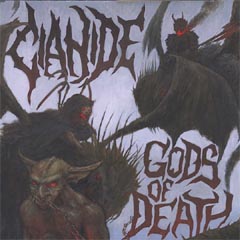 We who still love metal walk a fine line between the sold out nu-hardcore stylings of metalcore, and the tendency to hop on the bandwagon of the old school too much; the previous Cianide, Hell’s Rebirth, walked too far on the old school side — when a band loses direction, they imitate successful techniques and patterns from the past without knowing what those patterns evoked in the listeners.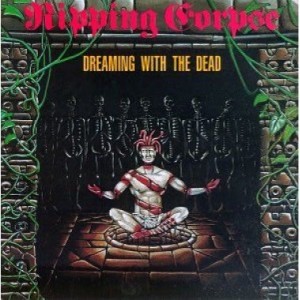
 Although the adverse effect of retaining such past influences would be that some later songs still structure themselves around anthemic choruses – a burden that most of Ripping Corpse’s contemporaries had already evolved far beyond – the band manages to employ enough compexity in their compositions to keep up with the demands of their vision. The sound of the guitars may be construed as being weak or mixed poorly, but this lighter texture lends itself well to the progression of riffs from measured punctuations of rhythm to insane variations by way of fucked up artificial harmonics and blastbeaten tremolo sequences. Tempo blurs the lines of what is considered primitive, though the act may be embellished with the jewels of modern society or justified in the name of some ideology. As layers of humanity are removed from the conscious mind, lead guitars erratically and uncontrollably rip through passages and bring a microcosmic level of culmination within a song, like the fleeting screams of demons being exorcised from a long tortured soul.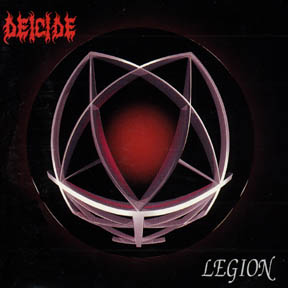
 It is often asserted that some of the best works of the death metal genre arose as if by accident. A better assertion is that by the early 1990′s, many artists prominent within this musical form found themselves at a level of impassable momentum; a culmination of instrumental violence, a taste for profound and subversive ideals and a sadistic will to power. The year 1992 found death metal at its most potent, chaotic, destructive and virile, just as speed metal was in ’86, and black metal in ’93. Legion sets itself in a league of its own, giving each musician a distinct elemental voice. Glen Benton’s cthonian barking is at its most virulent and savage, guttural yet dynamic, having a rhythmic cohesion that is comparable to that of David Vincent, but separable in tonality. His bass playing is clearly audible, sandwiched in between the juxtaposition of the trebly guitars, which are thankfully never distant or uninterpretable. The drumming of Steve Asheim is insanely over the top yet disciplined, as if one were battering cakes laced with grenades. The musical influence of Slayer is the clear template for Deicide’s work, and in terms of compact intensity, Legion is to their self titled debut what Reign In Blood was to Hell Awaits. A parallel can also be drawn to Slayer in the musical interplay in the dissonant soloing techniques that see the best ideas of Hanneman and King taken towards a polyphonic atonality. The album radiates just under half an hour of pure blasphemous momentum, and communicates through spiraling, chopping guitar riffs that sit in perfectly with a multi-faceted rhythm section. Structurally Legion emphasizes a highly proficient musical backdrop, which advances what was exhibited on their debut and compresses it into a greater density that is both a pleasure to listen to and gives Deicide a platform on which to construct their most unique and standout work. Virtuosity echoes the best work of Atheist and Voivod if the melodic and progressive rock tendencies were eschewed, whilst the pattern language and aesthetic is in league with the best work of Morbid Angel, Sepultura, Massacra and Suffocation. This is Deicide’s pinnacle, one they would never surpass. A fundamental cornerstone of death metal, one of the all time best.