


Poisoned

heavy_metal_anxietyThe best magicians work by making you think what they’re doing in front of you is the action, when in fact something goes on in the background that suddenly changes everything.

We experienced a change like that around 1999 from two factors, both technological. First, the internet arose and made it easy for any dog to appear as a band. Second, the one part of making a record that still wasn’t cheap — the recording process — became a home activity requiring a $400 PC only.

In the 1980s, DIY was radical, just as in the 1970s. Recording meant tape, and tape was expensive. Releasing your music meant getting a master, saving up a bunch of money, and putting it out there. That’s why bands did 7″ and cassette releases. A full LP was too expensive.

At the end of the 1980s, the newer CD pressing plants began offering far cheaper releases. CDs were smaller and cheaper to produce than LPs. This condition didn’t improve much until the mid-1990s, when suddenly everyone could afford a computer that could do (a) desktop publishing, including CD layouts, and (b) some kind of mastering and/or CD burning.

The cost barriers were falling.

Thus, while it was revolutionary to be underground in the 1980s, and while having a rough or dirty sound was somewhat of a stab against an expensive process then, it ceased to be in the mid to late 1990s. When it cost a lot to have a record sound good, throwing that aside was like a revolution. It was a rebellion against the tendency to make everything sound slick and perfect, and thus to overthrow the natural.

Now in the 2010s, we have a different problem. All production is a matter of choice. This is only going to get worse as the software improves. You can have perfect drums, pristine guitars, even autotune your vocals (or if you’re sneaky, your guitars). Thus now, making a dirty and abrasive production has no rebellion value. It’s just another option, like choosing to have a trumpet on the record or not.

What’s happened to metal? Some people decided to stick with repeating the past. They’ve formed a small and insular group that makes old school music. The only problem is that, while this group frequently talks up new releases, over the last ten years we haven’t seen anything great come out of them. “Above average” just isn’t impressive.

There’s another group that has gone commercial by making metal more like the parent genres from which it escaped, rock and punk (or rather, post-hardcore). This group has really improved instrumentalism, has excellent production, but completely hollow music that is distinguished only on the level of technique. It seems to have no content whatsoever except being in a band and knowing music theory.

The point here, I guess, is that we are being poisoned by form. Metal is stagnant because it hasn’t invented a new form that it can work with, or found a way to resurrect the old (mainly because of the parasitic past-repeaters). As a result, it’s left in perpetual limbo, either recycling the past or obliterating itself by becoming its opposition.

As a result, I suggest a new openness to difference in form. Let’s bring the weird back. Only where form and content are united does music make sense; otherwise, it’s either propaganda (content only) or decoration (form only). What will drive our new form is leaving behind the tropes of the past and attacking things that are real to us now.

That isn’t to say that the human condition, or that of art, has changed. It hasn’t. But art must carry the spirit of its age, and interact with its age, and strive for something. It must be a process of becoming. Metal ceased to be that in 1995 and its relevance dropped away, so now it feels like a drunk old man at a retirement home.

3 Comments

Tags: ,

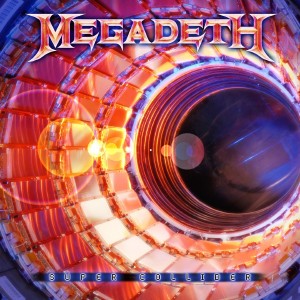
Megadeth – Supercollider

megadeth-super_colliderMegadeth has been a major influence on my journey through metal. I remember that when I first heard the opening riff to “Holy Wars”, I realized that this music was different. In contrast to the verse-chorus structure of the music I was listening to at the time; it was narrative based, similar to classical music.

It took the listener on a journey of apocalyptic visions of a society shot to pieces — where humanity had ceased to think and would rather delude itself into oblivion than deal with its problems. This was something that I could relate to, far easier than any of the forgettable faux-agression bands that the unwise me was enduring at the time. This eventually led me to discover death metal and then black metal, after realizing that both of these genres took this style of writing to new heights and did it more thoroughly and deeply, yet I still retain a soft spot for speed metal.

Over a month ago, this site previewed the first single from the band’s now released album, Supercollider. The track was rather off-putting as essentially a hard rock track, but I held out hope for an overall metal tone to the album…unfortunately, this was not the case. On the whole, Supercollider is a collection of songs that challenge no commercial norms and they are structured for mass radio appeal. Any superficial stylings of speed metal in a rare moment are quickly exposed for what they really are: metal in an aesthetic sense only.

Supercollider features riffs designed to fit into a verse-chorus structure rather than shaping the song around the riffs, as the band used to do. Solos and the drumming are entirely forgettable, in their highest moments their impact is merely of acknowledgment – they achieve their prescribed role in the song, but offer nothing to stick in your memory after they’re over – which is a fitting description of the album as a whole.

Yet, even in this wasteland, there are a few signs of life. In spots, the album has some impactful melodies — moments of brightness — before the waves of drudgery crash back down on the listener. Synths soar about crunchy guitar riffs, which are held together by Dave Mustaine’s unique vocal style, and as a folksy acoustic guitar adds a foreboding element to an otherwise unremarkable track. Astute readers may be noticing a pattern here — the album’s better points arise when the riffs are not the main focus of the song, which seems a bit backwards for a speed metal band. Vocals come in varying quality – some fans will cringe as Mustaine declares “Burn baby, burn!” in a style reminiscent of any ’80s stadium rock band, yet his piercing social criticism still surfaces and is as unabashed as ever.

Comparisons will inevitably be made with Risk, but I don’t think this is very accurate. Rather than a fake attempt at making the band more marketable, I think this is a more honest endeavor; it is the product of a band that has aged. Seemingly, at a certain point in time, the young provocateur grows up and realizes that he has spent decades of his life struggling against society – then wakes up one morning and notices that he has carved a pretty good life out for himself. He may not embrace it fully, but he no longer wishes to agitate either. The allure of riding out into the sunset eventually becomes greater than the misery of dissatisfaction and thus he decides to create a safe work that challenges no boundaries.

http://www.youtube.com/watch?v=Mk4Eeu7-XFc

5 Comments

Tags: ,

Metal is metal, not a grab-bag of other clichés

alt_nu_funk_rapNot for the first time I find myself reading a cringingly bad article from the Irish press about metal. This one is entitled Alt, Nu, Funk, Rap: there are many colours in the heavy metal rainbow and it ran in the Irish Times yesterday.

Ireland’s a frustrating country in which to be a metalhead. On the one hand, it’s the land that produced latter-day genre ambassadors Primordial and cool-as-fuck proto-metallers Thin Lizzy. On the other, metal in Ireland is stuck between a mass-culture slavishly obsessed with low-grade British TV and an arts/intelligentsia scene more interested in brushing up its phony posh Hiberno-English accent and patronising 3rd rate continental post-modern knock offs. Metal is a poorly-supported fringe genre; too morbid for popular culture and too loud and unpretentious to fit in with ‘sophisticated’ culture.

Because of this, as great as many Irish metallers are, the Irish metal scene is infected with a section of people with an attitude that is both happy to accept and produce novelty trash, and is simultaneously chronically under-confident about being a metaller – berating anyone who to takes it seriously. “Sure it’s only a bit of craic.”

Other than sneering at it, Irish Journalists and other arbiters of public opinion rarely take notice of metal unless they want to leech some of its credibility; an act that apparently doesn’t require any research beyond wheeling out a few tired anecdotes about barely relevant 50s/60s bands.

It’s no coincidence that today metal is growing fastest in countries with oppressive regimes, notably Iran and China. For all its genre- splitting, commercialisation and in-fighting, metal remains, in the broader socio-political field,a transgressive form of music signifying individuality and defiance of authority.

Last month leading Chinese dissident Ai Weiwei released the first single off his “avant-garde heavy metal” album. With lyrics railing against censorship and human rights abuses in China, it’s as potent – in a political way – as the opening chords of You Really Got Me must have sounded in 1964.

Sorry pal, but metal is not some nice, cuddly, inclusive sausage-fest, where everyone can listen to whatever flavour they like and we all finish off holding hands in a circle, smiling dumbly to the sound of “Kumbaya.” It is not about giving your parents the finger and escaping the oppression of society to go live in a vegan organic farm where everyone lives by love, tolerance and inclusivity.

Some of the best metal has been made by people with beliefs considered unacceptable in polite society. Metal isn’t a rejection of authority; it’s a rejection of the idea that society is the answer to our problems. Metal says: we can’t all get along. To a metaller, a greater ill than an extreme and unfriendly ideology is a wimpy attempt to pretend that the reality is more sanitary than it actually is.

Sadly for this, much of the metal he cites as counter-examples either doesn’t exist, or is of such painfully low quality as to be of no significance. Like many a media forgery, he has used one example of something — despite it getting nowhere in the genre — as an example of a “trend.” There is of course a healthy scene in Israel, but I suspect Israeli Jews would be more annoyed than flattered to read themselves being used as examples of un-metal sounding metal.

Even worse, like a salesman after a three-martini lunch, he’s trying the old trick of making metal palatable to us by claiming that it’s something we already recognize and accept. Citing ‘alt’ ‘rap’ and ‘funk’ as leading genres of metal shows almost no awareness of what defines metal and makes no account for it as anything other than an interchangeable synonym for rock. But that’s what he wants — he fears that metal might be something by itself and for itself, beyond the control of the society and social thinking he so slavishly obeys.

Whether the writer likes it or not (perhaps that should be ‘whether he knows it or not’, given the extent of investigation done appears to be sub-Wikipedia?) metal is not about fitting into a trendy political creed, but about exploring the dangerous, the feral and the ugly for the sake of transcending moralism and understanding the world as it is, not as it should be according to any given utopian outlook.

3 Comments

Tags: , ,

In defense of metal

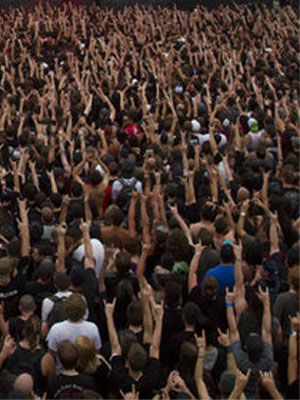
heavy_metal_audienceI think if you’d ask most hessians, they would say that we live in the age of kali yuga. If you get a chance to speak with lower-case-c conservative people, they express the same feeling: that something is lost. That some form of refinement, culture, and civility is gone from modern culture, if you could even call it that.

One of the complaints that repeats itself regards the state of the arts, and more specifically, music. It is simplistic, they complain. It is crass, uncultured, fatalistic, naval gazing, hedonistic, idiotic and stupefying. None of these is wrong.

It saddens me, then, when people complain about rap, rock, and Lady Gaga, they usually lump metal along with the complaint. I get it, though. The way metal appears to most of the world is not as a refined style. Some of it is also the product of the vast machine of idiocy that turned music into the nightmare that it is today. They made it safe, by making it mockable.

But some of the fault lies with hessians. Not all bands are Pantera and Slipknot. There is an entire world encapsulated in the metal genera. It is one of the only styles that keeps on expanding and developing. We have some commitment, as hessians, to support metal, in the great cultural discussion that extends through the generations.

Good metal will always be there, and will always be a legitimate art form. It would be sad, however, if those who could appreciate it (they don’t have to like it) would appreciate it, instead of buying into this elaborate hoax by the impetus of insignificance espoused by commercial music.

First and foremost, metal is a legitimate art form. A legitimate form of music. Yes, there is metal which is certainly not music. Pantera and Slipknot come to mind.

However, there is something in metal, a movement that existed since its advent in Black Sabbath’s first album, which expresses immortal truths. It feels as a sort of pessimistic conservative message.

Are things running down? Is there a process of degradation, a willful suicide enacted by modern culture? This observation was expressed by Black Sabbath, in an attempt to rain on the hippy party. We won’t go into why hippies are the end of civilization right now, but know that if some movement, since its advent, was diametrically opposed to such movement, there already is some root credibility to it. The hippies wanted to create a world without values, without temples or transcendence. Metal, on the other hand, constantly seeks transcendence, enlightenment, and a form of holiness. It is not base and animalistic, but in fact, a deeply religious experience.

In metal, there is encapsulated an idea that holiness cannot exist in a vacuum. If there is holiness in life, it must be whole. Blasphemy became an act of holiness and worship of life in its fullest.

To truly love life, you must love it completely, including the scary, red in tooth and claw parts. Metal expresses these aspects in purity and vicarious form. There is no need to describe beauty, truth, and love, because you cannot accept them until you have delved into pain, struggle, overcoming, violence, exposing hypocrisy, self reliance, heroism and individuality. These ideas are the bread and butter of metal music. It is not individualism, but individuality.

Undeniably, there is a nihilistic streak in metal. It is not the passive, fatalistic kind of nihilism, but the nihilism that views happiness, success and overcoming as dependent upon choices made by the self. No avoidance of consequences, looking ugly truths in the eye. There are inescapable things in life. Death, pain, lies, predators, and all the degeneration that arises from the human condition.

Do you deny these exist? Deny their necessity? It would be like denying rot and defecation. Ignore them and you’re in for a mess. Accept their inevitability, and you get a daily battle which never ends. It’s like mowing the lawn.

Metal is the tool which shapes this view of life. It might seem bleak, but the happy warrior never despairs. It’s an existential battle, and metal is the fuel, the blood in its veins, the fire burning in its soul.

I wouldn’t be who I am today without metal. Without these immortal truths as my guides and friends. I could be there, smoking the pipe-dreams of modernity. Drinking the kool-aid. Why chose suffering and a constant fight?

Maybe because I believe in tragedies.

9 Comments

Tags: , ,

University offers degree in heavy metal, and not all are thrilled

heavy_metal_foundation_degreeNew College Nottingham in the UK have recently announced that from September this year they will be offering students a foundation degree in Heavy Metal.

“We’ve created this pioneering course in response to student demand and Nottingham’s growing music and creative economy. At its heart is music performance so students will be forming bands, gigging and promoting, while academically delving into what makes metal such a music phenomenon. Applicants will be auditioned and will need to demonstrate an ability to play or sing up to Rock School, ABRSM or Trinity Grade 5 standard and have knowledge of music theory at ABRSM Grade 5,” the school announced in its class syllabus.

Further, New College opined, “Due to the largely unstructured nature of the music industry, the FdA in Music Performance (Heavy Metal) places a strong emphasis on the development of entrepreneurial skills designed to allow the students to work confidently on a self-employed basis.”

As supportive as I am of the growing area of metal studies in academia, this course sounds like a terrible idea – unless of course it consists of 21 hours a week forced listening to and analysis of Demilich’s Nespithe, in which case it’s worth every penny.

A budding metal musician would be much better off getting a degree in music – whether at a predominantly classical or jazz institute, they will get a much broader grounding in the theory and history of western music, and thereby understand better which bands and ideas are good and which are garbage. By the way, for those that don’t know, Grade 5 Rock School is not a very high benchmark for musicianship at all.

I’m sure that the college believe they are helping facilitate people into a niche and commercially lively area of the economy, but I wouldn’t be as optimistic as they are.

Its been a long time since the UK produced a viable classic metal band that could draw in a consistent crowd (let alone produced a noteworthy scene or movement), so its hard to think of a stable, growing sector in the UK metal economy other than Iron Maiden’s stage crew. Remember also that most metal musicians the world over will at least have to supplement their income with other work, if not wholly support their music through a day job. It’s also not as though, when business is slow, you can go play a few weddings or open mics when your stock repertoire consists of Slayer songs and originals that are probably only Slayer rip-offs.

I could of course be completely wrong about it; but if it were my kid choosing their degree — £7,000 a year for something that will only look bad on their CV — I don’t think I’d be too quick to let them test out the possibility of me being mistaken.

No quality metal band before now ever required this qualification to propel their career in the right direction or provide them with worthy scene credentials, and that will probably remain the case.

7 Comments

Tags: ,

Jeff Hanneman memorial announced

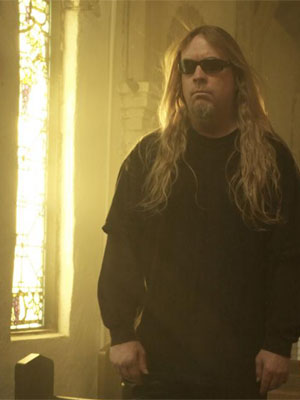
slayer-jeff_hannemanThe Jeff Hanneman Memorial Celebration will occur Thursday, May 23 at the Hollywood Palladium in Los Angeles from 3:30 – 7:30 PM.

It will be open to the public on a first-come basis subject to venue capacity. All ages are welcome, and paid parking will be available around the venue.

The Jeff Hanneman memorial celebrates the life and work of Slayer’s guitarist, who passed away on May 2. You may want to see tributes by other musicians, the band’s memories of Hanneman, our explanation of his importance, and a visual tribute to Jeff Hanneman by the National Day of Slayer.

To summarize the above, Hanneman was not only central to the Slayer sound but to the spirit of metal. At a time when most bands were trying to be more like pop music in order to be popular, Hanneman pushed Slayer to be more realistic and yet more mythological, joining artists such as J.R.R. Tolkien and John Milton in showing us occult doom all around us based on the degeneracy of modern people. His intense riffs, angular chord progressions, blazing solos and most of all spirit and attitude drove Slayer, and through them metal, to be more than just another flavor of rock. They became otherworldly.

The band issued the following statement:

Jeff Hanneman helped shape Slayer’s uncompromising thrash-metal sound as well as an entire genre of music. His riffs of fury and punk-rock attitude were heard in the songs he wrote, including Slayer classics “Angel of Death,” “Raining Blood,” “South of Heaven” and “War Ensemble.” Hanneman co-founded Slayer with fellow-guitarist Kerry King, bassist Tom Araya and drummer Dave Lombardo in Huntington Park, CA in 1981. For more than 30 years, Hanneman was the band member who stayed out of the spotlight, rarely did interviews, amassed an impressive collection of World War II memorabilia, was with his wife Kathy for nearly three decades, shut off his phone and went incommunicado when he was home from tour, did not want to be on the road too late into any December as Christmas was his favorite holiday, and, from the time he was about 12 years old, woke up every, single day with one thing on his mind: playing the guitar.

It was once suggested to Slayer that if they would write “just one mainstream song that could get on the radio,” they would likely sell millions of records and change the commercial course of their career, similar to what had happened to Metallica with 1993’s “Enter Sandman.” Jeff was the first to draw a line of integrity in the sand, replying, “We’re going to make a Slayer record. If you can get it on the radio, fine, if not, then fuck it.”

1 Comment

Tags: ,

International Journal for Community Music requests papers for its Metal Special issue

international_journal_of_community_musicThe International Journal for Community Music has issued a call for papers seeking research on “the heavy-metal community (and its communities) and the spaces and practices that shape heavy metal music as community music.”

So what is “community music”? In another issue, the journal defines “Community Music” by saying “community music may be thought of in a variety of ways, including (but not limited to): music teaching-learning interactions (for all people of all ages, ability levels, and interests) outside ‘formal’ music institutions (e.g., public schools, university music departments, conservatories, symphony orchestras), and/or partnerships between formal institutions and community music programs.” In other words, music as the basis for communities within communities, sort of like as a replacement for the culture we gave up for malls and television.

As the papers request itself says, its focus is on “the communities of heavy-metal fandom and the construction of heavy-metal music in community, semi-professional or amateur settings: heavy metal as community, heavy metal as leisure, and heavy metal as a place that fosters local and global senses of belonging and inclusion in an increasingly commercialized and atomized world.” This fits perfectly with the Hessianism concept of heavy metal as an “elective community,” something demonstrated when the National Day of Slayer showed people a metalhead presence in all parts of the globe.

If you are interested in submitting a paper, contact Dr. Karl Spracklen.

1 Comment

Tags: , , , ,

Interview: Jester King

Jester KingMany metalheads enjoy a nice brew. It was only a matter of time before a beer company was founded by fans of metal.

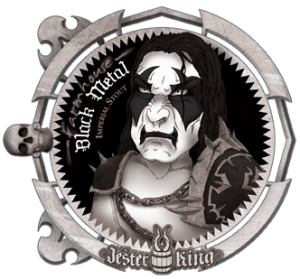
Being from Texas I have noticed a new brand of beer that has infiltrated my local corner stores. I observed a common face-painted figure on the label. It piqued my interested to purchase my first ‘Black Metal Imperial Stout’ beer. It was dark. It was strong. Oddly when I drank this beer I was listening to Beethoven’s 7th Symphony, but the alcohol enhanced it; almost gratingly. Some may perceive this as Black Metal further being commercialized, but that already happened in the 90’s. Jester King is operated by metal fans, which assists in promoting metal in commonplaces. In the scheme of things, this may further bring attentions to the genre.

Jeff from Jester King has offered some of his time to answer my questions.

Howdy Jester King! Thank you for your time. First off, what started Jester King? Did it start as a micro-brewery?

Jester King was started by my brother Michael and me. We began working on it in 2008 and eventually opened in 2010. We started and still are a micro-brewery making beer in the Texas Hill Country.

The main reason I am conducting this interview is to inquire about metal. What started your Black Metal beer? Are you guys Black Metal fans? How did you come up with the mix for this beer?

I listen to Black Metal and thought there were some similarities between the music and the beer. The beer is dark and punishing, but it also has some more symphonic notes from its fermentation with farmhouse yeast. I thought the musical style fit the beer. As far as the recipe, it’s a hybrid between the English and Franco-Belgian brewing traditions. The malt and hops are all English, but the fermentation is with Saison yeast.

Outside of Black Metal, what other types of music do you enjoy?

I also enjoy crossover thrash, blackened death metal, third wave ska and western swing

I noticed a lot of rather ‘morbid’ or ‘twisted’ themes with your beers. How did this come to be? Did you want to make a statement with each new recipe?

We try to make beer that’s a reflection of who we are and what we believe. We want what we do to have meaning, and that meaning comes from within. We try to put out work that has authenticity and character. We’re confident that if we be true to ourselves and do good work, there are others out there who will embrace it, even though we know mass appeal is something we’ll never have. We’re comfortable with that.

Some of the imagery, artwork and language we use can be somewhat dark and disturbing from time to time. Again, we try to be true to ourselves knowing full well that it’s not going to be for everyone. I wouldn’t want it any other way.

How has the response been to Jester King? I’ve noticed that grocery stores carry it now. Are you continuing to gain momentum? Will you eventually take on Shiner Bock? Do you even like Shiner Bock?

It’s been good. We’ve been really flattered in many cases by the reception it has received. We put a lot of thought, trial and error, great ingredients and time into our beer, so we’re grateful that it’s had a good reception. Right now we’re focused on unique flavors from wild yeasts, barrel-aged wild beers with fruit, and 100% spontaneous fermentation using our coolship.

I doubt we’ll ever make much more than a few thousand barrels of beer a year. By comparison, the Spoetzl Brewery that makes Shiner Bock is over 500 times larger than us. We’ll never come remotely close to their production volume. I actually haven’t had a Shiner Bock in quite some time, but I’m sure I’ll revisit it at some point. When I drink locally usually I’m having beer from Texas breweries such as Live Oak, Real Ale and (512).

Since we’re on the topic of Texas beer, I have always thought of Lonestar tasting like the dirty convenience stores that it’s often bought in. What are your thoughts on Lonestar? They do have a rather great marketing slogan of “The National Beer of Texas”.

The last I heard was that the Lonestar brand was owned by a hedge fund in Connecticut. I would hope that most people see that slogan as no more than hollow marketing rhetoric. I actually don’t have a problem with light lager. If someone loves light lager, that’s great. What I have a problem with is the companies that produce light lager (and their distributors) propping up laws in Texas that make it more difficult for small breweries in Texas like Jester King to sell beer.

When your team brews beer is metal allowed in the workplace? Is it part of the process of making your beer?

Metal is encouraged! My brother Michael listens to metal too. Lately he’s been playing Nile and Gortuary. Metal is definitely part of the beer making process for me. I can’t envision doing my work without it.

If I were to visit the brewery can I receive some extra beer for conducting this interview?

We’d be glad to share some beer with you.


3 Comments

Tags: ,

Nottingham College offers college degree in heavy metal, and we say the unspeakable

heavy_metal_foundation_degreePart of our job as people who support and believe in metal is to cheer its adoption in the world. However, as part of that mission, we want to make sure the task is done correctly. After all, McDonald’s “Black Metal Happy Meals” wouldn’t exactly be the direction we wanted to go in, would they? Nor would an article that argued heavy metal was a form of protest music or the continuation of disco (actually, that’s dubstep).

Thus we turn to Nottingham University’s new “heavy metal” undergraduate degree, which allows you to spend your college years learning music performance, composition, marketing and songwriting as you go through your degree program. On the surface, this is a great thing, in that it gives heavy metal some recognition in academia as a type of discipline. Or is it?

It seems to us that the approach followed by other metal academics is more sensible, which integrates heavy metal into fields like English literature, sociology, history, philosophy and linguistics. Instead of making metal an isolated commercial product, and teaching it in the same facility that because it teaches a rock-based curriculum will most likely teach a metal-flavored version of rock, the metal academics prefer to pursue metal on the graduate level.

While we applaud Nottingham University for being open to the idea of heavy metal in academia, we suggest a different approach. Metal is not a product, but the result of a thought process, which is the only way to unite such decentralized compositional elements into a singular concept. Thus the best use of the undergraduate degree is perhaps to study the background ideas that are needed to make sense of it…

No Comments

Tags: ,

Megadeth – Super Collider preview

megadeth-super_colliderSpeed metal legends Megadeth have released the title track from their upcoming album Super Collider. Sounding similar to the late 90s albums which found Megadeth exploring a more commercial direction, the new work features the standard hard rock structure designed for maximum radio exposure.

Although fans of their older material may not appreciate the return to that style of music, it will almost assuredly increase awareness of the Megadeth brand. Along with Metallica and Slayer, Megadeth was one of the foundational pillars of speed metal.

Mixing a blend of bursts of aggression in among longer songwriting narratives, the bands created an organic presentation of death, war, and other dark subjects; not simply to glorify the carnage but to break free of the politically correct time in which they were conceived and to present an alternative.

http://www.youtube.com/watch?v=dkR-Zau3HSM

4 Comments

Tags: ,

Classic reviews:
A B C D E F G H I J K L M N O P Q R S T U V W X Y Z