Visiting The Tobacco Barn (Brenham, Texas)

When one traipses through the country outside of the lock-step conformist big cities, it behooves the pipe smoker to look for those varieties of tobacco favored in the less “civilized” areas of the world. This might bring one to Brenham, Texas, where the Brookshire Brothers grocery store offers up a unique and wonderful American tradition: the drive-thru Tobacco Barn.

(more…)

7 Comments

Tags: , , , , , , , ,

Sadistic Metal Reviews: 10-23-2016

melting-cdr

Humans and metal bands are self-replenishing resources. There are always more to burn!

(more…)

12 Comments

Tags: , , , , , , , , , , , , , , , , , , , , , , , , , , , , , , , , , , , ,

Sadistic Metal Reviews: Fisting Female-Fronted Pseudo-Metal

goetz iron hand

Resistance fuels hatred and must be crushed beneath an iron fist.

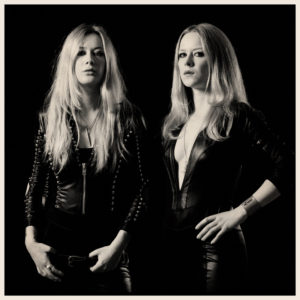
the oath
The Oath – The Oath (2014)
“Whoa!” – Keanu Reeves. These women are actually fairly attractive! Usually metal girls are fat, under 5’4, and have saggy tits. Or they love Slipknot. I can see why Lee Dorian is dicking the hot one. This at least has riffs even if most of the songs wear out their welcome fairly quickly. There are Cathedral albums more boring than this but most of these songs feel like Motorhead if they smoked dope instead of cranked speed. Motorhead if Motorhead were boring and the songs went on two minutes too long and had random riff salad bridges. If these two would actually get naked on the cover like the real Coven and separated or refined their compositions, maybe this would be more listenable. Hold it is that riff from Bad Company? Who steals riffs from Bad Company? What kind of degenerate does that? If this is among the more listenable grrrl metal…

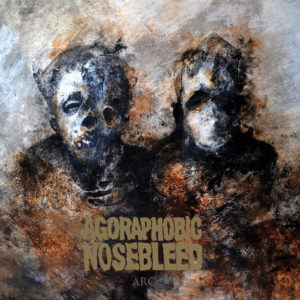
agoraphobic nosebleed arc
Agoraphobic Nosebleed – Arc (2016)
As ridiculous as their band name, Agoraphobic Nosebleed’s 2016 effort is a lazy mixture of stoner rock and deathcore. It consists of interleaved Black Sabbath-core grooves and pointless breakdowns accentuated by a menstruating screamo vocalist. By the very definition of those two genres, the reader should know this is but a string of feel-good moments with absolutely no point whatsoever.

One has to wonder if the band even knows what “agoraphobic” means, given their blatantly idiotic use in their band name. From there, we can easily tell how they would also try to use “fancy vocabs” from the metal terrain without even knowing what they are for, hence the constant groove with no beginning or ending. The meaningless breakdowns that do not necessarily make the stoner rock more bearable, but just emphasize what white trash trailer park music this is. It is an updated distorted-guitar redneck music.

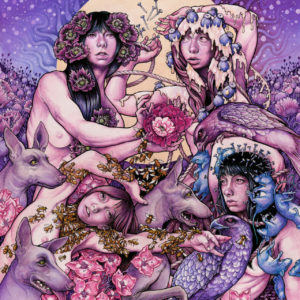
Baroness Purple
Baroness – Purple (2015)
The most generic heavy metal rhythm guitar riffing possible clipped with too much compression and mixed with queer hipster rock for those who question their sexuality. I’m pretty sure the hairy girls in this band are in a polygamous relationship with the dude singing and blow roadies on the side. Kind of like how Carrie Fischer let the crew members of the original Star Wars rip the tape off her tits only with more Hepatitis C positive semen from people who tried intravenous drugs. This album sounds like my local modern rock radio station who plays Bush twice a day. Baroness is the most generic 2003 rock possible only maybe one of these girls’ brothers had Led Zeppelin and Metallica posters in her bedroom. Baroness should go back to VH1. Wait VH1 doesn’t air this crap anymore as even VH1 realized how terrible it is. VH1 is Rock of Love now.

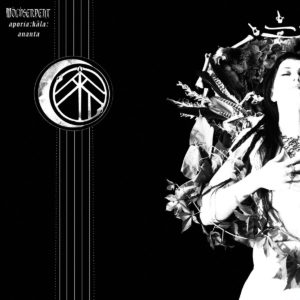
wolvserpent
Wolvserpent – Aporia:Kāla:Ananta (2016)
Who knows why we ever receive these sort of promos that are not remotely metal, though perhaps some suppose there is a connection because the sound and procedure may remind one of the pointlessness of post metal/rock. At the center of Wolvserpent’s music is a violin playing repetitive music while the fringes are filled with synthesizers, bass and some kind of distorted noise to fill the space. I imagine this purports to be ambient, and it evidently takes cues not only from what we know today as classic ambient but from the old, more noise-inclusive and experimental one. At some point during the 40 minutes of this release, towards the approach of its middle section, a growl-screech appears and we become the audience of a post-doom-black nothingness that lasts for about 5 minutes. After this, the music tries to pick up by adding some synths to beef up the emptiness of the lame doom metal writing that approximates what Esoteric do most of the time (waste your time with largely content-less sections while pretending to have an ambient edge). This amounts to little more than piled up noise with some consonance. This melting away proceeds for about 8 more minutes, after which we are introduced to a 4-minute hum. This hum gives then serves as background for some 3 classical string instruments playing repetitive disonant arpeggios for 3 or 4 more minutes until only they remain and the music fades out to the sound of soothing, rolling, waves. Empty and boring. Throw this away

Cult-of-Luna-and-Julie-Christmas-Mariner
Cult of Luna & Julie Christmas – Mariner (2016)
Enya songs with randomly inserted post-metalcore sludge bridges. Are those bongos? Is this Arise? Who thought of this? Whoever thought of this should be shot in the back of the head by their local troika, have their children post-nataly aborted, and their women deported to the camps for wives of traitors to the motherland.

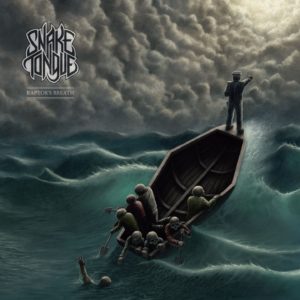
snake tongue
Snake Tongue – Raptor’s Breath (2016)
Random stolen eighties metal riffs made into Entombedcore with gang vocals by Kurt Ballou. I think that’s a woman in the promo picture. Maybe it’s a man who is just confused that his baby dick is a big clitoris. Yeah they can get that big. Haven’t you seen Backdoor to Chyna?
band

necrosic cover
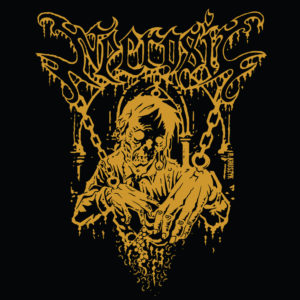
Necrosic – Putrid Decimation (2016)
These girls imagine what would have happened if in 1990 Autopsy had written songs entirely out of mosh riffs broken up by hardcore and shameless lifts from Slayer’s catalog. The answer is a metal band that would have only have been fit to play pizza parlors filled with 17 year olds too busy playing arcade games to pay attention. Anthrax if Anthrax decided to cash-in on sludge instead of nu-metal in the early 90s.

sacrilege reissue
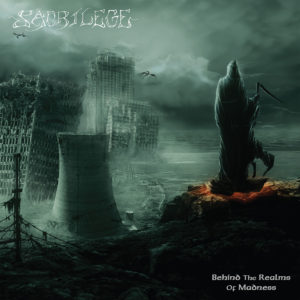
Sacrilege – Behind the Realms of Madness (1985)
This is the sort of release that exemplifies that some releases were never meant to be heard, not to mention be re-released. To pretend this is some sort of hidden gem is to pander to the clueless audience’s sense of nostalgia in the most dishonest way. Sacrilege never amounted to much as their music was never much. What we hear in hear in Behind the Realms of Madness is the sort of simpleton’s generic metal any angry teenager could be writing and playing in his garage with his friends after huffing glue. Each of these songs is based entirely upon a single riff played ad nauseam while an angry woman shouts about how much she hates her father. There are random supplementary riffs here and there but they are just meant to provide some sense of dynamism to the propulsion of the main riff. The main riffs in every song are generic and almost indistinguishable, the vocals are identical (some angry British woman screaming about how she got fucked over by her dad who wouldn’t pay for her BA in Womyn’s and Sexual Identity Studies), and every single song has the same kind of poser-trudging-accross-the-mall-food-court from Hot Topic vibe about it.

sacred few - beyond cover
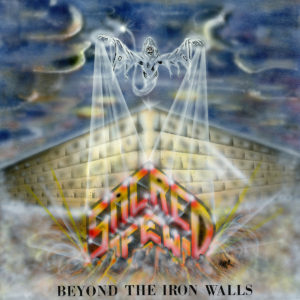
Sacred Few – Beyond the Walls (1985)
Another mediocre eighties heavy metal album with an annoying vocalist that deserved to be forgotten. Manilla Road this is not; the songwriting is generic, the riffs unoriginal, and the guitar tone too thin. This was only pressed to CD to cash in on idiot hipsters dumb enough to be deluded by Vice into believing that metal needs more dumpy women. I would rather listen to every Motorhead album I don’t remember even exists than this lame woman who drinks too much Budweiser again. This is retro-metal for cuckolded submissive males who think Steve Harris is Pogrom and jerked off to the blonde women in catsuits from The Oath instead of real porn. I’m going to crack open another Coors Banquet and use this CD as a coaster. Wait is the Puerto Rican  guy in the collar her slave?
Sacred_Few-promo_photo

lizzies cover
Lizzies – Good Luck (2016)
Judas Priest covered by Spanish pre-op transsexuals. Listening to this album makes me want to chop my leg off so my femoral artery will bleed out in three minutes. Two tracks in and I just put on Unleashed in the East instead. Let’s all listen to that classic instead of this crap:

59 Comments

Tags: , , , , , , , , , , , , , , , , , , , , , , , , , , , , , , , , , , , ,

Analysis of Evoken’s “Omniscient” from Promo 2002

the-mummys-shroud-lobby-card

This dissection was contributed to Death Metal Underground by Neil Sigmundsson.

Although the song that is the subject of this article differs considerably in tone from most funeral doom metal, and indeed from most of Evoken’s own work, it utilizes the basic style of that genre: open, sustained, low register power chords played at very slow tempi. In “Omniscient,” clean guitar melodies and synthesizers provide the music with detail, color, and different senses of spaciousness. Layering, interplay between instruments, and timbre play important roles in developing themes and emphasizing different aspects of emotions. The song has no human voice, a feature that facilitates listener immersion and an unharnessed imagination. The structure is simple and linear: A B C D. The four sections are described sequentially below in terms of one interpretation of the piece; this is an attempt to put into words a somewhat vague combination of images, thoughts, feelings, and emotions that occurs when listening to it. If this descriptive method comes across as tedious or unappealing, consider it the shortcoming of the writer and let the music speak for itself.

I. Description

Section A: The introduction revolves around a melody played on clean guitar, the tonality of which gives a vague feeling of uneasiness and of mystery. The technique of sliding into and between notes is used as ornamentation, presumably to make the melody more evocative. The slow tempo lends a sense of low energy, and the synthesizer adds a haziness to the atmosphere. When the electric guitar and percussion enter the song, the resulting sensation is similar to stepping from an inside room, where one can sense the heat outside, into the open air, or of transitioning from the awakening state of half-consciousness to that of complete alertness and awareness. The synthesizer then plays its part an octave higher than before, overpowering like the sharp glare of the sun and evoking an image of barrenness, vastness, and lifelessness. The timbre greatly increases the effect. After the synthesizer descends back to its original register, the theme is fully developed and the scene completely comprehended.

Section B: After a short silence, the music resumes at a crawl, as if an oppressive heat is sapping away all energy. The guitars reach up and play a short sequence with conviction, but fall back down in response to the synthesizer, as if defeated by the overwhelming wretchedness and aridity of existence. The entire pattern temporarily falls to a slightly lower register, conveying a sense of sinking to greater depths, though it musters enough energy to return to its original place. Listening to this section feels like crossing a desert, wondering whether the farther side will ever be reached with so little energy, when suddenly…

Section C: Great vigor and motivation well up from an unknown source, generating forward and upward motion from stagnation. The tempo increases, as does the speed of the drum pattern. The power chords are no longer relegated to the far lowest notes. The synthesizer, which represented the oppressive force, disappears and is replaced by a slowly rising clean guitar pattern. The overall tone here is energetic and anticipatory, and there is a sense of striving and of willpower where previously there was none. However, in the guitars there is a moment that balances this nature with sobriety and gravity, a few slightly dissonant notes that signify that all adversity has not been overcome. Like a reminder of the continued presence of the antagonistic element, this slight dissonance checks the melody, which falls accordingly (though it maintains its pace and energy) and dwells at its lowest point before steadily rising again.

Section D: Section C trails off at its highest stable point, and at this point the music slows down again and “opens up,” signifying that a plateau or a destination has been reached. Indeed, in the final and longest section of the song, a realization occurs. The first hint of this realization is a sequence of four notes played on the keyboard and accompanied by percussion. The “breathy” timbre and relatively low volume give a sense of distance and of large scale. This part evokes the emotions associated with pausing one’s toils, looking up at the clouds, and realizing their beauty. The electric guitars then enter enthusiastically, mimicking the four note pattern with power chords, and the aforementioned keyboard sequence gives way to a second one. This new keyboard part starts with a heart-warming tone that rises slightly and then settles into a sobering note of gravity, though even this last bit of weight and resistance falls away at the end of the sequence.

The full realization is represented by a blissful clean guitar melody that acts as an additional layer atop the second keyboard part and the power chords. The keyboards color the guitar melody in different ways with each note and with swells in volume, highlighting various nuances of the newfound conviction and peace of mind: solace, tranquility, the hugeness of nature and the cosmos and corresponding miniscule stature of man, the passing away of all things, and finally an understanding and acceptance that leads to release from all doubts and worries. The timbre of the synthesizers provides an airy nature to the conclusion of the song, yet this quality is light and fresh and differs greatly from the heavy, burdensome atmosphere of the introduction. The clean guitars eventually stop and the keyboards return to a fuller version of the first hint of the realization, the image that catalyzed the epiphany being revisited in terms of the new insight obtained. The full realization then resumes. By this point, all tension is completely resolved. Additional synthesizer effects give a sense of dissolving and of passing away, and the song begins to fade in volume. The clean guitar ends on an uplifting note.

II. Discussion

In the above description of “Omniscient,” the instruments symbolize different aspects of human experience. The electric guitar and the percussion represent the visceral sensations of the body, the clean guitar the movements of the mind, and the synthesizer the perception of the external environment. The role of the synthesizer in portraying an external oppressive force in sections A and B has already been described: it can be seen as a sort of indifferent but nevertheless harmful natural phenomenon. Of the four parts of the song, section B is the only one with no clean guitar, perhaps symbolizing how during an onerous experience in which the willpower of the mind has been defeated, the focus of consciousness oscillates between the suffering of the body and the alleged cause of that suffering. In section C the synthesizer disappears, but the sobering, slightly dissonant notes in both the clean guitar and the underlying power chords acknowledge that the environment/situation has not changed. Rather, the upwelling of energy from within is so powerful that it dominates the field of perception, as reflected in the dramatic increase in percussion activity. This section can be viewed as finding motivation to fight and overcome an oppositional force.

Section D resolves all conflict and tension in the song, not through external triumph – towards which section C seems directed – but through internal release. Maintaining the established symbolism and looking at the clean guitar parts (and lack thereof) throughout the song, there is a series that outlines a transformation of mind: A mind confused (A) becomes a mind completely defeated (B), which in turn is revitalized and invigorated (C) and finally becomes purified and instilled with confidence and peace (D). Considering the keyboards, as mentioned previously, the role and the qualities of those in section D are significantly different from those in sections A and B. Yet even at the very end of the song, there is still a sobering effect and a sense of gravity in the keyboards; the elation does not go unchecked. As in section C, this is the clue that the external environment has not changed, only the perception of that environment. Thus, the mind has undergone a change and as a result, the perception of life has changed even though life situations have not. Recalling the words of Marcus Aurelius: “Things do not touch the soul, for they are external and remain immovable; but our perturbations come only from the opinion which is within…Take away thy opinion, and then there is taken away the complaint, “I have been harmed.” Take away the complaint, “I have been harmed,” and the harm is taken away.” This is the essence of the realization in “Omniscient”: It is the knowledge that, though we may feel pain and discomfort, and though we may endure hardship, suffering is not inextricably bound up with these experiences. The power that external events claim on personal wellbeing is dictated by the mind and by the will. In this way can man go through life as an invincible force, as a “promontory against which the waves continually break, but it stands firm and tames the fury of the water around it.” With this spirit and conviction does the clean guitar sail calmly over the keyboards in section D, giving a sense of total peace and affirming that everything is alright.

Along with SkepticismStormcrowfleet and Monolithe – Monolithe I, “Omniscient” shows that the funeral doom style lends itself naturally to compositions that are not funereal in tone. This style has been used as a means of wallowing and despairing, and it could be argued that despondence, hopelessness, etc. are “heavy” emotions, but the self-obsessed state of depression, being a state of stress and contraction, shrinks the scale of the music to the personal level. This effect is contrary to the “big” sound of the funeral doom style, and to the powerful fighting spirit of metal in general, indicating that perhaps the style is more suitable for large-scale, impersonal topics.

Regarding musical composition, the careful and directed development of a select set of ideas maximizes the evocative quality of music by allowing themes to blossom to their full expressive potential. Furthermore, this increases the coherence of compositions, even when the composer does not intend a specific meaning or message, because new ideas arise only when the old ones are exhausted. Thus, in musical composition, as in life, it is wiser to look to necessity than to extremity. Extremes of technical musicianship, speed, and structural complexity, though sometimes useful, are generally not necessary for metal music to be heavy (in the meaning of bearing existential weight, of having deep content as opposed to shallowness, and of communicating an aspect of reality that transcends the individual). “Omniscient,” in its beautiful simplicity, is evidence in favor of this point. In its logical and complete development, its highly evocative sounds, its clear depiction of an inspiring and uplifting transformation, and the reward and reminder that its conclusion bestow upon the listener, “Omniscient” is a superlative work of art.

Notes:
1. Evoken recorded Promo 2002 “in 1 day on a cheap-o 8 track recorder.” “Omniscient” stands far above the other four songs on the promo, although “Reverie in Tears” is also well composed. Dario Derna, who was the adept drummer of the death metal band Infester, played the keyboards on this release.

2. A rerecorded version of “Omniscient” with lyrics appeared on the 2010 split between Evoken and Beneath the Frozen Soil.

22 Comments

Tags: , , , , , , , , ,

Sadistic Metal Reviews 10-13-14

OLYMPUS DIGITAL CAMERA

What are Sadistic Metal Reviews? The first metal album that you really connect with should be a magic experience, one that transforms your life. But a large group of people want you to apply that same feeling to their album so they can take your money, but their music is mediocre. SMR is the dividing line between the greatness and the forgettable, and we exult in the tears of the latter, for they are the sweetest of wines…

solace_of_requiem-casting_ruin

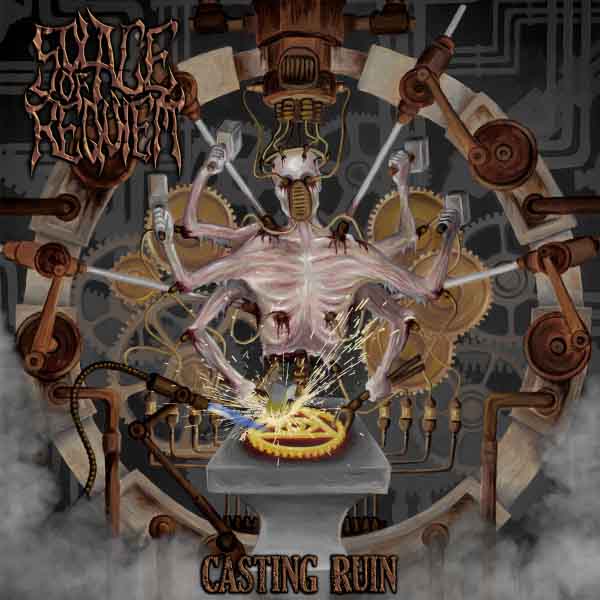
Solace of Requiem – Casting Ruin

A new epidemic trend grips metal, following war metal, which is the tendency to Angelcorpse — yes, that’s being used as a verb — a mixture of metal influences and tie the mess together with loud vocals. Fast guitars and overactive drums work for Angelcorpse, who clearly came along in the Fallen Christ vein of blasting streamlined death metal, but metal bands now are using that style like a tortilla to dump everything else into, wrap up the ends and make a metal burrito. While some bands that make burrito metal are able to keep interest, the problem with this style and the carnival music high contrast (read: randomness) aesthetic of bands like Behemoth that rose in parallel is that by turning the volume up to 11 for everything, it creates a constant flow of essentially invariant sound that possesses no dynamic and no real progression. It is thus easier to write; songs require no real internal contrast, and songwriters can stack bits of whatever they have on hand and stitch it up with some technicality. I find Solace of Requiem to be unlistenable for this reason. It is a barrage of noise that, if someone were to take any part of it and break it out into parts divided by its internal tension and then make a song of it, might work. But the whole burrito does not. The Solace of Requiem burrito includes more lead guitar and melody and some NYDM style technicality and sweeps borrowed from metalcore, but that does not differentiate its essential approach from all the other Behemoth/Angelcorpse hybrids. Like Taco Bell, it goes down quickly, is easily forgotten and leaves an unpleasant odor lingering in its wake.

wombbath-internal_caustic_torments

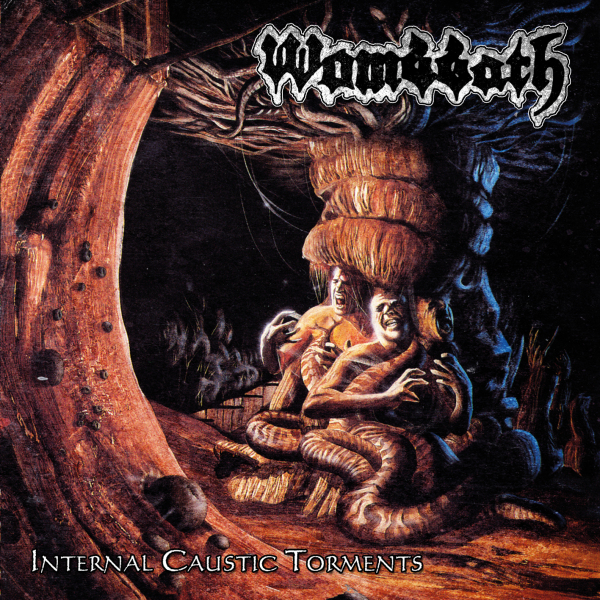
Wombbath – Internal Caustic Torments

This is one of those bands that makes plodding rhythms catchy to the point that a listener will fall into the groove and not mind, but also will not seek it out repeatedly because of the sheer repetition without much of a direction. These riffs came straight out of hard rock, got detuned and had some quick fills added, but remain as predictable as listening to AC/DC covers at the local karaoke bar. The result is that Wombbath batters your brain until it gives up, then pours a layer of relatively obvious material over it, including songs that complete an arc but without any real doubt or tension in the middle, such that like the riffs, the structure of the songs themselves is duplicative and numbing. Nothing is done poorly and this band clearly shows mastery of the old school style, but what it lacks is a reason for a listener who is aware of the best of old school death metal to embrace this. Internal Caustic Torments expresses in many ways the worst of old school death metal and the tendency that caused the genre to collapse on itself, which was nailing the style and then using it to hammer out repetition like propaganda. This album could be improved overnight by introducing actual tension between the first and second riffs, then seeing where that leads and using it to reorganize these songs, because many of the raw elements are there.

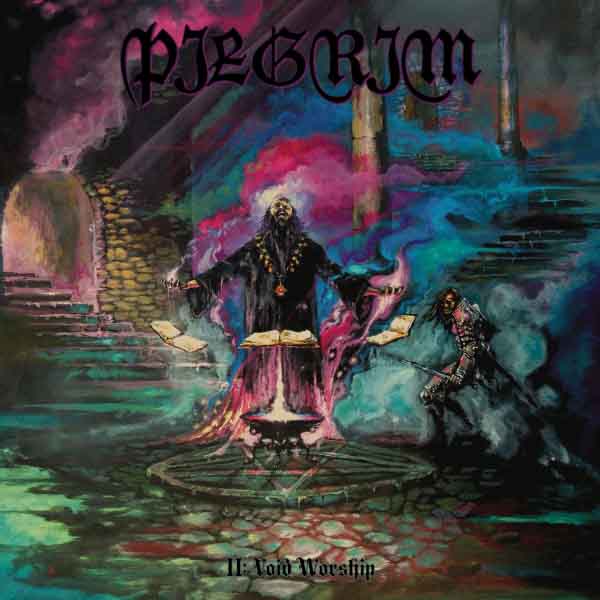
pilgrim-ii_void_worship

Pilgrim – II: Void Worship

Stoner doom metal happened when 1970s jam music swallowed up doom metal and remains basically stuck in the 1970s, Slacker, That 70s Show, etc. mentality. In other words, it aims to dig out wonder in the smallest of things, much as stoners can find a universe in their toenails. In this case, it is not the “doom” aspect that is problematic, but the fact that this music seems designed to find the fascinating and earth-shattering in simple chord progressions that remind us of Foreigner and Journey releases but without the strong sense of harmony. Instead, it’s every stoner’s dream: just start plodding along, then jam over that until some sort of magic emerges. When you think about it, that is what the Grateful Dead did for decades, blarting out never-ending tuneless solos that incorporated every technique in the book but to no end, because there was no point, only a desire to keep the jam going for as long as possible so the audience and band could take more drugs, be more groovy, pose more in front of the flower-painted school bus and other activities for people who have voids in their souls and no purpose to their lives. Pilgrim are more musically adept than most bands which cross this desk, but they take it nowhere. Songs jam, build up, trail off. Solos and fills drop in competently but express nothing. The album has a big concept somewhere if you read the theory about it that they include with all releases nowadays — I never do — but it is not expressed in the music. Much like a recent failed indie-metal album about whales, the putative topic is not the subject matter, but a cover story for playing the same crap. Really, just go get the first Def Leppard album because it does everything that happens here but with a purpose. A vapid purpose, but no purpose is more vapid than no purpose itself. Flee.

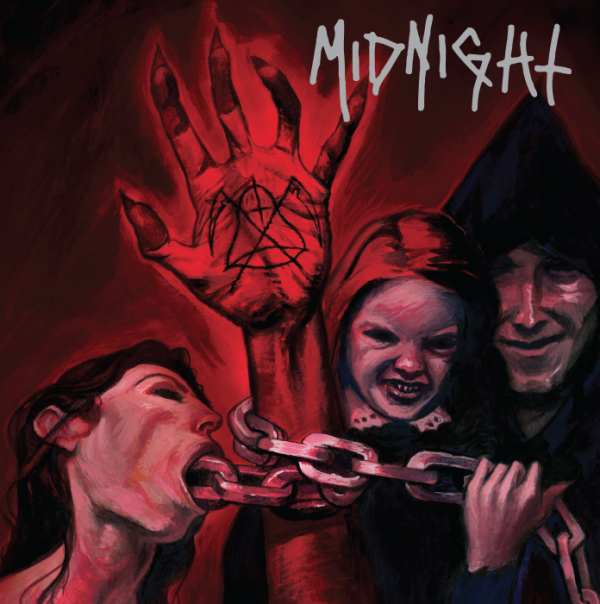
midnight-no_mercy_for_mayhem

Midnight – No Mercy for Mayhem

Warmed over NWOBHM with American glam metal glitz under a glaze of alt-death bands like Nifelheim or Gehennah. Remember when that stuff came out? It was 1998 and black metal had officially shot its wad, following death metal the dubious status of having a fully developed form but having expressed all of its relevant content three years or more prior. Thus bands thought, “Well, we have this new technology in the death metal and black metal styles, why not mix them and use them to encode the same old crap that bands were talking about in the 1970s?” You know, the safe stuff: alcohol, sex, partying and pissing off your parents. No one in a modern liberal democracy will argue with you for such an assertion of individualism and defiance of The Establishment. Thus it’s about as challenging and volatile as tap water, as controversial as feeding pigeons in a park, and the perfect product because it takes almost zero effort to make a few catchy hard rock songs with heavier vocals and more intense drums. Anyone can do it! Those were the words they used in the dying years of punk, also, which meant that anyone and everyone did do it, which ensured that the music became boring because it wasn’t about anything. Midnight isn’t about anything either. Its members are fixated only on being in a band and making some tunes that people like. That’s sort of like a chef deciding that he wants to make Big Macs instead of Filet Mignon because “people like it.” Like a Big Mac, No Mercy For Mayhem is soft and uniform in consistency and slightly sweet with a tangy sauce of rebellious high school rock. But it resembles an average of every burger ever made with the never-fail treatment of adding fat, salt and sugar, thus there is no growth, learning or evolution in it. It is simply an object, a product. And like all soulless things, it can only occupy your time, not enhance it, which means you stagnate, and you know what they say about stagnation.

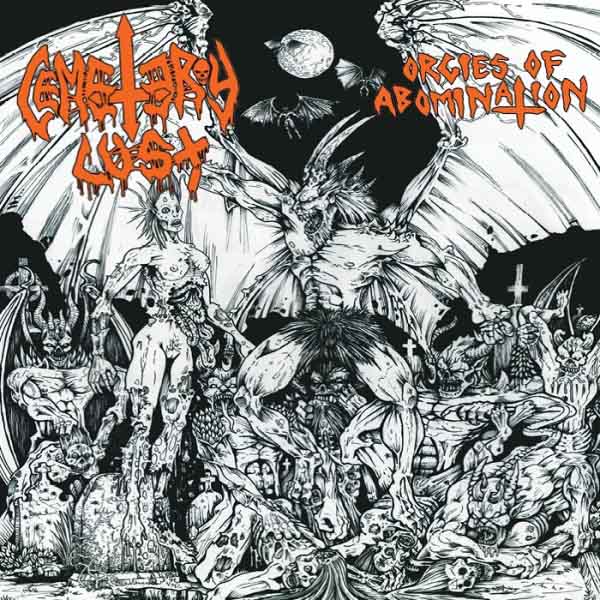
cemetery_lust-orgies_of_abomination

Cemetery Lust – Orgies of Abomination

I suppose this is intended to sound like Autopsy, but it more sounds like the bad SOD and DRI clones of the late 1980s: really simple sing-song two-point riffs driven by the vocals to keep the rhythmic hook alive because that is basically all the song does. Rhythms are very similar to old DRI, COC and SOD as well. Lots of downpicking. Nothing is poorly done and yet this style, like all rap music, is just too simple to express much of anything especially with these entirely standard song structures. Each song consists of two related riffs, a vocal hook, and support from other instruments. The result is not exciting unless people playing stuff faster than normal excites you. Lots of tropes from middle-1980s speed metal and early death metal, but the songs never really get any momentum going and sound about thirty years old, out of date and without personality. Some things belong in the past and should be buried next to all the bands who didn’t make it because they sounded like watered-down versions of their influences. This band can join them.

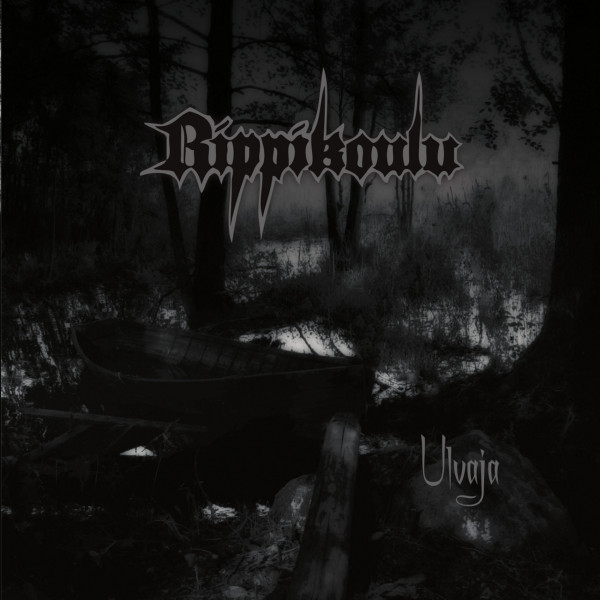
rippikoulu-ulvaja

Rippikoulu – Ulvaja

Funeral doom metal with death metal touches in the vein of Skepticism, Rippikoulu on this release create a convincing atmosphere that relies too much on texture of vocals and instrumentation but nonetheless is convincing. These songs begin with simple riffs and expand both depth and tonality, moving from minor-key intervals to more open intervals much like Ancient used to on its longer tracks, creating a sense of a moving target on a lengthy journey. Use of piano, strings and female vocals both soften the abrasive distortion and force more spacious dynamics, allowing other themes more room to move. While these songs clearly focus on atmosphere, the more important idea here is the change of moods like seasons, which gives them a grace and makes the distorted guitar seem actually jarring by way of contrast. Although this release is an EP and thus short, the mood created by this musical approach could be, like Summoning Nightshade Forests, the basis for a short escape from reality that reveals more about existence than direct confrontation ever could.

28 Comments

Tags: , , , , , , , , ,

Sadistic Metal Reviews 08-06-14

lobotomy_by_metal

What are Sadistic Metal Reviews? Most humans understand reality through social definitions because this flatters their pretense of being important in cold and empty universe. Others prefer to find meaning through bonding with reality in all of its darkness. For noticing the difference, we get called sadists.

Algebra – Feed the Ego

algebra-feed_the_egoLate 1980s speed metal gets a strong infusion of Slayer-styled energy and tempo. If you can imagine second-tier speed metal bands using the riff patterns and rhythmic shifts from Reign in Blood, you grasp the basic idea here. This makes for fun listening but underneath the surface, an ugly hard rock influence shows, and the derivative nature of the riffing makes it hard to take seriously.


Cradle of Filth – Total Fucking Darkness

cradle_of_filth-total_fucking_darknessThey released the demo of the band that initiated the downfall of black metal. Like Opeth, Cannibal Corpse, Meshuggah and Pantera, Cradle of Filth made a name for itself by taking a new style and dumbing it down for an audience that wanted spoon feeding. Notice the idiotic hipster trend of inserting the word “fucking” to make an otherwise recombinant title seem edgy. What you will hear on this lengthy demo is basic deathgrind verses with melodic heavy metal choruses kicked into high speed and aggression with borrowed technique. Oh wait, there are keyboards so you can feel more profound than your friends for listening to such an open-minded band. This entire thing is transparent and shows how from an early date, this band was scheming to make a vapid but “profound” (like dreamcatchers, Ansel Adams posters and Eckhart Tolle) sound. While it is not explicitly terrible it also fails to make any lasting connection to the inner layers of being, like higher brain functions or what we sometimes call a soul.


Ending Quest – The Summoning

ending_quest-the_summoningIn my dream, I was in a vast house by the seaside. In the east wing, the hallway had endless doors. I opened one and immediately recoiled. I was in the retro-Swedish death metal room again! Ending Quest provides a better than average take on the retro style but does not achieve any level of impact such that it must be listened to. Imagine mixing a melodic Necrophobic-style lead rhythm riff into a more rock ‘n’ roll version of Entombed Left Hand Path in the riff department. Then work in elements of the death ‘n’ roll that came a generation later: abrupt cuts, bouncy grooves, relatively standard song format and lots of melodic hooks. The problem is that after a while it starts to sound like sonic wallpaper because it uses roughly the same approach and template to writing each song. Thus what emerges is a dozen songs that feature familiar motifs and all run together into a blur of Swedish-tasting death metal with hard rock undertones.


Final Conflict – Ashes to Ashes

final_conflict-ashes_to_ashesI always enjoyed this late hardcore offering but never found it as hard-hitting as the Cro-Mags, Amebix or Discharge. There’s a good reason: if Descendents decided to make a hardcore, it might sound like this. Riffs fit the patterns of basic California hardcore adapted to the stream of powerchords attack of the Exploited or Cro-Mags. But ultimately, this is melodic punk. Vocal melodies predominate with heavy focus on chorus and riffs work in enough melody to be predominantly hook-driven. Add to this lyrics that span a gamut from radical anarchistic sentiment to mainstream right-wing moderate calls for defense of rights and freedoms, and you sense a movement looking for a purpose. However Final Conflict create an album without filler that hits hard and keeps riding that violent energy which makes this a hardcore album you can appreciate without descending into total alienation. It’s probably a great workout album.


Greenleaf – Trails and Passes

greenleaf-trails_and_passesDo they ever tire of peddling the same hackneyed crap? This sounds like early 1960s angry rock, with a heavy MC5 influence. Bluesy, with extended rhythmic breaks and emphasis on a hippie vocal, this band might think they are related to metal but this is purely on the aesthetic basis that they use distortion pedals. Baby Boomers love this stuff because it lets them revisit their ancient pointless youth in the free love and whatever-stupid-shit-you-think-is-OK-man 1960s, but for the rest of us this retro detour is a dead end.


Humut Tabal – The Dark Emperor ov the Shadow Realm

humut_tabal_dark_emperor_ov_the_shadow_realmSome of our writers here think highly of the Texas scene but it seems to me that much like Texas itself, the scene there is composed of odds and ends. Such is the case with Humut Tabal who are jack of all trades and master of none. The basis of this album is promising melodic black metal with too much influence from the ersatz article like Watain, but the band know how to write some songs that verge on the beautiful. Then they drop in some idiotic riff straight off a Pantera album and reduce the IQ in the room to Juggalo levels. While their melodic approach, reminiscent of Dawn and Sacramentum, is basically really good, the band overplay it and end up with an album that disappears into its own sound. On the plus side, these songs remain distinctive enough to tell the difference, which suggests this band has the ability to have a bright future if it wants it. But maybe drop the two-word trendy name and the ridiculous “ov” style spelling, get more of a purpose, and stop trying to please everyone at once. You can’t do it because it should never be done.


Mordbrand – Imago

Untitled-2
As a genre descends, it improves in attention to details including basic musicality but fails at its center where meaning lies. This Swedish death metal revival band bash out a formula at either fast or slow speeds, but the effect is the same. It is focused on chorus as hook like the later Sodom records and never really develops past having a cool melodic idea for a riff; songs are essentially in standard format and take huge influence from later crustpunk which was by definition formulaic. There are parts of this to admire but the whole adds up to less than the parts.


Steel Prophet – Omniscient

steel_prophet-omniscientMiddle 1980s style speed metal picks up a few stylistic flourishes from power metal but basically stays in the great quest for a catchy chorus that can be backed by lots of muted downstroke strumming. Melodically, it closest resembles Judas Priest but adds some Manowar-like touches. Songs fit more into the rock ‘n’ roll mold of building everything as a support structure for the vocals, and drums, bass and lead guitars generate a backgrond that is too busy to make this anything but the kind of sonic assault waged by a fast-sell commercial. The vocalist exhibits quite a bit of talent and none of the players are bad, but the way they choose to combine this material resembles the frenetic activity at a shopping mall in that for all that it is busy, it never gets anywhere.


Dawn – Nær Solen Gar Niþer For Evogher

dawn-naer_solen_gar_niber_for_evogherThis re-issue tempted me but ultimately I have decided it lives in a duality: it has great melodic ideas and riffs, but insists on the type of semi-random songwriting that later became famous with metalcore. Riffs shift into other riffs without any real sense to the arrangement; by rock theory, this is OK since they’re in the same key. But in metal, the riffs talk to each other. Sometimes this band tends to like to bash out fast repetitive melodies on a plodding rhythm until the audience shoots itself. But scattered throughout this album in abundance are good melodic ideas and some really great riff pairs. If the band had worked on song structure and arrangement more, this could have been an A-level black metal album.

85 Comments

Tags: , , , , , , ,

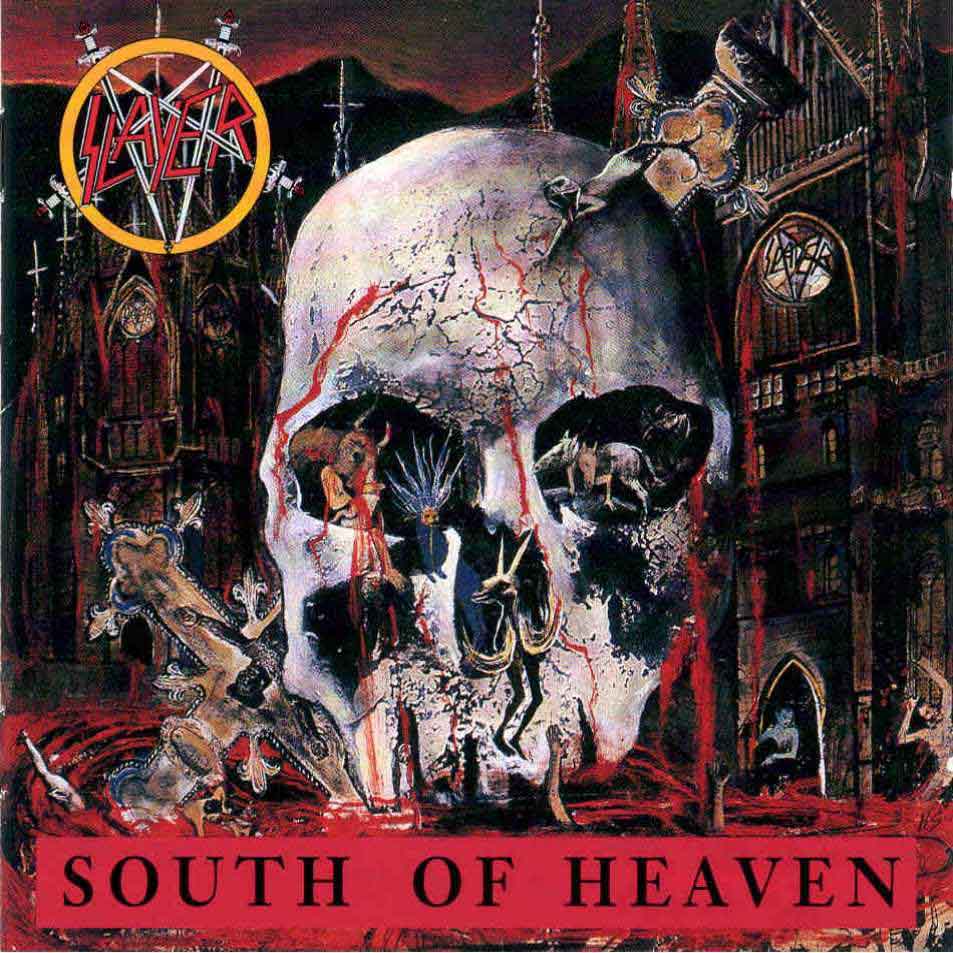
Why “South of Heaven” may be the best metal album of all time

slayer-south_of_heavenArthur Schopenhauer once wrote that there were three kinds of authors: those who write without thinking, those who think as they write, and those who write only because they have thought something and wish to pass it along.

Similarly, it is not hard to produce a decent heavy metal album. You cannot do it without thinking, but if you think while you go, you can stitch those riffs together and make a plausible effort that will delight the squealing masses.

But to produce an excellent heavy metal album is a great challenge. It’s also difficult to discuss, since if you ask 100 hessians for their list of excellent metal albums, you may well get 101 different answers. Still, all of us acknowledge that some albums rise above the rest.

South of Heaven is to my mind such an album because it hits on all levels. Crushing riffs: check. Intense abstract structures: check. Overall feeling of darkness, power, evil, foreboding and all the things forbidden in daylight society: check. But also: a pure enigmatic sublime sense of purpose, of an order beneath the skin of things, resulting in a mind-blowing expansion of perspective? That, too.

Slayer knew they’d hit the ball out of the park with Reign in Blood. That album single-handedly defined what the next generations of metal would shoot for. It also defined for many of us the high-water mark for metal, aesthetically. Any album that wanted to be metal should shoot for the same intensity of “Angel of Death” or “Raining Blood.” It forever raised the bar in terms of technique and overall impact. Music could never back down from that peak.

However, the fertile minds in Slayer did not want to imitate themselves and repeat the past. Instead, they wanted to find out what came next. The answer was to add depth to the intensity: to add melody — the holy grail of metal has since been how to make something with the intensity of Reign in Blood but the melodic power of Don’t Break the Oath — and flesh out the sound, to use more variation in tempo, to add depth of subject matter and to make an album that was more mystical than mechanical.

Only two years later, South of Heaven did exactly that. Many fans thought they wanted Reign in Blood: The Sequel (Return to the Angel of Death) but found out that actually, they liked the change. Where Reign in Blood was an unrelenting assault by enraged demons, South of Heaven was the dark forces who infiltrated your neighborhood at night, and in the morning looked just like everyone else. It was an album that found horror lurking behind normalcy, twisted sadistic power games behind politics, and the sense of a society not off course just in politics, economics, etc. but having gone down a bad path. Having sold it soul to Satan, in other words.

The depth of despair and foreboding terror found in this album was probably more than most of us could handle at the time. 1988 was after all the peak of the Cold War, shortly before the other side collapsed, but Slayer wasn’t talking about the Cold War. For them, the problem was deeper; it was within, and it resulted from our acceptance of some kind of illusion as a force of good, when really it concealed the lurking face of evil. This gave the album a depth and terror that none have touched since. It is wholly unsettling.

Musically, advancements came aplenty. Slayer detached themselves from the rock formula entirely, using chromatic riffs to great effectiveness and relegating key changes to a mode of layering riffs. Although it was simpler and more repetitive, South of Heaven was also more hypnotic as it merged subliminal rhythms with melodies that sounded like fragments of the past. The result was more like atmospheric or ambient music, and it swallowed up the listener and brought them into an entirely different world.

South of Heaven was also the last “mythological” album from Slayer. Following the example of Black Sabbath’s “War Pigs,” Slayer’s previous lyrics found metaphysical and occult reasons for humanity’s failures, but never let us off the hook. Bad decisions beget bad results in the Slayer worldview, and those who are happiest with it are the forces of evil who mislead us and enjoy our folly, as in “Satan laughing spreads his wings” or even “Satan laughs as you eternally rot.” The lyrics to “South of Heaven” could have come from the book of Revelations, with their portrayal of a culture and society given to lusts and wickedness, collapsing from within. (Three years later, Bathory made the Wagnerian counterpoint to this with “Twilight of the Gods.” Read the two lyrics together — it’s quite influential.)

Most of all, South of Heaven was a step forward as momentous as Reign in Blood for all future metal. We can create raw intensity, it said, but we need also to find heaviness in the implications of things. In the actions we take and their certain results. In the results of a lack of attention to even simple things, like where we throw our trash and how honest we are with each other. That is a message so profoundly subversive and all-encompassing that it is terrifying. Basically, you are never off the hook; you are always on watch, because your future depends on it.

Slayer awoke in many of us a sense beyond the immediate. We were accustomed to songs that told us about personal struggles, desires and goals. But what about looking at life through the lens of history? Or even the qualitative implications of our acts? Like Romantic poetry, Slayer was a looking glass into the ancient ruins of Greece and Rome, onto the battlefields of Verdun and Stalingrad, and even more, into our own souls. Reign in Blood broke popular music free from its sense of being “protest music” or “individualistic” and showed us a wider world. South of Heaven showed us we are the decisionmakers of this world, and without our constant attention, it will burn like hell itself.

I remember from back in the day how many of my friends were afraid of South of Heaven. The first two Slayer albums could be fun; Reign in Blood was just pure intensity; South of Heaven was awake at 3 a.m. and existentially confused, fearing death and insignificance, Nietzschean “fear and trembling” style music. It unnerved me then and it does still today, but I believe every note of it is an accurate reflection of reality, and of the charge to us to make right decisions instead of convenient ones. And now with Slayer gone, we have to compel ourselves to walk this path — alone.

13 Comments

Tags: , ,

The Best Underground Metal of 2012

The year is done. It brought many things: a new wave of hipster metal that blipped and died, an old school revival that’s been percolating for years, drama and sadness with the recent death of Rigor Mortis’ Mike Scaccia. Above all else, however, it brought us some quality music, some of which is heavy metal and some of which is metal in spirit only. Enjoy this survey of the best of 2012.

The Best Metal (and related) of 2012

  • Abhorrence – Completely Vulgar This legendary band existed before Amorphis and plays a grittier style of the bold, warlike and heavy yet melodic music that graced Amorphis’ first album, The Karelian Isthmus. These Abhorrence tracks show the band that would later write that album as they emerge from early grind/death stylings and gradually work more melody into their work. This is metal’s holy grail: how to be both epic and amoral in the nihilistic sense of worshipping power, darkness and nature, but also use melody and harmony to give the works some staying power. As this collection of re-released demos progresses, the fusion of the two gets more confident and deft, leading us up to the point where the greatness of the first Amorphis album was inevitable.

  • Angel Witch – As Above, So Below After a lengthy absence, this classic NWOBHM band returns with an album that shows integration of more recent influences, specifically American heavy metal and progressive metal, but still keeps up the power. These songs are not as distinctive or as oddball as the heavily personalitied offerings from their self-titled album, but As Above, So Below is important because it takes disparate influences and places them under the control of one voice and style, which gives others room to build on. The oil-on-water aspect of bands switching between influences is gone and replaced by a smooth enwrapping of these styles into the substrate of Angel Witch’s lauded and learned evil heavy metal.

  • Beherit – Celebrate the Dead If death metal was modernism, with its emphasis on structure, black metal was postmodernism, or an attempt to show through atmosphere the many facets of an idea in a clarity which could not be confined to a single statement. This was a quest as old as humanity, which is how to communicate in such a way that people who do not understand it do not simply imitate it from the outside-in and make something that looks about like it, fooling most people. Since the late 1990s Beherit have been at work inventing the next wave or movement of metal, one in which multiple statements co-exist in contradictory opposites that reveal the shadow or silhouette of an underlying truth. Two forms are in tension here: the “loop” form of traditional ambient music, in which layers are poured on top of a basic dub to create a simple sonic tapestry, and the pure narrative form which electro-acoustic music (and even some dubstep) touches on, in which a story is told through the change of riffs. This is closer to the original death metal idea of structure, but it is structure created through atmosphere, like old Tangerine Dream and Brian Eno albums, or even classical music. To this end, Beherit has re-released two demo songs from Engram which are ambitious longer (13- and 15-minute) works which show a deepening and changing of atmosphere, using both looping and narrative constructs at the same time. This is a valiant and clear-headed attempt to resurrect black metal, which has fallen into the hands of those who imitate the “external” aspects of the early classics like simple riffs and fast songs, but understand none of the underlying ideas or songwriting methods. While it seems unconventional at first, Celebrate the Dead is a return to the truest form of black metal by expanding its orthodoxy to include the transcendental narrative of those more experienced in both this world, and the realms beyond. Be not fooled — evil pervades this release, so subtly that you will not know until it has seized your soul.

  • Dead Can Dance – Anastasis For their return after some absence, Dead Can Dance have taken the style on Spiritchaser and refined it even more with the sensibility of modern club music and soundtrack influences. Rhythms and tempo work like you might expect a big label ambient album to work, fitting very much into the slightly picked up chill-out range with gentle backing beats that are still identifiable enough to make it easy to listen to. Consistent with even earlier work, songs use extended structures, but they fit the pattern of an early MTV video or short film more than a musical one. The result is that these are immersive little sonic ventures that are both easy to hear and not surprising, and also, rewarding in their consistency and adept arrangements. Melodies themselves are not as adventurous or period/locale-specific as older Dead Can Dance, and in fact more lifts from earlier influences can be heard (check out the Doors “The end” inspirations on the first track). For a purist, this will not be the best Dead Can Dance album, but for something that has stepped into the Loreena McKennit or Enya range of “accessible,” this is far beyond what most would encounter otherwise and makes for a pleasant listen on its own.

  • Demoncy – Enthroned is the Night Along with Beherit, this shares the top spot as album of the year. In 2012, a wave of bands like Cruciamentum and Heresiarch rediscovered the sound of classic Incantation from the Onward to Golgotha area. Having come from the same school, joined to Incantation by Ixithra’s former band Havohej’s primary composer, Paul Ledney, having been an original member of Incantation, Demoncy launched into the same by creating a faithful followup to 1996’s Joined in Darkness. In this case, Demoncy add a bit of melody and atmosphere, channeling from first album Unleashed and other Swedish death metal classics, thus combining the two most intense areas of death metal into what is really a death metal album with a black metal sense of atmosphere. The result is a descent into a dark and primal place in which occult spiritual warfare transpires through the battling of motifs in this complex album made of simple parts. Like Joined in Darkness, it is otherworldly and foreboding, but a bit less purely alienated; instead, this album creates a sense of symbolic significance emerging like melody from the clouded obscure. Very little black metal of this intensity has been made since the mid-1990s which makes this both faithful to the spirit and pushing the boundaries of the genre, a simultaneous advancement that eludes most musicians and fans alike.

  • Derkéta – In Death We Meet Arising from the ashes of Mythic, the all-female doom-death band from the early 1990s, Derkéta follows in a more purely doom metal path including some of the juicy 1970s heavy metal style doom metal that audiences enjoy with bands like Pentagram and Witchfinder General. 24 years later, this album is the first for this promising band, and holds back nothing. Like Mythic, the music is formed of giant bolsters of tunneling power chords colliding slowly over a changing melodic landscape. Atmosphere emerges from within. The simplicity of it removes the glitz and contentless enhancement of current doom metal bands, and takes the listeners back to the essence of the genre, which is an unsettling sense of pervasive dread. A prominent Candlemass Ancient Dreams influence seems to be present in these compact and droning songs.

  • Desecresy – The Doom Skeptron Desecresy approach Finnish death metal the way others might approach doom metal, using melody and abstract song structures to convey an experience not unlike watching the helmet camera of a pilot flying through a vast and ancient underground cave in which demons seem to lurk behind every stalagtite. Comparable to a hybrid between Amorphis and Skepticism, this album nonetheless keeps up the umptempo riffing and lets its melodies emerge to construct an emanating atmosphere. The result is both aggressive and enjoyable from a purely death metal perspective, but where appropriate, it uses the moods of doom metal to complete that raging insanity to produce an experience that is like a journey. There are doubts, fears, joys, rage and sadness, but pervading all of it is a sonorous melancholy which indicates a change in viewing life from orientation toward what is safe, to prizing what is adventurous and as such being alone on a planet of people concerned with safety labels and microwave cooking.

  • Drawn and Quartered – Feeding Hell’s Furnace Imagine a hybrid between Angelcorpse and Num Skull. These songs are extremely basic, like the melodies of horror movies, but are put together with interlocking rhythms that propel them forward and give them atmosphere. As a result, their themes feel intuitive like paths through a forest remembered from a childhood story. There will not be surprise at the ways these tunes twist and bend, but appreciation for a well-done interpretation on a necessary idea. In the same way you might appreciate an excellent sword or well-executed painting of a familiar subject, these songs will be appreciated for how well they do what they love. Just as most musicians make their best work when they design it to be enjoyed repeatedly by people with their own tastes, this faithful and yet creative interpretation of the old school death metal genre will be shared among those who can appreciate it, for taking the past and making it live on by keeping it current to itself and through inventiveness, an enjoyable listen.

  • Faustcoven – Hellfire and Funeral Bells This release is not particularly metal, or at least underground metal, even though it aspires to the aesthetics of it. Rather, this is like Marilyn Manson interpreting classic heavy metal in a gothic doom metal context as informed by death metal aesthetics but not technique. It’s basically blues rock with short phrase power chord riffs and highly compelling rhythm, underneath leads that are reminiscent of a friendlier version of St. Vitus. Good use of theme allows this release to be a faithful listen and also have some staying power for those who like this style. Like most doom metal, it is designed to build a repetitive atmosphere that is part curl of enjoyment, and part linear path of a melancholic mood. The death metal vocals would normally be out of place here but with the heavy reverb they take a backseat and let the guitars talk, which is the point of this band. It will probably not delight those who like underground metal, but if you’re looking for someplace to go for your next Cathedral or Sleep fix, this furry doom band holds the ticket.

  • Grave – Endless Procession of SoulsGrave return to the Swedish style which they helped make famous. Like later Fleshcrawl, this music is simplified from the original riff-salad which was reverse-assembled to make a journey into darkness emerge from thin air, but although it uses plenty of verse-chorus segments, they are not the entirety of each song. There are enough labyrinthine twists and turns to be fun, a good motivational rhythm, and an atmosphere of darkness and aggressive that is also (oddly) comforting and natural. Although musically this is fairly basic, like early Grave, it shows more use of melody and harmony, which adds an appreciable dimension of compactness and centering without falling into standard rock music. The result is easy to listen to and yet brings out its power in moments of sudden clarity which, as in life, make the listener think there might be more afoot than the obvious.

  • Imprecation – Jehovah Denied This four-song EP shows the resurrected Imprecation: more consistent in its songwriting, slightly less manic, and more inclined to create a pervasive atmosphere of darkness. The occult death metal founders from Houston originally shone in the early 1990s, when their demos and later CD were released, but returned after inaction and the lending of band members to other acts. Their earlier material had more of a Morbid Angel influence and presented itself as clear occultism, where the newer material goes back more toward where Possessed and early old school death metal (Morpheus Descends, Massacre) were headed back in their day. Mood-enhancing use of background keyboards gives an aura of the mysterious to these dark melodies and the organic rhythms which suffuse them. Influences on this music span from pre-death metal, through the walking and stalking rhythms of speed metal, to the later black metal works in song structure and atmosphere. This EP presages a killer full-length but stands on its own as quality music with a voice particular to its worldview.

  • Incantation – Vanquish in Vengeance With new personnel and possibly the strongest sense of unity in a long time, Incantation very sensibly took influences deliberately from their own two greatest successes: Onward to Golgotha and Diabolical Conquest. The result is an album that self-consciously borrows from those albums in style but tries to create new songs to wrap in that style, and with the aid of new guitarist Alex Bouks (ex-Goreaphobia) shapes its works around melodic shapes but does not adorn them in melodic riffing, creating a sense of an inner region of hidden energy within the exterior of rugged chromatic shapes. The result is one of Incantation’s most conventional albums but also a festival of the methods that made early Incantation so distinctive and powerful, which combined makes for a good later death metal listen.

  • Legion of Doom – The Summoning of Shadows This oddity of an album begins with some form of sung prayer and launches into songs that are both adorned in the harmonic glaze of melodic playing and also possessed of the manic simplicity of early black metal. Like the primitive era of black metal, these songs are specific structures fitting the content of each song, with droning riffs that interact and build to a culmination before dissipating. On this album, Legion of Doom use more death metal and speed metal technique in with their Burzum-inspired black metal, ending in a result that sounds more like an ornate and elegant version of Gorgoroth’s Destroyer. Like all Legion of Doom releases, The Summoning of Shadows features songs that accelerate thematic intensity in layers and produce an immerse, ambient experience that suspends reality through the sheer dominating power of its riffs. This album is more efficient than the last couple of releases of this band, and by embracing a listenable style, makes the type of outsider album that Marduk or Watain wish they could.

  • Lord Wind – Ales Stenar If you want to immerse yourself in ancient sensation, Graveland axeman Rob Darken’s ambient/neofolk/soundtrack project Lord Wind is a good place to start. Unlike previous Lord Wind efforts, Ales Stenar mixes real vocals and violin with electronic music that is roughly inspired by the Conan and Red Sonja soundtracks. The goal however is less like the rock-ish folk songs of neofolk, or the grand accompaniment for cinema provided by soundtracks; this is music like Burzum or Graveland that is designed for the listener to lose themselves in its repetitive hypnotic surges, like a catechism or mantra. Its soaring melodies and plunging dynamics give it a familiarity like the rush of blood through veins in the ears, and the result feels natural and yet inspired to rise above the mundane at the same time. Like entering a forest, the songs open up to repeated listens and soon each part is distinct, but our natural way is to hear it all at once and derive a sentimental feeling, perhaps warlike, from it. This is the most proficient and perhaps most profound of the Lord Wind albums, proffering a complete escape from reality to a world that is both fantasy and more real than the stuporous dream of modernity.

  • Master – The New Elite Over the past few albums, punk/heavy metal hybrid Master has steadily been migrating toward late-1990s death metal. This new album presents a more technical view than the verse-chorus-exposition songs that Master (and related Speckmann projects) evolved from. Much like On the Seventh Day God Created…Master, riffs are strummed with precision at high speed and tend to lead away from stable grouping by adding riffs to the existing loop. These riffs use longer progressions and more chromatic fills, giving the music a mechanical terror that makes it sound like technocracy taking over. Speckmann’s vocals are tighter than in the past and urge the music along, but somewhere in this musical process of evolution, his overall tone has started sounding less like protest music and more like a cheering of the coming conflagration. Seeing that Master keep improving over time provides a great incentive to follow this band as they evolve further.

  • Profanatica – Sickened by Holy Host / The Grand Masters Sessions Sometimes, in order to reach your next aspiration, it is necessary to part with the past. Profanatica have done this in grand style by accumulating old tracks and re-working them in parallel, with one disc containing newer versions done in the early 1990s style, and the other containing older session takes on the same songs, interspersed with acoustic landscapes by Aragorn Amori, the band’s much-admired deceased former guitarist. Through its long history, the entity known as Profanatica/Havohej (or: Paul Ledney and friends) has consistently released material showcasing a truly artistic brilliance. Usually, between moments of brilliance there are experiments and less intense offerings that make it easy to forget that when they are in full swing, these musicians are unstoppable forces creating a unique type of black metal that is closer to ambient death metal but unlike most black metal at this time, possessed of a full mythos and unique view of the world. Like the best of Profanatica/Havohej, these two discs are ripping sonic terror that transcend daily life and divulge the essence of the feral spirit of pre-civilized humanity. In that vision of evil, Profanatica offer us something both inspiring and instructive, and do so through some of the best music of their career.

  • Terrorizer – Hordes of Zombies People love change if it is constant and hate it if not. Terrorizer misstepped with their first post-World Downfall album, but came back with a strong contender on Hordes of Zombies. It does not attempt to be World Downfall II which is intelligent since outward-in emulation of the past usually produces hollow shells, and a good many classic bands have gone to their graves in disgrace by doing the same thing. Instead, this aims more at the territory scoped by Napalm Death with Fear, Emptiness, Despair: a modern form of grindcore that is musical and listenable without being commercial, and aims less at creating an atmosphere of terror and misery than creating motivational, energetic and yet literalist/realist music. These songs convey a desire to look at a dangerous situation with hopeless odds, then jump in and fight it out. It’s war music, but music of a normalized war, like going out into a declining civilization and fighting for mundane survival. Hordes of Zombies does this through a somewhat overused metal metaphor, that of the zombie takeover of society, but as a movie/musical trope this theme has remained consistent since the 1960s because it so aptly describes egalitarian society. Consumerism, mass trends, fads, panics, elections, Black Friday sales, save-the-children; it’s all in there. Terrorizer may be brilliant satirists for transforming all of that mass neurosis into a simple symbol and then making these engaging songs about it. Each piece uses a combination of rhythmic and slight melodic hook to lure us in, then pits grinding riffs against one another while fitting them into bounding rhythms that unleash an inner fury in their conflict between the fear and the mundane. The result is a stream of ferocious riffs in songs that hold together as songs in the Terrorizer tradition, creating an experience of immersion in conflict that is both justified and everyday. For a genre such as grindcore, this more stable form is preferable to re-living the past or trying to “innovate” by including outside elements. As a result, Hordes of Zombies is not only a great listening experience but an archetype others will follow.

  • Thevetat – Disease to Divide One of the more interesting entries comes from ex-Ceremonium musician Thomas Pioli who has assembled a new team to make music that sounds like early NYDM mixed with the melodic undertones of heavy but intriguing bands like Montrosity, Malevolent Creation and Gorguts. The result hits hard with a rushing wall of chords and then drops into socketed rhythms that invoke a change in riffs, causing a twisted inner torment to emerge in Protean form. This gives old school death metal a new life without giving it a new form, since the form is the result of the content, which is essentially unchanged but slightly updated since 1992. No concessions to “modernization” (a/k/a mixing death metal with rock, jazz, metalcore, disco, punk, etc.) occur here, which allows this music to be in touch with its own spirit and flow freely from the source of its own inspiration. It is thunderous and yet perceptive, bringing with it the spirit of doom metal and its introspective melancholy. Although a three-song EP, this release beats out most albums released this year for pure death metal intensity.

  • Timeghoul – 1992-1994 Metal developed its own sense of “progressive” and “technical” music long before it imported jazz-fusion in order to help it. In fact, part of metal’s birth was from the original progressive rock in the 1970s and the soundtracks of horror movies, which gave it a predilection for this direction. “Progressive” itself is a misnomer since nothing new gets discovered in music, but probably more accurately means “complex”: music with unconventional song structures, extensive use of harmony, melody and key; possibly linked to some kind of story outside the music itself and the usual topics (love, sex, drama) of pop songs. These songs craft winding riffs and intricate structures, using embedded melody to transition between more chromatic riffs, and culminate in odd twists of fate that translate them into seemingly the reverse of their initial outlook. Culminating in the epic 10-minute “Occurrence on Mimas,” this collection of early works by this band showcase the enjoyably weird variety of death metal in its early days.

  • War Master – Pyramid of the Necropolis This modern band attempts to revive the death metal style, starting with the deathgrind of its namesake Bolt Thrower and incorporating influences from many of the bands of the era, and succeeds by staying true to its own enjoyment. As a result, it’s working in a style, and not from a template; the band want to create old school death metal, but aren’t doing it by imitating songs or styles, but by writing in that style based on similar inspirations. As a result, this band has its own voice despite being very familiar in technique, and has chosen its own path for subject matter and thus the arrangement of many of these songs and the types of riffs used. Its aesthetic mixes the grinding mid-tempo riffs and repetitive choruses of grindcore with the circuitous riffing of death metal and its tendency to unveil changes in layers of rhythm, guitar and vocals. While the style shows the influences of later death metal, its sensibility is firmly grounded in the early years, which makes this a great old-school death metal experience. However, its most salient factor is that it’s also interesting music. Songs are formed around their topic, with riffs and structure contorting to resemble the object, and riffcraft shows learning from the past but creation of its own new forms. Guttural vocals which maintain an ascetic detachment from the emotional content of the music help to give Pyramid of the Necropolis the ultimate death metal point of view, which is as a dispassionate observer amongs the ruins detailing the conflict that created this mess, and must endure after its collapse.

Disappointments of 2012

Abigor – Quintessence

Apparently this is new and old material. The shift between the new and old is like jumping out of a sauna into the snow. The newer material shapes itself to an expectation, much like the newer Swedishy bands in the style of Watain, that combines melodic punk with raw and random riffing in catchy rhythms. The result is like a painting made of painted dog turds, in that from a distance it is appealing, but as you get closer its mundane nature is revealed. Abigor have always suffered from being too quick-thinking and inventive for their own good, because they can always throw together a bunch of quality riffs and make most people think a song happened, but here that model breaks down. The songs feel more like slide-shows than organic wholes. The older material is good however.

Absurd – Asgardsrei

This remaster of the 1998 album was in theory supposed to improve sound quality. Had they simply done that, this would have been a shining victory. Instead, it has been standardized. The drums have been pumped up to emphasize rhythm, and the guitars doubled and bass-maximized, with vocals shrouded in reverb. Alone that removes much of the distinctive sound, but attempts have also been made to lower the volume on elements that are not orthodox black metal-cum-oi that Absurd makes now. The result is a loss of detail and an emphasis on the simpler parts of each riff, not the interesting interplay of riffs. They’ve made this album sound more like their remakes of earlier material and by pandering to one audience, lost a lot of what made Absurd interesting.

Acephalix – Deathless Master

A highly-praised release, this album purports to combine Swedish death metal and crustcore. What it ends up with is neither, but a mishmash of riffs around a rollicking beat, changing entirely at random. You hear a little bit of old Entombed, some Dismember, and a lot of filler riffing that really goes nowhere. For about three songs, it’s pleasant listening because you can tap your toes to it and it reminds you of Left Hand Path. Then you realize the songs never went anywhere. They’re like wallpaper. And to the horror of any crust fan, this is built on the bouncy beats and song structures of pop-punk. It’s closer to Blink 182 than Entombed or Amebix.

Aura Noir – Out to Die

Once upon a time, I referred to Aura Noir as a black metal Britney Spears because their music is pop dressed up as black metal. However, it’s normally fun pop with high energy and catchy riffs, even if in verse-chorus structures so repetitive that you have to background it. But with this album, they go into the boring zone. This is almost like a drone with a horse galloping in the background to keep up energy. And yet, like the lady that doth protest too much, the more “energy” you need to inject, the less the music is actually compelling. And on that level, this album is basically the same speed metal/Motorhead style riffs that bands were rehashing back in the 1980s, but now revived in an even more exhausted form.

Coffin Texts – The Tomb of Infinite Ritual

The people behind this band are good, and their intentions are good. The result of their efforts however is bog-standard death metal, not so because it imitates anything else, but because it is unreflective of any purpose outside being death metal. It’s predictable in the sense that nothing is surprising, and yet, it doesn’t really gesture at anything more than being death metal itself. I hope these guys stop trying to be whatever they think they should be, and find whatever they actually enjoy instead. Best yardstick for your music: what you enjoy and would listen to on your own, even if you knew no one in the band.

Graf Spee – Reincarnation

Some things should stay in the 1980s. This is prescient in that it emphasizes the kind of bouncy riffing that fits on the spectrum from Anthrax to Meshuggah and onward to metalcore, but it’s disorganized, inconsistent with the vocals, and feels more like a pile of spare parts than a smoothly running engine.

Hellevetron – Death Scroll of Seven Hells and Its Infernal Majesty

2012 was the year everyone rediscovered Onward to Golgotha. I agree, it’s a killer album. There’s nothing wrong with Hellvetron, who seem like competent musicians, but this album attempts to imitate the outward form of Onward to Golgotha without grasping the underlying tension in the music that makes it work. As a result, Hellvetron impose current song structures (loops) and standards onto the aesthetic of the past, which makes for a decent listen until it becomes apparent that it’s not really about anything except itself.

Impiety – Ravage and Conquer

It’s hard not to enjoy this album, which is like a hybrid between Angelcorpse and Mortem with a squidge more melody. However, it is highly repetitive because it doesn’t go much beyond that concept. Like Krisiun before it, the concept is full speed ahead skull-crushing aesthetic, and this is so powerful it squeezes out most artistic content. This leaves you with some creative riffs, some talented use of tempo, but nothing that holds together long enough to listen to for a decade.

Inverloch – Dusk | Subside

These ex-Disembowelment musicians have a bit of a cult formed around themselves. Part of the reason is that unlike almost every other band before black metal, they knew how to write melodic music, which they do here as well, in something that resembles a cross between death-doom like Asphyx and melodic doom like Candlemass or Paradise Lost. Crashing riffs coexist with gentle melodic fills and overlays that create a dense atmosphere of nocturnal wonder. However, beyond that, the direction seems confused, which is appropriate for a re-entry EP but excludes it from this year’s best of.

Mantas – Death by Metal

Before the first Death album, Chuck Schuldiner tried out his riffcraft in Mantas, named in tribute (by educated guess) to Venom. There’s a reason these sort of re-releases are confined to collectors, and that is that these demos show a young band trying to get the order of riffs in its songs correct and at the same time develop an image, sound and voice. The result is great, if you like listening to parts of the same six songs 18 times each. A true-blue die-hard ultra-kvlt collector will put this on the stereo next to “Scream Bloody Gore” and “Spiritual Healing” and start working out each riff until he’s sure how everything works. Then again, with the hindsight of nearly thirty years, we know exactly how it should turn out, which means that for the rest of us, this will sit on the shelf in perpetuity except as a conversation piece.

Maveth – Coils of the Black Elite

This album reminds me of middle period Immolation, in which creative riffing often fell into very similar rhythms and as such, the songs sort of became a continuum which resembled pulled taffy: cut off a length of Immolation, let’s listen to that. Oh look, sliced Immolation! It’s the same way here. Maveth has very creating riffing with excellent right-hand control, but the songs themselves are a muddle because the riffs are the direction and as such, there’s not really a way to put the riffs together that makes sense, so the band converges on a mean and drops into very similar trudge rhythms to make the songs catchy. At first listen, especially the first three tracks, promise is everywhere; by track five, it’s clear that circularity has occurred.

Purtenance – Sacrifice the King

This EP suffers from a primary flaw, which is disorganization. It’s not random, but it’s what happens when you decide to make death metal and so treat that as a container, and then “write to fill” and twist the riffs into place so they work with each other. It’s not about anything, and thus is “random” in the sense that it could mean anything. As a musical experience, it mostly conveys a sense of disorganization and frustration. The best bands mold that sort of raw emotion into something which rises above the confusion and achieves clarity. If not beauty, truth, goodness, etc. at least something that is desired more than it is hated, and so inspires them, even if that goal is hatred itself.

25 Comments

Tags: , , , , , , , , , , , , , , , , , , , , ,

Ithaca, NY seizes Alex Perialas’ studio

Contacts: Alex Perialas, Pyramid Sound Andy Adelewitz, PR consultant
Phone: 607.273.3931 Phone: 607.257.0455
Email: alex@pyramidsoundstudios.com Email: andy@adelewitz.com

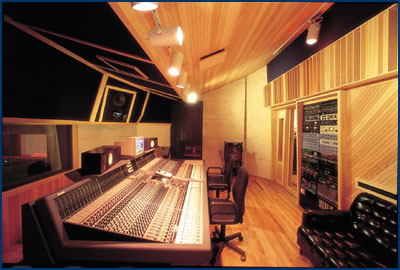
Pyramid Sound, Where Timbaland, David Gray, Anthrax and Others Recorded, At Risk From City

Bridge Construction Supporters Organize Protests, Petitions To Save Successful Ithaca Recording Studio

ITHACA, N.Y., June 21, 2012 — The future of a world-class recording studio that has hosted recording sessions by David Gray, Anthrax, Ginuwine, Aaliyah, Bad Religion, Missy Elliott, Joe Bonnamassa, producers including Timbaland and Tom Dowd, Pulitzer Prize winning composer Steven Stucky, classical pianist Malcolm Bilson, and many others is under threat due to the City of Ithaca’s poor planning of a bridge rebuilding project directly outside the studio walls.

Pyramid Sound, the studio operated for nearly four decades by producer/engineer Alex Perialas in downtown Ithaca, New York, has been unjustly condemned as of Tuesday, June 19, resulting in the devastating loss of a very successful business, and the potential destruction of its facility as the bridge construction gets underway.
After two years of asking for details of the construction plans and how they would affect his property, and being put off by then-mayor Carolyn Peterson and superintendent of public works Bill Gray, Perialas finally got an answer about when the project would commence when workers posted signs outside his studio warning the public that the street would close in two weeks. And as of yesterday, both the studio the separate storage garage next door, which Perialas also owns, have been posted by the city, after repeated promises from the
building department commissioner that they would not be; and no one, including Perialas, is allowed in.

Additionally, the building department employee who posted the building yesterday informed Perialas that the city had found his building condemnable two years ago, in the early planning stages of the bridge reconstruction. Perialas was unaware that an external inspection of his property had happened, and was never informed of the finding, leading to at least the appearance that he was deliberately kept in the dark until it was too late to mitigate problems with his facility, allowing the city to save money by condemning his property rather than compensating him under eminent domain or amending the unnecessarily aggressive construction
plans.

It marks the latest, and most grievous, in a series of bad-faith dealings with Perialas by the City of Ithaca. The story begins in 2004, when construction of a municipal parking garage across Clinton Street from Pyramid began. Seismic vibrations from that project resulted in cracks in the walls of the garage and studio buildings,
causing some damage. He complained to the city at the time, but was unable to see the fight through because he was simultaneously caring for his ailing father.

In May of this year, after being stonewalled by city officials for two months, Perialas received a report from a third-party structural engineer hired by the construction contractor in May. The report found the storage garage, which was closest to the bridge construction, to be in poor condition, and the external walls of the studio building itself to be in poor-but-stable condition; the method of pile driving that would be used on the bridge project would likely cause the nearest garage wall to collapse, representing a danger to occupants and the public. However, this report came two weeks after the bridge project was started, leaving Perialas with no
time to repair or reinforce his buildings. Yet the City of Ithaca has offered Perialas no meaningful compensation or assistance, and has refused to delay the project or issue a change order instructing the contractor to use an alternate, less aggressive method of pile driving that would not represent so great a threat to this thriving business.

After several meetings with new mayor Svante Myrick, Perialas was finally offered just $20,000 from the city to help cover the cost of reinforcing the garage wall. But that offer came just a day before drilling to prepare holes for the pile driving was scheduled to begin — too little, too late. And it came with the unacceptable
condition that Perialas indemnify the city against any further damages to his property caused by the bridge project.

Now that the buildings have been posted, Perialas is left with a slew of recording and mixing commitments that he’s unable to complete, as well as millions of dollars’ worth of sensitive equipment that he’s unable to check on or maintain. For example, the studio’s mixing board could overheat easily if the facility’s air
conditioning system were to fail, potentially causing a catastrophic fire; but with the building condemned, no one is able to monitor the studio’s climate conditions.

Perialas makes it clear that he’s not opposed to the bridge project in general, merely the way it’s been planned and executed without any timely consultation with him, despite his many inquiries over the last two years.

“There’s no doubt that this work is needed,” Perialas told the local weekly newspaper The Ithaca Times last week. “My concern is how it’s been handled. Normally when you do a project of this nature, you work with the property owner to deal with loss of business or interruption of business. You deal with them to talk about how
you’re going to shore the building if there’s going to be an issue, and none of that’s happened. The only thing that’s happened is that I’ve had to raise my voice, unfortunately, which I don’t really want to do. I’m not anti this project. I’m anti-the planning of this project.”

Perialas and his team have received vocal support from hundreds of local musicians and music fans who are horrified by the prospect of this historic local institution being shuttered, especially under such heartless circumstances. Two Facebook pages organized by supporters in order to protest the city’s disrespect and inaction have attracted more than 1,300 members between them, and led to the organization of a protest last week at the mayor’s parking space outside City Hall.
And an online petition urging Myrick to “do all in his power to ensure Pyramid Studio be fairly compensated for any and all lost business and possible relocation costs due to this bridge construction project” has received more than 600 signatures and counting.

In addition to signing the petition, supporters of Pyramid Studios (and of the rights of responsible business owners in general) are urged to contact City of Ithaca officials including mayor Svante Myrick (607.274.6501, svante@myrickforithaca.com), superintendent of public works Bill Gray (607.274.6527, email his executive assistant Kathy Gehring at kgehring@cityofithaca.org), building department
commissioner Phyllis Radke (607.274.6508, pradke@cityofithaca.org) and city attorney Aaron Lavine (607.274.6504, attorney@cityofithaca.org) to courteously express their support for the survival of Pyramid as both a local institution of international renown, and a successful local business deserving of respectful, good
faith negotiation, and fair compensation for damaged property and lost business.

More information in recent local media coverage:
WENY-TV (ABC affiliate in Elmira, NY)
http://blip.tv/wenytv/battle-on-the-bridge-6214476
The Ithaca Times (weekly):
http://www.ithaca.com/news/ithaca/article_00af9f6e-b4e6-11e1-bd5b-0019bb2963f4.html
YNN (local TV news):
http://centralny.ynn.com/content/top_stories/588030/future-uncertain-for-pyramid-sound-studios/

ALEX PERIALAS / PYRAMID SOUND SELECTED DISCOGRAPHY
Pop/Hip Hop/R&B//Rock/Blues
Year Album Artist Role
1984 Live at the Inferno Raven Engineer
1985 Speak English or Die S.O.D. Producer, Engineer, Mixing
1986 Slow Train Savoy Brown Engineer, Mixing
1987 Legacy Testament Producer, Engineer, Mixing
1987 Power Chords, Vol. 1 Various Artists Producer
1988 New Order Testament Producer, Engineer, Mixing
1988 State of Euphoria Anthrax Associate Producer, Engineer
1989 Practice What You Preach Testament Producer, Engineer, Mixing
1990 When The Storm Comes Down Flotsam & Jetsam Producer, Engineer, Mixing
1991 Deeper Into the Vault Various Artists Music Coordinator
1992 Foul Taste of Freedom Pro-Pain Producer, Engineer, Mixing
1992 Live at Budokan S.O.D. Producer, Engineer, Mixing
1993 I Hear Black Overkill Producer, Engineer, Mixing
1993 Substance & Soul Last Tribe Producer, Engineer, Mixing
1995 Belladonna Joey Belladonna Producer, Engineer, Mixing
1995 Concept Sam Rivers Mastering
1995 Under Pressure Such a Surge Producer, Engineer, Mixing
1996 Ginuwine…The Bachelor Ginuwine Engineer, Assembly
1996 Sell, Sell, Sell David Gray recorded at Pyramid
1996 Metal of Honor T.T. Quick Producer, Engineer
1996 Oz Factor Unwritten Law Engineer
1997 Signs of Chaos: Best of Testament Testament Producer, Engineer, Mixing
1998 No Substance Bad Religion Producer, Engineer
1998 Step Beyond Without Warning Producer, Engineer, Mixing
1998 Wrong Side of Memphis Johnny Dowd Re-mastering
1999 Ginuwine The Bachelor (Bonus CD) Ginuwine Engineer, Assembly
1999 Pictures from Life’s Other Side Johnny Dowd Mastering
2000 Bronx Casket Co. The Bronx Casket Co. Mixing
2000 Looking Up Cooter Mastering
2000 New Day Yesterday Joe Bonamassa Producer, Engineer, Mixing
2000 Phubar Phungusamungus Mastering
2000 Positive Friction Donna the Buffalo Mastering
2000 Red Is the Color Sunny Weather Mastering
2000 This Day John Brown’s Body Engineer
2001 Best of 2001 Edition (Master Series) Pro-Pain Producer, Engineer, Mixing
2001 Faust Original Soundtrack Producer
2001 Hillside Airstrip 10 Foot Ganja Plant Mastering
2001 Legends of the Nar Dead Cat Bounce Mastering
2001 Temporary Shelter Johnny Dowd Engineer, Mastering, Mixing
2002 Allophone Addison Groove Project Mastering
2002 EP Sunny Weather Engineer, Mastering, Mixing
2002 Into the Unknown Double Irie Mastering
2002 Live From the American Ballroom Donna the Buffalo Engineer, Mastering, Mixing
2002 Pawnbroker’s Wife Johnny Dowd Mastering
2002 Punk Rock Songs: The Epic Years Bad Religion Producer
2002 Sing Desire Jennie Stearns Engineer, Mastering, Mixing
2003 At First Sight Pete Pidgeon Mastering
2003 Farewell The Dent Producer, Engineer, Mixing
2003 Wait Til Spring Donna the Buffalo/Jim Lauderdale Engineer
2004 Bigga Than It Really Is GFE Engineer, Mixing
2004 Home Speaks To the Wandering Dead Cat Bounce Mastering
2004 Radioman Dwight Ritcher Mastering
2005 Life’s a Ride Donna the Buffalo Producer, Engineer, Mixing
2006 Each New Day Sim Redmond Band Mastering
2006 In Flight Radio In Flight Radio Producer, Engineer, Mixing
2007 W.O.A. Full Metal Juke Box, Vol.2 Various Artists Producer
2007 Conch moe. Engineer
2007 Again We Bleed God Size Hate Mixing, Mastering
2007 Heavy Metal [Box Set] Various Artists Producer
2007 Burning at the Speed of Light Thrasher Mixing, Engineer
2007 Heavy Metal Box [Rhino] Various Artists Producer
2007 Standing the Test of Time Attacker Producer
2008 Drunkard’s Masterpiece Johnny Dowd Mastering
2008 Ginuwine…The Bachelor/100% Ginuwine Engineer, Assembly
2008 Until the Ocean The Horse Flies Engineer
2008 Room in These Skies Sim Redmond Band Mastering
2008 Aneinu! Hasidic Orthodox Music Moshe Berlin Mastering, Re-mastering,
Editing
2009 Machines of Grace Machines of Grace Engineer
2009 Infidel At War Producer, Engineer
2010 Bitten by the Beast David “Rock” Feinstein Mixing
2011 I Put My Tongue On Window Boy with a Fish Overdub Engineer
2012 Performing The Score Malcolm Bilson/Liz Field Engineer, Mixer, Post Production supervisor
2012 No Regrets Johnny Dowd Mixing, Mastering
2012 The Blind Spots The Blind Spots Producer, Engineer, Mixing
2012 Late Last Summer Dick &Judy Hyman Engineer, Mixing, Mastering consultant
Classical
Year Album Artist Role
1976 Like A Duck to Water Mother Mallard’s Portable Digital Mastering
1983 Anatidae David Borden’s Mother Mallard Producer, Engineer
1997-2006 Selected live performances and recording sessions for Cornell Glee Club and
Female Chorus Engineer, Mixing, Mastering
1997 Echos From the Walls Cornell Glee Club Engineer, Editing, Mixing, Mastering
1999 1970-1973 Mother Mallard’s Portable Producer
2001 High Rise Xak Bjerken Engineer, Mixing, Mastering
2002 Liberación Amy Glicklich Recorded, Engineer, Mixing,
Mastering
2004 In Shadow, In Light: Music of Steve Stucky Ensemble X Engineer,
Editing, Mixing, Mastering
2005 Judith Weir: The Consolations of Scholarship Ensemble X
Engineer, Editing, Mixing, Mastering
2007 Midnight Prayer Joel Rubin Digital Editing, Mixing, Digital
Mastering
2007 Under The Bluest Sky David Parks Engineer, Mixing, Mastering
2011 The St. Petersburg Chamber Philharmonic Engineer, Mastering
2011 Horn Muse CD Gail Williams Engineer
Television Credits
Year Show Channel/Institution Role
1999 Swiftwater Rescue Discovery Pictures Engineer, Mixing
1999 Wildlife Legacy Turner Original Productions/National Wildlife Federation Engineer, Mixing
1999 Wild City Turner Original Productions/National Wildlife Federation Engineer, Mixing
1999 The Legends Series Turner Broadcasting Engineer, Mixing
2000 Detonators: Sheer Force BBC Engineer, Mixing
2001 True Colors Learning Channel Engineer, Mixing
2005 The Cultivated Life: Thomas Jefferson & Wine Madison Film, Inc. Engineer
Film Credits/DVD
Year Film Producer/Company Role
1998 A Stranger In the Kingdom Kingdom County Productions Engineer, Mixing
2002 The Year That Trembled Kingdom County Productions Engineer, Mixing
2012 Performing The Score Malcolm Bilson /Liz Field Engineer, Mixer, Post Production
supervisor
Live Recordings
2000 – present:
Adam Day, Amy Glicklich, Atomic Forces, Aurelio Martinez, Avett Brothers, Bad Dog, Dalfa Toujours, Ballake Sissoko, Bamboleo, Ben Suchy, Big Leg Emma, Black Castle, Blackfire, Bobbie Henrie & the Goners, Boubacar Traore, Boy With A Fish, Bubba George, Buvas, Calico Moon, Campbell Brothers, Cary Fridley, Cherish the Ladies, Christina Ortega, Cletus & the Burners, Crow Greenspun, Cypher:Dissident, Cyro Baptista & Beat the Donkey, D’Gary, December Wind, Donna the Buffalo, John Anderson, John Brown’s Body, John Specker, Johnny Donegan, Johnny Dowd, Jones Benally&American Indian Dance Troupe, Joules Graves, J-San & the Analogue Sons, Kanenhio Singers, Kathy Ziegler, Keith Franks & the Soileau Zydeco Band, Kekele, Kusun Ensemble, Life, Little Egypt, Lonesome Sisters, Los Lobos, Los Pochos, Lunasa, Mamadou Diabate, Mary Lorson & Saint Low, Mecca Bodega, Michael Franti & Spearhead, Miche Fambro, Minnies, Moochers, Moontee Sinquah, Musafir, Nedy Arevalo, Oculus, Old Crow Medicine Show, Squirrels, Paso Fino, Patty Loveless, Perfect Thyroid, Plastic Nebraska, Preston Frank & His Zydeco Family Band, Project Matsana, Ramatou Diakate, Randy Whitt & the Grits, Red Hots,
Red Stick Ramblers, Revision, Rickie Lee Jones, Ritsu Katsumata, Rockridge Brothers, Rodney’s Nigh, Rokia Traore, Ronnie Bowman and the Committee Rusted Roof, Samite, Scotty Campbell & Zydeco Experiment, Shane & Diana, Sillanpaa Family, Sim Redmon Band, Slo-Mo, Snake Oil Medicine Show, Solas, Son de Madero, Steve Riley & the Mamou Playboys, Sujata Sidhu, Sunny Weather, Susana Baca, The Believers, The Blue Rags, The Burren, The Buvas, The Campbell Brothers, The Del McCoury Band, The Duhks, The Fierce Guys, The Flying Clouds, The Hix, The Horse Flies, The Lonesome Sisters, The
Mahotella Queens, The Meditations, The Overtakers, The Red Hots, The Splendors, The Super Rail Band, The Sutras, The Thins, Thomas Mapfumo, Thousands of One, Ti Ti Chickapea, Tonemah, Trevor MacDonald, Walter Mouton & the Scott Playboys, Wingnut, Yo Mama’s Big Fat Booty, Zydeco Experiment.

# # #

http://www.pyramidsoundstudios.com/
Contacts:
Alex Perialas, Pyramid Sound
Phone: 607.273.3931
Email: alex@pyramidsoundstudios.com
Andy Adelewitz, PR consultant
Phone: 607.257.0455
Email: andy@adelewitz.com

Original source.

No Comments

July 16th, 2011 – A Day of Death, Buffalo NY

When the stars are right, when the planets of alien coordinates align in perfect syzygy, when the arcane progress of dark matter warps the cosmos into gravitations of sinister consequence, the Dead Gods may once again rise from their eonian slumber… but only if the proper rites are set in motion by those giftedly prescient of mortals. Chainsaw Abortion-ist Brian Pattison was one such a prophet who had succeeded before in the act: 1990′s Day of Death, an atrocity survived by none but a fanatical few, and the tale obscurely recounted within the scripture known as Glorious Times. Now 21 earth-years after that most notorious of receptions in the death metal saga, a wiser but no less maniacal Pattison determined the time was ripe for another extra-dimensional conjuration, with no less a death-god than Kam Lee in mind as his ultimate summoned entity. Naturally, the Buffalo territory of New York would again provide the setting, with the chosen temple for this installment being the rather profoundly-named Club Infinity.

An unprecedentedly cavernous venue, Club Infinity can house up to 500 or so bacchants before it becomes a legal deathtrap — yet attendance for the day must have been less than half of that numeral. Apparently, the local Buffalonians who would normally haunt the premises for their fix of alcohol and loud noises had absconded to a different corner of the land, lured up and away by the promise of an outdoor barbeque/live music festival of some sort. As it were, only the blackest-hearted diehards heeded the call to this cursed slice of suburbia, where memories from beyond time would once again climax in a lurid celebration of the horrific, the macabre, the rapacious and warfaring facets of existence from which fleeting mortality truly derives its meaning. Our lives — and indeed our deaths — would bear the distinct and indelible imprint of this Day as a scar that never heals, and whose free-flowing ichor blazes a sanguinary trail across ages…

Lethal Aggression: New Jersey’s crossover-thrash godfathers themselves had been the honorary headliners for the pre-Day of Death celebration, which of course had been successfully realized the previous Friday night; but for Saturday’s Day of Death proper, Lethal Aggression actually re-emerged from their dens — bleary-eyed and wracked with raging katzenjammer — at an ungodly brunch hour to be the very-fucking-first band in the proceedings, which was a display of tenacity mostly lost on the scant gathering of earlybirds. What followed was a forthright little blitzkrieg of their trademarked “drugcore” anti-anthems, which was made all the more special for the occasion with the return of classic-era guitarist Dave Gutierrez (though he may have been initially unrecognizable due to his new blue-dyed and bespiked hair), who additionally was commendable for drawing the wicked Lovecraft-inspired design for the Day of Death T-shirts. Towards the end of their timeslot, though, it became clear that vocalist John Saltz had most anticipated getting to the last song on the list — “No Scene” — as he had accidently launched into that whole vocal line during the beginning of penultimate song “Spooge”, causing the band to screech to a stop and start all over. In retrospect, the mixup should not have been too surprising, as the apathy-decrying, poseur-scourging lyric matter (the key verse being, “All you do is come to shows, sit around and stare”) was uncomfortably relevant enough to boil our blood. And this was an absolutely necessary kick-in-the-ass to start everything off on the right track.

Hubris: Being the first of four local bands to open up a 13-band procession is a task about as unpleasant as serving in the infantry during a foray into an uphill battle, and yet the cadre known as Hubris still mobilized for their set like the hungriest of mercenaries — corpse paint, wicked demeanors and all. Though they are a relatively new constellation in our Northern skies (to wit, all of their embryonic recordings thus far feature a drum machine because they could not, until recently, secure a faithful skinsman) Hubris’ style of black metal extrapolates directly from the most abrasive entries in the classical Scandinavian school, falling into a nebulous scape between Marduk’s Opus Nocturne and Immortal during their soulraping halcyon years with Demonaz. But at 4 p.m. in a sun-baked, poorly ventilated enclosure, the band’s blizzarding invocations of carnage-strewn battlefields and holocausted settlements were all but guaranteed to a tepid reception. Frontman Hellskald vehemently refused to let the standers-by off easily, however, and at numerous intervals demanded choruses of quasi-fascistic fistpumping from every slouched, beer-nursing figure in the near and far vicinity. It would be difficult to not be impressed by the young band’s charisma, and Hellskald’s exiting exhortation to “Rape angels! Drink their blood! Castrate God!” would basically set the tone for the remainder of the rituals to follow.

Seplophile: Attribute it to that everflowing stream of youthful vigor if you will, if that would most efficiently explain how Seplophile had the mettle to burn through one of their own setfuls of brutal death, just a few hours before they would entirely re-animate the godlike monolith of morbidity ‘From Beyond’ with living legend Kam Lee. Despite Seplophile’s ostensible “newcomer” status, they are a band that follows “The Old School Spirit” as their unshifting lodestar, and their drive is incited by memories of the vital role that the Buffalo scene had once taken in the death metal genesis (that is, before everyone and their grandparents emigrated to Florida). Their discography to date apparently features none but a single demo ‘…And Death Shall Have His Dominion’, so the boys did not exactly have a hell of a lot of material to choose over, but their formulas exhibit a certain potency of form and execution that echoes the advanced blastations formerly mastered by the early incarnations of Cannibal Corpse and Cryptopsy. If anything, the set was a reassurance that this fledgling local band had talent in abundance for the daunting role of Kam Lee’s backing band, and that would only further whet our bloodlusts for the Massacre to come.

Resist Control: Reportedly one of the all-time favorite newer Buffalonian bands of Brian Pattison himself, Resist Control followed swiftly on Seplophile’s heels with high-octane, classic hardcore-thrash madness that veers more towards the vehicle of purposeful, distinct narrative rather than uncontrolled paroxysms of angered words and misplaced epithets. This is the type of band that would incite violent, all-consuming pits amongst any gathering of punks and skins on a normal night, but of course since Resist Control were haplessly saddled on the first quarter of a 12-hour-long engagement, they were mostly just gawked at by those who weren’t caught up at the bar or the merchandise tables with all the luminous death metal celebrities. Still, the band gave voice to outrage as sonorously as a good “canary in a coalmine” ought, and it would be well-off if they could soon branch forth from their hometown Buffalo circuit and reach more disenchanted ears out in the rest of the Amerikan wasteland.

Sam Biles: Caught in similar circumstances with antihero-of-the-day Kam Lee, Sam Biles is an illustrious frontman who for some reason or other stands separated from his classic backing band — Hideous Mangleus, in this case — and so performed his best-loved songs at Day of Death eponymously, with the aid of youthful and capable hired hands. Somehow, Biles had managed to secure and implausibly import a star-crossed trio of Texan luminaries to stand in as his henchmen: on guitar, Francisco of HRA; on bass, Dave of PLF; and on the drumthrone, Matt of Blaspherian. This ad-hoc convocation had actually never before rehearsed with Biles, and yet their set for the evening came together with such natural beauty that a blind man would no less envision the old gang of Feev and the Brothers Bonde back at their respective spots (except — dare we say it — with tighter musicianship?). Preposterously outfitted with all of cast-iron armbands, leather pants and a fucking Ratt T-shirt, Biles prowled the peripheries of the stage like a caged beast whilst animating every disturbingly hilarious lyric with guttural prowess — and of course, the Tejas Squadron behind him did not once skip a stroke, faithfully re-enacting the catchiest death-throes behind material like “Question Your Motives” and “Burning Children” (“Remember kids, don’t play with matches! Aaaaaargh!“). If the audience gathered for the night had any doubts about Biles’ solo appearance, their apprehensions were completely quashed before the first song even ended; and by way of analogy, it could be correctly assumed that Kam Lee wouldn’t need Rick Rozz, Terry Butler or Bill Andrews to pull off the old Massacre songs with masterful [dis]grace.

Avulsion: The final of the local marauders to be showcased for the Day, Avulsion are elder guardians (est. ’92) of the Buffalo death metal tradition, though their essence is thoroughly imbued with eclectic dosages of hardcore and grind. Shrewdly tongue-in-cheek yet convicted in their anti-humanist manifestos, this band effectively mimics the torments of alienation through truncated songs patched together from ambiguously buzzing tremolo riffs. But perhaps their most distinctive asset is the uncanny throat-power of their frontman, who is able to switch so rapidly between a strident punk shout and a rattling growl that it was easy to be fooled into believing there was more than one lead vocalist at work. After completing a formidable listing of original compositions in record time, Avulsion thought well enough to conclude their set with a cover of Carcass’ “Empathological Necroticism”, which certainly tweaked the ears of all those yakkers in the vicinity who were only half-listening otherwise.

Goatcraft: The horned and cloven-hooved brainchild of keyboardist Jason “Lonegoat” Kiss, Goatcraft is purest piano metal unbounded from the conventional backdrop of screaming strings and timekeeping clangor, essentially comprising foreshortened sonatas that weave narratives and paint airs with bleak minimalism — obviously, this performance would be the one looked upon as the “oddball” on the bill by a large portion of the audience, if only for their bewilderment over aesthetics! Matters were not made much more agreeable due to the fact that The Lonegoat did not have access to his personal keyboard for the night, and thus had to make do with a rented piece of junk that would hiss and sputter at loathsomely frequent intervals. Though the technical difficulties as well as the piss-drunken interjections of certain audiencemembers shot through any semblance of good ambiance for this listening session, the one-man-band remained steadfastly transfixed at his post, only uttering a few words of exposition when necessary, or still more rarely betraying a glare from beneath a heavily corpsepainted and bloodsoaked brow. It may be a sad inevitability that those few ambitious souls who elect to play solo, ambient Metal in a concert setting will never have the right kind of audience, as people who walk the hessian path between Classical and Metal appreciations are still unmercifully uncommon, especially in regards to the U.S front. But for any matter, Goatcraft is still a promising work in progress; expect to hear more from this satyrid maestro in further compositions both personal and collaborative.

Druid Lord: The newest creative vehicle of former Acheron axemen Tony Blakk and Pete Slate, as well as their skin-hammering Equinox comrade Stephen Spillers, Druid Lord is a death/doom affair that draws its most prominent tributaries from the sludge-tainted fountainheads of Winter’s Into Darkness and Autopsy’s Mental Funeral, with perhaps the faintest hints of vintage Cathedral coursing noxiously through the solution. But whatever feeble combinations of band names one chooses for describing Druid Lord, it remains that this band gathers its purpose in delineating true imageries and sensations of Horror: the same inspiration for all music branching from the germinal genius of Black Sabbath. For their Day of Death appearance, Druid Lord had driven up north nonstop from their vantage point in the opposite pole of the country (Orlando, Florida), which might have added an honest dimension of bodily-excruciation to their already torturous live show. Though their 2010 LP Hymns for the Wicked lists Druid Lord as being a three-piece, they have since added Ben Ross as a rhythm guitarist, allowing The Great Slate to solo to his evil heart’s content whilst dense riffing frequencies are maintained. Bassist/vocalist Tony Blakk, already bedecked with plenty of frontman’s credentials for his years in Equinox, was practically thespian here in his snarled descantations of grisly fates. But for the song “All Hallows Evil”, he stepped aside to allow Kam Lee to take over on vocals — a very honorary guest appearance that would only be shared for the night by Derketa. Speaking of which…

Derketa: As of late, reunions in classic death metal have occurred on such a frequent scale that even the over-sanguine among us are becoming rather desensitized; an entity like Derketa, however, is so improbable a phoenix to rise from the ash that only the ignorant could fail to take notice. Formulated in the foundational ’80s era by Sharon Bascovsky and Terri Heggen, Derketa holds historical leverage alone for being the first female death metal band; of course, they earned their musical leverage by their demo recordings and the ‘Premature Burial’ EP, which featured decelerated-tempo, incredibly growly songs that sounded somewhere deep within the realms of Hellhammer and Nihilist. But the immediate intrigue that the band’s output garnered seemed to cause the very pressure that broke them apart, although Bascovsky put forth several honest attempts to keep Derketa’s name alive over the years, finally succeeding in a full reunion by 2006. Only five years later did the revitalized cult feel strong enough to begin live outings: the first three in their native Pittsburgh, and the forth to be Buffalo’s Day of Death 2011 — significantly, the girls (minus current bassist Robin Mazen, who was busy with Demonomacy back in Florida) had been in the audience for the fest’s 1990 edition. When it was finally time for Derketa to commence with their first out-of-state appearance and the opening sequence for “Premature Burial” was sounded, practically the whole fan-populace in the venue came flying to crush in front of the stage. Guitars sounded appropriately huge and menacing (although in the beginning only Sharon and Robin could be heard, as Mary Bielich’s distortion pedal had shorted out), and it’s apparent that over the years Sharon has trained her vocals to be even more fearsome. It was especially uplifting, though, to see Terri reprise her role as the original female death metal drummer — still the rarissimus avis of the genre — and as she was able to borrow Rottrevore’s massive drum kit, her blows were as sonorous as they could be. A brand new song called “Rest in Peace” (dedicated to Seth Putnam and others in a growing list of “dead metal guys”) was showcased: it could be the most doom-influenced track they’ve composed yet, which probably hints a lot at the overall aesthetic to expect on the imminent debut LP, In Death We Meet. And, as mentioned before, Kam Lee made one more guest appearance for the song ‘Last Rites’, growling along with his brightest female disciple for what must have been a very high point in the band’s lifespan.

Rottrevore: After Derketa and Sam Biles-technically-Hideous Mangleus, Rottrevore were the last in a series of revitalized Pennsylvanian cults to preside over Day of Death with their characteristically Northeastern, bowel-wrenching odes to the evil in man. Known best amongst the underground for their solitary full-length opus Iniquitous — an onerous, eldritch epitaph crafted after the most primeval echoes of the Stockholm and New York schools — the band almost inexplicably vanished from the scene shortly after the release, issuing no signs whatsoever from under their official banner save for the ‘Disembodied’ compilation pressed by Necroharmonic some time ago. This being so, their sudden resurgence back into action this year — signing with Spain’s Xtreem Music, dusting off unreleased songs, logging studio time with Erik Rutan for a new EP — is more than remarkable, and Day of Death would be honored with the first Rottrevore performance in nearly two decades. Frontman Chris Weber did not at all contrive much fanfare and flamboyance about the distinction, however, and preferred to be businesslike in his dispensation of aural punishment. Their set of course included all the choicest bits from Iniquitous (this humble narrator was partial to ‘Unanimous Approval’ and ‘Incompetent Secondary’, but everything honestly sounded true-to-form), and there was also a peppering of the new material which sounded to be very close in spirit to the classics, which is a very good thing indeed. This reunion show turned out to be a success in any respect, and the fact that it was all only a preview of what is to come can only confer the best of prospects.

Deceased: Who could have imagined that our most beloved Virginian bizarro-deathmeisters Deceased would be the only holdovers from the first incarnation of Day of Death? Granted, in the 21 years that have elapsed since then, the band has metamorphosed into an almost entirely different beast: the latest album Surreal Overdose features a tightly-crafted continuation of the ripping speed metal that has become their standard since the mid-’90s; and of course, King Fowley now vocalizes at the helm rather than behind the drumkit, backed by a quartet of mostly drafted-for-the-live-show mercenaries (including, for the very first time, guitarist Danzo of New York City-area hilaritythrashers Vermefüg). With a varied listing of the old savage classics mingled with everything up to the newborn creations, Deceased had a canonical time-travelling drama to offer their audience, although their stage time had to be disconcertedly hurried along due to some fascist schedule-policing on the venue’s part. This constraint was especially bogus for a born raconteur like King, who barely had an adequate moment to address his audience between songs, yet he still strived for those full Deceased theatrics we’ve all come to expect, complete with fucked-up monster masks and all such related tomfoolery. Perhaps, in recognition of the spirit of Day of Death, Deceased should have traded out some of their later-period songs for more selections off the early milestone ‘Luck of the Corpse’ and so on, since the audience was uniformly comprised of old-school hessians hellbent on tradition. But whatever the case, it was gratifying to have one of the original fest participants return for the second incarnation — and how many bands other than Deceased truly demonstrate the longevity of the underground death metal practice?

Insanity: It would not at all be a droll exaggeration to nominate San Francisco’s Insanity as the least fortunate band in all of death metal, following from their absurdly tragical biography as the one-time most promising vanguards of the newly developing extreme style, poised at the very cusp of self-realization yet cruelly denied their seat in the pantheon due to terminal illnesses, crippling accidents, and the ever shifting sands of label-backed patronage. Fate is a bitch, as superhumanly tenacious frontman Dave Gorsuch knows only so well at this point, and Her cantankerous whims sure enough wrought hell on Insanity’s maiden voyage across the Northeast. The very first tour date in Toronto had to be cancelled due to issues with bordercrossing policies, and during that same time bassist Falko Bolte was sniffed out for drug possession and was summarily locked away in a local jail, for as long as it would take for his sentence to be issued. Shaved down to a trio with no low-end support, Insanity nonetheless soldiered onward to Club Infinity intent on following through on the warpath they had carved. Guitarist Ivan Munguia took over Falko’s vocal duties on the spot, and both guitarists turned up the bass on their amplifiers with the hopes of plastering up the frequency gap in their wall of sound. It was evident then that failure was decisively averted once the opening strains of ‘Attack of the Archangels’ sounded out across the hall, electrifying the East Coastal audience who had before only dreamed of bearing witness to California’s most mythical entity. Since Insanity’s complex, many-riffed compositions emphasize guitar theatrics over everything else, the lack of Falko did not distract too much from the live reenactments, and the normally-silent Ivan’s backup growls turned out to be commendably feral, especially for the newer material which draws more than usual from call-and-response vocal forms. But the high point had to be marked by the song “Fire Death Fate”, which might be declared the most well-known of all Insanity songs if mostly for the fact that Napalm Death did a cover of it on their ‘Leaders Not Followers’ tribute album: a rather late piece of evidence concerning the remarkably deep-rooted influence that Insanity exerted on British extreme metal. In all, Insanity’s appearance was laudable in spite of the hindrances that seem to perennially plague them, and your humble narrator would go on to follow the band for two more dates of the tour, which were similarly sublime beyond all belief and yet met with shockingly low turnout. But that, friends, is a story for another odd time and place…

Nokturnel: After Goatcraft and Sam Biles’ One-Off Backing Band, Nokturnel were the last of the fiends who flew up from Texas to play a set — although, most old-schoolers remember the band from when they were still based in their native New Jersey, rattling out an intriguingly odd permutation of Voivodian death-thrash on the oft-overlooked opus Nothing But Hatred (another lamentable victim of the doomstruck vessel that was JL America Records). But sadly, nothing at all from the back catalogue was to be on the menu for the night: Nokturnel were quite literally debuting a new drummer and it was simply not in their longterm interest to teach him anything other than their contemporary songs, which are structured and conceptualized out of a much different mindset than the ’90s fare. It was a let-down for the diehards — come to think of it, *everyone* who was gathered for Day of Death was essentially a diehard in some way (especially that magnificent bastard who adamantly demanded to hear “Nuke Seattle”: may you have Satan’s blessings) — but sets will be sets, and it was still fun to watch Tom Stevens shred like a maniac (until his guitar strap came flying off its peg in the middle of everything). We were, however, treated to some completely new material: “Demonic Supremacy” and “Ancestral Calling”, the latter of which was astonishingly pulled off despite the drummer’s inexperience of ever rehearsing it. But at the end of it all, when Tom and the gang were packing it up, the restless energy in the room very palpably spiked to the critical mass: with Nokturnel down, the strike of the fatal hour was fast approaching with the grand finale…

Kam Lee/Seplophile: Primogenitor, mastermind, chieftain, elder god — in death metal, these honorary titles can only officially be coronated onto one Kam Lee. As vocalist for the overwhelmingly foundational bands Death and Massacre, it was Kam who devised the guttural vocal approach closest associated with the genre; and — as is only natural for a Samhain-born son — it was also Kam’s profound knowledge of literary and cinematic Horror, as well as the darker facets of world history that gave concept and soul to an artistic movement. Though his deathgrowls became the stuff of legend early on in the ’80s tapetrading network, his best known contribution is arguably the full-length Massacre album From Beyond, and the fact that this meisterwerk would be fully re-concerted for Day of Death [or should it have been called “Asscrack-of-Morning of Death” at this point?] imparted a dizzying sense of disbelief on the intimate, rabid crowd clinging in front of the stage. But indeed, it wasn’t a collective delusion: the familiar hearkening of “Dawn of Eternity” resonated true through us all, and surely enough Kam Lee stepped forth from the shadows, with Seplophile’s instrumentalists trailing close behind. Previously, Kam had worn a Bone Gnawer shirt for lounging around with his fans and peers off-stage, but for this set he switched to one bearing a “Herbert West: Reanimator” logo — of course, very appropriately referring to the film based on the Lovecraft novella of the same name, with its central theme of profligate science hideously inverting the laws behind life and death. What followed was a set that went by a true-to-album, track-by-track order of those nine anthems we all know better and love better than family; Kam’s live execution captured the full, terrifying intensity of the recordings of his youth, and his ribald yet quickwitted banter in between is always prime entertainment. All the while, the axemen of Seplophile darted to and fro across the stage like winged nightgaunts, and considering how the band had only three rehearsals with Kam to prepare for the night, their performance was almost too good to be true. When “Corpse Grinder” finally ground everything to a halt, Kam and the boys made a hasty exit… but everyone knew the slaughter couldn’t possibly be over yet! And in no time, of course, the spotlights flickered back on and Kam had indeed returned with a few bonuses in store. There was “Provoked Accurser” from the fabled single of the same name, a cover of Impetigo‘s “Boneyard”, a ridiculously fun cover of “Skulls” by the Misfits (which Kam introduced with a paean to punk’s crucial relation to death metal’s genealogy), and finally the ‘Inhuman Condition’ EP’s cover of Venom’s “Warhead” (similarly introduced with reverent words for the Newcastle trio, and how they were responsible for Kam’s fateful crossover from punkship to metaldom). Kam also took advantage of his stagetime to relate some news concerning future exploits: apparently, he has rekindled his alliance with veteran Massacre/Obituary guitarist Allen West, and the duo are in the midst of a scheme Kam has decided to name “Corpse Rot” — a portmanteau of the Massacre song “Corpse Grinder” and the Obituary song “Slowly We Rot”… naturally! And with that, the stars again shifted into benign coordinates and the glorious spell was broken, yet the harrowing tale would be scribed immortally within the Necronomicon of death metal’s saga. For this Day would surely be the last Day that Kam Lee would perform those classic Massacre songs live in concert, and those who missed it, have missed it for all eternity.  

-Thanatotron-

No Comments
Tags: , , , , , ,

Classic reviews:
A B C D E F G H I J K L M N O P Q R S T U V W X Y Z