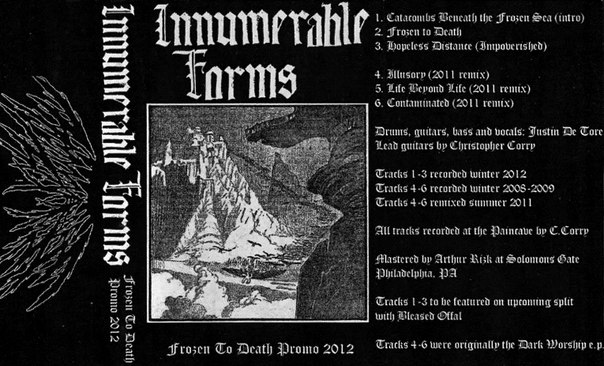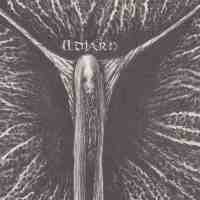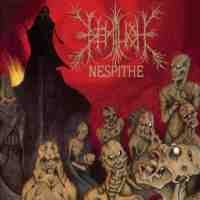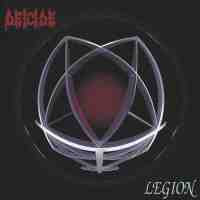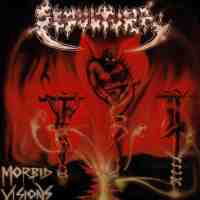
Innumerable Forms – Frozen to Death (2012)

innumerable forms full

Article by Lance Viggiano.

Innumerable Form’s Frozen to Death is a compelling and brief release which recalls Dark Descent’s roster yet avoids the calculated, clean retro nostalgia trips that mires their outfits. Motifs follow in the Darkthrone tradition of John Carpenter managing menace on a Casio. The melodic component of Innumerable Forms is steeped in Finnish death metal which delivered mystical melodies that sounded as if they were being recited by a saw blade descending into steel. Here the effect greater resembles mental anguish as if one was forced to say, “Yes!” to an incomprehensibly vast and hostile existence. Frozen to Death distinguishes itself from its inspirations in this way.

(more…)

6 Comments

Tags: , , , , ,

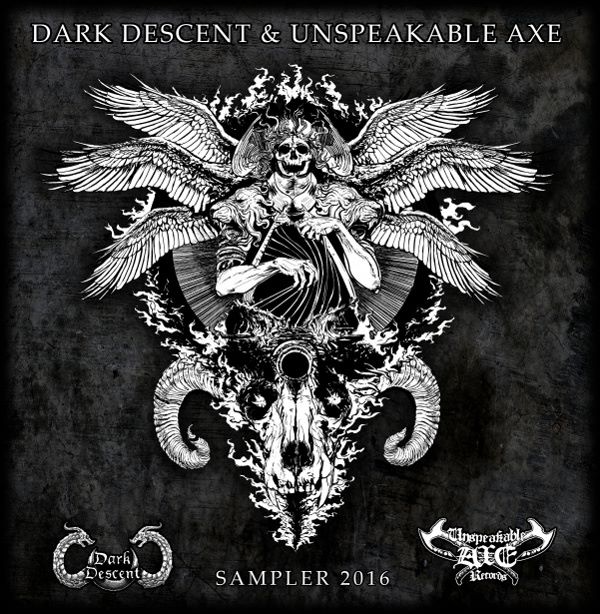
Free Dark Descent and Unspeakable Axe Records Sampler CD

Dark Descent New Release Sampler #4

Dark Descent and Unspeakable Axe Records have released a new free sampler CD of their recent upcoming releases. It is freely available with a purchase from the Dark Descent online store and for free download on their Bandcamp page with four additional tracks that couldn’t fit on the CD.

The new Dark Descent Records/Unspeakable Axe 2016 CD sampler is now available. This is a FREE sampler and available with purchase through our web store and at Unspeakable Axe. Included on the disc is 16 tracks (8 from each label) with premieres from Blood Incantation, Excommunion, Lantern and Ruinous. The sampler also includes an discount code good for our web stores. Get yours now before it’s too late!

Trenchrot – Hell Pilot’s Call
Blood Incantation – Chaoplasm
Ripper – Anthropophagic Life
Ghoulgotha – The Sulphur Age
Hemotoxin – Transparent Eyes
Sheidim – Without Reins
Nucleus – Cube
Excommunion – Nemesis
Mortal Scepter – Violent Revenge
Nox Formulae – Hidden Clan NXN
Scorched – Lust for Strangulation
Lantern – Cleansing of the Air
Manic Scum – Strapped to the Gurney
Ellorsith – Jerome I
Obscure Evil – Enchants of Bitterness
Ruinous – Dragmarks

6 Comments

Tags: , , , , , ,

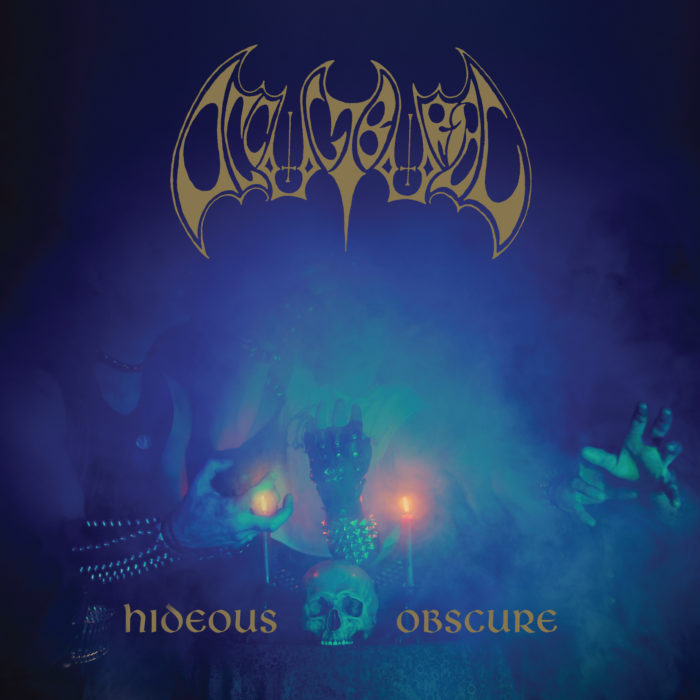
Occult Burial – Hideous Obscure (2016)

occult burial - cover

Article by Corey M.

Overall satisfying (but not quite inspiring) straightforward songs with equal parts thrash and proto-death metal present. I don’t quite hear the “occult” sound these guys are evidently going for; their music sounds too immediate and, weirdly, fun. The band members clearly enjoy creating this music and therefore their work is free of pretense; no revivalist coat-tail riding here. Expect to hear fairly similar-sounding riffs throughout, without much in the way of dynamics. Compared to their contemporaries in bands like Nifelheim and Aura Noir, Occult Burial are competent and maybe even a step ahead of the more popular bands that mix thrash with modern metal because they aren’t impeded by gimmickry. Their lack of theatrics may work against them because they will probably continue to be overlooked until they learn to cut loose and let their imaginations run a little more wild with their songs. Compared to the more aggressive speed metal classics from Coroner and Razor, parts of Hideous Obscure are downright boring. Even playing a bit faster and cleaning up the recording could do wonders for the effectiveness of these songs. Some parts sound truly terrible. For instance, the snare drum sounds  in the words of my favorite robot puppet “like a bag of sardines thrown up against the side of a pole barn.” Nevertheless there is promise here and I would reserve more judgment until Occult Burial release a proper-sounding album or I can catch them live.

22 Comments

Tags: , , , , , , , , , , , ,

Analysis of Evoken’s “Omniscient” from Promo 2002

the-mummys-shroud-lobby-card

This dissection was contributed to Death Metal Underground by Neil Sigmundsson.

Although the song that is the subject of this article differs considerably in tone from most funeral doom metal, and indeed from most of Evoken’s own work, it utilizes the basic style of that genre: open, sustained, low register power chords played at very slow tempi. In “Omniscient,” clean guitar melodies and synthesizers provide the music with detail, color, and different senses of spaciousness. Layering, interplay between instruments, and timbre play important roles in developing themes and emphasizing different aspects of emotions. The song has no human voice, a feature that facilitates listener immersion and an unharnessed imagination. The structure is simple and linear: A B C D. The four sections are described sequentially below in terms of one interpretation of the piece; this is an attempt to put into words a somewhat vague combination of images, thoughts, feelings, and emotions that occurs when listening to it. If this descriptive method comes across as tedious or unappealing, consider it the shortcoming of the writer and let the music speak for itself.

I. Description

Section A: The introduction revolves around a melody played on clean guitar, the tonality of which gives a vague feeling of uneasiness and of mystery. The technique of sliding into and between notes is used as ornamentation, presumably to make the melody more evocative. The slow tempo lends a sense of low energy, and the synthesizer adds a haziness to the atmosphere. When the electric guitar and percussion enter the song, the resulting sensation is similar to stepping from an inside room, where one can sense the heat outside, into the open air, or of transitioning from the awakening state of half-consciousness to that of complete alertness and awareness. The synthesizer then plays its part an octave higher than before, overpowering like the sharp glare of the sun and evoking an image of barrenness, vastness, and lifelessness. The timbre greatly increases the effect. After the synthesizer descends back to its original register, the theme is fully developed and the scene completely comprehended.

Section B: After a short silence, the music resumes at a crawl, as if an oppressive heat is sapping away all energy. The guitars reach up and play a short sequence with conviction, but fall back down in response to the synthesizer, as if defeated by the overwhelming wretchedness and aridity of existence. The entire pattern temporarily falls to a slightly lower register, conveying a sense of sinking to greater depths, though it musters enough energy to return to its original place. Listening to this section feels like crossing a desert, wondering whether the farther side will ever be reached with so little energy, when suddenly…

Section C: Great vigor and motivation well up from an unknown source, generating forward and upward motion from stagnation. The tempo increases, as does the speed of the drum pattern. The power chords are no longer relegated to the far lowest notes. The synthesizer, which represented the oppressive force, disappears and is replaced by a slowly rising clean guitar pattern. The overall tone here is energetic and anticipatory, and there is a sense of striving and of willpower where previously there was none. However, in the guitars there is a moment that balances this nature with sobriety and gravity, a few slightly dissonant notes that signify that all adversity has not been overcome. Like a reminder of the continued presence of the antagonistic element, this slight dissonance checks the melody, which falls accordingly (though it maintains its pace and energy) and dwells at its lowest point before steadily rising again.

Section D: Section C trails off at its highest stable point, and at this point the music slows down again and “opens up,” signifying that a plateau or a destination has been reached. Indeed, in the final and longest section of the song, a realization occurs. The first hint of this realization is a sequence of four notes played on the keyboard and accompanied by percussion. The “breathy” timbre and relatively low volume give a sense of distance and of large scale. This part evokes the emotions associated with pausing one’s toils, looking up at the clouds, and realizing their beauty. The electric guitars then enter enthusiastically, mimicking the four note pattern with power chords, and the aforementioned keyboard sequence gives way to a second one. This new keyboard part starts with a heart-warming tone that rises slightly and then settles into a sobering note of gravity, though even this last bit of weight and resistance falls away at the end of the sequence.

The full realization is represented by a blissful clean guitar melody that acts as an additional layer atop the second keyboard part and the power chords. The keyboards color the guitar melody in different ways with each note and with swells in volume, highlighting various nuances of the newfound conviction and peace of mind: solace, tranquility, the hugeness of nature and the cosmos and corresponding miniscule stature of man, the passing away of all things, and finally an understanding and acceptance that leads to release from all doubts and worries. The timbre of the synthesizers provides an airy nature to the conclusion of the song, yet this quality is light and fresh and differs greatly from the heavy, burdensome atmosphere of the introduction. The clean guitars eventually stop and the keyboards return to a fuller version of the first hint of the realization, the image that catalyzed the epiphany being revisited in terms of the new insight obtained. The full realization then resumes. By this point, all tension is completely resolved. Additional synthesizer effects give a sense of dissolving and of passing away, and the song begins to fade in volume. The clean guitar ends on an uplifting note.

II. Discussion

In the above description of “Omniscient,” the instruments symbolize different aspects of human experience. The electric guitar and the percussion represent the visceral sensations of the body, the clean guitar the movements of the mind, and the synthesizer the perception of the external environment. The role of the synthesizer in portraying an external oppressive force in sections A and B has already been described: it can be seen as a sort of indifferent but nevertheless harmful natural phenomenon. Of the four parts of the song, section B is the only one with no clean guitar, perhaps symbolizing how during an onerous experience in which the willpower of the mind has been defeated, the focus of consciousness oscillates between the suffering of the body and the alleged cause of that suffering. In section C the synthesizer disappears, but the sobering, slightly dissonant notes in both the clean guitar and the underlying power chords acknowledge that the environment/situation has not changed. Rather, the upwelling of energy from within is so powerful that it dominates the field of perception, as reflected in the dramatic increase in percussion activity. This section can be viewed as finding motivation to fight and overcome an oppositional force.

Section D resolves all conflict and tension in the song, not through external triumph – towards which section C seems directed – but through internal release. Maintaining the established symbolism and looking at the clean guitar parts (and lack thereof) throughout the song, there is a series that outlines a transformation of mind: A mind confused (A) becomes a mind completely defeated (B), which in turn is revitalized and invigorated (C) and finally becomes purified and instilled with confidence and peace (D). Considering the keyboards, as mentioned previously, the role and the qualities of those in section D are significantly different from those in sections A and B. Yet even at the very end of the song, there is still a sobering effect and a sense of gravity in the keyboards; the elation does not go unchecked. As in section C, this is the clue that the external environment has not changed, only the perception of that environment. Thus, the mind has undergone a change and as a result, the perception of life has changed even though life situations have not. Recalling the words of Marcus Aurelius: “Things do not touch the soul, for they are external and remain immovable; but our perturbations come only from the opinion which is within…Take away thy opinion, and then there is taken away the complaint, “I have been harmed.” Take away the complaint, “I have been harmed,” and the harm is taken away.” This is the essence of the realization in “Omniscient”: It is the knowledge that, though we may feel pain and discomfort, and though we may endure hardship, suffering is not inextricably bound up with these experiences. The power that external events claim on personal wellbeing is dictated by the mind and by the will. In this way can man go through life as an invincible force, as a “promontory against which the waves continually break, but it stands firm and tames the fury of the water around it.” With this spirit and conviction does the clean guitar sail calmly over the keyboards in section D, giving a sense of total peace and affirming that everything is alright.

Along with SkepticismStormcrowfleet and Monolithe – Monolithe I, “Omniscient” shows that the funeral doom style lends itself naturally to compositions that are not funereal in tone. This style has been used as a means of wallowing and despairing, and it could be argued that despondence, hopelessness, etc. are “heavy” emotions, but the self-obsessed state of depression, being a state of stress and contraction, shrinks the scale of the music to the personal level. This effect is contrary to the “big” sound of the funeral doom style, and to the powerful fighting spirit of metal in general, indicating that perhaps the style is more suitable for large-scale, impersonal topics.

Regarding musical composition, the careful and directed development of a select set of ideas maximizes the evocative quality of music by allowing themes to blossom to their full expressive potential. Furthermore, this increases the coherence of compositions, even when the composer does not intend a specific meaning or message, because new ideas arise only when the old ones are exhausted. Thus, in musical composition, as in life, it is wiser to look to necessity than to extremity. Extremes of technical musicianship, speed, and structural complexity, though sometimes useful, are generally not necessary for metal music to be heavy (in the meaning of bearing existential weight, of having deep content as opposed to shallowness, and of communicating an aspect of reality that transcends the individual). “Omniscient,” in its beautiful simplicity, is evidence in favor of this point. In its logical and complete development, its highly evocative sounds, its clear depiction of an inspiring and uplifting transformation, and the reward and reminder that its conclusion bestow upon the listener, “Omniscient” is a superlative work of art.

Notes:
1. Evoken recorded Promo 2002 “in 1 day on a cheap-o 8 track recorder.” “Omniscient” stands far above the other four songs on the promo, although “Reverie in Tears” is also well composed. Dario Derna, who was the adept drummer of the death metal band Infester, played the keyboards on this release.

2. A rerecorded version of “Omniscient” with lyrics appeared on the 2010 split between Evoken and Beneath the Frozen Soil.

22 Comments

Tags: , , , , , , , , ,

Grupo Modelo S.A. de C.V. – Corona Familiar (2016)

corona_-_familiar

My first thought when drinking this beer was: someone finally fixed Coors regular. This is what is called an adjunct beer, meaning that they use overstock of cheap grains like corn to brew the stuff, and keep other ingredients low, resulting in a sweet light beer with a warm fermented but not malty taste.

Personally, I like these, because they are all-day beers: simple but not simplified flavor, gentle and yet enough alcohol to keep interest, and thin / mild so that you can drink 38 of them before you decide to sing along with “Wonderwall.” Corona Familiar is no different, joining other “beach beers” like Caguama and Landshark Lager in my stable of tools for casual alcoholism.

Unlike its watery/uriney cousin Corona Especial, Corona Familiar is somewhat hearty but can still be a relatively hydrating and yet refreshingly intoxicating — at 6% ABV — beach beer. It has more of an squash-like fermented flavor, probably from the corn and rice used, but burns clean and leaves a pleasant mild intoxicating effect about appropriate for lawn chairs, sunny days, blue skies and ill-advised relations with women named Candi.

Unlike most beach beers, this one can be found in its 32oz size for under $3. That makes this wino beer for people who do not want to end up under bridges or in vans down by the river. While I admit violent bigotry against all Corona products for the name alone, this one is worth buying again.

****/*****

5 Comments

Tags: , , , , ,

Another Cirith Gorgor – Visions of Exalted Lucifer review

cirith_gorgor_-_visions_of_exalted_lucifer

Article by Corey M. A more skeptical take appeared last December.

Visions of Exalted Lucifer comprises the type of surefooted, almost passive confidence that a band like Cirith Gorgor can be expected to gain with as much experience as they’ve had in black metal. Experience (not to be confused with longevity, as many bands have been around for a long time yet never learned from their mistakes or successes) alone has no intrinsic merit but does provide for musicians a way of mapping their excursions into the imagination, so as not to become lost or distracted by pointless tangents on their flights of fancy. Rarely does a band hone their skills through experience without losing that primal virility that drove them to reckless discovery. Usually, one strength overcomes the other as time wears on. Cirith Gorgor like most any black metal band active from the early ’90s into the mid-’00s, began producing clean, smooth, uninspired-and-uninspiring music that never ventures far from familiar topical territory.

Cirith Gorgor show no signs of exhaustion from their long service in the war against all that is modern and mundane, even though their current method of composition exhibits a firm grasp of a decidedly contemporary style of black metal instrumentation. Featuring intricate guitar melodies that weave about one another like caducean serpents, this constant use of counterpoint achieves a delicate balance between consonant resolution and dissonant suspension. This relentless feeling of teetering between sappy harmonic indulgence and chaotic keyless atonality without the music ever succumbing to one extreme shows the guitarists’ songwriting prowess. A band riding this knife edge of tension with efficient agility inspires a nervous awe.

Emphasizing Cirith Gorgor’s fearless wont to take black metal techniques to their logical extremes, some interesting “progressive” bits appear in the album. First, during the main riff in the second track, “Visions of Exalted Lucifer”, there is a somewhat hesitant stutter in the middle of the crucial chord change, shifting the beat count into 9s rather than 8s. In one of the verses that build up to a more unifying crescendo in “Rite of Purification – Vanished from this World”, this reoccurs; The guitar melody rises and falls in an arrogant refusal to be subjugated by the simple 3/4 time signature. While many might think that such technical meddling would negatively impact the direct delivery that makes black metal great, this opinion is understandably misguided thanks to the unprincipled pseudo-prog tendencies that modern metal acts are likely to shoehorn into their otherwise bland songs. For Visions of Exalted Lucifer, these odd phrases and atypical harmonic mutations are actually necessary to lead each song through its natural ebb and flow. They sure each riff’s opening, closing, and transitionary moments are satisfyingly wrapped up without exception. The drummer deserves credit for deftly assisting the chemical reaction-like relationship of guitar melodies, playing aggressive bursts only as needed at any given time, providing traction for the motivating riffs and assuring that a song never spins its wheels.

Listening to this album can be psychologically draining. Due to the constant whirling spiral of guitar harmonies, it is impossible to guess whether some riffs will resolve on a consonant closing chord or introduce more tension by shifting into a new key with its own harmonic space. Almost always, a lead melody is playing over the rhythm chords and spiking out toward strange and uncomfortable modulations. Whether the modulation occurs or is only hinted at is also difficult and sometimes impossible to anticipate. The modulations are not random, they are enigmatic. The stressful ambiguity of any proceeding direction can leave the listener with the vision of Dune‘s Paul Muad-Dib after ingesting a high dose of spice for the first time being assaulted by the infinity of possibilities as every potential future unfolds indistinctly at once. The listener will probably either be annoyed, rejecting the perceived unreasonableness, or submit and allow themselves to be dragged along for the wild ride, coming away with glimpses into the strange depths of alienated human minds. This is not an album for passive listening; it is appreciably polarizing and meticulously crafted.

Visions of Exalted Lucifer may be listened to on Hammerheart’s Bandcamp.

2 Comments

Tags: , , , , , ,

Sorcier des Glaces – North

Article by Corey M

An astounding eighteen years after releasing their debut full-length, Sorcier des Glaces releases North, maintaining their streak of high-quality albums. The themes of their last album, Ritual of the End (one of 2014’s best releases), are still present here and revolve around the band’s signature lyrical and melodic concepts; descriptions of people and places undergoing freezing damnation, in their unique vision of death occurring over epic spans of time.

This music holds the rare power to instill visions and sensations of ice-covered ruins and crippling cold by its melodic prowess alone. However, the vocals and lyrics are praiseworthy as well as the delivery is unnervingly clear, poetically orating scenes of melancholic morbidity illustrated by the music. This is achieved by Sorcier des Glaces’ idiosyncratic approach to writing long riffs with slow and steady chord changes all augmented by faster-moving melodies that anticipate and resolve the myriad melodically unorthodox transitions. It’s so rare to hear this style of complex harmonic activity performed this adroitly that the only similar album I can think of that achieves this level of complexity tempered by an intuitive sense of coherency is Far Away from the Sun. That is a high compliment.

In terms of technical performance, the musicians’ set-up is very similar to what is heard on Ritual of the End. Driving drums impel the helical, tremolo-picked, complimentary melodies which the lone guitarist/bassist cleanly divides into trios. The main melodies are carried by the rhythm guitar’s very long chains of power chords and the bass guitar modifies the basic root notes of the rhythm guitar, adding much harmonic depth to the songs. Meanwhile, one or more guitars play high-register leading melodies that expertly illuminate the emotive potential of the progressions. Playing their instruments at such a wide range of timbre and speed creates a broad, orchestral sound. The band’s creative flexibility allows the orchestra to tower indomitably, or branch out and flow smoothly, winding naturally around musical obstacles, like the trickle of water over irregular, rocky terrain.

The musicians even get a little bit more boldly experimental on North, particularly during the title track “North”, utilizing some long sections of cleanly picked chords that mutate and creep toward obscure resolutions while the bass dances its own giddy cadenza beneath the reverberating guitars. Typically this sort of deviation would wreck the feel of a song in the hands of inadept musicians, but here it is a delight. “Dawn of the Apocalypse” features an epic lyrical narrative enhanced by some more extreme shifts in dynamic intensity of the music. None of the changes are jarring or illogical; rather, they occur organically.

Despite the long and winding song progressions, I would recommend this album even to uninitiated metal fans. The sweeping guitar orchestration will ensnare anyone with a keen sense of musical passion, allowing Sorcier des Glaces’ malevolent shroud to obscure their sense of righteousness as they succumb to the awesome power of ice and occultic magic. North is an excellent album that will provide many journeys into the frigid recesses of the unconscious, at once harrowing and wondrous.

North may be previewed and purchased directly from Sorcier des Glaces at their official Bandcamp page.

28 Comments

Tags: , , , , , , ,

Chthe’ilist – Le Dernier Crépuscule (2016)

folder

Article by David Rosales

Chthe’ilist’s debut has been expected by underground death metal fans for some time.  To them, it seems like a promising project faithful to the ideals of atmospheric technical bands such as Demilich and Timeghoul, from whom it takes unmistakable cues. Less fortunate are the influences of popular (in the underground) but ultimately less effective acts Rippikoulu and Crematory. The first two lend a constructive helping hand while Crematory’s contribution distracts with purely technical and empty nonsense detached from clear evocation, and the unimpressive Rippikoulu lends its spacious approach that suffers from the blunders of Wagnerian operas: sparsely located treasures in a sea of boredom. Worth mentioning are a couple of very Voivodesque moments that are surprisingly integrated in a way that they do not seem out of place.

There are several reasons why this release is worth taking a close look at independently of how close we consider it to come to a masterpiece. Existing reviews come awfully short of a real musical insight, opting instead to spend a huge chunk of the time in talking about how cool the guys in the band are, or how ‘awesome’ the vibe is. They are utterly useless when they reach their faux attempts at providing any meaningful observations on the technical side of things. At most, they manage a colorful picture of the mental impressions that the music gives them; this at least is inspiring. Chthe’ilist’s album gives us so much more to discuss not only from its plentiful contents but what they relate to as descendants and composers.

In the interest of a well-rounded critique, Le Dernier Crépuscule should be observed from two different vantage points. The first is to place it within its historical context, and keep present whatever musical influences it appears to have. The second is to ignore everything but our intuition (which is dependent on past experience and understanding, in any case), so that we allow it to articulate and speak out for itself as it draws energy from predecessors we take notice only as an afterthought.

I. Technical Overview

Le Dernier Crépuscule can be roughly divided into two sections, the first consisting of the first five tracks and the second of the remaining two. The first track itself should probably be excluded as it is little more than an intro. The structuring of the next four follows a certain pattern while the last two each follow a freer approach than the one preceding them. The first is Crematory-dominated, while the last increasingly shows a predominant Timeghoul presence. Throughout the record one finds Demilich’s riff style in about half of the individual riffs. This emulation ranges from almost outright shoplifting from Nespithe to more respectable yet still recognizable inspiration. The rest of the riffs also contain the less distinct (read as ‘more random’) but technically recognizable influence of Crematory and some war metal filler while the more creative and original single sections probably come from general Timeghoul influence, which allows for more open interpretation.

Tracks two to five follow a rough plan of riff variations1 lined up one after the other until the solo comes to mark a climax, after which there is a reiteration of previous material and the song ends. It is the “easy way out” of death metal structures, albeit expanded by a greater quantity of riffs. Le Dernier Crépuscule takes the most relaxed route when it comes to conceptualization as well, choosing to go for Crematory’s2 brand of strands of riff variations connected in riff salad manner. Now, Crematory’s style is marked by another particular aspect, and that is that it places technical flare and variety at the top of its priority list. Its choice of allowing runs of related riffs is more the following of what was in vogue at the time, since one can observe that songwise, there is very little keeping it all together but the general tag of the genre. Something similar happens to these first songs by Chthe’ilist.

The sixth and seventh tracks are clearly steeped in a more progressive mindset, allowing for creativity to bubble up as the band tries to craft a narrative. This is conducted with far more success on the last track, ‘Tales of the Majora Mythos Part 1″, than on the hybrid ‘Vecoiitn’aphnaat’smaala’. This emphasis on following a far-reaching narrative reaches formidable proportions in this last track where I would venture to call it a storyline. Variety in riff type is actually richer here than anywhere else in the album, yet through this story-telling technique (that is very much reminiscent of the dramatic flair of Timeghoul on Panaramic Twilight) Chthe’ilist achieves something beyond mere coherence — a smooth flow of ideas connected through careful considerations in texture and rhythmic contrast between sections. These considerations must reach further than adjacent riffs or mere riff-strands so that the song itself does not fall apart.

Unfortunately, although this last track shows us the brightest future for Chthe’ilist, Monsieur Tougas has yet to learn how to finish a song, and what could be an incredible opus is watered down by an unsure appendage after the coda following the solo, a four-minute long welling up of unnecessary nothingness. Content-wise, this adds nothing to the song except confusion, since it is mostly noise and blast beats, which we may presume is an ill-achieved attempt at creating ambience3. The rest of the song itself might be as clear-minded as Timeghoul’s best work, but it is still a work in progress.

I. Aural Impressions

Le Dernier Crépuscule is constantly touted as “Lovecraftian death metal”, and while I get the reference, it seems to me that the character of the music is much more cartoonish than even the original stories, which is saying a lot considering that Lovecraft’s work is already minimalist pulp horror. Taking only a chunk from this author’s work and making a concept album out of it becomes a bit redundant after 2 or 3 songs, and in this album I mostly hear At the Mountains of Madness with some more general references to the Cthulhu mythos towards the end. This limitation results in a bloated album with more words than actual things to say.

In fact, I’d say that for a Lovecraftian experience this is too limited. Timeghoul’s sound, for instance, is very appropriate for expanding on the whole range of cloudy feelings and visages that Lovecraft exposes, not only the mouth-tentacles of his famous monster-deity. Proof of this is that while a Demilich sound on a Crematory template can at most show entrails and guts and an in-your-face horror, the last track had me catching glimpses of R’lyeh through the oceanmist. In Lovecraft you find not only the gnarly gore of slimy and ghoulish creatures, but visitations to otherworldly views in a variety of dream states, alienation from reality expressed through either an increasingly horrifying vision of the world or just not knowing at which side of the sleep curtain it lies.

Lovecraft condenses the very essence of the death metal spirit in its several manifestations and a project with the gigantic potential of Chthe’ilist is surprisingly limited in its choice of evocation, while playing around withtoo many riffs than needed in what appears to be that Crematory-like bloating of content for its own sake with little reference to anything beyond it. Chthe’ilist has a potential of ‘epic proportions’, as the common saying goes. It could have us contemplating at Algol, wondering… it could take us on a bizarre journey through perilous Kadath, and it could make us doubt the very truthfulness of our material existence. In short, it could be the long-awaited metal Messiah that crystallizes the whole of Lovecraftian experience from the essence of the most meaningful obscure acts of the past. But it isn’t.

III. Integral Critique

Bringing together the last two discussions allows us to properly discuss the results Chthe’ilist has achieved. Most bands seem to create a division between music making and lyrical topics, which is not necessarily a bad decision if everything is flowing from a same wellspring of inspiration. The pitfall of this approach is that the sources could end up being distinct, even if compatible, so that the impact of either is dulled by even the slightest hint of cognitive dissonance. This dissonance may even occur in music that is supposedly unified with its lyrical content, and in the case of technically-oriented bands like Chthe’ilist it usually comes about in the form of what could be called ‘riff distraction’.

Riff distraction is a phenomenon that consists of the metal artist losing sight of perspective as he lies on the floor, dull-sensed on proverbial soma. This sends riff-writers off in a mythical quest for the perfect riff combination until they end up with a mass of exciting but ultimately meaningless mumbo jumbo. This is the plague that afflicts this release; its most obvious priority seems to be riff-making, and the clearest sign of a climax is the guitar solo. This album’s is very intentional and varied, but with no precise evocative purpose in mind, so that this huge ball of varied rhythms ends up being a uniform mass when seen from afar. The guitar solo, then, becomes the only way of bringing the song to a breaking point so that at least something in the landscape stands out as a signaling agent for the ending to come with at least a semblance of an excuse.

Alas, the limitation that is holding back Chthe’ilist lies in the mindset of Master Tougas: his towering talent and creative juices ooze with latent power, but his imagination appears to be held back by rationalist prejudices of modern thought that reduce a powerful mythos to mere cartoon. This results in tongue-in-cheek funny horror, which may be an overplaying of the purposely awkward feeling of Demilich that is often perceived simply as funny yet interesting. Timeghoul’s immense aural depth could be the answer here, as the flexibility of its approach lies in the dramatic expansion of predefined techniques within a limited (yet more varied, at the same time) vocabulary that makes even its most complex statements convincing and manifestly intelligible4.

IV. Final Remarks

As pretentious as the thousands of words I’ve already written might make me sound, I would still like to encourage Monsieur Tougas to continue this general line of thinking, while paying closer attention to composition and evocation aspects that lead to a stronger narrative in longer songs. These seem to possess, at least in their present state, the greatest potential of his technical and atmospheric style. His work can bring to reality not only what Timeghoul could have become, but something beyond it, with a long-awaited deftly and graciously applied riffcraft inspired by Demilich. Ditch the Crematory when it comes to structuring decisions, and refactor out any content that isn’t completely indispensable5.

Personally, when it comes to heavily-charged albums such as Le Dernier Crépuscule, I hold a 10-time listening policy: testing how well and in what manner a music album holds up after listening to it completely the first ten times in less than a few days. This has several interesting effects, the first of which is that initial shock effects fade away, technical flare appears more fixed to context, everything gains perspective. Sadly, this album only made it to six listens before losing its luster, and this is mainly because the overall structure of songs and the character they evoke fall into place as an integral whole, revealing the utter simplicity lying behind the tons of riffs and tasty guitar licks.

The reason why the most convincing underground metal has almost always come from the minds that are most “out there” is because their music flows from deeply-ingrained convictions, veritable nightmares that are as real as the sun’s burning sensation, or the excruciating pain of sincere longing for a different reality. While your metal remains “meta”, while it remains only a “fun” way of exploring “spooky” images that are “not real”, your metal will also remain a laughable cartoon.

In earlier ages, as instinctive concepts welled up in the mind of man, his conscious mind could no doubt integrate them into a coherent psychic pattern. But the “civilized” man is no longer able to do this. His “advanced” consciousness has deprived itself of the means by which the auxiliary contributions of the instincts and the unconscious can be assimilated. These organs of assimilation and integration were numinous symbols, held holy by common consent.

In earlier times, these principles were worshiped in all sorts of rituals, which at least showed the psychic significance they held for man. But now they have become mere abstract concepts.

— Carl Jung, Man and His Symbols

1 By riff variation, I mean a grouping of related riffs that arise as variations from a seminal idea.

2 When taking Crematory’s Denial as a point of reference, we can observe how Crematory cannot hold a mood and a line of thought for too long. The music is based on providing variation; for instance, it introduces contrasting ideas in rhythm in extreme fashion so that even very Latin African rhythms pop up right besides more grindy ones with no particular purpose. It may be more difficult to notice, but Demilich already contains such range of variation, but it is much better organized, so that it does not feel haphazard. Furthermore, Demilich is able to stamp their own seal on each section by delimiting certain combinations of rhythm and mode, while Crematory pretty much just throws whatever it can find in your face as it desperately clutches for more content to display a different drum technique.

It’s not that Crematory plays no positive role in the music of Chthe’ilist, but it should be used within its effective scope: the riff variation; and taking note from those who excel at long-range composition when organizing structure.

3 This is a distractor that infects the mentality of modern death metal musicians; it’s almost as if they feel that the music is not enough, that they need to add more “stuff”, whatever it is. This fools the less-focused sort of listeners (apparently, the majority), but not those who would listen to music from multiple angles so as to extract all it contains and more.

4 That is to say, although the difference between the opposite styles within Timeghoul’s vocabulary (from pounding, crowded gnarly riffs to clean-vocal lamentations) may be wider than Crematory’s, the consistency with which they are used imbues them with a more meaningful sense of purpose.

5 A lesson might be learned from Ludwig van Beethoven’s own methods. He is probably the most respectable of classical composers with an inclination for “wild progressive” ideas, since he did not slip into avant-garde stupidity. Beethoven’s music was shocking in its own time for its juxtaposition of apparently contrasting ideas, but he would not leave them there. They were justified, as it were, through their careful development and envelopment throughout the rest of the piece or even in later movements, creating an unprecedented technique in bringing together content in long-range fashion through a process of entanglement.

17 Comments

Tags: , , , , , , , ,

A Playlist: Horror

horror

Article by David Rosales

The eighties, as any other decade, had its own particular flavor, and popular culture had turned to fantasy and horror as a sort of addictive drug. The most grueling slasher films with fake yet more tangible appearances than the digitized reproductions directed at desensitized audiences that we have today. It may be guessed that a lot of this was an outlet for repressed feelings of hopelessness towards the end of the Cold War, in the midst of death squad strikes and political assassinations throughout the world by the very pseudo protectors of liberty.

The menace of a nuclear holocaust made the idea of a post-apocalyptic scenario not so much the stuff of dreams but a possible (and plausible) future not more than a few decades ahead. There was terror in the air, as desperation and fear had already become the habit of a whole generation raised in the shadow of the fairy tales of the great wars and disarmed through the enhancing of shadows on the wall as their very protectors backstabbed them.

The kids born of this former failed generation of proper workmen and citizens grew to distrust all the bullshit thrown at them. Growing up in this era of tension and constant threats outside a bubble of hypocrisy and bigotry made young men of a more realist mentality long for the collapse of the system of lies built by the ‘mature and responsible’. This is the world that gave us death metal as Slayer’s lessons were ran through hardcore punk and then grindcore.

Cromags

1. Cro-Mags – Age of Quarrel (1986)

Expressing the most bare-bones discontent with society with a sincerity that only the punk spirit can deliver, Cro-Mags adopt metal riff phrasing techniques to give further elaboration to paint pictures of collapse and humanity’s demise that are more grim and nihilistic than the lyrics themselves.

repulsion-horrified

2. Repulsion – Horrified (1989)

While Age of Quarrel is the image of a decadent civilization malfunctioning its way to its own zombification, Repulsion shows us the explosion and its aftermath. The first is fear of impending doom, this latter is terror, desperation and psychotic breakdown in the face of monstrous reality.

carnage

3. Carnage – Dark Recollections (1990)

Beneath the blatant visions of disaster and discomfort, the reveling in what is seen as an unavoidable outcome, or perhaps an already present state, is laughed at with the humor of a cancerous patient that knows no clean escape from his own impossible situation. It takes death metal to come out as the triumphant anti-hero, shotgun in hand, ready to do away with the weakness of modern man.

14 Comments

Tags: , , , , , ,

Sarcasm – Burial Dimensions (2015)

Sarcasm-Burial-Dimensions-44488-1

Article by Corey M

Burial Dimensions is a compilation of releases by Swedish death metal band Sarcasm, featuring six demos (released between 1992 and 1994) and a full-length album (also recorded in 1994, but first officially released in 2011). For most of this review, I’ll be talking mainly about the titular full-length album when I use “Burial Dimensions”, and not the compilation as a whole.

As for the compilation as a complete package – It has cool cover art and all the demos you could want, but they sounded redundant to me, though in full disclosure, I was unfamiliar with Sarcasm before getting this release, and didn’t know any of their demos before listening to this compilation. Fans will no doubt find more value in having this large collection of demos on two CDs, even though casual listeners may not spend much time listening to them. The full-length features the best songs with the best production quality, so I focused in listening to it the most.

Some listeners might be able to guess that Sarcasm are Swedish by the first riff, and most of the musical techniques they use had been well-developed by 1994, so this album is more about refining a craft than innovating. Except for a few incongruent flourishes, Burial Interludes is mostly sinewy, sometimes fluttery death metal, but melodically bears resemblance to some contemporary heavy metal-influenced black metal like Rotting Christ’s Thy Mighty Contract, with a lot of tense, enigmatic harmonies and an emphasis on keeping songs flowing smoothly throughout dynamic transitions between high- and low-intensity passages. However, due to the band’s admirable unwillingness to shift dynamics too quickly, some of the more low-tension parts in songs drag on for too long, dispelling the sinister insinuations of the more intense passages as we are lulled by comfortable but impotent consonance. These soft sections subvert the dark spirit that these songs aim to conjure, and are almost always too off-putting to ignore. Examples include a brief break for a female operatic vocal to take over a song which is otherwise made of imposing, sharp riffs, and some dull segments that showcase an unmotivated (and unmotivating) lead meandering over a melodramatic chord progression. These parts always sound insincere and drag the album down because other parts of the songs really rip into you.

The production of Burial Dimensions is raw (and the demos sound considerably worse), with some gnarly analog compression and heavy reverb on everything, giving the sensation of the sound being squished and distant. This isn’t necessarily bad and allows the guitars space to grind through high and low frequencies, giving the rhythm guitars a dangerous-sounding, shredded, spiky texture. In many riffs, a second guitar will pick out a higher-register harmony that stands separate from the rhythm guitars by having a distinct echoing tone. Usually following the rhythm fairly closely, the second guitar is also sometimes used for counterpoint melodies, and at times these are very effective at bringing out the full impact of the riffs, especially when the bass guitar splits from playing in unison with the rhythm guitars and all three guitar melodies hit you from different directions in three-part harmony. Sarcasm can create an impressively broad and rich sound with the three guitars being utilized this way, but during the worst parts of the songs, the counterpoint will be played in some such off-kilter way that doesn’t synchronize intuitively with the rhythm guitars and some strange harmonies emerge, negatively altering the flow of tension that is channeled so well during the more simply-structured passages.

Sarcasm sound amateur at worst, mainly due to the artificial melancholy that butts in and trips up a series of otherwise engaging riffs. Some of the better examples of riffs that really take you along for a ride begin the songs “Through Tears of Gold” and “Never After”, but frustratingly their momentum falters when one of the more flaccid, weepy progressions intrudes with clean guitars and soft synthesizer washes. “Pile of Bodies” and “Scattered Ashes” both begin with slow, chunky riffs that menace and lumber, but eventually either song gets bogged down in slowly-strummed reverb-drenched chords and leads too timid to venture far enough from the chords to inspire much sense of wonder or foreboding.

All considered, this album probably never achieved wide recognition because of the incongruent dynamics which can leave you with a sense of ambiguity about the whole experience. If you listen closely, you’ll hear lots of cool-sounding riffs scattered throughout, but they are offset by the sappiness that inevitably kicks in during any song’s development. In this way the amateur nature of the band works for and against them; when they get into energetic and fearsome riffing, the sensation is both threatening and mystical, but their inability to maintain tension while focusing more on the mystical than the threatening aspect means that each burst of strong riffs is undermined by a stretch of weak soloing or ostentatious gimmicks.

If you are a fan of Sarcasm, this release is right up your alley; you get some upgraded album art and a collection of demos in their original condition (not retouched or remastered, as far as I can tell). If you are not a fan but curious to see what Sarcasm are all about, I strongly recommend finding some of the music online or streaming it and giving it a close listen before making the decision to purchase. Personally, I don’t see any lasting replay value in Burial Dimensions; Sarcasm are just one of the many death metal bands that fell by the wayside during the ’90s heyday, and for good reason. If you are really itching to hear some death metal from the ’90s with lots of black metal-esque melody and heavy metal leads, compare this album to Necrophobic’s The Nocturnal Silence, which is a perfect example of how these influences (black, death, and heavy metal) can merge fluidly and efficiently. And Intestine Baalism beat these Swedes at their own game with 1997’s An Anatomy of the Beast, which does a better job than Burial Dimensions of combining raw and evil-sounding riffs with dramatically melancholic lead melodies.

2 Comments

Tags: , , , , , ,

Classic reviews:
A B C D E F G H I J K L M N O P Q R S T U V W X Y Z